Saudi Arabia Meat Substitutes Market Growth Rate
According to 6Wresearch internal database and industry insights,
Saudi Arabia Meat Substitutes Market Year-wise Growth Rate and Key Drivers
This graph illustrates the annual growth rates of the Saudi Arabia Meat Substitutes Market from 2022 to 2032, highlighting stable industrial expansion, infrastructure-driven demand, and increasing adoption of precision finishing solutions.
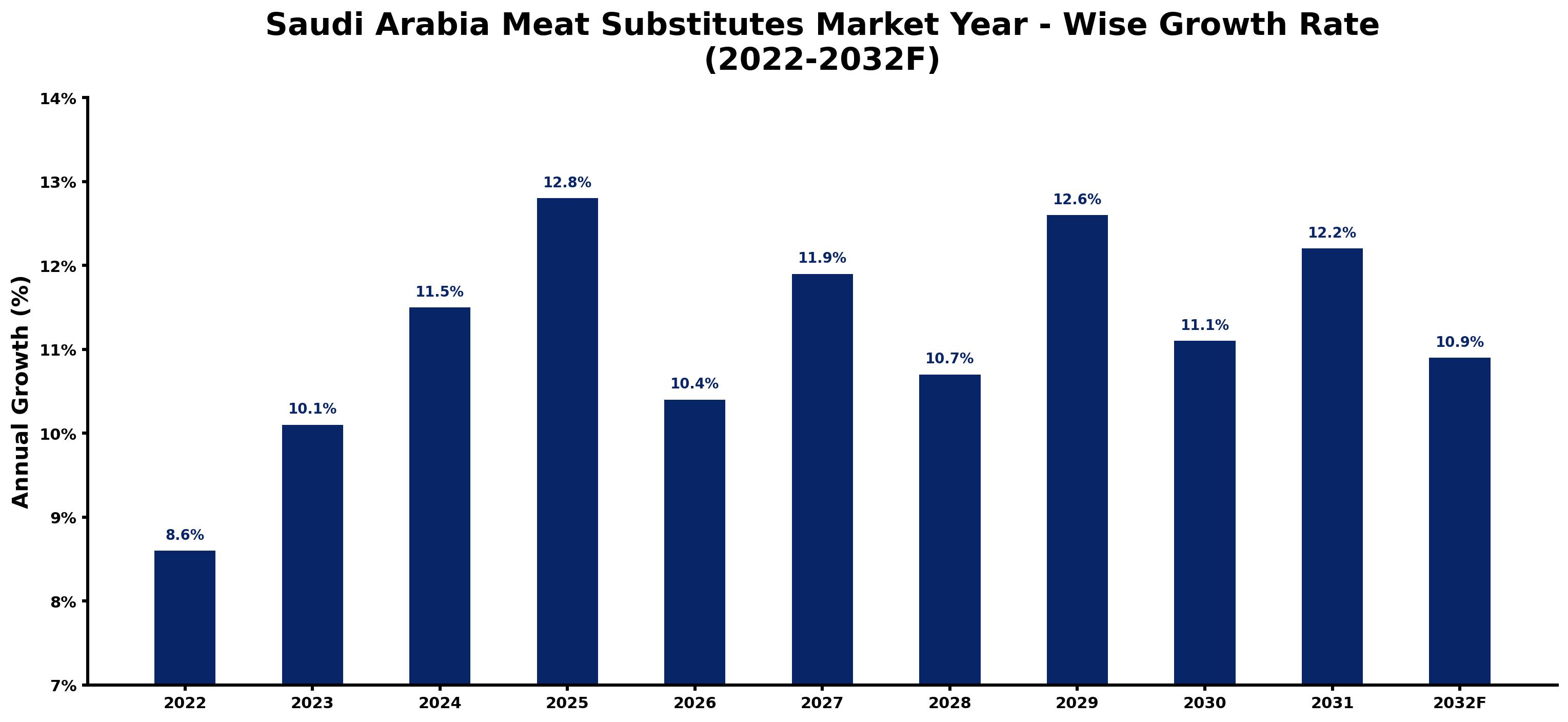
The following table summarizes the historical and forecasted growth rates of the Saudi Arabia Meat Substitutes Market, along with the rationale behind each year’s performance.
| Year | Estimated Growth | Growth Drivers |
| 2022 | 8.6% | Growing awareness of plant-based nutrition, increased availability in premium supermarkets, and rising health-conscious consumer demand supported market expansion. |
| 2023 | 10.1% | International brands expanded their presence, while online grocery platforms and modern retail channels improved product accessibility across major cities. |
| 2024 | 11.5% | Rapid introduction of localized plant-based meat products, increasing foodservice adoption, and stronger marketing campaigns accelerated demand. |
| 2025 | 12.8% | Significant expansion by quick-service restaurants, higher disposable incomes, and broader product portfolios drove exceptional market growth. |
| 2026 | 10.4% | Inflationary pressures and premium product pricing moderated consumer spending despite continued retail expansion. |
| 2027 | 11.9% | Recovery in consumer purchasing power and increasing investments in alternative protein manufacturing strengthened market demand. |
| 2028 | 10.7% | Growth softened due to intensified competition from conventional meat and private-label products, while awareness continued to improve. |
| 2029 | 12.6% | Expansion into secondary cities, increasing institutional demand, and wider availability through hypermarkets boosted market performance. |
| 2030 | 11.1% | Product innovation in hybrid proteins and improved affordability maintained healthy market expansion despite gradual market maturation. |
| 2031 | 12.2% | Government sustainability initiatives, local manufacturing investments, and higher foodservice penetration accelerated market growth. |
| 2032 | 10.9% | Market maturity and price competition slightly moderated annual growth, although demand remained strong due to expanding consumer acceptance. |
Topics Covered in the Saudi Arabia Meat Substitutes Market Report
The Saudi Arabia Meat Substitutes Market report thoroughly covers the market by product, source, types and form. The report provides an unbiased and detailed analysis of ongoing market trends, opportunities/high-growth areas, and market drivers that will help stakeholders devise and align strategies according to current and future market dynamics.
Saudi Arabia Meat Substitutes Market Highlights
| Report Name | Saudi Arabia Meat Substitutes Market |
| Forecast period | 2026-2032 |
| CAGR | 11.4% |
| Growing Sector | Food & Beverage |
Saudi Arabia Meat Substitutes Market Synopsis
The Saudi Arabia Meat Substitutes Industry is witnessing a massive growth, driven by various factors, such as wellness-centric households and premium modern trade expansion. The localization of plant-based formats to traditional recipes (shish kebab, kofta, shawarma) is another major factor estimated to boost the growth of the market. Additionally, the meat substitute demand is on the rise due to the rapid expansion of modern retail and e‑commerce outlets is making plant‑based products more accessible.
Evaluation of Growth Drivers in the Saudi Arabia Meat Substitutes Market
Below mentioned are some prominent drivers and their influence on the Saudi Arabia Meat Substitutes Market dynamics:
| Drivers | Primary Segments Affected | Why it Matters (Evidence) |
| Health & Wellness Shift | Product; Source | Higher protein, lower fat and sodium attract fitness-conscious consumers. |
| Halal Assurance & Certification | Product; Form | Trusted halal certification builds confidence for global plant-based brands. |
| Retail & QSR Partnerships | Product; Types | Menu and private labels propel awareness, trial, and make them purchase again. |
| Localization of Flavors & Formats | Product | Arab-spiced patties, kofta, and shawarma strips boost relevance and usage. |
| Cold-chain & E-commerce Reach | Form | Strong logistics sustain product quality and broader availability. |
The Saudi Arabia Meat Substitutes Market is expected to grow steadily at a 11.4% CAGR between 2026 and 2032. The upward trajectory of the market is credited to expanding halal-certified assortments, strategic QSR tie-ups, and premium retail placement that normalize plant-based choices. Along with that, investments in recipe localization, protein fortification, and cleaner labels reinforce household penetration, while better price packs and promotions enhance affordability. Additionally, culinary education through influencer chefs and retailer demos is forming a new, sustained category adoption. Rising youth preference for sustainable diets and growing food-tech collaborations further strengthen market growth and innovation potential in Saudi Arabia.
Evaluation of Restraints in the Saudi Arabia Meat Substitutes Market
Below mentioned are some major restraints and their influence on the Saudi Arabia Meat Substitutes Market dynamics:
| Restraints | Primary Segments Affected | What this Means (Evidence) |
| Price Premium vs. Meat | Product; Types | Higher prices than conventional meat limit mass adoption; require affordable value packs. |
| Taste & Texture Expectations | Product | Sensory gaps versus fresh meat demand better formulations and chef-led education. |
| Cold-chain Dependence | Form | Breaks in frozen or chilled logistics put quality and customer dissatisfaction in a compromising position. |
| Label Clarity (Allergens/Protein) | Source | Transparency on soy/gluten and protein content is important for trust and compliance. |
| Limited Local Manufacturing | Types | Huge dependency on imports, increases costs and slows innovation cycles. |
Saudi Arabia Meat Substitutes Market Challenges
While the market is developing, challenges include narrowing the taste–texture gap, optimizing pricing to reduce premiums, and strengthening frozen distribution in secondary cities. Additionally, educating consumers, making sure of allergen clarity, and developing local co-manufacturing remain essential for repeat purchases. Furthermore, continued cold-chain investment and consistent marketing will help in gaining trust, accessibility, and long-term category growth in Saudi Arabia.
Saudi Arabia Meat Substitutes Market Trends
Several significant trends are impacting the Saudi Arabia Meat Substitutes Market
- High-Protein, Clean-Label Claims: Shorter labels with pea/soy proteins and reduced sodium attract gym and family buyers.
- Culinary Localization: Shawarma strips, kofta mince, and kebab skewers designed for regional cuisines drive everyday usage.
- Halal-Certified International Brands: Strong halal assurance and recognizable global names build trust and trial.
- Private Label & Value Packs: Retailer-owned brands and family packs lower entry price points and expand reach.
- Hybrid Blends & Functional Nutrition: Vegetable-forward blends with added fiber/omega fortification improve nutrition and acceptance.
Investment Opportunities in the Saudi Arabia Meat Substitutes Industry
Some of the notable investment opportunities are:
- Local Co-manufacturing & Co-packing: JV facilities for halal-certified patties, mince, and TVP to cut costs and speed innovation.
- Culinary R&D & Flavor Houses: Regional spice systems and fat-encapsulation tech to close sensory gaps.
- Cold-chain & Quick-commerce Enablement: Freezer capacity, route optimization, and dark-store partnerships for superior availability.
- HORECA Partnerships: Menu development with QSRs, cafés, and hotels for plant-based shawarma, burgers, and breakfast lines.
Top 5 Leading Players in the Saudi Arabia Meat Substitutes Market
Below is the list of prominent companies leading in the Saudi Arabia Meat Substitutes Market Share:
1. Quorn Foods
| Company Name | Quorn Foods |
| Established Year | 1985 |
| Headquarters |
Stokesley, United Kingdom |
| Official Website | Click Here |
Mycoprotein-based range (mince, fillets, nuggets) with halal-certified SKUs in GCC; strong culinary support and retail partnerships.
2. Beyond Meat (Saudi Distribution)
| Company Name | Beyond Meat (Saudi Distribution) |
| Established Year | 2009 |
| Headquarters |
El Segundo, California, USA |
| Official Website | Click Here |
Plant-based burgers, mince, and sausages distributed via modern trade and HORECA; focuses on high-protein, clean-label profiles.
3. IFFCO THRYVE Plant-Based
| Company Name | IFFCO THRYVE Plant-Based |
| Established Year | 1975 (Group legacy) |
| Headquarters |
Dubai, UAE |
| Official Website | Click Here |
Regional plant-based portfolio (patties, kofta, kebab) tailored for Middle Eastern flavors; halal-certified and expanding in KSA retail.
4. Al Islami Foods (Plant-Based Range)
| Company Name | Al Islami Foods (Plant-Based Range) |
| Established Year | 1981 |
| Headquarters |
Dubai, UAE |
| Official Website | Click Here |
Halal plant-based nuggets and patties; strong freezer presence in GCC hypermarkets with value-pack strategy.
5. Nestlé (Harvest Gourmet)
| Company Name | Nestlé (Harvest Gourmet) |
| Established Year | 1866 (Global legacy) |
| Headquarters |
Vevey, Switzerland |
| Official Website | Click Here |
Harvest Gourmet patties, mince, and schnitzel formats; leverages regional culinary R&D and retailer activations in KSA.
Government Regulations Introduced in the Saudi Arabia Meat Substitutes Market
According to Saudi government data, initiatives such as SFDA nutrition labeling needs, the Saudi Halal Center’s certification frameworks, and the Healthy Food Strategy encouraging reduced salt/fat intake support category credibility. Examples include front-of-pack energy disclosure on packaged foods, halal certification audits for imported plant-based products, school and workplace wellness guidance encouraging healthier menus, and Vision 2030 retail modernization that improves cold-chain infrastructure and product access.
Future Insights of the Saudi Arabia Meat Substitutes Market
The Saudi Arabia Meat Substitutes Industry will sustain its upward growth trajectory as brands localize flavors, expand halal-certified ranges, and scale retail/HORECA penetration. Private labels and co-manufacturing will compress price premiums, while sensory upgrades and chef partnerships foster repeat buying. Digital campaigns, freezer-door execution, and quick-commerce bundles will enhance visibility and frequency across family and youth cohorts, driving continued Saudi Arabia Meat Substitutes Market Growth and long-term consumer engagement.
Market Segmentation Analysis
The report offers a comprehensive study of the subsequent market segments and their leading categories.
By Product – Textured Vegetable Protein to Dominate the Market
According to Vanshika Arora, Senior Research Analyst, 6Wresearch, textured Vegetable Protein (TVP) is expected to dominate Saudi Arabia meat substitutes market size due to its affordability, versatility in local formats (kofta, kebab, keema/ mince), and strong suitability for both retail and foodservice.
By Source – Pea Protein to Lead the Market
Pea protein is projected to lead by source as it aligns with non-soy preferences, clean-label positioning, and allergen-conscious segments, while maintaining good texture in patties, mince, and shawarma strips.
By Types – Textured to Dominate the Market
Textured types are anticipated to dominate given their fibrous bite and culinary flexibility across kebabs, kofta, and shredded shawarma-style applications, enabling close meat mimicry in home and HORECA settings.
By Form – Solid to Dominate the Market
Solid formats (frozen patties, nuggets, mince, fillets, TVP granules) are set to dominate due to freezer-led retail, convenience, and better handling in foodservice. Liquid formats, including ready-to-cook sauces and protein bases for cloud kitchens, are emerging but smaller, used to speed preparation and standardize recipes.
Key attractiveness of the report
- 10 Years Market Numbers.
- Historical Data Starting from 2022 to 2025.
- Base Year: 2025
- Forecast Data until 2032.
- Key Performance Indicators Impacting the Market.
- Major Upcoming Developments and Projects.
Key Highlights of the Report:
- Saudi Arabia Meat Substitutes Market Outlook
- Market Size of Saudi Arabia Meat Substitutes Market, 2025
- Forecast of Saudi Arabia Meat Substitutes Market, 2032
- Historical Data and Forecast of Saudi Arabia Meat Substitutes Revenues & Volume for the Period 2022-2032
- Saudi Arabia Meat Substitutes Market Trend Evolution
- Saudi Arabia Meat Substitutes Market Drivers and Challenges
- Saudi Arabia Meat Substitutes Price Trends
- Saudi Arabia Meat Substitutes Porter's Five Forces
- Saudi Arabia Meat Substitutes Industry Life Cycle
- Historical Data and Forecast of Saudi Arabia Meat Substitutes Market Revenues & Volume By Product for the Period 2022-2032
- Historical Data and Forecast of Saudi Arabia Meat Substitutes Market Revenues & Volume By Tofu for the Period 2022-2032
- Historical Data and Forecast of Saudi Arabia Meat Substitutes Market Revenues & Volume By Tempeh for the Period 2022-2032
- Historical Data and Forecast of Saudi Arabia Meat Substitutes Market Revenues & Volume By Textured Vegetable Protein for the Period 2022-2032
- Historical Data and Forecast of Saudi Arabia Meat Substitutes Market Revenues & Volume By Seitan for the Period 2022-2032
- Historical Data and Forecast of Saudi Arabia Meat Substitutes Market Revenues & Volume By Quorn for the Period 2022-2032
- Historical Data and Forecast of Saudi Arabia Meat Substitutes Market Revenues & Volume By Other Product for the Period 2022-2032
- Historical Data and Forecast of Saudi Arabia Meat Substitutes Market Revenues & Volume By Source for the Period 2022-2032
- Historical Data and Forecast of Saudi Arabia Meat Substitutes Market Revenues & Volume By Soy Protein for the Period 2022-2032
- Historical Data and Forecast of Saudi Arabia Meat Substitutes Market Revenues & Volume By Wheat Protein for the Period 2022-2032
- Historical Data and Forecast of Saudi Arabia Meat Substitutes Market Revenues & Volume By Pea Protein for the Period 2022-2032
- Historical Data and Forecast of Saudi Arabia Meat Substitutes Market Revenues & Volume By Other Sources for the Period 2022-2032
- Historical Data and Forecast of Saudi Arabia Meat Substitutes Market Revenues & Volume By Types for the Period 2022-2032
- Historical Data and Forecast of Saudi Arabia Meat Substitutes Market Revenues & Volume By Concentrates for the Period 2022-2032
- Historical Data and Forecast of Saudi Arabia Meat Substitutes Market Revenues & Volume By Isolates for the Period 2022-2032
- Historical Data and Forecast of Saudi Arabia Meat Substitutes Market Revenues & Volume By Textured for the Period 2022-2032
- Historical Data and Forecast of Saudi Arabia Meat Substitutes Market Revenues & Volume By Form for the Period 2022-2032
- Historical Data and Forecast of Saudi Arabia Meat Substitutes Market Revenues & Volume By Solid for the Period 2022-2032
- Historical Data and Forecast of Saudi Arabia Meat Substitutes Market Revenues & Volume By Liquid for the Period 2022-2032
- Saudi Arabia Meat Substitutes Import Export Trade Statistics
- Market Opportunity Assessment By Product
- Market Opportunity Assessment By Source
- Market Opportunity Assessment By Types
- Market Opportunity Assessment By Form
- Saudi Arabia Meat Substitutes Top Companies Market Share
- Saudi Arabia Meat Substitutes Competitive Benchmarking By Technical and Operational Parameters
- Saudi Arabia Meat Substitutes Company Profiles
- Saudi Arabia Meat Substitutes Key Strategic Recommendations
Markets Covered
The Saudi Arabia meat substitutes market provides a detailed analysis of the following market segments:
By Product
- Tofu
- Tempeh
- Textured Vegetable Protein
- Seitan
- Quorn
- Other Product
By Source
- Soy Protein
- Wheat Protein
- Pea Protein
- Other Sources
By Types
- Concentrates
- Isolates
- Textured
By Form
- Solid
- Liquid






































