Saudi Arabia Three Wheeler Market Size, Share & Growth Rate
The Saudi Arabia Three Wheeler Market was estimated at USD 335 Million in 2025 and is projected to reach USD 428 Million by 2032, growing at a CAGR of 3.6% from 2026 to 2032. This anticipated growth is driven by increasing urbanization and the growing need for efficient transportation options in densely populated urban areas. Additionally, the rising preference for cost-effective last-mile delivery services underscores the demand for three-wheelers, which are well-suited for navigating congested streets.
Saudi Arabia Three Wheeler Market Year-wise Growth Rate and Key Drivers
This graph highlights how the Saudi Arabia Three Wheeler Market has steadily grown over the years, supported by major growth factors.
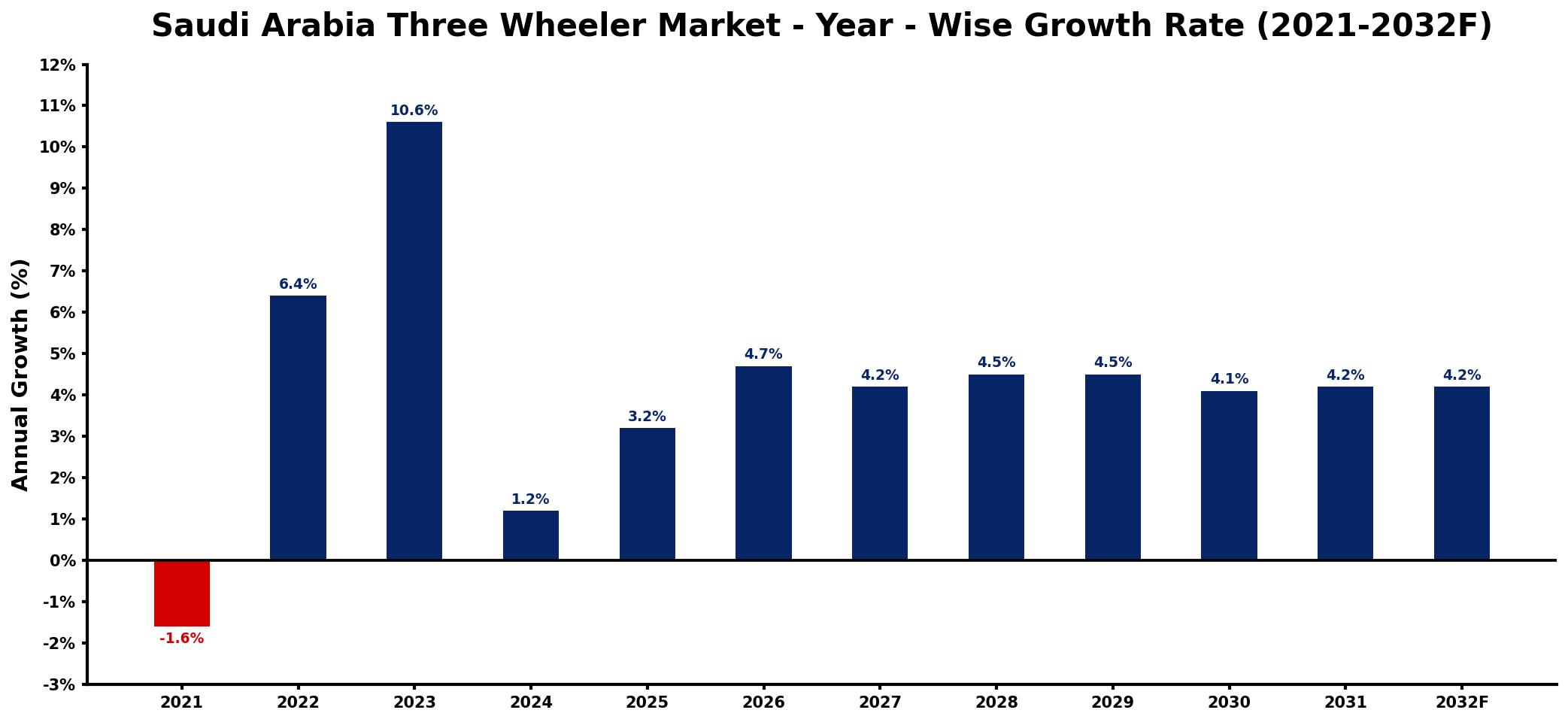
The table below presents the year‑wise growth rates along with the key drivers influencing the market
| Year | Growth Rate | Major Drivers |
| 2021 | -1.6% | decreased demand for local transport |
| 2022 | 6.4% | increased urban mobility solutions |
| 2023 | 10.6% | growing investment in logistics |
| 2024 | 1.2% | expansion of last mile delivery |
| 2025 | 3.2% | rise in fuel efficiency standards |
| 2026 | 4.7% | enhanced public transportation initiatives |
| 2027 | 4.2% | increased consumer preference for alternatives |
| 2028 | 4.5% | growing eco-friendly transportation options |
| 2029 | 4.5% | rising infrastructure development spending |
| 2030 | 4.1% | increased urbanization and infrastructure |
| 2031 | 4.2% | growing interest in electric vehicles |
| 2032 | 4.2% | improved raw material availability |
Note: Market size estimations and growth projections presented in this report are based on 6Wresearch's proprietary forecasting methodology, utilizing the latest available industry data, government publications, and primary research inputs.
Saudi Arabia Three Wheeler Market Synopsis
The three-wheeler market in Saudi Arabia has recently witnessed significant momentum, driven largely by the need for versatile transportation solutions. As urban centers expand, three-wheelers have emerged as a practical choice for short-distance travel and cargo movement, contributing to reduced traffic congestion.
Looking ahead, the market is poised for further growth, propelled by government initiatives that prioritize sustainable transportation alternatives. The shift towards eco-friendly mobility solutions is likely to enhance the acceptance of three-wheelers, making them integral to the urban transportation landscape.
Saudi Arabia Three Wheeler Market Key Takeaways
- The market is projected to grow steadily, reaching USD 428 Million by 2032.
- Increased urbanization and last-mile delivery demand are primary growth drivers.
- Three-wheelers are gaining recognition for their maneuverability in congested areas.
- Government policies favoring sustainable transport are likely to bolster market expansion.
- Limited consumer awareness poses challenges that must be addressed for widespread adoption.
Evaluation of Restraints in Saudi Arabia Three Wheeler Market
Despite the promising outlook for the Saudi Arabia three-wheeler market, several restraints are hindering its growth. A significant challenge is the absence of well-defined regulatory frameworks that cater specifically to three-wheelers, resulting in ambiguous safety standards. Furthermore, consumer misconceptions about the practicality and reliability of three-wheelers compared to traditional vehicles impede their acceptance. This is compounded by limited financing options, making it difficult for potential buyers to invest in these vehicles. To truly unlock the market's potential, stakeholders must collaborate to establish clearer guidelines and improve public perception.
Saudi Arabia Three Wheeler Market Trends
Current trends in the Saudi Arabia three-wheeler market emphasize the integration of technology and sustainability. Manufacturers are increasingly focusing on developing fuel-efficient models and exploring electric three-wheelers to cater to environmental concerns. Additionally, the rise of e-commerce is driving demand for three-wheelers in last-mile delivery, prompting innovations in cargo solutions. As urban mobility strategies evolve, the adaptability of three-wheelers to local conditions positions them favorably for future growth.
Saudi Arabia Three Wheeler Market Opportunities
The Saudi Arabia three-wheeler market presents genuine growth opportunities, particularly in the realm of last-mile delivery and urban transport solutions. As businesses increasingly seek efficient logistics solutions, three-wheelers offer a cost-effective alternative for navigating crowded urban centers. Moreover, collaboration between industry stakeholders and government bodies could pave the way for enhanced regulatory frameworks, boosting consumer confidence and facilitating broader adoption. Innovative financing models will also be crucial in making three-wheelers more accessible to the average consumer.
Government Initiatives in the Saudi Arabia Three Wheeler Market
The Saudi government has been proactive in promoting sustainable transportation solutions, which directly benefits the three-wheeler market. By investing in public transport infrastructure and formulating policies that encourage the use of eco-friendly vehicles, the government aims to alleviate congestion in urban areas. Initiatives that support the development of electric three-wheelers and promote their integration into public transportation systems are expected to play a significant role in shaping the future of this market.
Future Insights of the Saudi Arabia Three Wheeler Market
From 2026 to 2032, the Saudi Arabia three-wheeler market is likely to evolve significantly. As urbanization continues to rise, three-wheelers are expected to become a cornerstone of urban mobility solutions. The integration of advanced technologies, such as smart connectivity features and electric powertrains, will further enhance their appeal. Furthermore, as awareness grows around environmental sustainability, the shift towards greener transport options will likely elevate the status of three-wheelers as essential components of the urban transport ecosystem.
Saudi Arabia Three Wheeler Market Latest Developments (2025 - 2026)
Recent developments in the Saudi Arabia three-wheeler market indicate a shift toward increasing consumer interest in eco-friendly transportation options. As manufacturers unveil new models that cater to sustainability, the overall market direction appears positive. Concurrently, initiatives aimed at fostering greater public awareness and education around the benefits of three-wheelers are gaining traction. The evolving landscape suggests a vibrant future as urban transportation continues to adapt to new demands and challenges.
Saudi Arabia Three Wheeler Market - Key Attractiveness of the Report
- 10 Years of Market Numbers
- Historical Data Starting from 2022 to 2025
- Base Year: 2025
- Forecast Data until 2032
- Key Performance Indicators Impacting the Market
- Major Upcoming Developments and Projects
Key Highlights of the Report:
- Saudi Arabia Three Wheeler Market Outlook
- Market Size of Saudi Arabia Three Wheeler Market, 2025
- Forecast of Saudi Arabia Three Wheeler Market, 2032
- Historical Data and Forecast of Saudi Arabia Three Wheeler Revenues & Volume for the Period 2022-2032F
- Saudi Arabia Three Wheeler Market Trend Evolution
- Saudi Arabia Three Wheeler Market Drivers and Challenges
- Saudi Arabia Three Wheeler Price Trends
- Saudi Arabia Three Wheeler Porter's Five Forces
- Saudi Arabia Three Wheeler Industry Life Cycle
- Historical Data and Forecast of Saudi Arabia Three Wheeler Market Revenues & Volume By Fuel Type for the Period 2022-2032F
- Historical Data and Forecast of Saudi Arabia Three Wheeler Market Revenues & Volume By Petrol/CNG for the Period 2022-2032F
- Historical Data and Forecast of Saudi Arabia Three Wheeler Market Revenues & Volume By Diesel for the Period 2022-2032F
- Historical Data and Forecast of Saudi Arabia Three Wheeler Market Revenues & Volume By Electric for the Period 2022-2032F
- Historical Data and Forecast of Saudi Arabia Three Wheeler Market Revenues & Volume By Vehicle Type for the Period 2022-2032F
- Historical Data and Forecast of Saudi Arabia Three Wheeler Market Revenues & Volume By Passenger Carrier for the Period 2022-2032F
- Historical Data and Forecast of Saudi Arabia Three Wheeler Market Revenues & Volume By Load Carrier for the Period 2022-2032F
- Saudi Arabia Three Wheeler Import Export Trade Statistics
- Market Opportunity Assessment By Fuel Type
- Market Opportunity Assessment By Vehicle Type
- Saudi Arabia Three Wheeler Top Companies Market Share
- Saudi Arabia Three Wheeler Competitive Benchmarking By Technical and Operational Parameters
- Saudi Arabia Three Wheeler Company Profiles
- Saudi Arabia Three Wheeler Key Strategic Recommendations






































