Senegal First Aid Market: Top 5 Importing Countries and Market Competition (HHI) Analysis
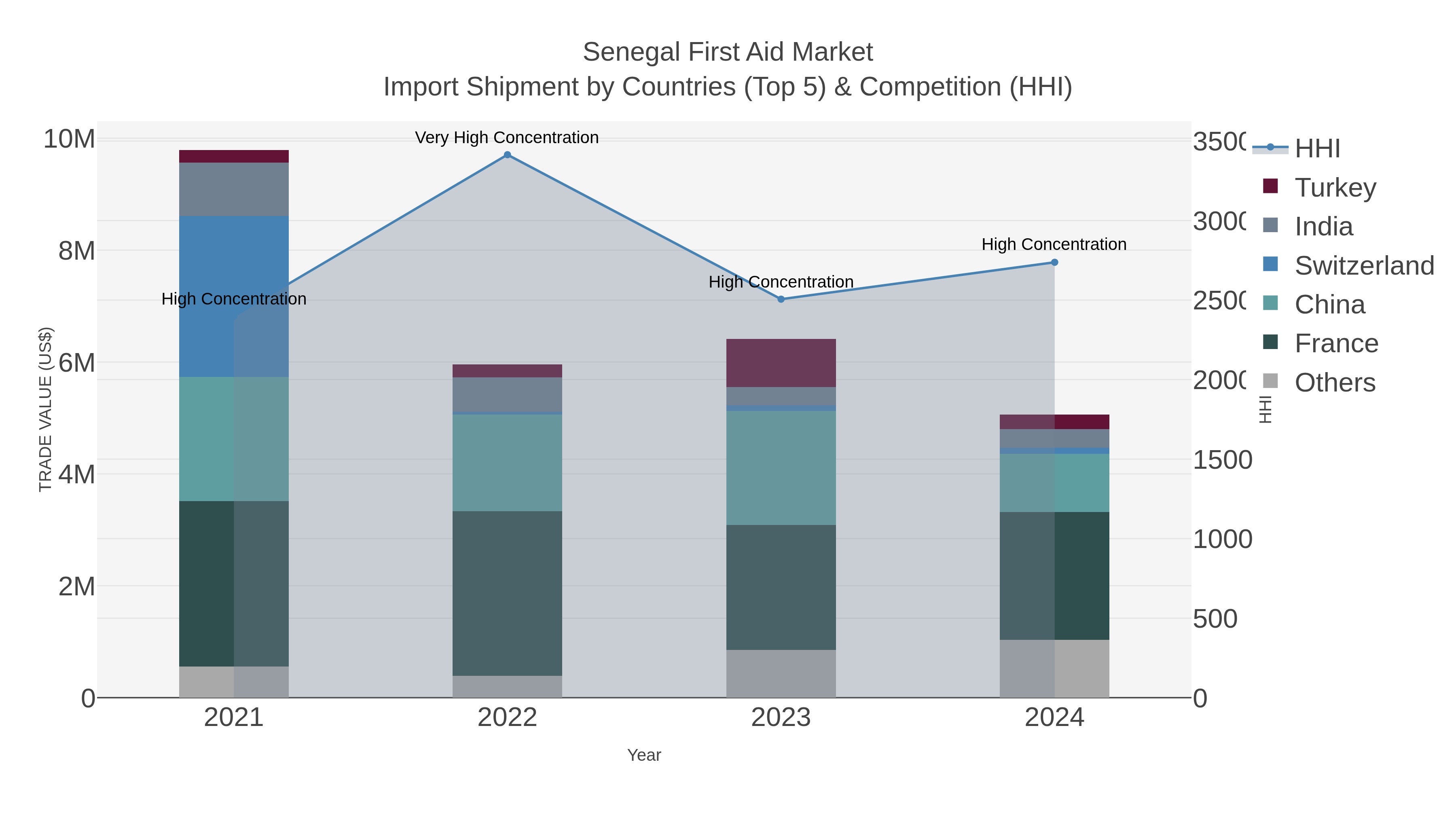
Senegal first aid import market in 2024 saw major contributions from top exporters such as France, China, India, Turkey, and Areas, nes. Despite a high concentration with a Herfindahl-Hirschman Index (HHI), the market experienced a significant decline with a Compound Annual Growth Rate (CAGR) of -19.74% and a growth rate of -21.06%. This indicates challenges and changes in the market dynamics that may require further analysis and strategic adjustments for importers and exporters in the first aid sector.
Senegal First Aid Market Overview
The Senegal First Aid Market is steadily growing due to the increasing awareness about the importance of first aid and safety measures. With a focus on providing essential first aid supplies such as bandages, antiseptics, and first aid kits, the market is driven by a rising emphasis on workplace safety, healthcare infrastructure development, and government initiatives promoting first aid training. Key players in the market include local distributors, international brands, and healthcare organizations, all contributing to the expansion of the sector. Additionally, the market is witnessing a trend towards digitalization with the introduction of first aid mobile apps and online training programs. Overall, the Senegal First Aid Market presents opportunities for further growth and innovation in ensuring public safety and emergency preparedness.
Senegal First Aid Market Trends and Opportunities
The Senegal First Aid Market is experiencing growth due to increasing awareness about the importance of first aid training and equipment. With a growing emphasis on workplace safety and public health, there is a rising demand for first aid kits, training programs, and emergency response services. Additionally, the government`s efforts to improve healthcare infrastructure and emergency response systems present opportunities for companies to expand their presence in the market. Collaborations between healthcare providers, educational institutions, and businesses to promote first aid education and accessibility are also driving market growth. As the market continues to evolve, innovative technologies such as mobile apps for first aid guidance and remote monitoring devices are expected to further enhance the sector`s offerings and accessibility.
Senegal First Aid Market Challenges
In the Senegal First Aid Market, challenges include limited public awareness and education on the importance of first aid, leading to a lack of demand for first aid products and services. Accessibility to quality first aid products and training is also a concern, particularly in rural areas where resources may be scarce. Additionally, regulatory hurdles and inconsistent enforcement of standards pose obstacles for companies looking to enter or expand in the market. Cultural factors and beliefs about traditional healing methods may also impact the acceptance and adoption of modern first aid practices. Overall, addressing these challenges will require a multi-faceted approach involving education campaigns, improved infrastructure, regulatory reforms, and collaboration with local communities to promote the value of first aid in Senegal.
Senegal First Aid Market Drivers
The Senegal First Aid Market is being primarily driven by the growing awareness about the importance of immediate medical assistance during emergencies and accidents. The increasing number of road accidents, workplace injuries, and other medical emergencies have highlighted the crucial need for access to first aid supplies and training among individuals and organizations. Additionally, government initiatives and campaigns promoting first aid education and training have further fueled the demand for first aid products and services in Senegal. The rising focus on healthcare infrastructure development and the availability of advanced first aid products are also contributing factors driving the growth of the Senegal First Aid Market. Overall, the market is expected to continue expanding as more emphasis is placed on ensuring timely and effective first aid response across various sectors in the country.
Senegal First Aid Market Government Policies
The Senegalese government has implemented policies to promote the importance of first aid in the country by providing training programs through organizations like the Senegalese Red Cross and the Ministry of Health. Additionally, there are regulations in place to ensure that first aid kits are readily available in public spaces and workplaces. The government also encourages partnerships with private companies to expand first aid services and products in the market. Overall, the government`s focus on improving access to first aid training and supplies underscores its commitment to enhancing emergency response capabilities and ensuring public safety in Senegal.
Senegal First Aid Market Future Outlook
The Senegal First Aid Market is poised for steady growth in the coming years, driven by increasing awareness of the importance of first aid training and equipment across various sectors including healthcare, education, and the workplace. Factors such as government initiatives to promote first aid education, rising healthcare expenditure, and a growing emphasis on occupational safety are expected to contribute to market expansion. Moreover, the rising incidence of accidents and emergencies necessitates the availability of first aid supplies and services, further boosting market demand. With an evolving healthcare landscape and a focus on improving emergency response capabilities, the Senegal First Aid Market is likely to witness a positive growth trajectory, presenting opportunities for both local and international providers to cater to the growing need for effective first aid solutions.
Key Highlights of the Report:
- Senegal First Aid Market Outlook
- Market Size of Senegal First Aid Market, 2024
- Forecast of Senegal First Aid Market, 2031
- Historical Data and Forecast of Senegal First Aid Revenues & Volume for the Period 2021- 2031
- Senegal First Aid Market Trend Evolution
- Senegal First Aid Market Drivers and Challenges
- Senegal First Aid Price Trends
- Senegal First Aid Porter's Five Forces
- Senegal First Aid Industry Life Cycle
- Historical Data and Forecast of Senegal First Aid Market Revenues & Volume By Type for the Period 2021- 2031
- Historical Data and Forecast of Senegal First Aid Market Revenues & Volume By First Aid Room Equipment for the Period 2021- 2031
- Historical Data and Forecast of Senegal First Aid Market Revenues & Volume By Automated External Defibrillators for the Period 2021- 2031
- Historical Data and Forecast of Senegal First Aid Market Revenues & Volume By First Aid Training Products for the Period 2021- 2031
- Historical Data and Forecast of Senegal First Aid Market Revenues & Volume By End-use for the Period 2021- 2031
- Historical Data and Forecast of Senegal First Aid Market Revenues & Volume By Hospital & Clinics for the Period 2021- 2031
- Historical Data and Forecast of Senegal First Aid Market Revenues & Volume By Home & Offices for the Period 2021- 2031
- Senegal First Aid Import Export Trade Statistics
- Market Opportunity Assessment By Type
- Market Opportunity Assessment By End-use
- Senegal First Aid Top Companies Market Share
- Senegal First Aid Competitive Benchmarking By Technical and Operational Parameters
- Senegal First Aid Company Profiles
- Senegal First Aid Key Strategic Recommendations






































