Singapore Aromatic Compounds Market: Import Trend Analysis
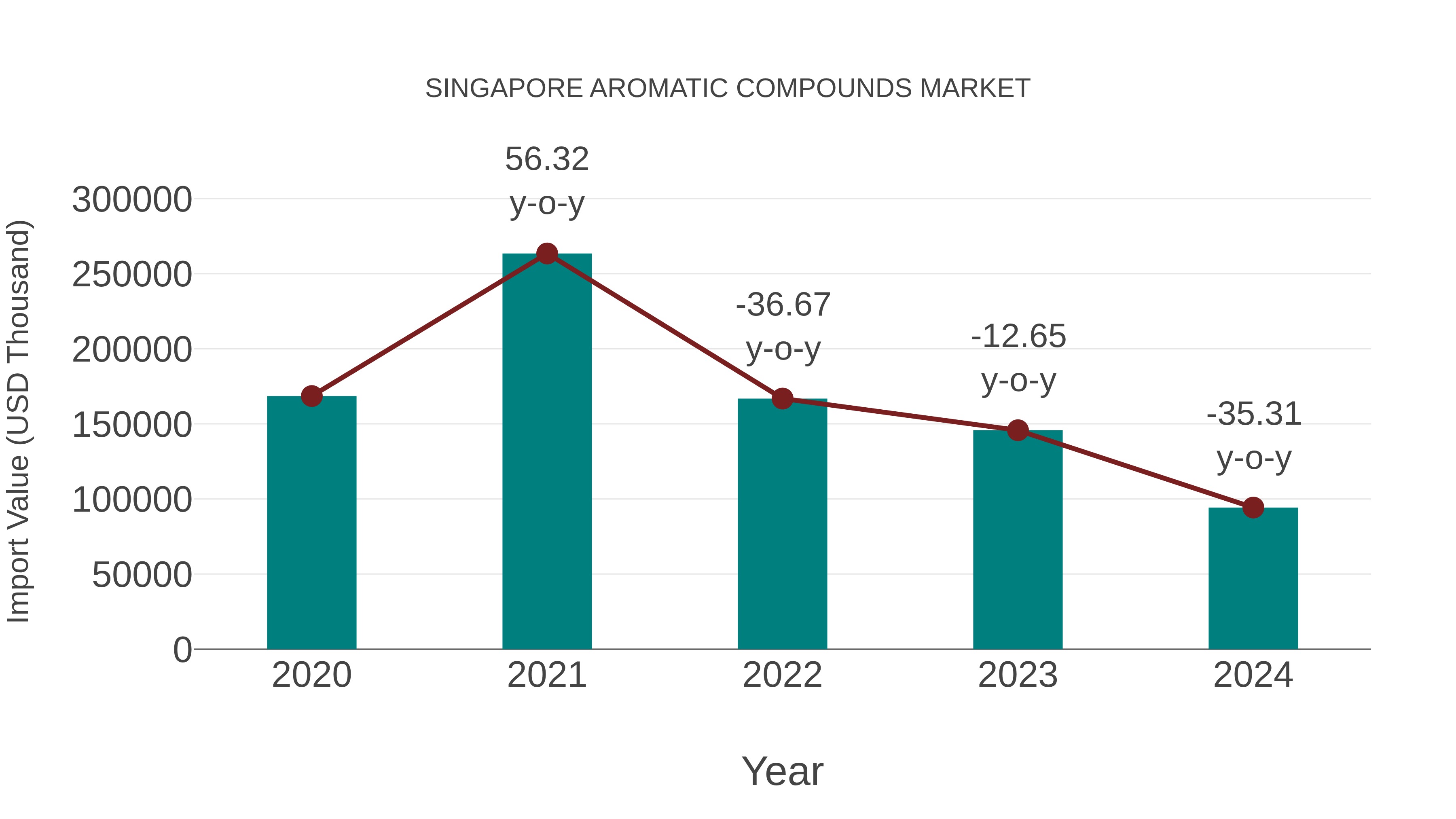
In the Singapore aromatic compounds market, the import trend experienced a notable decline from 2023 to 2024, with a growth rate of -35.31%. The compound annual growth rate (CAGR) for the period 2020-2024 stood at -13.52%. This negative import momentum may indicate a significant demand shift, potentially influenced by changing market dynamics or trade policies during the period.
Singapore Aromatic Compounds Market Synopsis
The Singapore aromatic compounds market provides essential chemicals with various applications in industries such as petrochemicals, pharmaceuticals, and perfumery. Market trends are influenced by production efficiency, product quality, and compliance with safety and environmental regulations to meet the diverse needs of industrial sectors.
Drivers of the Market
The Singapore aromatic compounds market may see growth due to its applications in the chemical and petrochemical industries. Aromatic compounds serve as key raw materials for the production of plastics, resins, and synthetic fibers. As these industries continue to evolve and innovate, the demand for aromatic compounds is expected to increase. Singapore position as a trading and manufacturing hub can contribute to market growth.
Challenges of the Market
The aromatic compounds market in Singapore confronts challenges concerning chemical production, product innovation, and regulatory compliance. Aromatic compounds have diverse industrial applications, and ensuring their purity and safety is vital. Managing chemical production processes, addressing concerns about product safety, and meeting regulatory requirements for chemical manufacturing are key challenges for market viability.
COVID-19 Impact on the Market
The aromatic compounds market in Singapore showed adaptability during the COVID-19 pandemic. While some sectors experienced disruptions, the market continued to serve various industries, including petrochemicals, pharmaceuticals, and perfumery. Aromatic compound suppliers adapted by optimizing production processes and ensuring a stable supply chain. The pandemic underscored the importance of aromatic compounds in essential products, influencing market strategies.
Key Players in the Market
The Singapore aromatic compounds market involves a range of industries, including chemicals, perfumes, and flavorings. Key players in this market include multinational chemical companies like BASF, Evonik, and Dow Chemical. These companies are known for producing and supplying a variety of aromatic compounds used in various industrial applications, including the production of fragrances, plastics, and chemicals.
Key Highlights of the Report:
- Singapore Aromatic Compounds Market Outlook
- Market Size of Singapore Aromatic Compounds Market, 2025
- Forecast of Singapore Aromatic Compounds Market, 2032
- Historical Data and Forecast of Singapore Aromatic Compounds Revenues & Volume for the Period 2022-2032F
- Singapore Aromatic Compounds Market Trend Evolution
- Singapore Aromatic Compounds Market Drivers and Challenges
- Singapore Aromatic Compounds Price Trends
- Singapore Aromatic Compounds Porter's Five Forces
- Singapore Aromatic Compounds Industry Life Cycle
- Historical Data and Forecast of Singapore Aromatic Compounds Market Revenues & Volume By Type for the Period 2022-2032F
- Historical Data and Forecast of Singapore Aromatic Compounds Market Revenues & Volume By Benzene for the Period 2022-2032F
- Historical Data and Forecast of Singapore Aromatic Compounds Market Revenues & Volume By Xylene for the Period 2022-2032F
- Historical Data and Forecast of Singapore Aromatic Compounds Market Revenues & Volume By Toluene for the Period 2022-2032F
- Historical Data and Forecast of Singapore Aromatic Compounds Market Revenues & Volume By Application for the Period 2022-2032F
- Historical Data and Forecast of Singapore Aromatic Compounds Market Revenues & Volume By Solvent for the Period 2022-2032F
- Historical Data and Forecast of Singapore Aromatic Compounds Market Revenues & Volume By Additive for the Period 2022-2032F
- Historical Data and Forecast of Singapore Aromatic Compounds Market Revenues & Volume By End-use for the Period 2022-2032F
- Historical Data and Forecast of Singapore Aromatic Compounds Market Revenues & Volume By Packaging for the Period 2022-2032F
- Historical Data and Forecast of Singapore Aromatic Compounds Market Revenues & Volume By Detergent And Dyes for the Period 2022-2032F
- Historical Data and Forecast of Singapore Aromatic Compounds Market Revenues & Volume By Automobile for the Period 2022-2032F
- Historical Data and Forecast of Singapore Aromatic Compounds Market Revenues & Volume By Electronic Devices for the Period 2022-2032F
- Historical Data and Forecast of Singapore Aromatic Compounds Market Revenues & Volume By Medical Devices for the Period 2022-2032F
- Historical Data and Forecast of Singapore Aromatic Compounds Market Revenues & Volume By Pharmaceuticals for the Period 2022-2032F
- Historical Data and Forecast of Singapore Aromatic Compounds Market Revenues & Volume By Gasoline for the Period 2022-2032F
- Historical Data and Forecast of Singapore Aromatic Compounds Market Revenues & Volume By Tire for the Period 2022-2032F
- Singapore Aromatic Compounds Import Export Trade Statistics
- Market Opportunity Assessment By Type
- Market Opportunity Assessment By Application
- Market Opportunity Assessment By End-use
- Singapore Aromatic Compounds Top Companies Market Share
- Singapore Aromatic Compounds Competitive Benchmarking By Technical and Operational Parameters
- Singapore Aromatic Compounds Company Profiles
- Singapore Aromatic Compounds Key Strategic Recommendations






































