Singapore Computer Software Market Size, Share & Growth Rate
The Singapore Computer Software Market was estimated at USD 761 Million in 2025 and is projected to reach USD 1089 Million by 2032, growing at a CAGR of 5.3% from 2026 to 2032. This growth trajectory reflects the robust demand for innovative software solutions, fueled by the nations ongoing digital transformation and an increasing emphasis on automation and data analytics. As industries rapidly adopt cloud technologies and software-as-a-service (SaaS) models, the market is positioned for sustained expansion.
Singapore Computer Software Market Year-wise Growth Rate and Key Drivers
This graph highlights how the Singapore Computer Software Market has steadily grown over the years, supported by major growth factors.
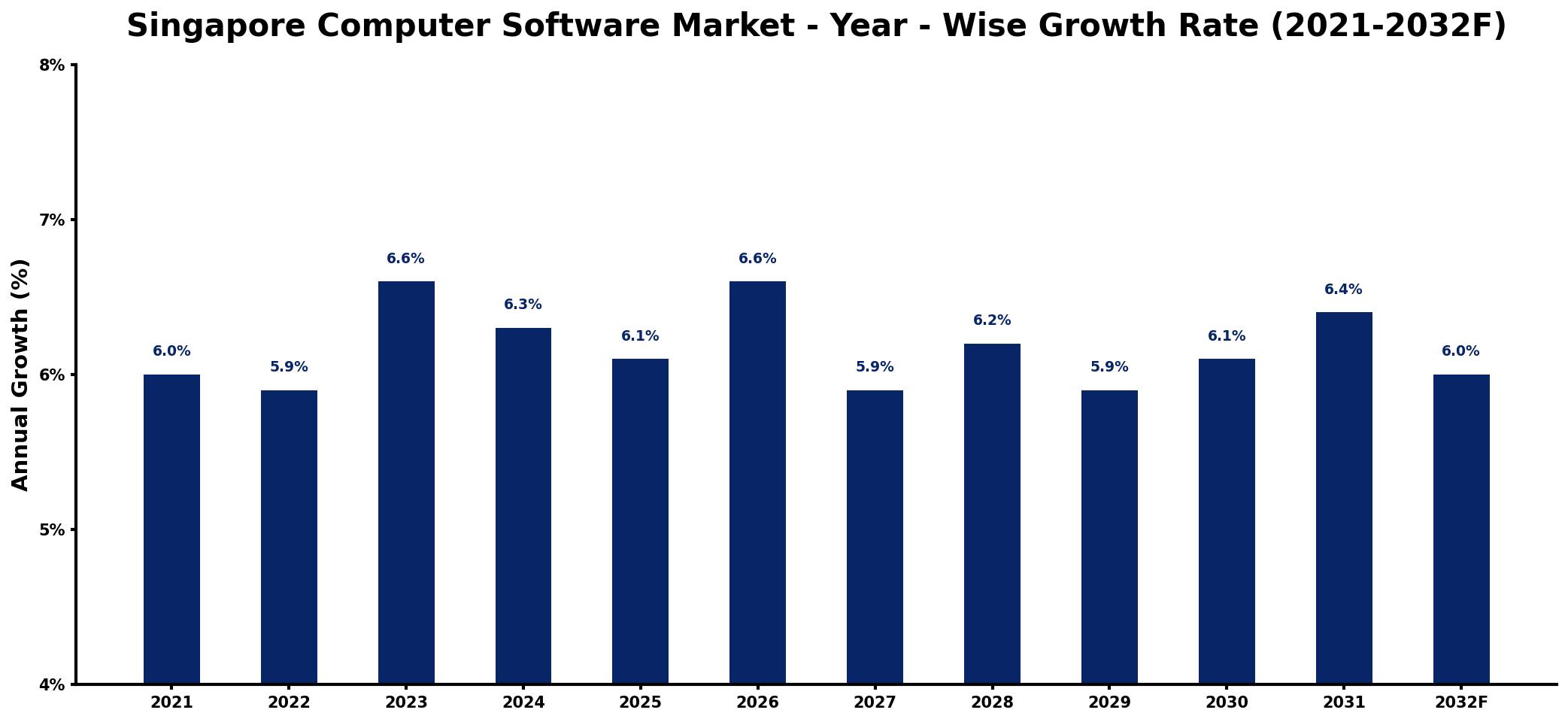
The table below presents the year‑wise growth rates along with the key drivers influencing the market
| Year | Growth Rate | Major Drivers |
| 2021 | 6.0% | Rising demand for digital solutions |
| 2022 | 5.9% | Increased investment in tech innovation |
| 2023 | 6.6% | Expansion of cloud computing services |
| 2024 | 6.3% | Growth in e-commerce platforms |
| 2025 | 6.1% | Surge in cybersecurity initiatives |
| 2026 | 6.6% | Emergence of AI applications |
| 2027 | 5.9% | Development of mobile applications |
| 2028 | 6.2% | Higher adoption of automation tools |
| 2029 | 5.9% | Boost in remote working technologies |
| 2030 | 6.1% | Investments in data analytics capabilities |
| 2031 | 6.4% | Advancement of collaborative platforms |
| 2032 | 6.0% | Enhancement of user experience design |
Note: Market size estimations and growth projections presented in this report are based on 6Wresearch's proprietary forecasting methodology, utilizing the latest available industry data, government publications, and primary research inputs.
Singapore Computer Software Market Synopsis
Recent momentum in the Singapore computer software market has been remarkable, driven primarily by the urgent need for businesses to digitalize operations and enhance customer interactions. Looking ahead, the market is on a path of continuous growth, supported by government initiatives aimed at transforming Singapore into a Smart Nation, which will further stimulate software adoption across sectors such as healthcare, transportation, and e-commerce.
As organizations transition towards advanced technological ecosystems, they increasingly rely on software solutions to improve efficiency and decision-making processes. This shift not only underscores the importance of software in modern enterprises but also highlights the evolving landscape of consumer expectations and regulatory frameworks that support such advancements.
Singapore Computer Software Market Key Takeaways
- Strong growth trajectory driven by digital transformation and cloud adoption.
- Government initiatives bolster investment in Smart Nation projects, enhancing software relevance.
- Increased reliance on automation and data analytics is shaping demand for advanced software solutions.
- Growing software needs across various sectors, particularly healthcare and e-commerce.
- Global players continue to dominate with a diverse range of offerings catering to local needs.
Evaluation of Restraints in Singapore Computer Software Market
Despite the favorable conditions for growth, the Singapore computer software market faces several restraints. The rapid evolution of technology necessitates that software providers continuously update their offerings, which can strain resources and lead to potential market fragmentation. Furthermore, challenges surrounding intellectual property rights and data privacy compliance are paramount, as firms navigate a landscape where data utilization is both crucial and regulated. Companies must therefore invest significantly in security measures and stay ahead of regulatory changes to mitigate risks.
Singapore Computer Software Market Trends
Several trends are currently shaping the Singapore computer software market. The rise of artificial intelligence and machine learning is enhancing predictive analytics capabilities, driving innovation in various applications. Furthermore, the growing adoption of cloud technologies is prompting organizations to transition away from traditional software models to more flexible, scalable solutions. As remote work becomes a norm, collaboration software and cybersecurity tools are increasingly vital, ensuring that business continuity is maintained without compromising on security.
Singapore Computer Software Market Opportunities
Amidst these dynamic trends, significant growth opportunities lie in the development of niche software solutions tailored to specific industries. For example, sectors like fintech and healthtech present avenues for specialized software that addresses their unique operational needs. Additionally, the ongoing shift towards sustainability is driving demand for software that facilitates energy efficiency and environmental compliance. Businesses willing to innovate and adapt to these emerging needs are likely to gain substantial competitive advantages in the evolving landscape.
Government Initiatives in the Singapore Computer Software Market
The Singaporean government plays a crucial role in bolstering the computer software market through various initiatives aimed at promoting digitalization. Programs supporting the Smart Nation vision are designed to foster innovation and encourage the adoption of cutting-edge technology across sectors. By investing in infrastructure and offering incentives for businesses to embrace technology, the government is helping to create an environment conducive to software growth and development. These efforts ensure that Singapore remains a regional technology hub, attracting investment and talent.
Future Insights of the Singapore Computer Software Market
Looking toward the future, the Singapore computer software market is poised for robust growth through 2032 and beyond. As digital transformation continues to permeate all facets of business, the demand for sophisticated software solutions is expected to escalate. Advances in artificial intelligence and cloud computing will likely redefine user experiences, making software not just a tool, but a critical component of strategic decision-making. Companies that invest in R&D and focus on customer-centric innovations will thrive in this evolving market landscape.
Singapore Computer Software Market Latest Developments (2025 - 2026)
The Singapore computer software market has seen significant developments, particularly in the areas of cloud computing and AI integration. Businesses are increasingly adopting hybrid cloud solutions to optimize their operations while enhancing security measures. Concurrently, new partnerships between software firms and local enterprises are fostering innovation in product offerings. These collaborations aim to address emerging challenges, such as data privacy and integration issues, reflecting the market's adaptive nature to evolving demands.
Singapore Computer Software Market - Key Attractiveness of the Report
- 10 Years of Market Numbers
- Historical Data Starting from 2022 to 2025
- Base Year: 2025
- Forecast Data until 2032
- Key Performance Indicators Impacting the Market
- Major Upcoming Developments and Projects
Key Highlights of the Report:
- Singapore Computer Software Market Outlook
- Market Size of Singapore Computer Software Market, 2025
- Forecast of Singapore Computer Software Market, 2032
- Historical Data and Forecast of Singapore Computer Software Revenues & Volume for the Period 2022-2032F
- Singapore Computer Software Market Trend Evolution
- Singapore Computer Software Market Drivers and Challenges
- Singapore Computer Software Price Trends
- Singapore Computer Software Porter's Five Forces
- Singapore Computer Software Industry Life Cycle
- Historical Data and Forecast of Singapore Computer Software Market Revenues & Volume By Type for the Period 2022-2032F
- Historical Data and Forecast of Singapore Computer Software Market Revenues & Volume By Operating Systems & Productivity Software Publishing for the Period 2022-2032F
- Historical Data and Forecast of Singapore Computer Software Market Revenues & Volume By Database, Storage & Backup Software Publishing for the Period 2022-2032F
- Historical Data and Forecast of Singapore Computer Software Market Revenues & Volume By Business Analytics & Enterprise Software for the Period 2022-2032F
- Historical Data and Forecast of Singapore Computer Software Market Revenues & Volume By Video Game Software for the Period 2022-2032F
- Historical Data and Forecast of Singapore Computer Software Market Revenues & Volume By Design for the Period 2022-2032F
- Historical Data and Forecast of Singapore Computer Software Market Revenues & Volume By Editing & Rendering Software for the Period 2022-2032F
- Historical Data and Forecast of Singapore Computer Software Market Revenues & Volume By Application for the Period 2022-2032F
- Historical Data and Forecast of Singapore Computer Software Market Revenues & Volume By Personal for the Period 2022-2032F
- Historical Data and Forecast of Singapore Computer Software Market Revenues & Volume By Business/Commercial for the Period 2022-2032F
- Historical Data and Forecast of Singapore Computer Software Market Revenues & Volume By Industrial for the Period 2022-2032F
- Historical Data and Forecast of Singapore Computer Software Market Revenues & Volume By Industry Verticals for the Period 2022-2032F
- Historical Data and Forecast of Singapore Computer Software Market Revenues & Volume By BFSI for the Period 2022-2032F
- Historical Data and Forecast of Singapore Computer Software Market Revenues & Volume By Media & Entertainment for the Period 2022-2032F
- Historical Data and Forecast of Singapore Computer Software Market Revenues & Volume By IT & Telecommunications for the Period 2022-2032F
- Historical Data and Forecast of Singapore Computer Software Market Revenues & Volume By Energy & Utilities for the Period 2022-2032F
- Historical Data and Forecast of Singapore Computer Software Market Revenues & Volume By Government & Public Sector for the Period 2022-2032F
- Historical Data and Forecast of Singapore Computer Software Market Revenues & Volume By Retail & Consumer Goods for the Period 2022-2032F
- Historical Data and Forecast of Singapore Computer Software Market Revenues & Volume By Manufacturing for the Period 2022-2032F
- Historical Data and Forecast of Singapore Computer Software Market Revenues & Volume By Others for the Period 2022-2032F
- Singapore Computer Software Import Export Trade Statistics
- Market Opportunity Assessment By Type
- Market Opportunity Assessment By Application
- Market Opportunity Assessment By Industry Verticals
- Singapore Computer Software Top Companies Market Share
- Singapore Computer Software Competitive Benchmarking By Technical and Operational Parameters
- Singapore Computer Software Company Profiles
- Singapore Computer Software Key Strategic Recommendations






































