Singapore IPTV Market Size, Share & Growth Rate
The Singapore IPTV Market was estimated at USD 444 Million in 2025 and is projected to reach USD 603 Million by 2032, growing at a CAGR of 4.5% from 2026 to 2032. This upward trajectory is fueled by the growing demand for high-quality, personalized content, as consumers increasingly prefer on-demand viewing options. Additionally, the proliferation of smart TVs and the expansion of high-speed internet connectivity are further propelling the adoption of IPTV services in Singapore.
Singapore IPTV Market Year-wise Growth Rate and Key Drivers
This graph highlights how the Singapore IPTV Market has steadily grown over the years, supported by major growth factors.
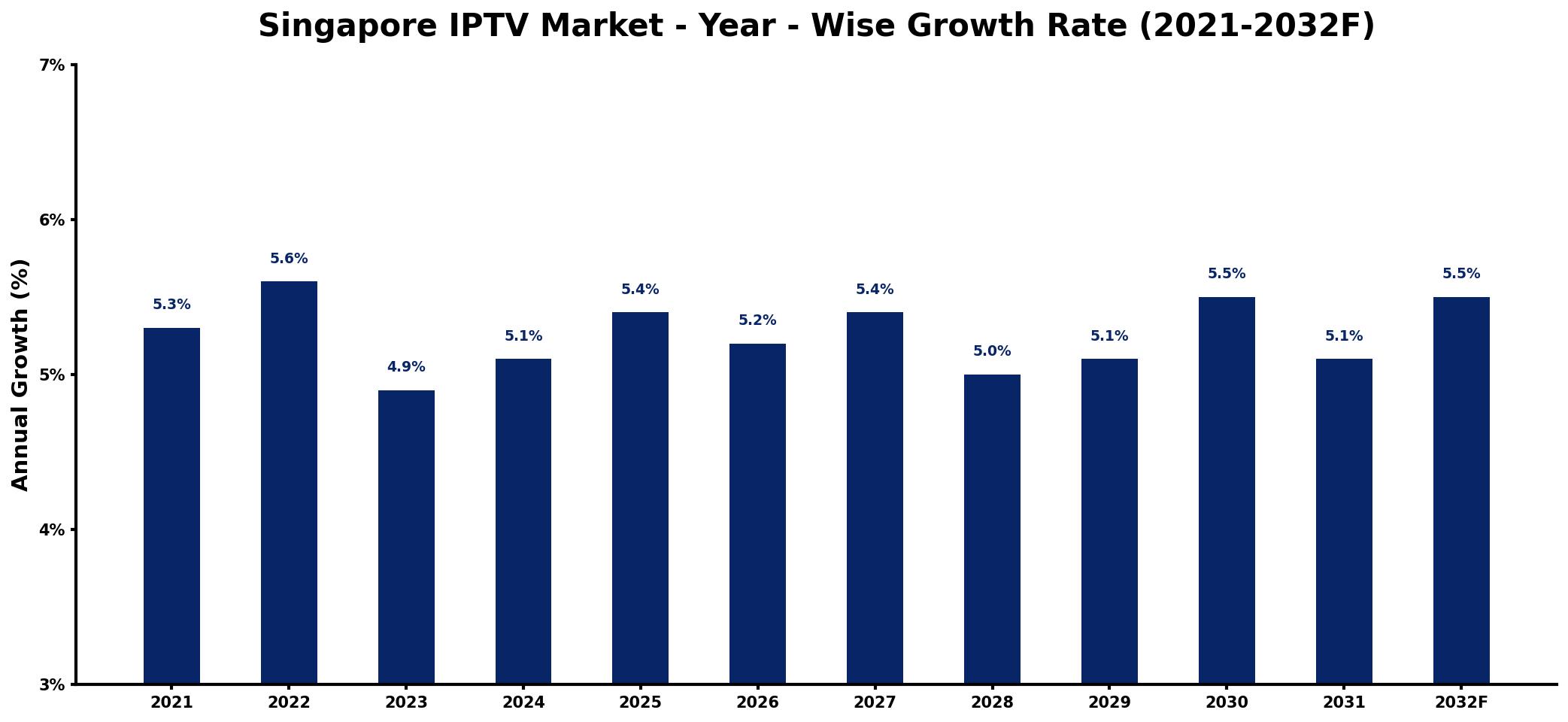
The table below presents the year‑wise growth rates along with the key drivers influencing the market
| Year | Growth Rate | Major Drivers |
| 2021 | 5.3% | rising demand for streaming services |
| 2022 | 5.6% | increased investment in infrastructure |
| 2023 | 4.9% | growing popularity of mobile viewing |
| 2024 | 5.1% | expansion of content offerings |
| 2025 | 5.4% | enhanced user experience technologies |
| 2026 | 5.2% | greater accessibility to high-speed internet |
| 2027 | 5.4% | surge in original programming content |
| 2028 | 5.0% | development of bundled service packages |
| 2029 | 5.1% | increased partnerships with content creators |
| 2030 | 5.5% | wider adoption of smart devices |
| 2031 | 5.1% | growth in subscription-based models |
| 2032 | 5.5% | rising consumer interest in personalization |
Note: Market size estimations and growth projections presented in this report are based on 6Wresearch's proprietary forecasting methodology, utilizing the latest available industry data, government publications, and primary research inputs.
Singapore IPTV Market Synopsis
In recent years, Singapore has witnessed a notable shift in consumer behavior towards interactive and customizable viewing experiences. IPTV services are at the forefront of this trend, offering users the flexibility to curate their entertainment options and access a diverse array of on-demand content.
The convergence of internet and television services is reshaping the landscape of media consumption in Singapore. As households increasingly rely on digital platforms for entertainment, IPTV is emerging as a crucial component of modern viewing habits, catering to the needs of a tech-savvy population.
Singapore IPTV Market Key Takeaways
- The Singapore IPTV market is driven by high demand for on-demand and personalized content.
- Significant growth is anticipated as internet infrastructure improves and smart TV adoption increases.
- Competition from traditional cable and satellite services poses challenges for market penetration.
- COVID-19 catalyzed a surge in IPTV subscriptions, highlighting consumer preferences for home entertainment.
- Robust regulatory frameworks govern content licensing and broadcasting standards in the market.
Evaluation of Restraints in Singapore IPTV Market
Despite its promising growth trajectory, the Singapore IPTV market faces significant restraints that could hinder its potential. The existing dominance of cable and satellite TV services makes it challenging for IPTV providers to entice consumers to switch. Moreover, the need for a reliable, high-speed internet connection is critical; any degradation in service quality due to network congestion can negatively impact user experiences. Additionally, navigating the complexities of copyright and content licensing presents ongoing challenges that could limit the availability of desirable programming. Regulatory compliance also remains a key concern, as IPTV services must align with broadcasting standards and content regulations enforced by the government.
Singapore IPTV Market Trends
Emerging trends are significantly shaping the Singapore IPTV market, notably the integration of artificial intelligence and machine learning for personalized recommendations. As IPTV platforms leverage data analytics to enhance user experiences, consumer satisfaction is expected to rise. Furthermore, the growing inclination towards subscription-based models over traditional cable packages indicates a major shift in viewing preferences, aligning with the global transition towards direct-to-consumer services.
The incorporation of interactive features such as real-time viewer engagement and multi-screen experiences is also gaining traction. These innovations not only enhance viewer engagement but also facilitate content discovery, allowing users to explore a broader range of media offerings.
Singapore IPTV Market Opportunities
The Singapore IPTV market presents numerous growth and investment opportunities. As demand for diverse content continues to rise, providers that focus on securing exclusive content deals and enhancing user engagement will likely gain a competitive advantage. Additionally, the burgeoning interest in esports and gaming-related content offers untapped potential for IPTV service providers. By expanding their offerings to include these genres, companies can capitalize on the growing viewer base seeking specialized entertainment options.
Government Initiatives in the Singapore IPTV Market
The Singaporean government has implemented several initiatives to bolster the digital economy, indirectly supporting the IPTV market. Policies aimed at enhancing broadband infrastructure and promoting digital literacy are vital to ensuring a robust framework for IPTV adoption. Furthermore, the government encourages innovation in media technologies, providing incentives for companies to invest in the development of advanced IPTV solutions that meet local consumer needs.
Future Insights of the Singapore IPTV Market
Looking ahead to 2026-2032, the Singapore IPTV market is poised for robust growth as consumer preferences continue to evolve. As the demand for personalized and interactive viewing experiences intensifies, service providers will need to adapt quickly to remain competitive. The focus on content diversity, alongside advancements in technology, will be crucial in shaping the market's future landscape. Moreover, the successful integration of emerging technologies will enhance the overall user experience and drive further subscription growth.
Singapore IPTV Market Latest Developments (2025 - 2026)
Recent developments in the Singapore IPTV market highlight a growing emphasis on content diversification and enhanced user experiences. Providers are increasingly collaborating with local and international content creators to enrich their libraries. Additionally, technological advancements are paving the way for improved streaming capabilities, ensuring users receive high-quality content without interruptions. As the landscape evolves, companies are focusing on innovative strategies to engage audiences and adapt to shifting consumer demands.
Singapore IPTV Market - Key Attractiveness of the Report
- 10 Years of Market Numbers
- Historical Data Starting from 2022 to 2025
- Base Year: 2025
- Forecast Data until 2032
- Key Performance Indicators Impacting the Market
- Major Upcoming Developments and Projects
Key Highlights of the Report:
- Singapore IPTV Market Outlook
- Market Size of Singapore IPTV Market, 2025
- Forecast of Singapore IPTV Market, 2032
- Historical Data and Forecast of Singapore IPTV Revenues & Volume for the Period 2022-2032F
- Singapore IPTV Market Trend Evolution
- Singapore IPTV Market Drivers and Challenges
- Singapore IPTV Price Trends
- Singapore IPTV Porter's Five Forces
- Singapore IPTV Industry Life Cycle
- Historical Data and Forecast of Singapore IPTV Market Revenues & Volume By Component for the Period 2022-2032F
- Historical Data and Forecast of Singapore IPTV Market Revenues & Volume By Hardware (Router, Set-top Box, Receiver, Encoder) for the Period 2022-2032F
- Historical Data and Forecast of Singapore IPTV Market Revenues & Volume By Services (In-house services, Managed services) for the Period 2022-2032F
- Historical Data and Forecast of Singapore IPTV Market Revenues & Volume By Software for the Period 2022-2032F
- Historical Data and Forecast of Singapore IPTV Market Revenues & Volume By Transmission Type for the Period 2022-2032F
- Historical Data and Forecast of Singapore IPTV Market Revenues & Volume By Wired for the Period 2022-2032F
- Historical Data and Forecast of Singapore IPTV Market Revenues & Volume By Wireless for the Period 2022-2032F
- Historical Data and Forecast of Singapore IPTV Market Revenues & Volume By Streaming Type for the Period 2022-2032F
- Historical Data and Forecast of Singapore IPTV Market Revenues & Volume By Non-Video Television for the Period 2022-2032F
- Historical Data and Forecast of Singapore IPTV Market Revenues & Volume By Video Television for the Period 2022-2032F
- Historical Data and Forecast of Singapore IPTV Market Revenues & Volume By Subscription Type for the Period 2022-2032F
- Historical Data and Forecast of Singapore IPTV Market Revenues & Volume By Subscription-based IPTV for the Period 2022-2032F
- Historical Data and Forecast of Singapore IPTV Market Revenues & Volume By Subscription free IPTV for the Period 2022-2032F
- Historical Data and Forecast of Singapore IPTV Market Revenues & Volume By Device Type for the Period 2022-2032F
- Historical Data and Forecast of Singapore IPTV Market Revenues & Volume By Smartphones and tablets for the Period 2022-2032F
- Historical Data and Forecast of Singapore IPTV Market Revenues & Volume By Smart TVs for the Period 2022-2032F
- Historical Data and Forecast of Singapore IPTV Market Revenues & Volume By Desktops and laptops for the Period 2022-2032F
- Historical Data and Forecast of Singapore IPTV Market Revenues & Volume By Application for the Period 2022-2032F
- Historical Data and Forecast of Singapore IPTV Market Revenues & Volume By Linear Television for the Period 2022-2032F
- Historical Data and Forecast of Singapore IPTV Market Revenues & Volume By Non-linear Television for the Period 2022-2032F
- Historical Data and Forecast of Singapore IPTV Market Revenues & Volume By End User for the Period 2022-2032F
- Historical Data and Forecast of Singapore IPTV Market Revenues & Volume By SMEs for the Period 2022-2032F
- Historical Data and Forecast of Singapore IPTV Market Revenues & Volume By Large Enterprises for the Period 2022-2032F
- Historical Data and Forecast of Singapore IPTV Market Revenues & Volume By Residential customers for the Period 2022-2032F
- Historical Data and Forecast of Singapore IPTV Market Revenues & Volume By Vertical for the Period 2022-2032F
- Historical Data and Forecast of Singapore IPTV Market Revenues & Volume By Advertising and marketing for the Period 2022-2032F
- Historical Data and Forecast of Singapore IPTV Market Revenues & Volume By Media and entertainment for the Period 2022-2032F
- Historical Data and Forecast of Singapore IPTV Market Revenues & Volume By Gaming for the Period 2022-2032F
- Historical Data and Forecast of Singapore IPTV Market Revenues & Volume By Online stores for the Period 2022-2032F
- Historical Data and Forecast of Singapore IPTV Market Revenues & Volume By Telecom and IT for the Period 2022-2032F
- Historical Data and Forecast of Singapore IPTV Market Revenues & Volume By Healthcare and medical for the Period 2022-2032F
- Historical Data and Forecast of Singapore IPTV Market Revenues & Volume By Other Verticals (education and manufacturing). for the Period 2022-2032F
- Singapore IPTV Import Export Trade Statistics
- Market Opportunity Assessment By Component
- Market Opportunity Assessment By Transmission Type
- Market Opportunity Assessment By Streaming Type
- Market Opportunity Assessment By Subscription Type
- Market Opportunity Assessment By Device Type
- Market Opportunity Assessment By Application
- Market Opportunity Assessment By End User
- Market Opportunity Assessment By Vertical
- Singapore IPTV Top Companies Market Share
- Singapore IPTV Competitive Benchmarking By Technical and Operational Parameters
- Singapore IPTV Company Profiles
- Singapore IPTV Key Strategic Recommendations






































