Singapore LTE IoT Market Size & Growth Rate (2026-2032)
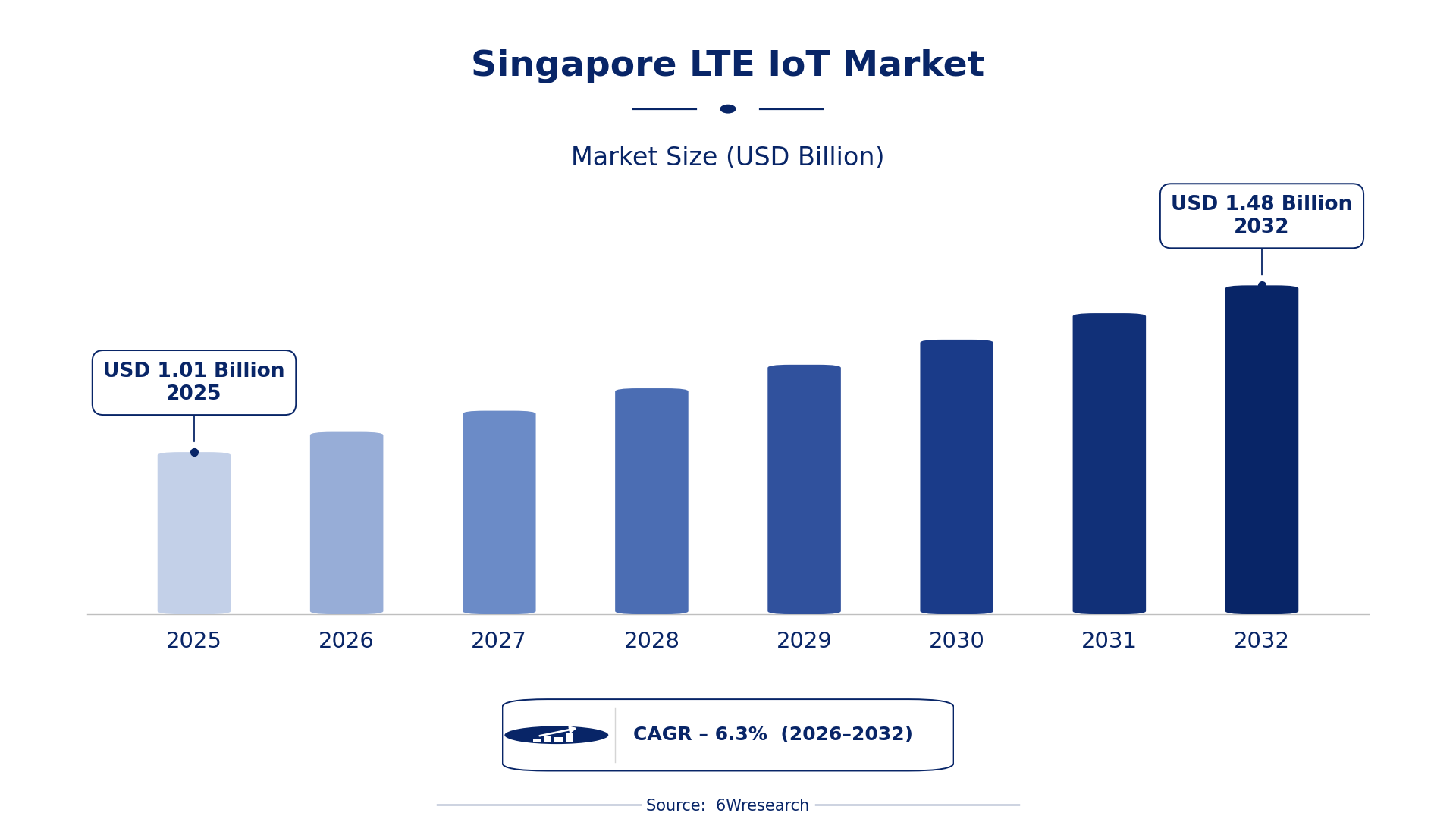
The Singapore LTE IoT Market was estimated at USD 1012 Million in 2025 and is projected to reach USD 1480 Million by 2032, growing at a CAGR of 6.3% from 2026 to 2032.
Singapore LTE IoT Market Synopsis
The Singapore LTE IoT market stands at a pivotal crossroads, with accelerated adoption across various sectors driven by technological advancements and increasing demand for connectivity. Industries like healthcare and logistics are particularly capitalizing on the efficiencies offered by LTE IoT technology, which provides reliable, low-power connectivity for a multitude of devices.
As the nation enhances its smart city initiatives, the role of LTE IoT becomes even more pronounced. With applications ranging from environmental monitoring to smart transportation solutions, Singapore's commitment to becoming a data-driven economy is solidifying LTE IoT as an essential element of its digital infrastructure.
Singapore LTE IoT Market Year-wise Growth Rate and Key Drivers
This graph illustrates the annual growth rates of the Singapore LTE IoT Market from 2021 to 2032, highlighting a steady upward trajectory and projected expansion over the forecast period.
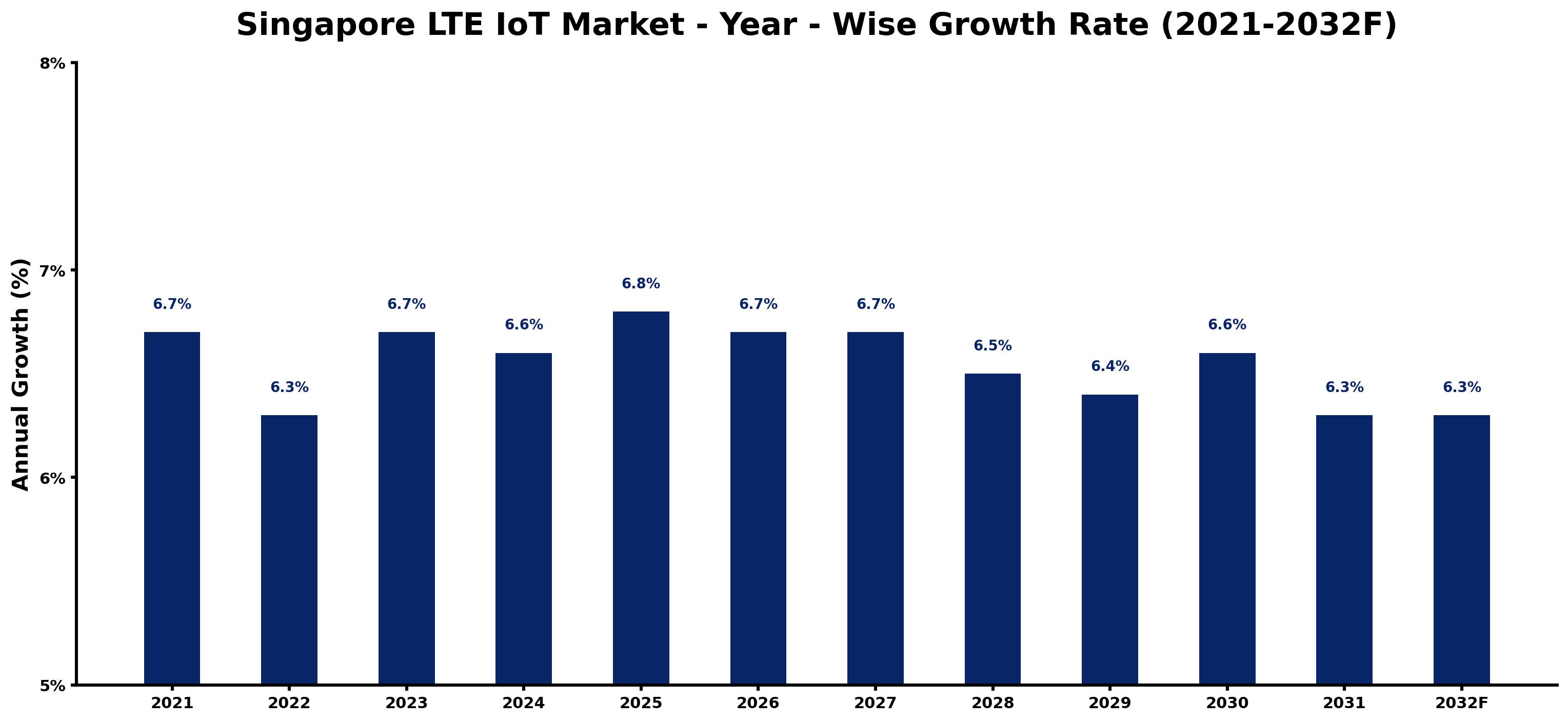
The table below presents the year‑wise growth rates along with the key drivers influencing the market
| Year | Growth Rate | Major Drivers |
| 2021 | 6.7% | Launch of Smart Nation initiative promoting IoT integration |
| 2022 | 6.3% | Government subsidies for IoT startups driving innovation |
| 2023 | 6.7% | Rising adoption of smart meters in energy management |
| 2024 | 6.6% | Implementation of data privacy regulations ensuring user trust |
| 2025 | 6.8% | Investment in maritime IoT applications enhancing shipping efficiency |
| 2026 | 6.7% | Growing interest in smart city projects boosting IoT rollout |
| 2027 | 6.7% | Collaboration between telecom firms and tech companies for IoT |
| 2028 | 6.5% | Emerging demand for smart agriculture solutions in urban farming |
| 2029 | 6.4% | Increased focus on public safety IoT applications post-2020 |
| 2030 | 6.6% | Rising usage of smart wearables in health monitoring |
| 2031 | 6.3% | Support for digitalization in logistics enhancing IoT adoption |
| 2032 | 6.3% | Growing interest in smart home technologies among consumers |
Note: Market size estimations and growth projections presented in this report are based on 6Wresearch's proprietary forecasting methodology, utilizing the latest available industry data, government publications, and primary research inputs.
Singapore LTE IoT Market Key Takeaways
Below are some of the specific key takeaways from the market, including:
- The growth in the market is strongly influenced by the deployment of LTE-M and NB-IoT networks.
- Security concerns around IoT devices and networks remain a critical issue for stakeholders.
- Healthcare and logistics sectors are leading the way in LTE IoT applications.
- Efficient spectrum allocation is vital to accommodate the rising number of IoT devices.
- The market's recovery post-COVID-19 is driving renewed investment and focus on IoT solutions.
Evaluation of Restraints in Singapore LTE IoT Market
The Singapore LTE IoT market faces notable challenges that could impede its growth trajectory. Spectrum allocation poses significant hurdles, as the increasing number of connected devices intensifies competition for bandwidth. This challenge is magnified in rural areas, where expanding LTE coverage can be both technically and financially demanding. Furthermore, the rise of cyber threats adds another layer of complexity, necessitating robust security measures to protect IoT ecosystems. Without addressing these issues, the full potential of the LTE IoT market may be stymied.
Singapore LTE IoT Market Trends
An upward trend toward automation and remote monitoring is becoming apparent across various sectors, especially in healthcare and logistics. Organizations are increasingly adopting LTE IoT technologies to enhance efficiency and data-driven decision-making capabilities. Another emerging trend is the integration of artificial intelligence and machine learning into IoT systems, elevating operational insights and predictive capabilities. As the focus on sustainable development grows, applications related to smart city initiatives are gaining traction, further reinforcing the relevance of LTE IoT in this evolving landscape.
Singapore LTE IoT Market Opportunities
The market is ripe for growth, particularly as sectors like agriculture and smart transportation begin to leverage IoT technologies. Investments in innovative solutions that facilitate energy efficiency and resource management offer lucrative opportunities for stakeholders. Additionally, partnerships between public and private sectors are likely to amplify market reach, enhancing infrastructure and connectivity. As Singapore continues its digital transformation, the landscape for LTE IoT will only expand, presenting numerous avenues for investment.
Government Initiatives in the Singapore LTE IoT Market
The Singaporean government is actively shaping the LTE IoT market through targeted initiatives and regulatory frameworks aimed at enhancing digital infrastructure. By prioritizing innovation and connectivity, these initiatives are critical for fostering a conducive environment for IoT growth. Public sector policies are essential in establishing guidelines and funding mechanisms to stimulate investment in LTE IoT technologies.
- A national digital infrastructure upgrade programme now in its rollout phase aims to bolster connectivity for IoT applications.
- Ongoing initiatives focus on improving security protocols for IoT devices to mitigate cybersecurity risks.
- A regulatory framework introduced in 2025 mandates the implementation of billing transparency in IoT service contracts.
- Current plans include a public-private initiative expected to expand telecom infrastructure access by 2028.
Future Insights of the Singapore LTE IoT Market
Looking towards 2026-2032, the Singapore LTE IoT market is anticipated to experience substantial advancements driven by technological innovations and strategic investments. The emphasis on smart city initiatives will continue to evolve, integrating IoT solutions that enhance urban living. As stakeholders prioritize sustainability, the demand for energy-efficient IoT applications will rise, shaping the future trajectory of this market. The success of these initiatives will heavily depend on collaboration among government, industry, and technology providers.
Singapore LTE IoT Market Latest Developments
Recent activity within the Singapore LTE IoT market showcases a dynamic shift towards enhanced connectivity and application deployment. Over the past year, various sectors have ramped up efforts to implement IoT solutions, influenced by the imperative for efficiency and resilience. This momentum indicates a clear trajectory towards a more interconnected future.
- A major technology vendor launched a comprehensive IoT security framework in Q1 2025, enhancing protection for IoT devices.
- In mid-2025, a leading regional operator began rolling out its LTE-M network across urban areas, improving connectivity for IoT devices.
- An initiative to promote smart agriculture technologies is currently underway, aiming for completion by late 2025.
- A rollout of new low-power IoT sensors is expected to begin in early 2026, targeting applications in environmental monitoring.
Singapore LTE IoT Market - Key Attractiveness of the Report
- 10 Years of Market Numbers
- Historical Data Starting from 2022 to 2025
- Base Year: 2025
- Forecast Data until 2032
- Key Performance Indicators Impacting the Market
- Major Upcoming Developments and Projects
Key Highlights of the Report:
- Singapore LTE IoT Market Outlook
- Market Size of Singapore LTE IoT Market, 2025
- Forecast of Singapore LTE IoT Market, 2032
- Historical Data and Forecast of Singapore LTE IoT Revenues & Volume for the Period 2022-2032F
- Singapore LTE IoT Market Trend Evolution
- Singapore LTE IoT Market Drivers and Challenges
- Singapore LTE IoT Price Trends
- Singapore LTE IoT Porter's Five Forces
- Singapore LTE IoT Industry Life Cycle
- Historical Data and Forecast of Singapore LTE IoT Market Revenues & Volume By Technology for the Period 2022-2032F
- Historical Data and Forecast of Singapore LTE IoT Market Revenues & Volume By NB-IoT for the Period 2022-2032F
- Historical Data and Forecast of Singapore LTE IoT Market Revenues & Volume By LTE-M for the Period 2022-2032F
- Historical Data and Forecast of Singapore LTE IoT Market Revenues & Volume By Service for the Period 2022-2032F
- Historical Data and Forecast of Singapore LTE IoT Market Revenues & Volume By Professional Services for the Period 2022-2032F
- Historical Data and Forecast of Singapore LTE IoT Market Revenues & Volume By Managed Services for the Period 2022-2032F
- Historical Data and Forecast of Singapore LTE IoT Market Revenues & Volume By Industry for the Period 2022-2032F
- Historical Data and Forecast of Singapore LTE IoT Market Revenues & Volume By Manufacturing for the Period 2022-2032F
- Historical Data and Forecast of Singapore LTE IoT Market Revenues & Volume By Energy and utilities for the Period 2022-2032F
- Historical Data and Forecast of Singapore LTE IoT Market Revenues & Volume By Transportation and logistics for the Period 2022-2032F
- Historical Data and Forecast of Singapore LTE IoT Market Revenues & Volume By Healthcare for the Period 2022-2032F
- Historical Data and Forecast of Singapore LTE IoT Market Revenues & Volume By Agriculture for the Period 2022-2032F
- Singapore LTE IoT Import Export Trade Statistics
- Market Opportunity Assessment By Technology
- Market Opportunity Assessment By Service
- Market Opportunity Assessment By Industry
- Singapore LTE IoT Top Companies Market Share
- Singapore LTE IoT Competitive Benchmarking By Technical and Operational Parameters
- Singapore LTE IoT Company Profiles
- Singapore LTE IoT Key Strategic Recommendations






































