Singapore Micronized Ptfe Market: Import Trend Analysis
In 2024, Singapore`s import trend for micronized PTFE remained steady, reflecting consistent demand within the market. The data indicated a stable flow of imports for this specialized product, suggesting a well-established supply chain and market presence.
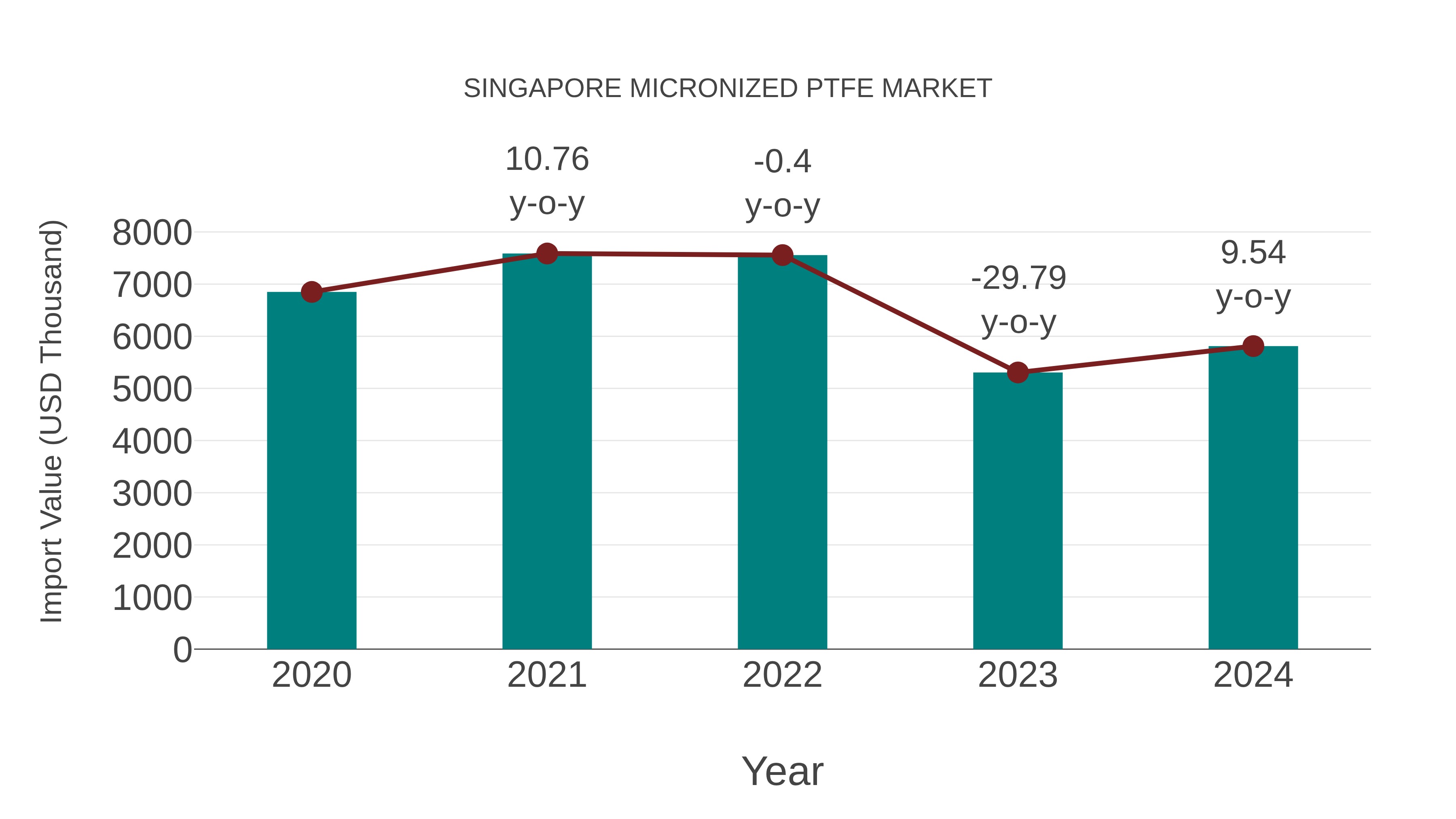
Singapore Micronized Ptfe Market Overview
The micronized polytetrafluoroethylene (PTFE) market in Singapore is experiencing growth as the demand for high-performance lubricants, coatings, and additives in various industries rises. Micronized PTFE, with its low friction and anti-stick properties, finds applications in automotive, manufacturing, and food processing. The market is driven by the need for improved product performance, reduced wear and friction, and enhanced chemical resistance. Market players are actively engaged in developing specialized micronized PTFE products to meet the specific requirements of different industries, contributing to the market`s expansion.
Drivers of the Market
The Singapore Micronized PTFE market is driven by its applications in lubricants, coatings, and plastics to reduce friction and enhance performance. Micronized PTFE particles offer exceptional lubricity and anti-stick properties. As industries seek to improve the efficiency of mechanical systems and enhance the quality of various products, the demand for micronized PTFE is expected to increase, promoting smoother operations and product functionality.
Challenges of the Market
The Singapore Micronized PTFE (Polytetrafluoroethylene) Market faces challenges related to material performance and application diversity. Ensuring that micronized PTFE materials meet specific performance requirements in various sectors, including lubricants, coatings, and plastics, is essential. Overcoming material consistency issues and addressing concerns about the efficient dispersion of micronized PTFE are important. Additionally, competition from other lubrication and coating additives and the need for continuous research and development pose ongoing challenges in this market.
Covid-19 impact of the Market
The COVID-19 pandemic had an impact on the Singapore micronized PTFE market. This market caters to industries like electronics, automotive, and medical devices. While the pandemic disrupted production and supply chains in these sectors, it also reinforced the importance of micronized PTFE in critical applications. As industries recover and invest in technologies that require high-performance materials, the micronized PTFE market is expected to regain momentum.
Leading Players of the Market
The Singapore Micronized PTFE market is dominated by companies like Daikin Industries, a leading manufacturer of PTFE materials including micronized PTFE. Shamrock Technologies is known for its micronized PTFE products used in various industries. 3M also offers a range of specialized PTFE materials, including micronized PTFE, for different applications.
Key Highlights of the Report:
- Singapore Micronized PTFE Market Outlook
- Market Size of Singapore Micronized PTFE Market, 2025
- Forecast of Singapore Micronized PTFE Market, 2032
- Historical Data and Forecast of Singapore Micronized PTFE Revenues & Volume for the Period 2022-2032F
- Singapore Micronized PTFE Market Trend Evolution
- Singapore Micronized PTFE Market Drivers and Challenges
- Singapore Micronized PTFE Price Trends
- Singapore Micronized PTFE Porter's Five Forces
- Singapore Micronized PTFE Industry Life Cycle
- Historical Data and Forecast of Singapore Micronized PTFE Market Revenues & Volume By Application for the Period 2022-2032F
- Historical Data and Forecast of Singapore Micronized PTFE Market Revenues & Volume By Inks for the Period 2022-2032F
- Historical Data and Forecast of Singapore Micronized PTFE Market Revenues & Volume By Thermoplastics for the Period 2022-2032F
- Historical Data and Forecast of Singapore Micronized PTFE Market Revenues & Volume By Coatings for the Period 2022-2032F
- Historical Data and Forecast of Singapore Micronized PTFE Market Revenues & Volume By Grease & Lubricants for the Period 2022-2032F
- Historical Data and Forecast of Singapore Micronized PTFE Market Revenues & Volume By Elastomers for the Period 2022-2032F
- Singapore Micronized PTFE Import Export Trade Statistics
- Market Opportunity Assessment By Application
- Singapore Micronized PTFE Top Companies Market Share
- Singapore Micronized PTFE Competitive Benchmarking By Technical and Operational Parameters
- Singapore Micronized PTFE Company Profiles
- Singapore Micronized PTFE Key Strategic Recommendations






































