Singapore Mobile Application Security Market Size & Growth Rate (2026-2032)
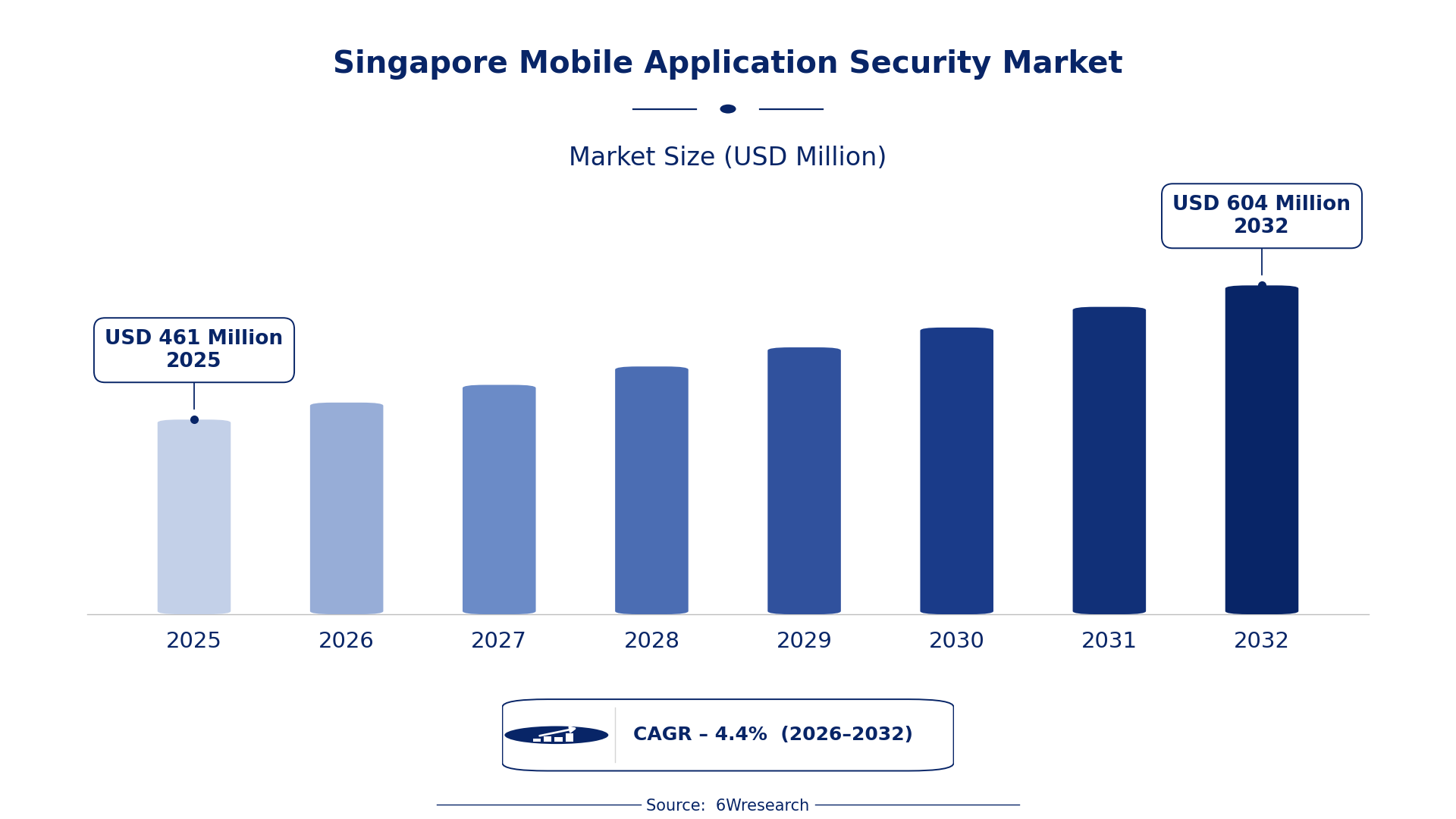
The Singapore Mobile Application Security Market was estimated at USD 461 Million in 2025 and is projected to reach USD 604 Million by 2032, growing at a CAGR of 4.4% from 2026 to 2032.
Singapore Mobile Application Security Market Synopsis
The Singapore Mobile Application Security market has witnessed impressive growth recently, driven by the increasing reliance on mobile apps for everyday tasks and business operations. As businesses and individuals alike turn to mobile platforms, the need for robust security solutions has never been more urgent, ensuring the safeguarding of user data and overall application integrity.
Looking ahead, the market is positioned to further expand, spurred by heightened regulatory scrutiny and rising consumer expectations for app security. As technology advances, organizations must adapt, integrating cutting-edge security solutions to mitigate emerging threats and maintain user trust in a mobile-first world.
Singapore Mobile Application Security Market Year-wise Growth Rate and Key Drivers
This graph illustrates the annual growth rates of the Singapore Mobile Application Security Market from 2021 to 2032, highlighting a steady upward trajectory and projected expansion over the forecast period.
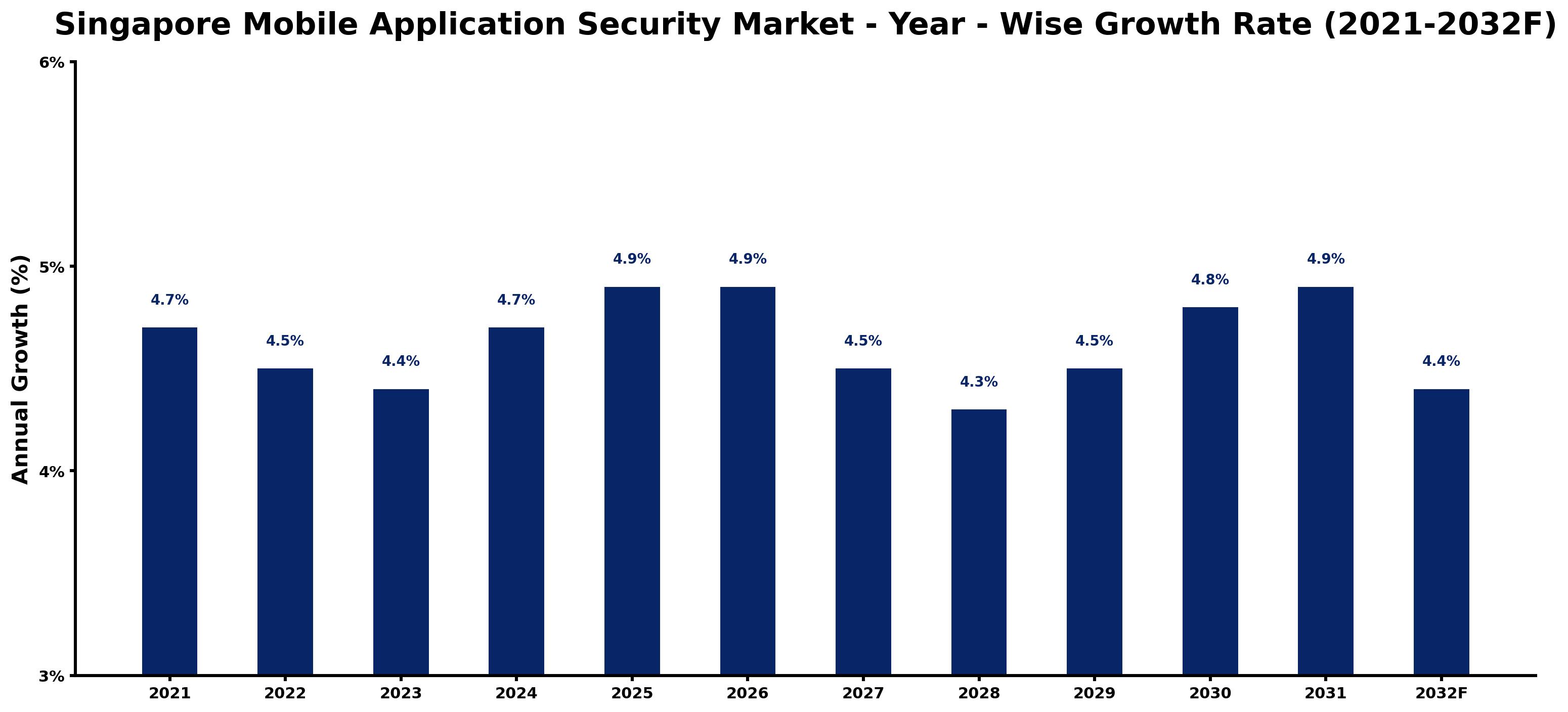
The table below presents the year‑wise growth rates along with the key drivers influencing the market
| Year | Growth Rate | Major Drivers |
| 2021 | 4.7% | Cybersecurity Agency's new mobile app security guidelines published |
| 2022 | 4.5% | Rising mobile device adoption among Singaporean consumers |
| 2023 | 4.4% | Increased awareness of data privacy regulations enforcement |
| 2024 | 4.7% | Growing fintech innovations requiring stronger app security measures |
| 2025 | 4.9% | Rise in mobile health apps driving security concerns |
| 2026 | 4.9% | Government push for digital economy enhances app security focus |
| 2027 | 4.5% | Heightened fraud risk in e-commerce applications prompts upgrades |
| 2028 | 4.3% | Emergence of 5G technology boosts app security investments |
| 2029 | 4.5% | Focus on secure remote work solutions increases mobile demand |
| 2030 | 4.8% | Regulatory compliance demands strengthen mobile app security measures |
| 2031 | 4.9% | Consistent cyberattack incidents drive mobile security enhancements |
| 2032 | 4.4% | Increased integration of AI in apps necessitates security upgrades |
Note: Market size estimations and growth projections presented in this report are based on 6Wresearch's proprietary forecasting methodology, utilizing the latest available industry data, government publications, and primary research inputs.
Singapore Mobile Application Security Market Key Takeaways
Below are some of the specific key takeaways from the market, including:
- The market is experiencing sustained growth due to increased mobile app usage across various sectors.
- Heightened regulatory requirements are compelling organizations to invest in security solutions.
- There is a critical need to balance security with user experience in mobile app development.
- The COVID-19 pandemic has accelerated the focus on mobile security, reshaping demand.
- Leading companies are innovating continuously to stay ahead of potential threats and vulnerabilities.
Evaluation of Restraints in Singapore Mobile Application Security Market
Despite its growth, the Singapore Mobile Application Security market faces substantial constraints. One primary challenge is the diverse range of threats that mobile applications encounter, from malware to sophisticated phishing attacks. Developers must ensure that robust security measures are integrated without hindering the performance or user experience of the applications. Additionally, the fast-paced nature of technology can leave some organizations struggling to keep up with the latest security trends and best practices, potentially exposing them to risks.
Singapore Mobile Application Security Market Trends
A few trends are noticeably shaping the Singapore Mobile Application Security market. First, the rise of AI and machine learning technologies is influencing security practices, allowing for more proactive threat detection and response. on top of that, a greater emphasis on secure coding practices is emerging among developers, aiming to address vulnerabilities at the foundational level. Lastly, the growing popularity of cloud-based mobile solutions requires enhanced security measures to protect data across multiple platforms.
Singapore Mobile Application Security Market Opportunities
Investment opportunities abound within the Singapore Mobile Application Security market. Organizations can benefit significantly from adopting advanced threat detection technologies, such as behavior analytics. Additionally, the demand for consultation and compliance services is rising, as companies seek to align with regulatory standards. Expanding partnerships between tech firms and security vendors also offers potential for innovative solutions that address evolving security needs.
Government Initiatives in the Singapore Mobile Application Security Market
The Singapore government plays an active role in shaping the Mobile Application Security market through various initiatives aimed at enhancing cybersecurity. Regulatory frameworks are tightening, emphasizing the importance of security measures in protecting user data. These policies highlight the commitment to fostering a secure digital ecosystem, addressing vulnerabilities in mobile applications and elevating the overall trust in technology.
- A regulatory framework introduced in 2025 mandating app developers to implement essential security features.
- A national digital infrastructure upgrade program currently underway, focused on enhancing mobile security standards.
- A planned public-private initiative expected to launch in 2026, aimed at improving cybersecurity awareness and training.
- The establishment of a cybersecurity advisory board in early 2025, tasked with monitoring mobile security threats and trends.
- A collaborative program with educational institutions promoting cybersecurity education in mobile development, set to roll out by late 2025.
Future Insights of the Singapore Mobile Application Security Market
Between 2026 and 2032, the Singapore Mobile Application Security market will likely see intensified competition as companies innovate to deliver more effective security solutions. The integration of advanced technologies, such as blockchain for data protection and more sophisticated AI systems, will set new industry standards. As users become increasingly aware of security risks, their preferences for secure applications will drive demand, prompting organizations to prioritize security as a core element of their mobile strategy.
Singapore Mobile Application Security Market Latest Developments
In the past year, the Singapore Mobile Application Security market has experienced significant developments, reflecting the urgency of addressing mobile security threats. Companies are rapidly enhancing their offerings, introducing new technologies and solutions to combat evolving vulnerabilities. This momentum underscores a collective commitment to safeguarding user data and instilling confidence in mobile applications.
- A major technology vendor announced the launch of an advanced mobile security solution in early 2025, targeting data breach prevention.
- An ongoing initiative aims to establish a network of cybersecurity experts who will provide continuous training for developers, enhancing their security skills.
- A leading regional operator is set to unveil a cutting-edge threat detection system by mid-2026, designed to identify and neutralize threats in real time.
- A public-private partnership launched in Q1 2025 focuses on accelerating research in mobile security technology, fostering innovation.
- Plans for a comprehensive mobile app security certification program are expected to roll out in late 2026, aimed at raising industry standards.
Singapore Mobile Application Security Market - Key Attractiveness of the Report
- 10 Years of Market Numbers
- Historical Data Starting from 2022 to 2025
- Base Year: 2025
- Forecast Data until 2032
- Key Performance Indicators Impacting the Market
- Major Upcoming Developments and Projects
Key Highlights of the Report:
- Singapore Mobile Application Security Market Outlook
- Market Size of Singapore Mobile Application Security Market, 2025
- Forecast of Singapore Mobile Application Security Market, 2032
- Historical Data and Forecast of Singapore Mobile Application Security Revenues & Volume for the Period 2022-2032F
- Singapore Mobile Application Security Market Trend Evolution
- Singapore Mobile Application Security Market Drivers and Challenges
- Singapore Mobile Application Security Price Trends
- Singapore Mobile Application Security Porter's Five Forces
- Singapore Mobile Application Security Industry Life Cycle
- Historical Data and Forecast of Singapore Mobile Application Security Market Revenues & Volume By Solution for the Period 2022-2032F
- Historical Data and Forecast of Singapore Mobile Application Security Market Revenues & Volume By Antivirus & Antitheft for the Period 2022-2032F
- Historical Data and Forecast of Singapore Mobile Application Security Market Revenues & Volume By Data Recovery for the Period 2022-2032F
- Historical Data and Forecast of Singapore Mobile Application Security Market Revenues & Volume By Others for the Period 2022-2032F
- Historical Data and Forecast of Singapore Mobile Application Security Market Revenues & Volume By Deployment Type for the Period 2022-2032F
- Historical Data and Forecast of Singapore Mobile Application Security Market Revenues & Volume By Cloud for the Period 2022-2032F
- Historical Data and Forecast of Singapore Mobile Application Security Market Revenues & Volume By On Premise for the Period 2022-2032F
- Historical Data and Forecast of Singapore Mobile Application Security Market Revenues & Volume By Industry Vertical for the Period 2022-2032F
- Historical Data and Forecast of Singapore Mobile Application Security Market Revenues & Volume By BFSI for the Period 2022-2032F
- Historical Data and Forecast of Singapore Mobile Application Security Market Revenues & Volume By Healthcare for the Period 2022-2032F
- Historical Data and Forecast of Singapore Mobile Application Security Market Revenues & Volume By IT & Telecom for the Period 2022-2032F
- Historical Data and Forecast of Singapore Mobile Application Security Market Revenues & Volume By Manufacturing for the Period 2022-2032F
- Historical Data and Forecast of Singapore Mobile Application Security Market Revenues & Volume By Government and Public Sector for the Period 2022-2032F
- Historical Data and Forecast of Singapore Mobile Application Security Market Revenues & Volume By Retail & E-commerce for the Period 2022-2032F
- Historical Data and Forecast of Singapore Mobile Application Security Market Revenues & Volume By Others for the Period 2022-2032F
- Singapore Mobile Application Security Import Export Trade Statistics
- Market Opportunity Assessment By Solution
- Market Opportunity Assessment By Deployment Type
- Market Opportunity Assessment By Industry Vertical
- Singapore Mobile Application Security Top Companies Market Share
- Singapore Mobile Application Security Competitive Benchmarking By Technical and Operational Parameters
- Singapore Mobile Application Security Company Profiles
- Singapore Mobile Application Security Key Strategic Recommendations






































