Singapore Modified Starch Market: Import Trend Analysis
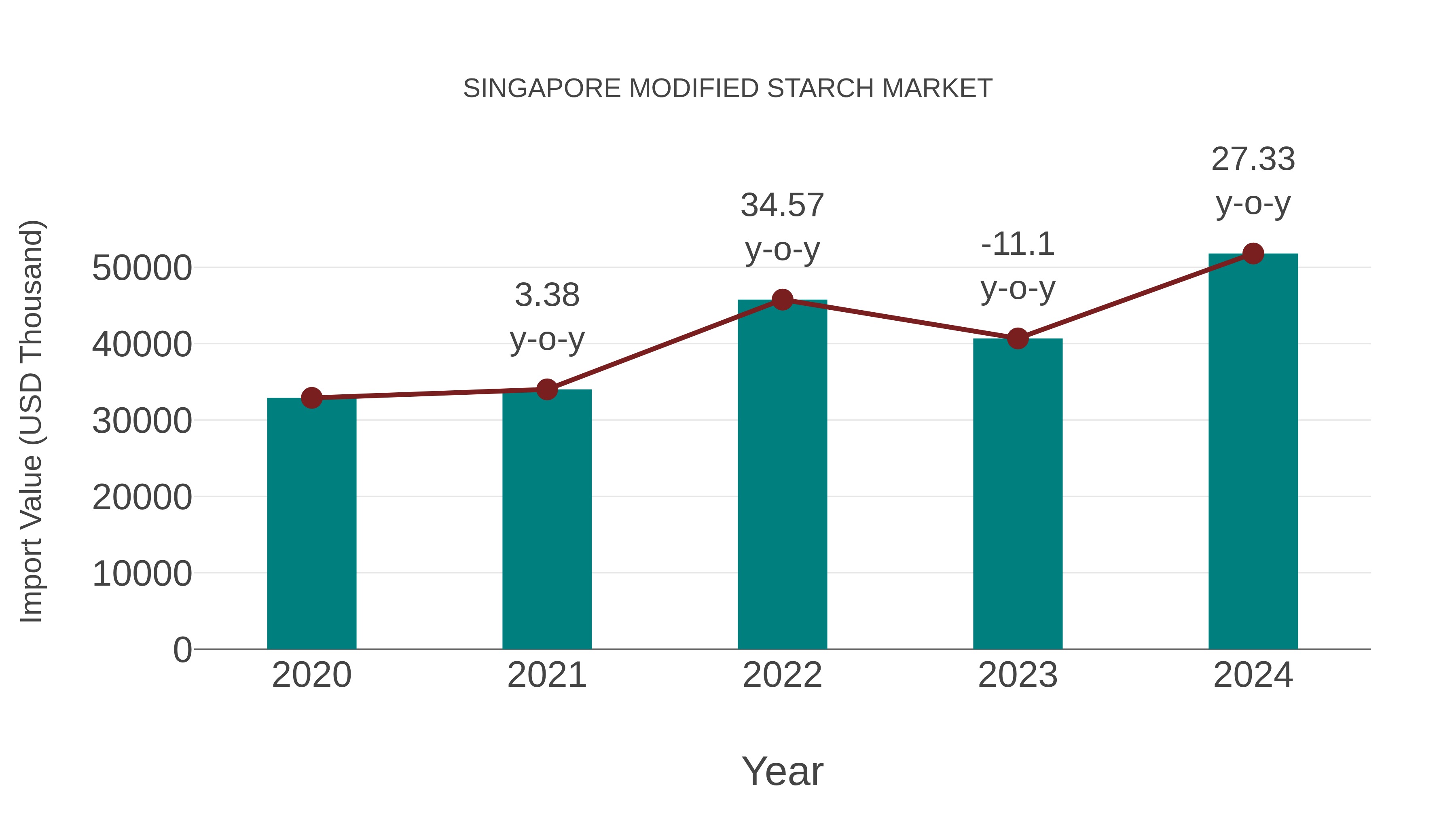
In 2024, Singapore`s import trend for modified starch indicated a steady increase, driven by rising demand from the food and beverage industry. Imports primarily sourced from countries like Thailand, Indonesia, and Malaysia, reflecting the region`s strong supply chain integration.
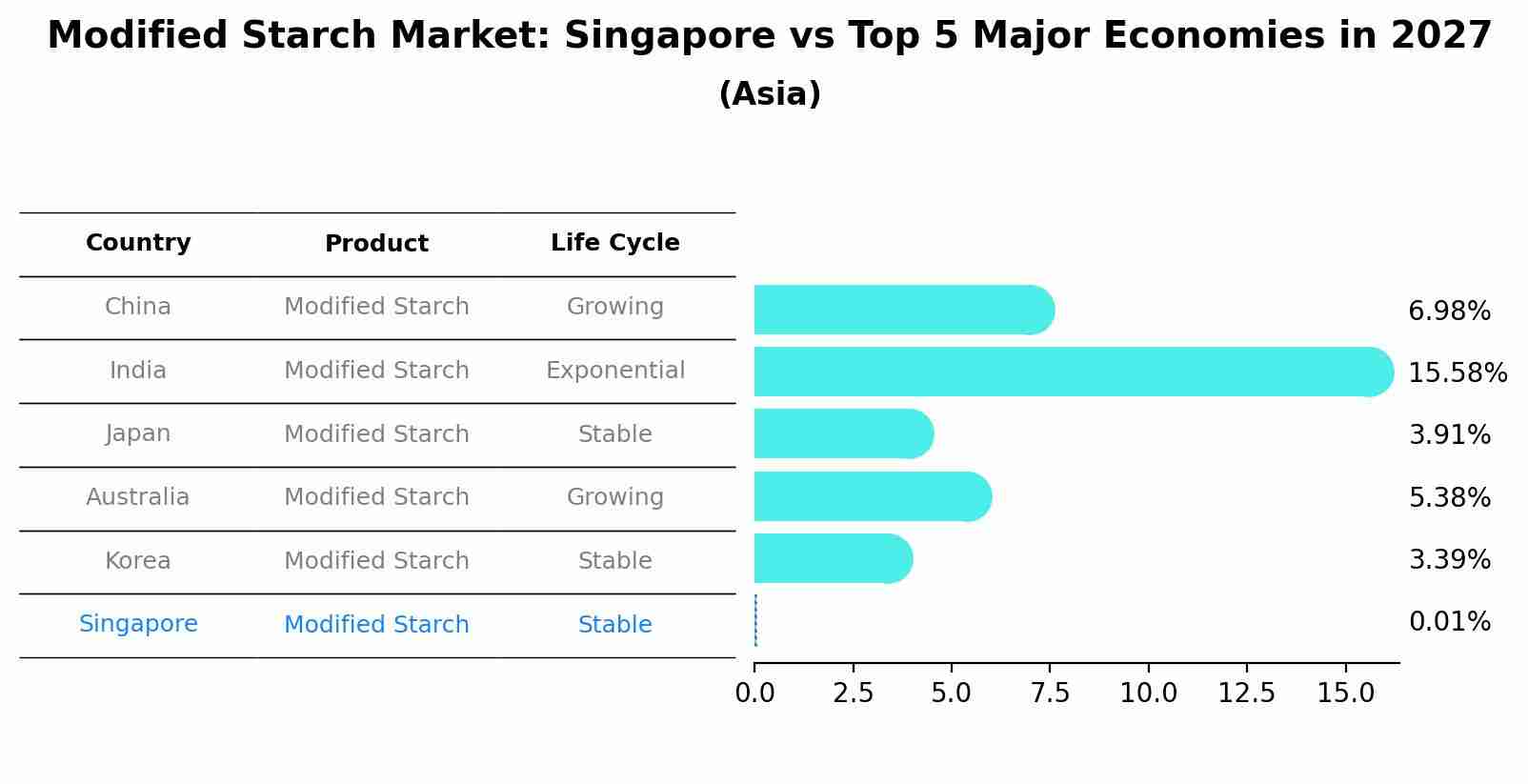
Modified Starch Market: Singapore vs Top 5 Major Economies in 2027 (Asia)
By 2027, Singapore's Modified Starch market is forecasted to achieve a stable growth rate of 0.01%, with China leading the Asia region, followed by India, Japan, Australia and South Korea.
Singapore Modified Starch Market Synopsis
The Singapore modified starch market is witnessing growth driven by the food and beverage, pharmaceutical, and paper industries. Modified starches, which exhibit enhanced properties like thickening, stabilizing, and gelling, are in high demand in food processing, contributing to improved texture and shelf life. In pharmaceuticals, they serve as excipients in drug formulation. The paper industry utilizes modified starch for surface sizing and coating applications. Singapore strong manufacturing sector and its reputation for product quality make it a prominent market for modified starches. As consumers seek cleaner-label and natural products, the market is witnessing a shift towards modified starches derived from sustainable sources. Regulatory approval processes ensure that products meet safety and quality standards, instilling confidence among end-users. The Singapore modified starch market is likely to see continued growth as industries evolve to meet changing consumer preferences and environmental concerns.
Drivers of the Market
The Singapore modified starch market is witnessing substantial growth due to its wide range of applications in the food and beverage, pharmaceutical, and industrial sectors. Modified starches are used to improve texture, stability, and shelf life in various products. The market is driven by the food industry`s demand for clean label and natural ingredients. Modified starches offer functional benefits without compromising product quality. Additionally, the pharmaceutical and industrial sectors are adopting modified starches for various purposes, including drug formulation and paper production. This versatility is contributing to the market`s positive outlook.
Challenges of the Market
The Singapore Modified Starch market faces challenges related to changing consumer preferences and dietary trends. Increasing awareness of health-conscious choices and dietary restrictions poses challenges for modified starch producers to adapt and innovate. Competition from alternative thickening and binding agents in food and industrial applications also challenges market stability. Moreover, supply chain disruptions and price fluctuations in raw materials can impact production costs. Nevertheless, modified starches offer versatility and functionality in various industries, including food, pharmaceuticals, and textiles, providing growth opportunities for manufacturers.
COVID-19 Impact on the Market
Modified starch is used in a wide range of industries, including food, textiles, and pharmaceuticals. The market in Singapore has shown promise, driven by increasing industrial applications. During the pandemic, there was a shift in demand patterns as some industries reduced production while others experienced growth. This market`s outlook is closely tied to economic recovery and industrial expansion.
Key Players in the Market
The Singapore modified starch market is poised for growth due to its diverse applications in the food and beverage, pharmaceutical, and textile industries. Leading companies in this sector include Cargill, Ingredion, Archer Daniels Midland (ADM), Tate & Lyle, and Roquette.
Key Highlights of the Report:
- Singapore Modified Starch Market Outlook
- Market Size of Singapore Modified Starch Market, 2023
- Forecast of Singapore Modified Starch Market, 2030
- Historical Data and Forecast of Singapore Modified Starch Revenues & Volume for the Period 2020-2030
- Singapore Modified Starch Market Trend Evolution
- Singapore Modified Starch Market Drivers and Challenges
- Singapore Modified Starch Price Trends
- Singapore Modified Starch Porter's Five Forces
- Singapore Modified Starch Industry Life Cycle
- Historical Data and Forecast of Singapore Modified Starch Market Revenues & Volume By Source for the Period 2020-2030
- Historical Data and Forecast of Singapore Modified Starch Market Revenues & Volume By Corn for the Period 2020-2030
- Historical Data and Forecast of Singapore Modified Starch Market Revenues & Volume By Wheat for the Period 2020-2030
- Historical Data and Forecast of Singapore Modified Starch Market Revenues & Volume By Cassava for the Period 2020-2030
- Historical Data and Forecast of Singapore Modified Starch Market Revenues & Volume By Potato for the Period 2020-2030
- Historical Data and Forecast of Singapore Modified Starch Market Revenues & Volume By Application for the Period 2020-2030
- Historical Data and Forecast of Singapore Modified Starch Market Revenues & Volume By Food & Beverages for the Period 2020-2030
- Historical Data and Forecast of Singapore Modified Starch Market Revenues & Volume By Animal Feed for the Period 2020-2030
- Historical Data and Forecast of Singapore Modified Starch Market Revenues & Volume By Others for the Period 2020-2030
- Singapore Modified Starch Import Export Trade Statistics
- Market Opportunity Assessment By Source
- Market Opportunity Assessment By Application
- Singapore Modified Starch Top Companies Market Share
- Singapore Modified Starch Competitive Benchmarking By Technical and Operational Parameters
- Singapore Modified Starch Company Profiles
- Singapore Modified Starch Key Strategic Recommendations






































