Singapore Nicotine Replacement Therapy Market Size, Share & Growth Rate
The Singapore Nicotine Replacement Therapy Market was estimated at USD 367 Million in 2025 and is projected to reach USD 483 Million by 2032, growing at a CAGR of 4.0% from 2026 to 2032. This upward trajectory is driven by an increasing public commitment to smoking cessation, backed by government policies and a heightened awareness of the adverse health impacts of smoking. The growing accessibility of NRT products through pharmacies and healthcare channels plays a crucial role in facilitating this shift towards healthier alternatives.
Singapore Nicotine Replacement Therapy Market Year-wise Growth Rate and Key Drivers
This graph highlights how the Singapore Nicotine Replacement Therapy Market has steadily grown over the years, supported by major growth factors.
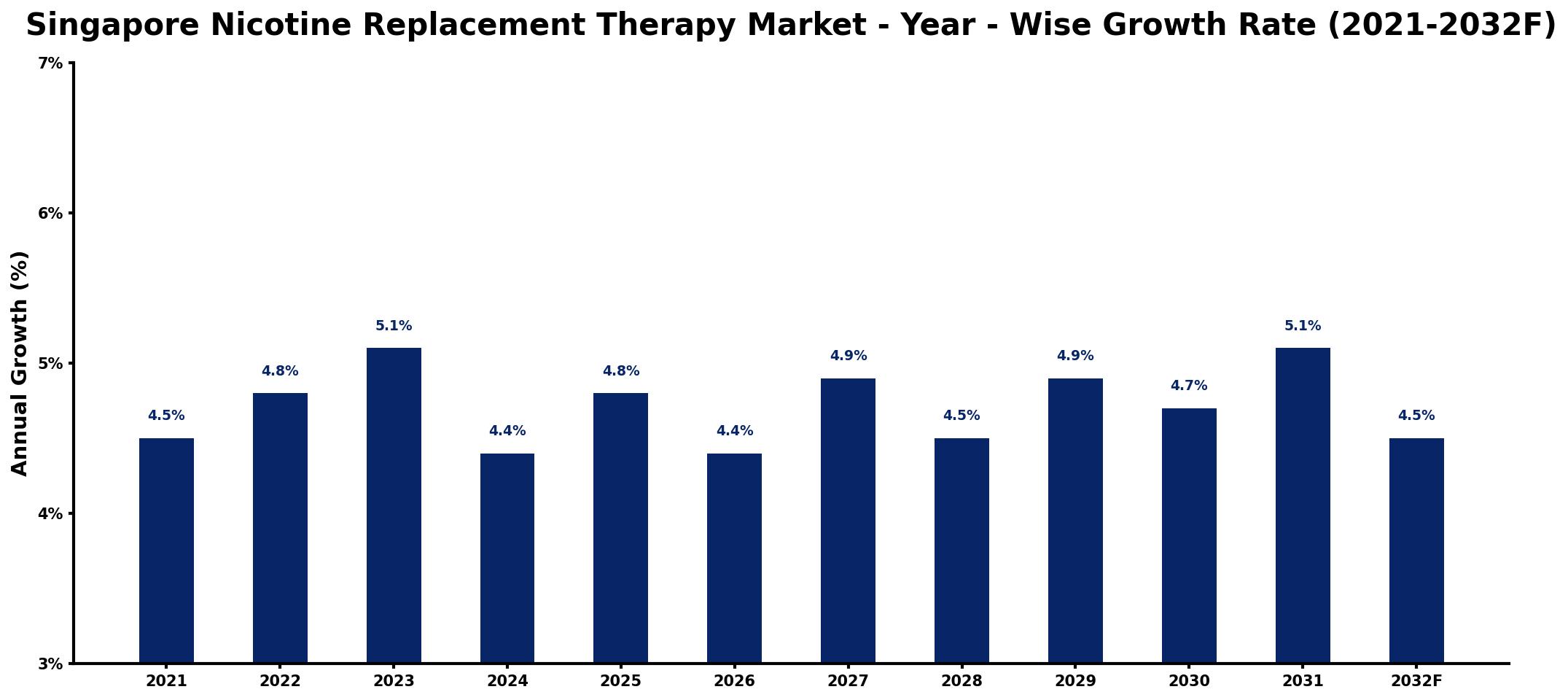
The table below presents the year‑wise growth rates along with the key drivers influencing the market
| Year | Growth Rate | Major Drivers |
| 2021 | 4.5% | Rising consumer health consciousness trends |
| 2022 | 4.8% | Increased government health initiatives |
| 2023 | 5.1% | Expanding digital health platforms |
| 2024 | 4.4% | Growing demand for smoking cessation |
| 2025 | 4.8% | Heightened awareness of wellness benefits |
| 2026 | 4.4% | Investment in innovative healthcare solutions |
| 2027 | 4.9% | Strengthening public health campaigns |
| 2028 | 4.5% | Advancements in healthcare technology adoption |
| 2029 | 4.9% | Emerging markets embracing wellness |
| 2030 | 4.7% | Collaborations between healthcare providers |
| 2031 | 5.1% | Expansion of retail distribution channels |
| 2032 | 4.5% | Focus on preventive health measures |
Note: Market size estimations and growth projections presented in this report are based on 6Wresearch's proprietary forecasting methodology, utilizing the latest available industry data, government publications, and primary research inputs.
Singapore Nicotine Replacement Therapy Market Synopsis
In Singapore, the demand for nicotine replacement therapy (NRT) has surged in recent years, reflecting a proactive public health strategy aimed at reducing smoking rates. As healthcare organizations amplify their anti-smoking campaigns, individuals are increasingly turning to NRT products such as gums, patches, and lozenges as essential tools in their journey to quit.
The availability of these therapies at both local pharmacies and through healthcare professionals enhances their accessibility, making it easier for smokers to find suitable options. Coupled with a society that is becoming more health-conscious, the NRT market is poised for continued growth.
Singapore Nicotine Replacement Therapy Market Key Takeaways
- The market is on a growth trajectory, driven by increased government initiatives for smoking cessation.
- Products such as gums, patches, and lozenges are becoming more accessible through pharmacies and online platforms.
- Heightened awareness about health risks associated with smoking is compelling more individuals to seek NRT options.
- Collaboration between healthcare providers and regulatory bodies enhances the effectiveness of public health messaging.
- Innovation in product offerings, including flavors and formulations, is appealing to a broader demographic.
Evaluation of Restraints in Singapore Nicotine Replacement Therapy Market
The growth of the nicotine replacement therapy market in Singapore faces several constraints that are pivotal to understanding its dynamics. Strict regulatory frameworks surrounding nicotine products necessitate businesses to remain agile in compliance efforts, which can limit market expansion. Moreover, public perceptions influenced by anti-smoking campaigns may shift focus away from traditional NRT solutions, particularly in light of the growing popularity of alternative cessation methods like e-cigarettes. These factors necessitate continuous investment in research and development to maintain product relevance and efficacy while striving to ensure these therapies are both affordable and widely accessible.
Singapore Nicotine Replacement Therapy Market Trends
Emerging trends in the Singapore nicotine replacement therapy market reveal a growing consumer inclination towards personalized treatment options. As awareness of the diverse needs of smokers increases, companies are responding by tailoring NRT products to better suit individual preferences, including unique flavors and formulations. Additionally, digital health innovations are making waves, with mobile applications and online support communities gaining popularity as supplemental resources for those on their quitting journey.
Singapore Nicotine Replacement Therapy Market Opportunities
The market is ripe with opportunities for investment, particularly in the realm of technological integration. Companies that develop robust online platforms for NRT distribution and support services stand to benefit from a growing digital-savvy consumer base. Furthermore, partnerships with healthcare providers can foster comprehensive cessation programs that incorporate both NRT and behavioral support, significantly enhancing quitting success rates. The push for natural and organic products also presents avenues for innovation, appealing to health-conscious consumers seeking sustainable solutions.
Government Initiatives in the Singapore Nicotine Replacement Therapy Market
The Singaporean government has been proactive in promoting smoking cessation through various policies and public health initiatives. These efforts include funding for smoking cessation programs that integrate NRT options as part of their strategies. Public health campaigns aimed at reducing smoking prevalence underscore the importance of nicotine replacement therapies, while regulatory frameworks ensure that these products remain accessible to the public. Incentives for research into effective cessation methods also play a significant role in shaping the market.
Future Insights of the Singapore Nicotine Replacement Therapy Market
Looking forward to 2026-2032, the Singapore nicotine replacement therapy market is expected to continue on its growth path, fueled by ongoing public health initiatives and a persistent commitment to reducing smoking rates. As smokers increasingly seek effective cessation methods, the demand for diverse and accessible NRT products is anticipated to expand. Additionally, innovations that align with consumer preferences for personalization and sustainability will likely shape the product landscape, ensuring that the market adapts to evolving needs.
Singapore Nicotine Replacement Therapy Market Latest Developments (2025 - 2026)
Recent developments in the Singapore nicotine replacement therapy market indicate a shift towards increased digital engagement. Companies are enhancing their online presence, providing comprehensive resources for consumers looking to quit smoking. Furthermore, there is a notable trend towards integrating behavioral health support within cessation programs, providing a more holistic approach to smoking cessation. This evolution highlights the market's adaptability in responding to consumer demands and industry challenges.
Singapore Nicotine Replacement Therapy Market - Key Attractiveness of the Report
- 10 Years of Market Numbers
- Historical Data Starting from 2022 to 2025
- Base Year: 2025
- Forecast Data until 2032
- Key Performance Indicators Impacting the Market
- Major Upcoming Developments and Projects
Key Highlights of the Report:
- Singapore Nicotine Replacement Therapy Market Outlook
- Market Size of Singapore Nicotine Replacement Therapy Market, 2025
- Forecast of Singapore Nicotine Replacement Therapy Market, 2032
- Historical Data and Forecast of Singapore Nicotine Replacement Therapy Revenues & Volume for the Period 2022-2032F
- Singapore Nicotine Replacement Therapy Market Trend Evolution
- Singapore Nicotine Replacement Therapy Market Drivers and Challenges
- Singapore Nicotine Replacement Therapy Price Trends
- Singapore Nicotine Replacement Therapy Porter's Five Forces
- Singapore Nicotine Replacement Therapy Industry Life Cycle
- Historical Data and Forecast of Singapore Nicotine Replacement Therapy Market Revenues & Volume By Product for the Period 2022-2032F
- Historical Data and Forecast of Singapore Nicotine Replacement Therapy Market Revenues & Volume By Nicotine Replacement Therapy for the Period 2022-2032F
- Historical Data and Forecast of Singapore Nicotine Replacement Therapy Market Revenues & Volume By E-cigarettes for the Period 2022-2032F
- Historical Data and Forecast of Singapore Nicotine Replacement Therapy Market Revenues & Volume By Heat-not-burn Tobacco Products for the Period 2022-2032F
- Historical Data and Forecast of Singapore Nicotine Replacement Therapy Market Revenues & Volume By Distribution Channel for the Period 2022-2032F
- Historical Data and Forecast of Singapore Nicotine Replacement Therapy Market Revenues & Volume By Offline for the Period 2022-2032F
- Historical Data and Forecast of Singapore Nicotine Replacement Therapy Market Revenues & Volume By Online for the Period 2022-2032F
- Singapore Nicotine Replacement Therapy Import Export Trade Statistics
- Market Opportunity Assessment By Product
- Market Opportunity Assessment By Distribution Channel
- Singapore Nicotine Replacement Therapy Top Companies Market Share
- Singapore Nicotine Replacement Therapy Competitive Benchmarking By Technical and Operational Parameters
- Singapore Nicotine Replacement Therapy Company Profiles
- Singapore Nicotine Replacement Therapy Key Strategic Recommendations






































