Singapore POS Security Market Size & Growth Rate (2026-2032)
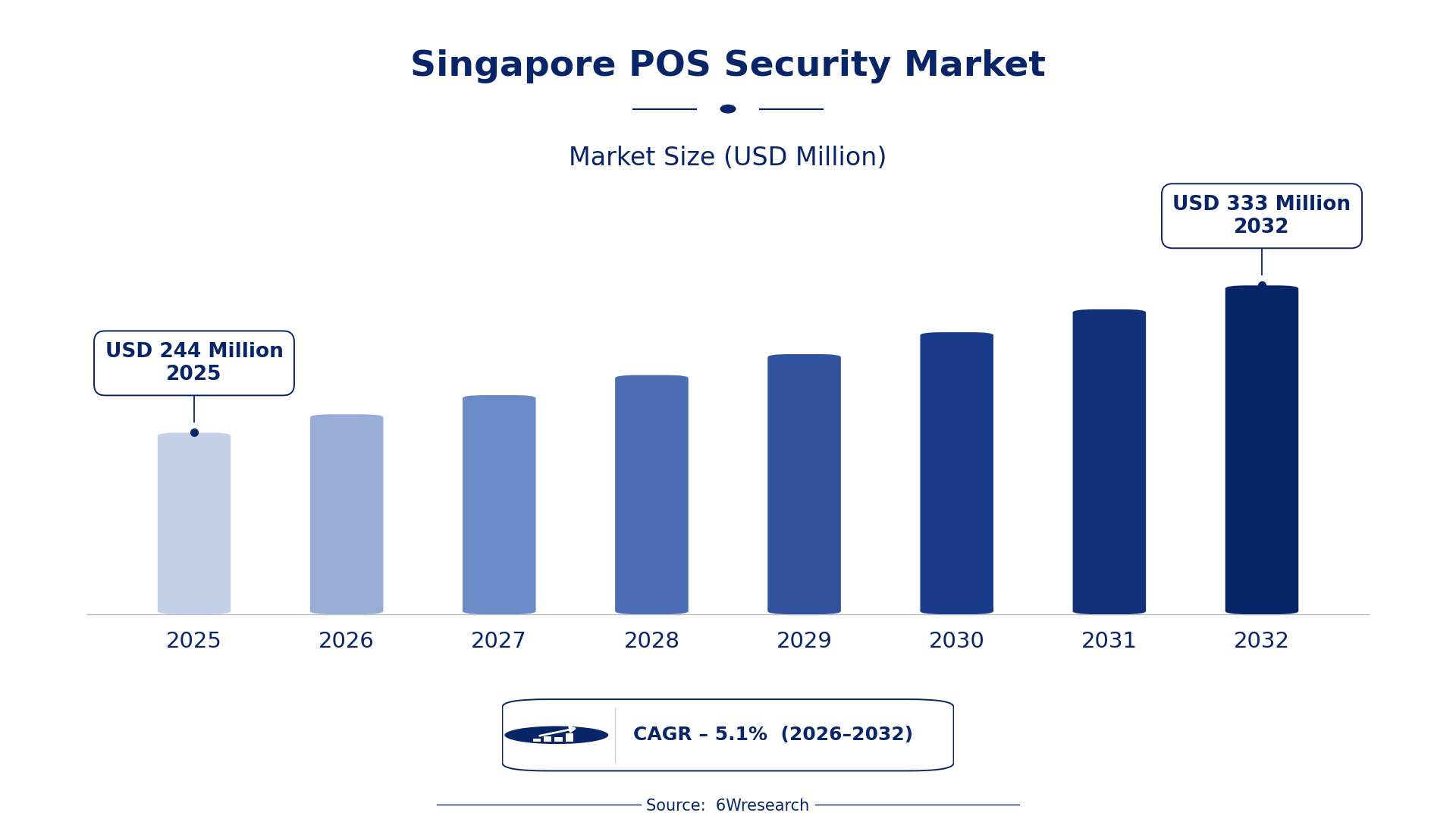
The Singapore POS Security Market was estimated at USD 244 Million in 2025 and is projected to reach USD 333 Million by 2032, growing at a CAGR of 5.1% from 2026 to 2032.
Singapore POS Security Market Synopsis
The demand for POS security solutions in Singapore is driven by the rapid adoption of contactless payment methods across various sectors, particularly retail and hospitality. As more transactions are processed digitally, the importance of safeguarding sensitive financial information intensifies.
Businesses are not just adopting advanced POS systems; they are also compelled to invest in security measures to address a rising tide of cyber threats. This includes card skimming and data breaches, which have become prevalent as digital payments gain traction.
Singapore POS Security Market Year-wise Growth Rate and Key Drivers
This graph illustrates the annual growth rates of the Singapore POS Security Market from 2021 to 2032, highlighting a steady upward trajectory and projected expansion over the forecast period.
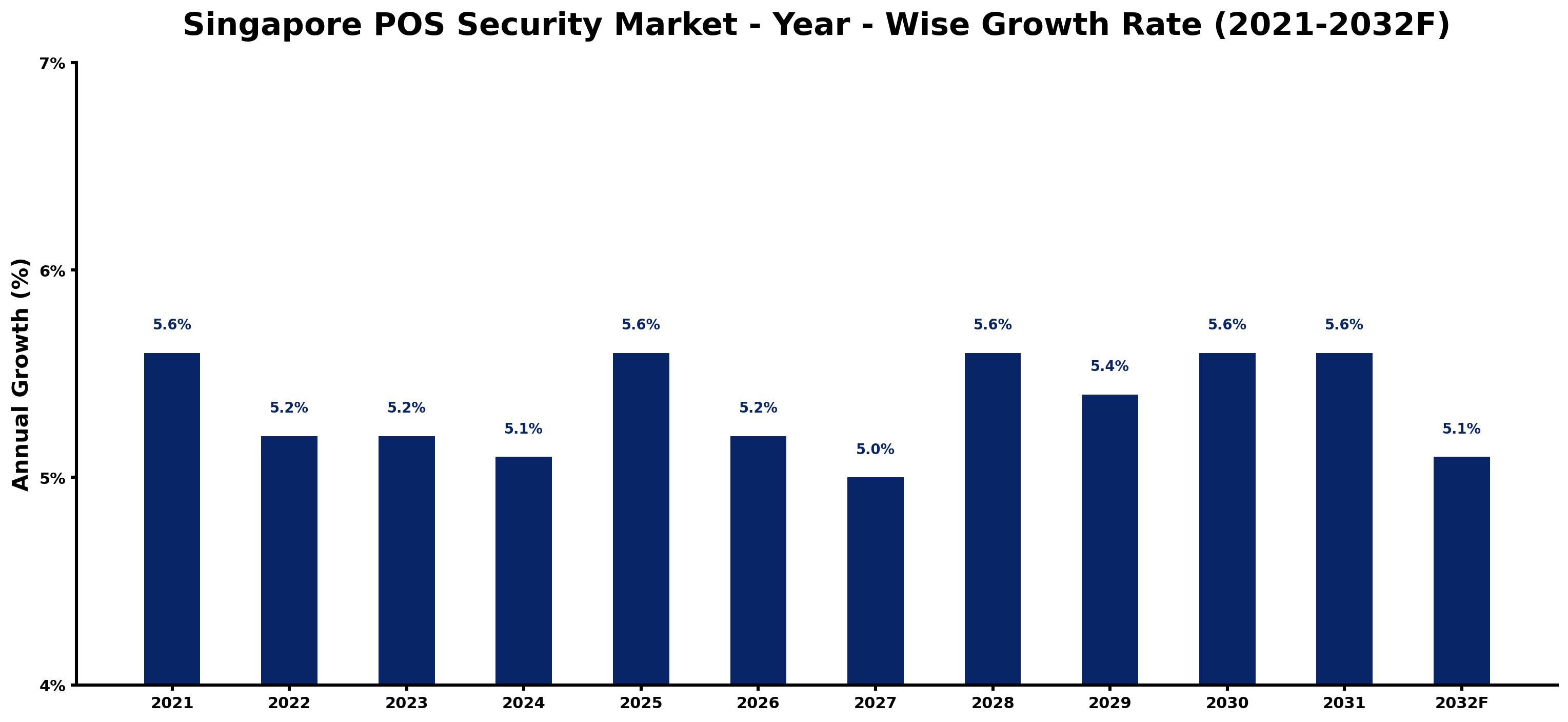
The table below presents the year‑wise growth rates along with the key drivers influencing the market
| Year | Growth Rate | Major Drivers |
| 2021 | 5.6% | Government push for contactless payment security standards |
| 2022 | 5.2% | Increase in digital payment fraud incidents prompting security upgrades |
| 2023 | 5.2% | Rising mobile payment adoption among retail consumers |
| 2024 | 5.1% | Emergence of new cybersecurity regulations by Cyber Security Agency |
| 2025 | 5.6% | Supportive policies from Monetary Authority of Singapore on fintech |
| 2026 | 5.2% | Growing small business adoption of digital payment systems |
| 2027 | 5.0% | Boost in cashless transactions due to pandemic recovery |
| 2028 | 5.6% | Strategic alliances between banks and POS solution providers |
| 2029 | 5.4% | Heightened consumer awareness around data protection and privacy |
| 2030 | 5.6% | Integration of biometric authentication in retail payment systems |
| 2031 | 5.6% | Increased investment in cybersecurity training for retail staff |
| 2032 | 5.1% | Continuing government initiatives to enhance digital infrastructure |
Note: Market size estimations and growth projections presented in this report are based on 6Wresearch's proprietary forecasting methodology, utilizing the latest available industry data, government publications, and primary research inputs.
Singapore POS Security Market Key Takeaways
Below are some of the specific key takeaways from the market, including:
- The market's growth is significantly influenced by regulatory compliance, particularly the PCI DSS standards.
- Contactless payment adoption is propelling investments in advanced POS security technologies.
- Businesses are prioritizing end-to-end encryption and tokenization to enhance security measures.
- The increasing frequency and sophistication of cyber attacks are driving a critical need for robust security solutions.
- Remote management capabilities are becoming a necessity for effective POS system oversight.
Evaluation of Restraints in Singapore POS Security Market
The Singapore POS security market faces challenges, particularly from rapidly changing payment technologies. As new payment methods emerge, ensuring that security systems can effectively protect against fraud and data breaches becomes increasingly complex. There's a constant tension between implementing robust security measures and maintaining a smooth user experience, which can deter some businesses from investing in the latest security advancements. Furthermore, strict compliance requirements can create hurdles for smaller businesses trying to keep up with industry standards.
Singapore POS Security Market Trends
A noticeable trend is the growing integration of advanced security features such as biometric authentication within POS systems. Businesses are also investing in artificial intelligence-driven security solutions that can predict and prevent fraud. Additionally, the trend toward remote management and monitoring of POS systems is gaining traction as businesses seek more flexibility in overseeing their transactions. The demand for seamless integration with e-commerce platforms is also shaping how POS security solutions are developed.
Singapore POS Security Market Opportunities
There are significant growth opportunities in the Singapore POS security market, particularly for companies that can offer innovative security solutions tailored to the unique needs of local businesses. Developing advanced mobile payment security systems can tap into the burgeoning contactless payment segment. Furthermore, the enhancement of customer loyalty programs, integrated with secure payment systems, can drive additional investment and interest in POS security solutions. The focus on sustainability and reducing carbon footprints also opens avenues for technology providers that can align security solutions with eco-friendly practices.
Government Initiatives in the Singapore POS Security Market
Government policy plays a crucial role in shaping the Singapore POS Security Market, emphasizing the need for stringent security measures amidst the growing prevalence of digital payments. The regulatory framework is designed to foster a safe and secure environment for businesses and consumers alike, ensuring that robust measures are in place to mitigate risks associated with fraud and data breaches.
- A recently completed initiative focused on strengthening the regulatory standards for financial transactions, enhancing security protocols across all sectors.
- Currently ongoing programs aim to provide grants and incentives for small businesses to upgrade their POS security systems, ensuring compliance with PCI DSS standards.
- A planned public-private partnership expected to launch in 2026 will focus on enhancing cybersecurity training programs for business personnel managing POS systems.
- New regulatory updates are set for rollout in early 2026, mandating clearer transparency in payment processes for all merchants.
- An infrastructure upgrade initiative is underway, aimed at improving the cybersecurity framework supporting the digital payment systems across Singapore.
Future Insights of the Singapore POS Security Market
Looking ahead to 2026-2032, the Singapore POS security market is expected to evolve rapidly, influenced by technological advancements and an increasingly digital economy. The shift toward integrated security solutions will be prominent, with businesses prioritizing investments in technologies that offer comprehensive protection against sophisticated cyber threats. As consumers grow more comfortable with digital transactions, the demand for enhanced security measures will continue to rise, necessitating continuous innovation from security solution providers.
Singapore POS Security Market Latest Developments
In the past year, the Singapore POS security market has seen increased activity driven by heightened security needs due to rising fraud incidents. Companies are actively pursuing advancements in technology to stay ahead of evolving threats while ensuring compliance with government regulations.
- A technology vendor launched a new suite of security solutions designed to enhance encryption methods for POS transactions in Q1 2025.
- An ongoing initiative by a leading financial institution focuses on implementing AI-driven fraud detection systems, which began in mid-2025 and is expected to continue until late 2026.
- A major telecommunications provider has announced an upcoming rollout of a secure payment processing platform, scheduled for late 2026, which aims to integrate seamlessly with current POS systems.
- A public sector-led program aimed at increasing awareness and training for cybersecurity best practices has been gaining traction, with sessions occurring monthly throughout 2025.
- A recently developed cloud-based security monitoring service for POS systems was successfully completed in early 2025 and is now being adopted by various local businesses.
Singapore POS Security Market - Key Attractiveness of the Report
- 10 Years of Market Numbers
- Historical Data Starting from 2022 to 2025
- Base Year: 2025
- Forecast Data until 2032
- Key Performance Indicators Impacting the Market
- Major Upcoming Developments and Projects
Key Highlights of the Report:
- Singapore POS Security Market Outlook
- Market Size of Singapore POS Security Market, 2025
- Forecast of Singapore POS Security Market, 2032
- Historical Data and Forecast of Singapore POS Security Revenues & Volume for the Period 2022-2032F
- Singapore POS Security Market Trend Evolution
- Singapore POS Security Market Drivers and Challenges
- Singapore POS Security Price Trends
- Singapore POS Security Porter's Five Forces
- Singapore POS Security Industry Life Cycle
- Historical Data and Forecast of Singapore POS Security Market Revenues & Volume By Offering for the Period 2022-2032F
- Historical Data and Forecast of Singapore POS Security Market Revenues & Volume By Solutions for the Period 2022-2032F
- Historical Data and Forecast of Singapore POS Security Market Revenues & Volume By Services for the Period 2022-2032F
- Historical Data and Forecast of Singapore POS Security Market Revenues & Volume By Organization Size for the Period 2022-2032F
- Historical Data and Forecast of Singapore POS Security Market Revenues & Volume By SMEs for the Period 2022-2032F
- Historical Data and Forecast of Singapore POS Security Market Revenues & Volume By Large Enterprises for the Period 2022-2032F
- Historical Data and Forecast of Singapore POS Security Market Revenues & Volume By Vertical for the Period 2022-2032F
- Historical Data and Forecast of Singapore POS Security Market Revenues & Volume By Retail for the Period 2022-2032F
- Historical Data and Forecast of Singapore POS Security Market Revenues & Volume By Restaurants for the Period 2022-2032F
- Historical Data and Forecast of Singapore POS Security Market Revenues & Volume By Hospitality for the Period 2022-2032F
- Singapore POS Security Import Export Trade Statistics
- Market Opportunity Assessment By Offering
- Market Opportunity Assessment By Organization Size
- Market Opportunity Assessment By Vertical
- Singapore POS Security Top Companies Market Share
- Singapore POS Security Competitive Benchmarking By Technical and Operational Parameters
- Singapore POS Security Company Profiles
- Singapore POS Security Key Strategic Recommendations






































