Singapore Potassium chlorate Market Size, Share & Growth Rate
The Singapore Potassium chlorate Market was estimated at USD 328 Million in 2025 and is projected to reach USD 437 Million by 2032, growing at a CAGR of 4.2% from 2026 to 2032. This growth trajectory is largely driven by the recovery of the construction and entertainment sectors, which are significant consumers of potassium chlorate for pyrotechnic applications. Furthermore, increased industrial activity as Singapore emerges from the pandemic is expected to boost demand for this versatile oxidizing agent.
Singapore Potassium chlorate Market Year-wise Growth Rate and Key Drivers
This graph highlights how the Singapore Potassium chlorate Market has steadily grown over the years, supported by major growth factors.
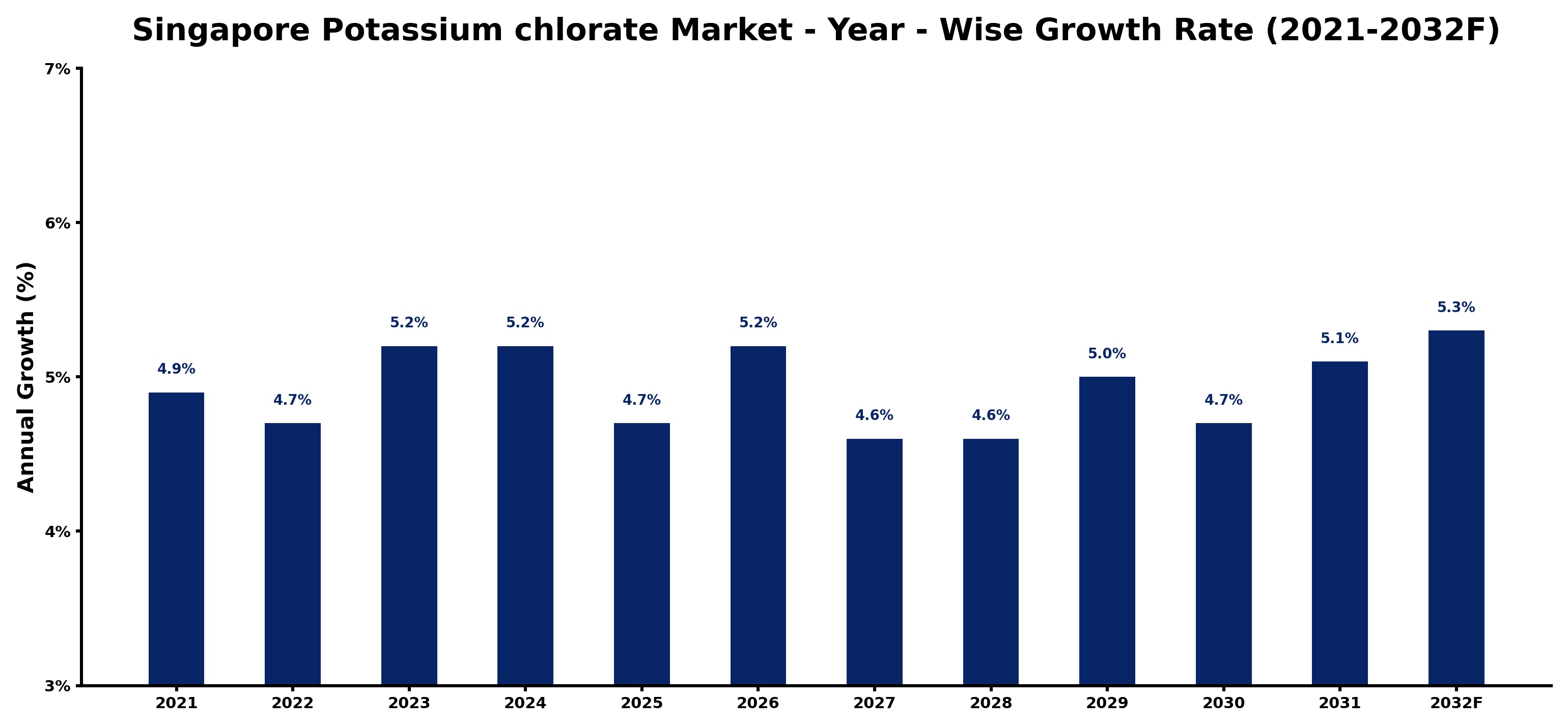
The table below presents the year‑wise growth rates along with the key drivers influencing the market
| Year | Growth Rate | Major Drivers |
| 2021 | 4.9% | Advanced production techniques boosted local potassium chlorate manufacturing capacity |
| 2022 | 4.7% | Local manufacturers invest in advanced facilities for potassium chlorate production |
| 2023 | 5.2% | Chemical facility upgrades boosted potassium chlorate production capacity |
| 2024 | 5.2% | Advanced production technologies boost potassium chlorate manufacturing efficiencies |
| 2025 | 4.7% | Revamped processing plants boosted potassium chlorate production efficiency |
| 2026 | 5.2% | Technological upgrades in chemical production facilities boost output efficiency |
| 2027 | 4.6% | Revitalized chemical production bolstered potassium chlorate market demand |
| 2028 | 4.6% | Production optimization led to higher potassium chlorate manufacturing efficiency |
| 2029 | 5.0% | Advanced production techniques enhanced potassium chlorate manufacturing efficiency |
| 2030 | 4.7% | Local manufacturing investments boost potassium chlorate production capacity |
| 2031 | 5.1% | Modernization of chemical plants boosted potassium chlorate production efficiency |
| 2032 | 5.3% | New manufacturing plants boost potassium chlorate production capacity significantly |
Note - Market size estimations and growth projections presented in this report are based on 6Wresearch’s advanced forecasting approach, validated with industry datasets as of June 2026.
Singapore Potassium chlorate Market Synopsis
The Singapore Potassium chlorate Market is experiencing a unique phase characterized by a renewed interest in safety and compliance within its applications, including fireworks and explosives. Recent regulatory scrutiny has prompted a shift towards enhanced safety measures, impacting how manufacturers operate in this specialized field.
As Singapore continues to position itself as a hub for safe and innovative industrial practices, the market for potassium chlorate is adapting to meet emerging regulations while seeking sustainable solutions. This evolving landscape presents both challenges and opportunities for stakeholders invested in this niche market.
Singapore Potassium chlorate Market Key Takeaways
- Moderate growth projected, driven by the recovery of construction and entertainment sectors.
- Strict regulatory compliance necessitates investment in safety protocols and operational adjustments.
- Environmental concerns require the adoption of sustainable production and disposal practices.
- Increased competition from global suppliers necessitates strategic differentiation for local manufacturers.
- Market demand remains cyclical, influenced by fluctuations in the fireworks and explosives industries.
Evaluation of Restraints in Singapore Potassium chlorate Market
The Singapore potassium chlorate market faces several restraints that may hinder its growth potential. Stringent regulations regarding the handling and production of potassium chlorate, driven by its explosive properties, significantly increase operational costs for manufacturers. These regulations require rigorous compliance measures, which can deter new entrants and challenge existing players. Additionally, fluctuations in demand from the fireworks and explosives sectors create uncertainties in inventory management and production planning. Environmental concerns surrounding production processes also necessitate investment in sustainable practices, further complicating operational dynamics for market participants.
Singapore Potassium chlorate Market Trends
Emerging trends in the Singapore potassium chlorate market are shaping both demand and technological advancements. There is an increasing focus on safety and compliance, spurred by heightened regulatory frameworks. This has led to innovations in production processes that prioritize environmentally friendly practices. Moreover, digitalization is making its way into supply chain management, enabling better tracking and compliance monitoring. The demand for potassium chlorate in specialty applications, such as pyrotechnics for events and festivals, is also on the rise, reflecting a cultural inclination towards enhanced entertainment experiences.
Singapore Potassium chlorate Market Opportunities
Opportunities for growth in the Singapore potassium chlorate market lie in the ongoing expansion of the construction and entertainment sectors. As these industries rebound, the potential for increased demand for pyrotechnics and related products becomes more pronounced. Additionally, the push towards sustainability offers avenues for investment in eco-friendly production methods that could serve to attract environmentally conscious consumers. Engaging in partnerships with local industries focused on innovation can also unlock new market potentials, providing competitive advantages in a recovering economy.
Government Initiatives in the Singapore Potassium chlorate Market
The Singaporean government has emphasized safety and sustainability across industrial sectors, including those that utilize potassium chlorate. Policies aimed at bolstering workplace safety and environmental responsibility are influencing market dynamics. Public spending on safety regulation enforcement and the promotion of sustainable manufacturing practices is expected to shape the future landscape of the potassium chlorate market. Furthermore, government initiatives supporting research and development in safer chemical processing methods may provide manufacturers with valuable resources and frameworks for compliance.
Future Insights of the Singapore Potassium chlorate Market
Looking ahead, the Singapore potassium chlorate market is set to evolve significantly by 2032, driven by a combination of regulatory adaptations and industry recovery. As compliance standards tighten, manufacturers are likely to invest in advanced safety technologies and sustainable practices. The demand from the entertainment sector, in particular, is expected to flourish as consumer events ramp up, providing a solid foundation for growth. Ultimately, those who navigate the regulatory landscape effectively while embracing innovation will be well-positioned for success in this dynamic market.
Singapore Potassium chlorate Market Latest Developments (May 2025 - June 2026)
In recent months, the Singapore potassium chlorate market has witnessed a flurry of developments. Companies are actively enhancing safety protocols to align with evolving regulations, focusing on both operational excellence and compliance. Additionally, there have been discussions around collaborating with local authorities to promote safer usage practices within the fireworks industry. The market is also seeing increased interest from stakeholders in sustainable production methods, which is becoming a focal point for future investments.
Singapore Potassium chlorate Market - Key Attractiveness of the Report
- 10 Years of Market Numbers
- Historical Data Starting from 2022 to 2025
- Base Year: 2025
- Forecast Data until 2032
- Key Performance Indicators Impacting the Market
- Major Upcoming Developments and Projects
Key Highlights of the Report:
- Singapore Potassium chlorate Market Outlook
- Market Size of Singapore Potassium chlorate Market, 2025
- Forecast of Singapore Potassium chlorate Market, 2032
- Historical Data and Forecast of Singapore Potassium chlorate Revenues & Volume for the Period 2022-2032F
- Singapore Potassium chlorate Market Trend Evolution
- Singapore Potassium chlorate Market Drivers and Challenges
- Singapore Potassium chlorate Price Trends
- Singapore Potassium chlorate Porter's Five Forces
- Singapore Potassium chlorate Industry Life Cycle
- Historical Data and Forecast of Singapore Potassium chlorate Market Revenues & Volume By Product type for the Period 2022-2032F
- Historical Data and Forecast of Singapore Potassium chlorate Market Revenues & Volume By Pharmaceutical Grade for the Period 2022-2032F
- Historical Data and Forecast of Singapore Potassium chlorate Market Revenues & Volume By Chemical Grade for the Period 2022-2032F
- Historical Data and Forecast of Singapore Potassium chlorate Market Revenues & Volume By End-use for the Period 2022-2032F
- Historical Data and Forecast of Singapore Potassium chlorate Market Revenues & Volume By Explosives for the Period 2022-2032F
- Historical Data and Forecast of Singapore Potassium chlorate Market Revenues & Volume By Matches for the Period 2022-2032F
- Historical Data and Forecast of Singapore Potassium chlorate Market Revenues & Volume By Disinfectants for the Period 2022-2032F
- Historical Data and Forecast of Singapore Potassium chlorate Market Revenues & Volume By Bleaches for the Period 2022-2032F
- Historical Data and Forecast of Singapore Potassium chlorate Market Revenues & Volume By Medical for the Period 2022-2032F
- Singapore Potassium chlorate Import Export Trade Statistics
- Market Opportunity Assessment By Product type
- Market Opportunity Assessment By End-use
- Singapore Potassium chlorate Top Companies Market Share
- Singapore Potassium chlorate Competitive Benchmarking By Technical and Operational Parameters
- Singapore Potassium chlorate Company Profiles
- Singapore Potassium chlorate Key Strategic Recommendations






































