Singapore Secondary Battery Market: Import Trend Analysis
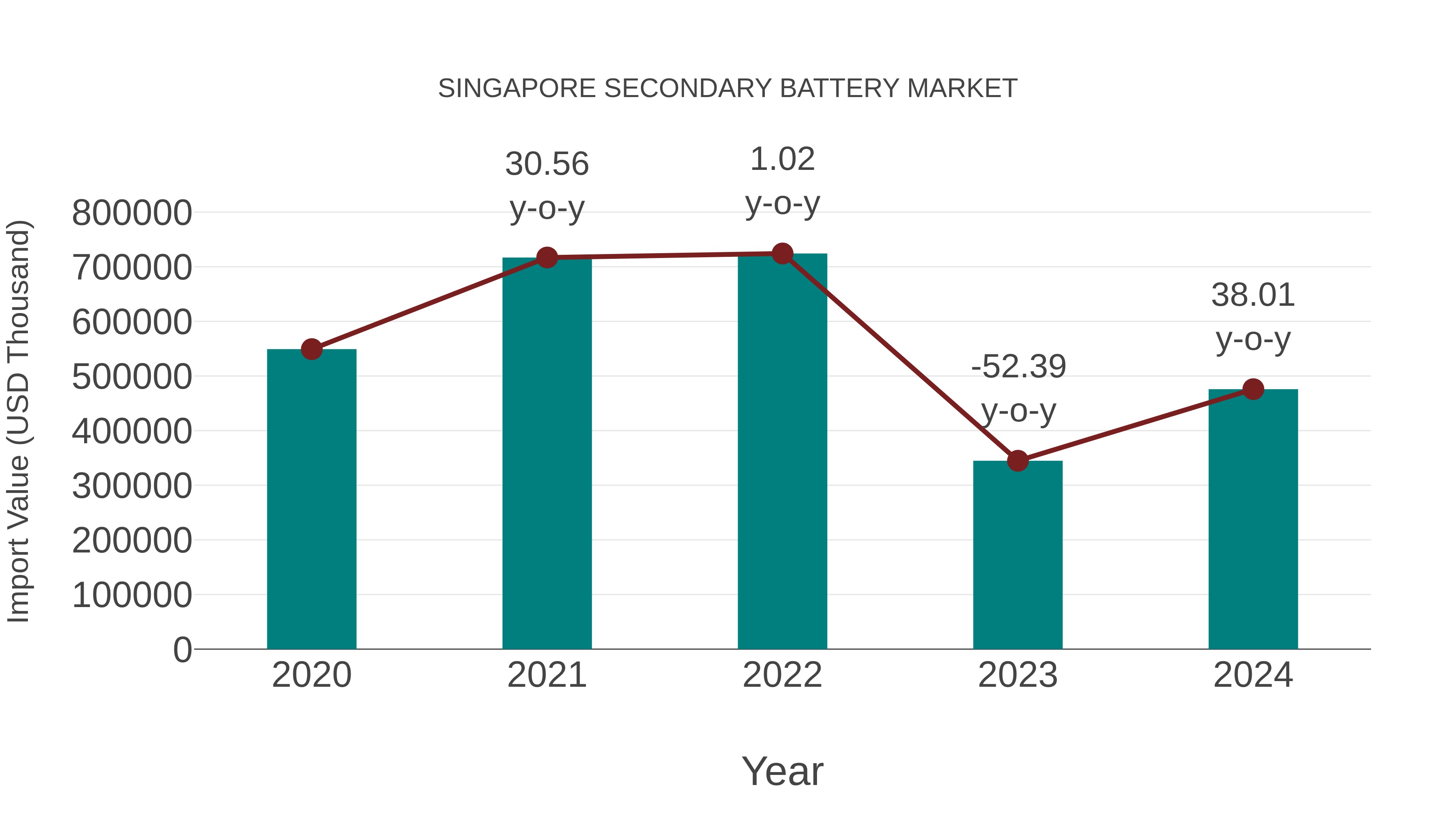
In 2024, Singapore`s secondary battery market saw a notable increase in imports. The trend indicated a growing demand for secondary batteries within the market. This rise in imports suggests a potential shift in consumer preferences or an increase in industrial applications requiring secondary batteries.
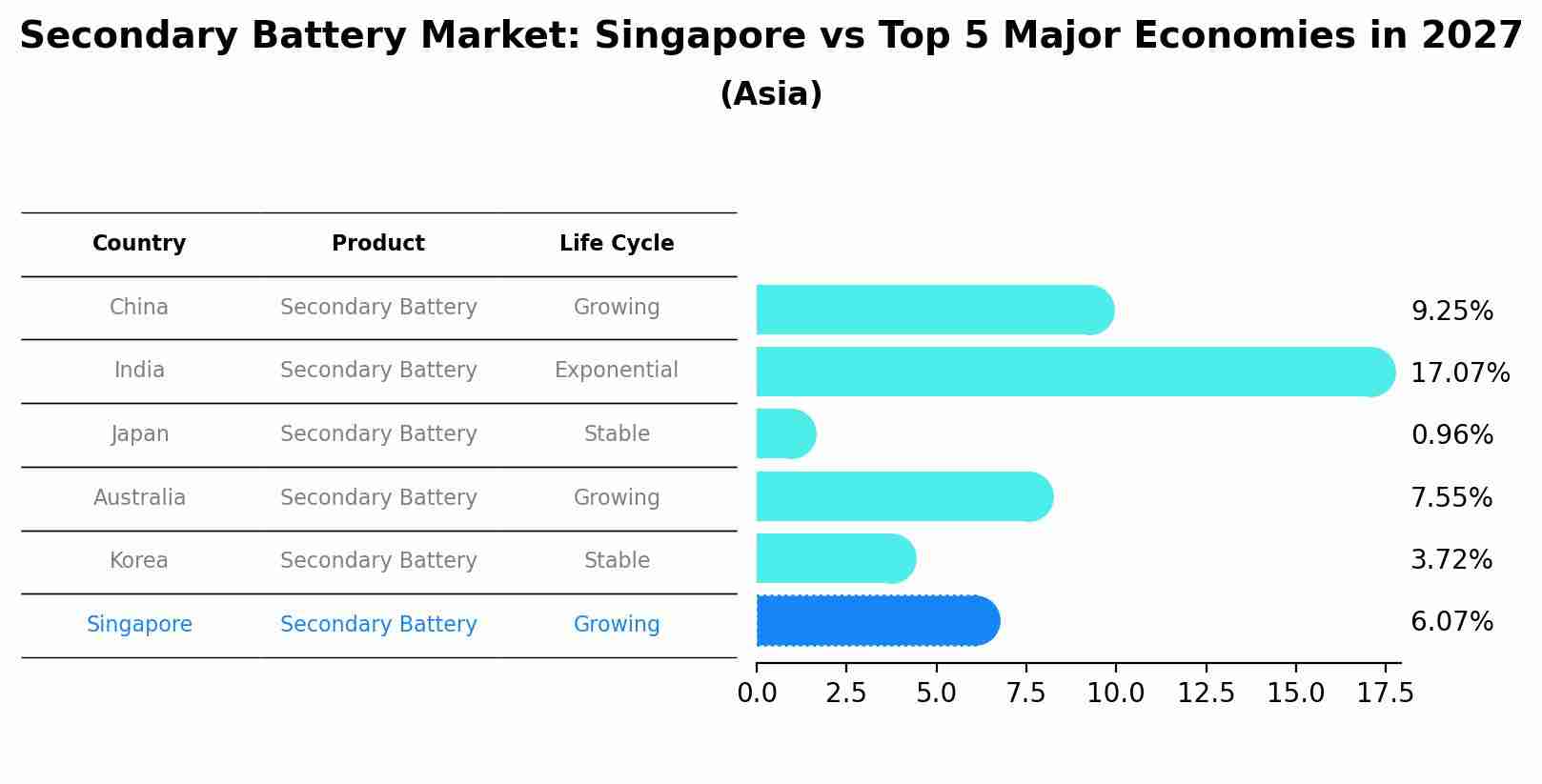
Secondary Battery Market: Singapore vs Top 5 Major Economies in 2027 (Asia)
The Secondary Battery market in Singapore is projected to grow at a growing growth rate of 6.07% by 2027, within the Asia region led by China, along with other countries like India, Japan, Australia and South Korea, collectively shaping a dynamic and evolving market environment driven by innovation and increasing adoption of emerging technologies.
Singapore Secondary Battery Market Synopsis
The secondary battery market in Singapore is expected to experience robust growth in the coming years, driven by the increasing demand for energy storage solutions across various sectors. Secondary batteries, including lithium-ion batteries, have gained prominence due to their applications in renewable energy integration, electric vehicles, consumer electronics, and backup power systems. Singapore commitment to sustainability and its push toward electrification contribute to the growing adoption of secondary batteries. The government`s support for research and development in battery technologies further propels the market`s expansion. As energy efficiency and storage become paramount, the secondary battery market in Singapore is likely to witness innovations and investments that cater to the evolving energy landscape.
Drivers of the Market
The Singapore secondary battery market is growing rapidly as demand for energy storage solutions surges. Secondary batteries, including lithium-ion and nickel-metal hydride batteries, are crucial components in electric vehicles, renewable energy systems, and consumer electronics. The market is driven by the transition to clean energy sources and the increasing adoption of electric vehicles in Singapore. Moreover, efforts to improve battery energy density and longevity are contributing to market expansion.
Challenges of the Market
The secondary battery market in Singapore faces challenges related to energy density, sustainability, and cost. As the demand for electric vehicles and renewable energy storage solutions grows, there is a continuous need for batteries with higher energy density and longer cycle life. Sustainability concerns, such as the responsible sourcing of raw materials and recycling, are becoming increasingly important. Balancing these factors while keeping costs competitive is a significant challenge for battery manufacturers.
COVID-19 Impact on the Market
The COVID-19 pandemic had a mixed impact on the secondary battery market in Singapore. While the initial disruptions in the supply chain and manufacturing caused delays and reduced production capacity, the market saw a rebound as demand for electronic devices and electric vehicles surged due to remote working and environmental concerns. As more people turned to gadgets and electric vehicles to minimize contact and reduce emissions, the secondary battery market experienced a steady recovery and even growth. Companies adapted by diversifying their supply chains and increasing investments in research and development to meet the growing demand for energy storage solutions.
Key Players in the Market
In the Singapore secondary battery market, some of the prominent players include Panasonic Corporation, Samsung SDI Co., Ltd., LG Chem Ltd., and Sony Corporation. These companies are known for their advanced battery technologies and have a significant presence in the market, catering to various industries including consumer electronics and automotive.
Key Highlights of the Report:
- Singapore Secondary Battery Market Outlook
- Market Size of Singapore Secondary Battery Market, 2025
- Forecast of Singapore Secondary Battery Market, 2032
- Historical Data and Forecast of Singapore Secondary Battery Revenues & Volume for the Period 2022-2032F
- Singapore Secondary Battery Market Trend Evolution
- Singapore Secondary Battery Market Drivers and Challenges
- Singapore Secondary Battery Price Trends
- Singapore Secondary Battery Porter's Five Forces
- Singapore Secondary Battery Industry Life Cycle
- Historical Data and Forecast of Singapore Secondary Battery Market Revenues & Volume By Technology for the Period 2022-2032F
- Historical Data and Forecast of Singapore Secondary Battery Market Revenues & Volume By Lead-acid Battery for the Period 2022-2032F
- Historical Data and Forecast of Singapore Secondary Battery Market Revenues & Volume By Lithium-ion Battery for the Period 2022-2032F
- Historical Data and Forecast of Singapore Secondary Battery Market Revenues & Volume By Other Technologies (NiMh, NiCD, etc.) for the Period 2022-2032F
- Historical Data and Forecast of Singapore Secondary Battery Market Revenues & Volume By Application for the Period 2022-2032F
- Historical Data and Forecast of Singapore Secondary Battery Market Revenues & Volume By Automotive Batteries (HEV, PHEV, and EV) for the Period 2022-2032F
- Historical Data and Forecast of Singapore Secondary Battery Market Revenues & Volume By Industrial Batteries (Motive, Stationary (Telecom, UPS, Energy Storage Systems (ESS), etc.) for the Period 2022-2032F
- Historical Data and Forecast of Singapore Secondary Battery Market Revenues & Volume By Portable Batteries (Consumer Electronics, etc.) for the Period 2022-2032F
- Historical Data and Forecast of Singapore Secondary Battery Market Revenues & Volume By Other Applications for the Period 2022-2032F
- Singapore Secondary Battery Import Export Trade Statistics
- Market Opportunity Assessment By Technology
- Market Opportunity Assessment By Application
- Singapore Secondary Battery Top Companies Market Share
- Singapore Secondary Battery Competitive Benchmarking By Technical and Operational Parameters
- Singapore Secondary Battery Company Profiles
- Singapore Secondary Battery Key Strategic Recommendations






































