Singapore SIP Trunking Services Market Size & Growth Rate (2026-2032)
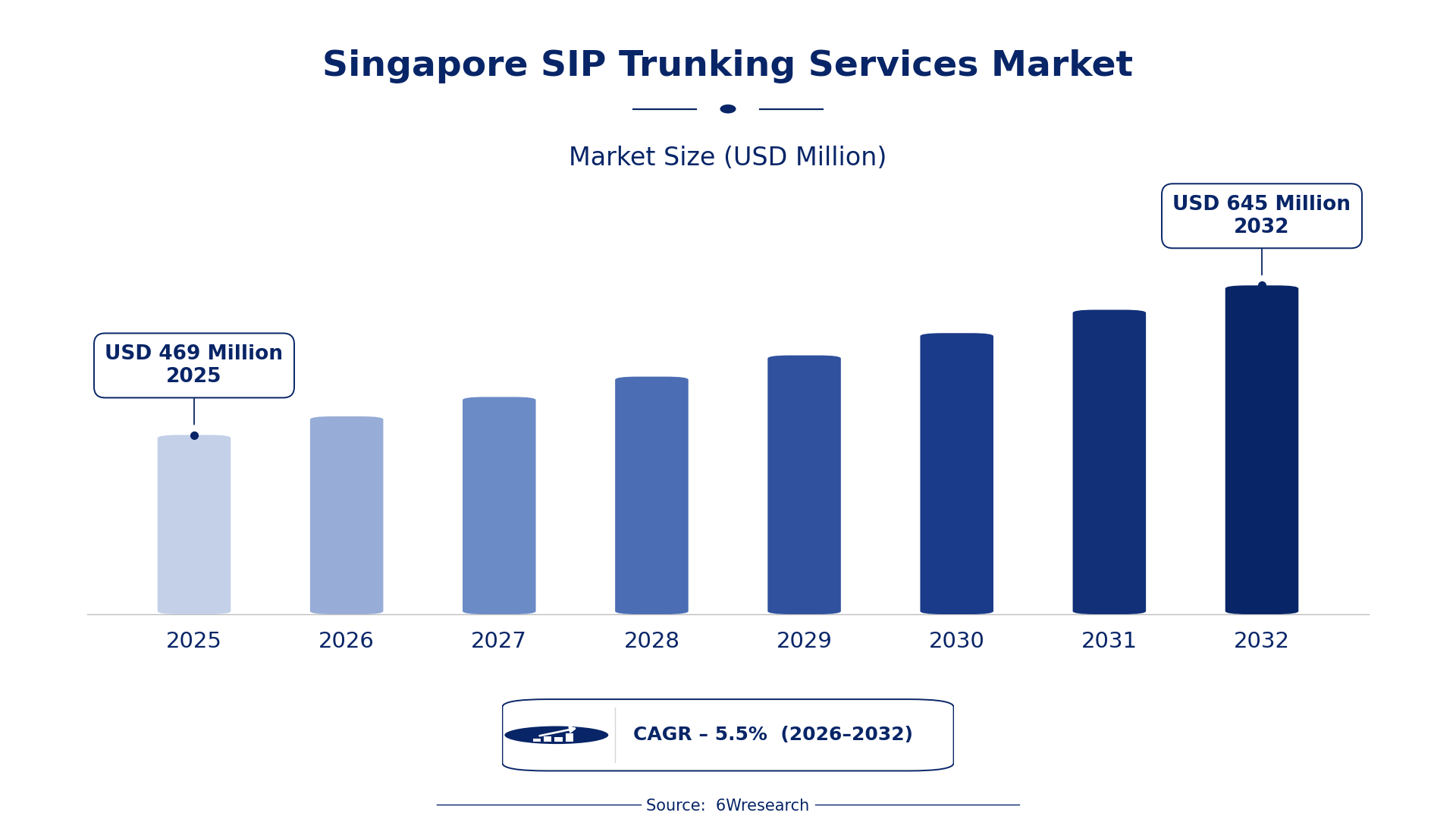
The Singapore SIP Trunking Services Market was estimated at USD 469 Million in 2025 and is projected to reach USD 645 Million by 2032, growing at a CAGR of 5.5% from 2026 to 2032.
Singapore SIP Trunking Services Market Synopsis
With Singapore's progressive shift towards digital transformation, the demand for SIP trunking services is rising sharply. Enterprises are increasingly looking for solutions that not only enhance communication capabilities but also reduce costs associated with traditional telephony systems.
The SIP trunking market stands out due to its ability to allow businesses to integrate their communication systems with the public switched telephone network (PSTN) via the internet. This flexibility is becoming a critical component for organizations striving for operational efficiency and scalability.
Singapore SIP Trunking Services Market Year-wise Growth Rate and Key Drivers
This graph illustrates the annual growth rates of the Singapore SIP Trunking Services Market from 2021 to 2032, highlighting a steady upward trajectory and projected expansion over the forecast period.
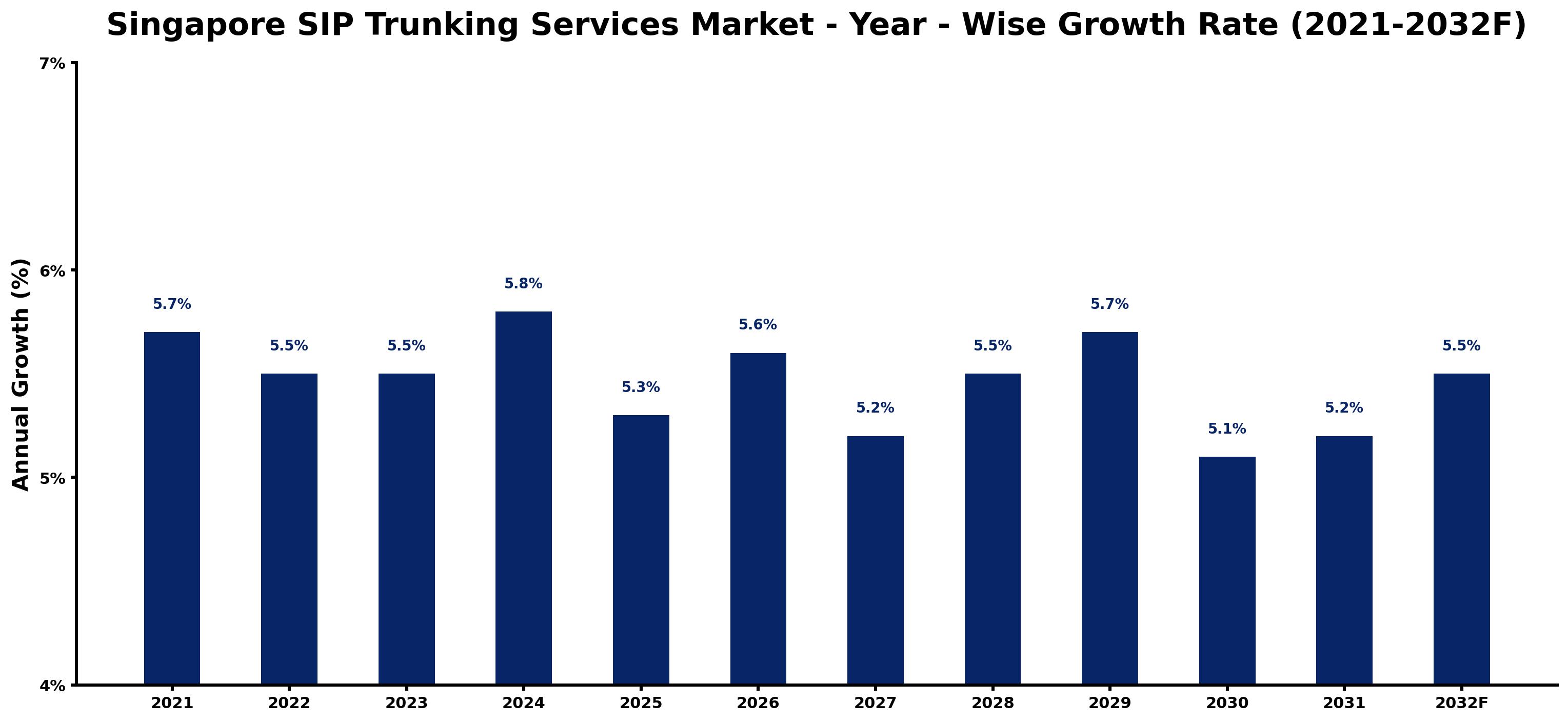
The table below presents the year‑wise growth rates along with the key drivers influencing the market
| Year | Growth Rate | Major Drivers |
| 2021 | 5.7% | Launch of Smart Nation initiative promoting digital connectivity. |
| 2022 | 5.5% | Telecom regulatory changes facilitating SIP trunking adoption. |
| 2023 | 5.5% | Increase in cloud-based communications among local enterprises. |
| 2024 | 5.8% | Rise in demand for unified communications solutions. |
| 2025 | 5.3% | Local businesses shifting to cost-effective communication options. |
| 2026 | 5.6% | Growth in IoT applications enhancing voice service needs. |
| 2027 | 5.2% | Corporate investments in cybersecurity driving secure VoIP adoption. |
| 2028 | 5.5% | Increased internet penetration fueling SIP trunking usage. |
| 2029 | 5.7% | Telecom partnerships enhancing service reliability and integration. |
| 2030 | 5.1% | Focus on green technology promoting sustainable communications. |
| 2031 | 5.2% | Demand for disaster recovery solutions boosting SIP trunking. |
| 2032 | 5.5% | Regulatory push for enhanced digital infrastructure resilience. |
Note: Market size estimations and growth projections presented in this report are based on 6Wresearch's proprietary forecasting methodology, utilizing the latest available industry data, government publications, and primary research inputs.
Singapore SIP Trunking Services Market Key Takeaways
Below are some of the specific key takeaways from the market, including:
- Cost-effective communication solutions driving business adoption.
- The trend towards increased VoIP technology integration is shaping service offerings.
- Regulatory compliance remains a crucial focus area for service providers.
- The market is experiencing accelerated growth due to heightened demand for remote communication tools post-pandemic.
- Ongoing advancements in security measures are essential to maintain service reliability and user trust.
Evaluation of Restraints in Singapore SIP Trunking Services Market
Interoperability issues pose a significant challenge within the Singapore SIP trunking services market. Ensuring that various communication platforms and hardware function smoothly together requires continuous attention and investment from service providers. Additionally, regulatory compliance with both local and international VoIP standards can hinder swift market adaptation. Achieving optimal call quality and reliability remains a technical hurdle that many companies must navigate, impacting customer satisfaction and service uptake.
Singapore SIP Trunking Services Market Trends
One of the dominant trends in the market is the growing reliance on cloud-based communications, which supports the shift from traditional systems to SIP trunking. Businesses are increasingly looking to merge voice, video, and data services under one platform. This convergence enhances collaboration and efficiency, making the adoption of SIP trunking services more appealing. Furthermore, the focus on security and compliance is intensifying as organizations become more aware of the vulnerabilities associated with remote communication.
Singapore SIP Trunking Services Market Opportunities
The market presents substantial growth opportunities, particularly for companies that invest in innovative technology solutions. As more organizations transition to cloud-based infrastructures, the demand for robust and scalable SIP trunking solutions will rise. Additionally, strategic partnerships between telecom providers and technology firms can lead to enhanced service offerings and improve customer experiences. Emphasizing security features within SIP services is also an avenue for differentiation and capturing market share.
Government Initiatives in the Singapore SIP Trunking Services Market
Government initiatives are instrumental in shaping the Singapore SIP Trunking Services Market. Policies focusing on enhancing digital communication infrastructure reflect the nation's commitment to a digitally empowered economy. The regulatory environment is becoming increasingly favorable for service providers, encouraging innovation while ensuring compliance with industry standards.
- A recently completed initiative aimed at upgrading national digital infrastructure, enhancing accessibility to high-quality communication services.
- Current efforts to streamline regulatory compliance for VoIP services are underway, enabling faster implementation of SIP trunking solutions.
- Upcoming policies designed to boost security protocols in telecommunication systems are expected to be introduced by mid-2026.
- Ongoing public-private partnerships aimed at expanding digital services in remote areas, enhancing SIP trunking adoption across various sectors.
Future Insights of the Singapore SIP Trunking Services Market
As we look towards 2026-2032, the Singapore SIP Trunking Services Market is set to expand significantly. Continued technological advancements will push more businesses to explore SIP as a primary communication method. The emphasis on cost efficiency, coupled with the increasing demand for integrated communication solutions, will drive market growth. Companies prioritizing security and compliance will likely emerge as leaders, shaping the future of voice communication in the country.
Singapore SIP Trunking Services Market Latest Developments
The last 12-14 months have seen considerable progress within the Singapore SIP Trunking Services Market. As businesses adapt to the post-pandemic world, innovation and technological adoption have surged. Service providers are actively upgrading their offerings to meet the evolving needs of their clients.
- In early 2025, a major telecom operator launched an upgraded SIP trunking platform aimed at enhancing customer service and operational efficiency.
- An ongoing initiative started in Q3 2025 focuses on integrating advanced analytics into SIP services, allowing businesses to optimize call management.
- A rollout expected to begin in late 2026 seeks to introduce AI-driven customer support solutions within the SIP trunking framework.
- A partnership formed in early 2025 between technology vendors aims to enhance security protocols for SIP communications.
Singapore SIP Trunking Services Market - Key Attractiveness of the Report
- 10 Years of Market Numbers
- Historical Data Starting from 2022 to 2025
- Base Year: 2025
- Forecast Data until 2032
- Key Performance Indicators Impacting the Market
- Major Upcoming Developments and Projects
Key Highlights of the Report:
- Singapore SIP Trunking Services Market Outlook
- Market Size of Singapore SIP Trunking Services Market, 2025
- Forecast of Singapore SIP Trunking Services Market, 2032
- Historical Data and Forecast of Singapore SIP Trunking Services Revenues & Volume for the Period 2022-2032F
- Singapore SIP Trunking Services Market Trend Evolution
- Singapore SIP Trunking Services Market Drivers and Challenges
- Singapore SIP Trunking Services Price Trends
- Singapore SIP Trunking Services Porter's Five Forces
- Singapore SIP Trunking Services Industry Life Cycle
- Historical Data and Forecast of Singapore SIP Trunking Services Market Revenues & Volume By Organization Size for the Period 2022-2032F
- Historical Data and Forecast of Singapore SIP Trunking Services Market Revenues & Volume By Small Businesses for the Period 2022-2032F
- Historical Data and Forecast of Singapore SIP Trunking Services Market Revenues & Volume By Mid-sized Businesses for the Period 2022-2032F
- Historical Data and Forecast of Singapore SIP Trunking Services Market Revenues & Volume By Enterprises for the Period 2022-2032F
- Historical Data and Forecast of Singapore SIP Trunking Services Market Revenues & Volume By End-user for the Period 2022-2032F
- Historical Data and Forecast of Singapore SIP Trunking Services Market Revenues & Volume By Verticals (BFSI, High-Tech, Government, Healthcare, Education, Retail, Transportation and Logistics, Manufacturing, Travel and Hospitality) for the Period 2022-2032F
- Historical Data and Forecast of Singapore SIP Trunking Services Market Revenues & Volume By Wholesale for the Period 2022-2032F
- Singapore SIP Trunking Services Import Export Trade Statistics
- Market Opportunity Assessment By Organization Size
- Market Opportunity Assessment By End-user
- Singapore SIP Trunking Services Top Companies Market Share
- Singapore SIP Trunking Services Competitive Benchmarking By Technical and Operational Parameters
- Singapore SIP Trunking Services Company Profiles
- Singapore SIP Trunking Services Key Strategic Recommendations






































