Singapore Slag Cement Market Size, Share & Growth Rate
The Singapore Slag Cement Market was estimated at USD 422 Million in 2025 and is projected to reach USD 591 Million by 2032, growing at a CAGR of 4.9% from 2026 to 2032. This growth is propelled by the increasing preference for eco-friendly construction materials, as stakeholders in the construction industry actively seek sustainable options that reduce the carbon footprint of their projects. With an emphasis on durability and resilience, slag cement is increasingly becoming a crucial component in modern construction techniques.
Singapore Slag Cement Market Year-wise Growth Rate and Key Drivers
This graph highlights how the Singapore Slag Cement Market has steadily grown over the years, supported by major growth factors.
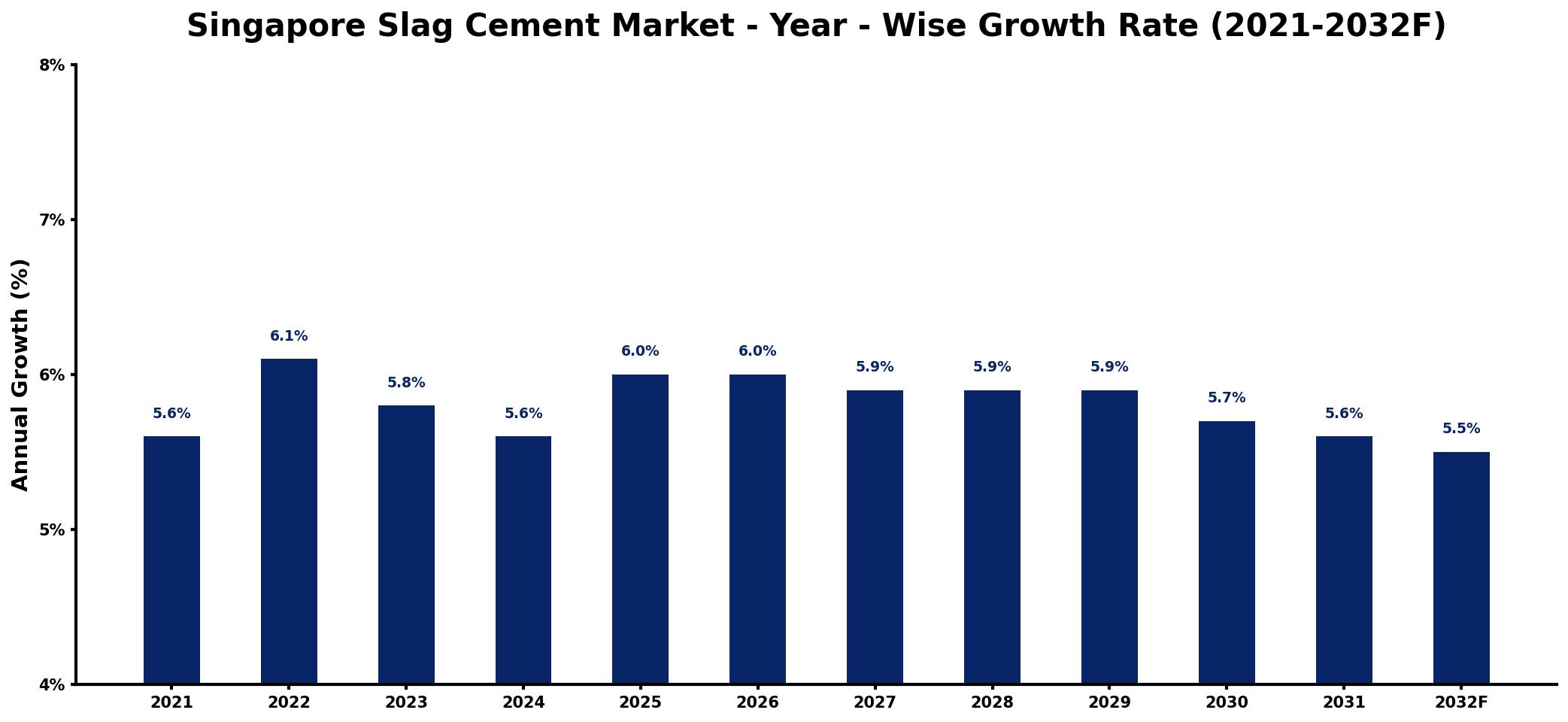
The table below presents the year‑wise growth rates along with the key drivers influencing the market
| Year | Growth Rate | Major Drivers |
| 2021 | 5.6% | Increased infrastructure project investments |
| 2022 | 6.1% | Growing demand from construction sector |
| 2023 | 5.8% | Expansion of green building initiatives |
| 2024 | 5.6% | Rising urbanization and population growth |
| 2025 | 6.0% | Government support for sustainable materials |
| 2026 | 6.0% | expanding healthcare application demand |
| 2027 | 5.9% | Higher residential construction activities |
| 2028 | 5.9% | Increased public infrastructure spending |
| 2029 | 5.9% | Growing awareness of environmental benefits |
| 2030 | 5.7% | Strengthened regulations on emissions |
| 2031 | 5.6% | Rising adoption of circular economy |
| 2032 | 5.5% | Increased focus on energy efficiency |
Note: Market size estimations and growth projections presented in this report are based on 6Wresearch's proprietary forecasting methodology, utilizing the latest available industry data, government publications, and primary research inputs.
Singapore Slag Cement Market Synopsis
The strongest force shaping the Singapore slag cement market is the rising demand for sustainable construction solutions. As environmental concerns take center stage, construction firms are prioritizing materials that not only enhance the longevity of structures but also align with eco-friendly practices.
Moreover, governmental initiatives aimed at promoting sustainable infrastructure further bolster market dynamics. The push for regulations that support reduced carbon emissions is fostering a favorable environment for slag cement, making it a preferred choice among industry stakeholders.
Singapore Slag Cement Market Key Takeaways
- The market is experiencing a significant increase in demand due to the shift towards sustainable construction practices.
- Slag cement provides unique benefits, such as improved durability and reduced environmental impact compared to traditional cement.
- Consumer awareness about the benefits of eco-friendly materials is growing, which will drive market adoption.
- Government incentives and policies supporting green building initiatives are crucial for market expansion.
- Collaboration between manufacturers and construction firms is essential for promoting the use of slag cement.
Evaluation of Restraints in Singapore Slag Cement Market
Despite its promising potential, the Singapore slag cement market faces real restraints, primarily stemming from consumer awareness. A considerable segment of the construction industry remains skeptical about transitioning to alternative materials. The relatively lower market penetration of slag cement compared to traditional products underscores the necessity for manufacturers to enhance consumer education regarding the environmental benefits and performance attributes of slag cement. Additionally, strong competition from established cement brands complicates the situation, necessitating strategic marketing and collaboration to elevate slag cement's visibility and adoption.
Singapore Slag Cement Market Trends
Key trends shaping the Singapore slag cement market include a growing focus on green building certifications and the adoption of advanced technologies in production. As more construction projects aim for LEED and BCA Green Mark certifications, the demand for materials that contribute to these standards is on the rise. Additionally, manufacturers are exploring innovations in slag cement production processes to improve performance, reduce costs, and increase the overall sustainability of their offerings.
Singapore Slag Cement Market Opportunities
The true growth opportunities lie in enhancing partnerships with construction firms and expanding into emerging market segments such as infrastructure development and high-rise buildings. As Singapore's urban landscape evolves, opportunities for integrating slag cement into public works and private projects will flourish. Investments in marketing initiatives that educate architects, engineers, and builders about slag cement's advantages can further stimulate demand.
Government Initiatives in the Singapore Slag Cement Market
The Singapore government is actively pursuing policies to encourage sustainable construction practices, including incentives for projects that utilize eco-friendly materials like slag cement. Initiatives such as the Sustainable Singapore Blueprint and the Green Building Masterplan showcase a commitment to reducing carbon emissions within the construction sector, thereby driving demand for innovative solutions like slag cement. Public spending on infrastructure projects focused on sustainability further amplifies the market's growth potential.
Future Insights of the Singapore Slag Cement Market
Looking ahead to 2026-2032, the Singapore slag cement market is expected to evolve in tandem with global sustainability trends. Increased regulatory pressures and a growing number of construction projects aimed at achieving sustainability goals will enhance the market's foundation. Additionally, as stakeholders become more adept at integrating eco-friendly materials into their projects, slag cement will be positioned as a vital component, solidifying its role in the future of sustainable construction.
Singapore Slag Cement Market Latest Developments (2025 - 2026)
Recent industry developments indicate a trend towards innovation in slag cement formulations, with manufacturers exploring ways to enhance performance characteristics. Collaborative efforts between construction firms and cement producers are on the rise, aimed at promoting awareness of the material's benefits. Additionally, new government policies continue to emerge, aligning with the focus on sustainability within the construction sector. Overall, the market is witnessing progressive shifts in both production practices and end-user perceptions.
Singapore Slag Cement Market - Key Attractiveness of the Report
- 10 Years of Market Numbers
- Historical Data Starting from 2022 to 2025
- Base Year: 2025
- Forecast Data until 2032
- Key Performance Indicators Impacting the Market
- Major Upcoming Developments and Projects
Key Highlights of the Report:
- Singapore Slag Cement Market Outlook
- Market Size of Singapore Slag Cement Market, 2025
- Forecast of Singapore Slag Cement Market, 2032
- Historical Data and Forecast of Singapore Slag Cement Revenues & Volume for the Period 2022-2032F
- Singapore Slag Cement Market Trend Evolution
- Singapore Slag Cement Market Drivers and Challenges
- Singapore Slag Cement Price Trends
- Singapore Slag Cement Porter's Five Forces
- Singapore Slag Cement Industry Life Cycle
- Historical Data and Forecast of Singapore Slag Cement Market Revenues & Volume By Product for the Period 2022-2032F
- Historical Data and Forecast of Singapore Slag Cement Market Revenues & Volume By Low Heat Cement for the Period 2022-2032F
- Historical Data and Forecast of Singapore Slag Cement Market Revenues & Volume By Sulphates resisting cement for the Period 2022-2032F
- Historical Data and Forecast of Singapore Slag Cement Market Revenues & Volume By Blast Furnace Slag Cement for the Period 2022-2032F
- Historical Data and Forecast of Singapore Slag Cement Market Revenues & Volume By High Alumina Cement for the Period 2022-2032F
- Historical Data and Forecast of Singapore Slag Cement Market Revenues & Volume By White Cement for the Period 2022-2032F
- Historical Data and Forecast of Singapore Slag Cement Market Revenues & Volume By Coloured cement for the Period 2022-2032F
- Historical Data and Forecast of Singapore Slag Cement Market Revenues & Volume By Pozzolanic Cement for the Period 2022-2032F
- Historical Data and Forecast of Singapore Slag Cement Market Revenues & Volume By Applications for the Period 2022-2032F
- Historical Data and Forecast of Singapore Slag Cement Market Revenues & Volume By Residential Buildings for the Period 2022-2032F
- Historical Data and Forecast of Singapore Slag Cement Market Revenues & Volume By Industrial Buildings for the Period 2022-2032F
- Historical Data and Forecast of Singapore Slag Cement Market Revenues & Volume By Commercial Buildings for the Period 2022-2032F
- Singapore Slag Cement Import Export Trade Statistics
- Market Opportunity Assessment By Product
- Market Opportunity Assessment By Applications
- Singapore Slag Cement Top Companies Market Share
- Singapore Slag Cement Competitive Benchmarking By Technical and Operational Parameters
- Singapore Slag Cement Company Profiles
- Singapore Slag Cement Key Strategic Recommendations






































