Singapore Speaker Amplifier Market Size, Share & Growth Rate
The Singapore Speaker Amplifier Market was estimated at USD 266 Million in 2025 and is projected to reach USD 370 Million by 2032, growing at a CAGR of 4.8% from 2026 to 2032. This anticipated growth is largely driven by an increasing emphasis on high-quality audio across diverse sectors, including entertainment, corporate events, and home audio systems. Furthermore, the integration of cutting-edge technology such as wireless capabilities and digital signal processing is enhancing the allure of speaker amplifiers for consumers and professionals alike.
Singapore Speaker Amplifier Market Year-wise Growth Rate and Key Drivers
This graph highlights how the Singapore Speaker Amplifier Market has steadily grown over the years, supported by major growth factors.
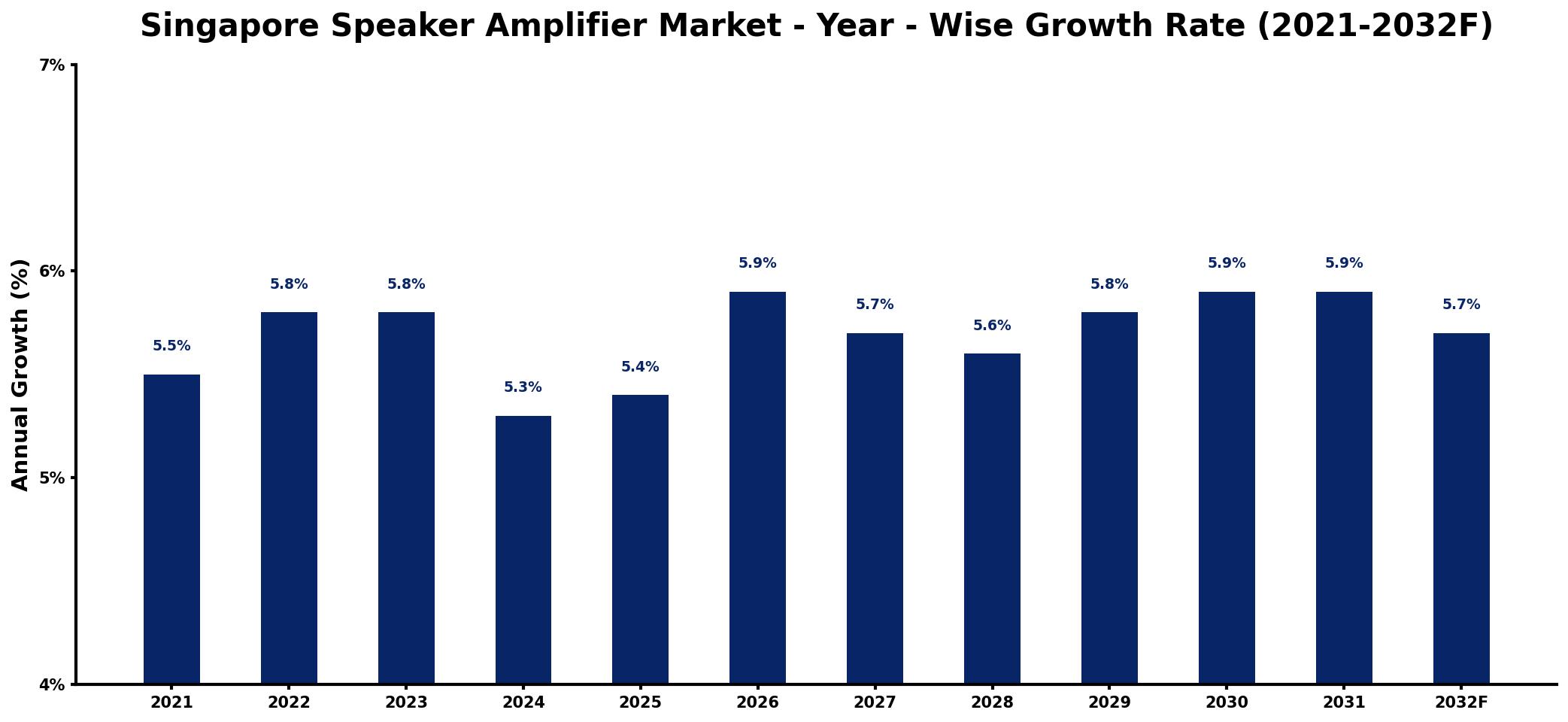
The table below presents the year‑wise growth rates along with the key drivers influencing the market
| Year | Growth Rate | Major Drivers |
| 2021 | 5.5% | Rising consumer electronics demand |
| 2022 | 5.8% | Increased live event attendance |
| 2023 | 5.8% | Growth in home entertainment systems |
| 2024 | 5.3% | Expansion of outdoor recreational activities |
| 2025 | 5.4% | Surge in corporate event hosting |
| 2026 | 5.9% | Investment in smart home technology |
| 2027 | 5.7% | strengthening international trade flows |
| 2028 | 5.6% | Increasing popularity of fitness events |
| 2029 | 5.8% | Rise in music festival culture |
| 2030 | 5.9% | Enhancement of mobile entertainment options |
| 2031 | 5.9% | strengthening underlying market demand |
| 2032 | 5.7% | rising demand from electronics |
Note: Market size estimations and growth projections presented in this report are based on 6Wresearch's proprietary forecasting methodology, utilizing the latest available industry data, government publications, and primary research inputs.
Singapore Speaker Amplifier Market Synopsis
The Singapore speaker amplifier market has experienced a notable surge, fueled by a vibrant events landscape and the growing multimedia content consumption. As both businesses and individuals prioritize superior audio experiences, the market trajectory appears increasingly positive. The shift towards more sophisticated audio solutions is not just a passing trend, but a fundamental change in consumer expectations.
In the coming years, this momentum is expected to intensify as new players enter the market and established entities innovate to meet the evolving demands. The call for immersive sound experiences and high-quality audio systems is spurring growth, setting the stage for sustained expansion in the Singapore speaker amplifier market.
Singapore Speaker Amplifier Market Key Takeaways
- The market is witnessing a robust demand for high-quality audio solutions across various sectors.
- Wireless connectivity and advanced signal processing are key drivers of amplifier innovation.
- Consumer interest in home entertainment systems is significantly influencing market dynamics.
- The integration of technology is pushing manufacturers to balance size, efficiency, and sound fidelity.
- As event activity rebounds post-pandemic, demand for professional-grade audio equipment is set to increase.
Evaluation of Restraints in Singapore Speaker Amplifier Market
While the Singapore speaker amplifier market shows promising growth potential, several restraints could hinder its full development. One primary concern is the intense competition among manufacturers, which often leads to price wars that can compromise audio quality. Additionally, as consumer expectations evolve, there is an increasing demand for smaller, yet powerful amplifiers. Balancing size and efficiency without sacrificing sound fidelity presents a technical challenge for many manufacturers. Furthermore, the lingering effects of economic uncertainties can impact consumer spending patterns, adding another layer of complexity to market dynamics.
Singapore Speaker Amplifier Market Trends
Current trends shaping the Singapore speaker amplifier market include the rapid adoption of smart audio technologies, which allow for voice control and integration with smart home systems. This trend is encouraging manufacturers to innovate and provide amplifiers that not only enhance sound quality but also offer seamless connectivity with other smart devices. Moreover, there is a noticeable shift towards eco-friendly products, prompting manufacturers to explore sustainable materials and energy-efficient designs. The demand for customizable audio experiences is also on the rise, with consumers seeking tailored solutions that fit their unique sound preferences.
Singapore Speaker Amplifier Market Opportunities
The evolving landscape of the Singapore speaker amplifier market presents numerous opportunities for growth and investment. A particularly promising area lies in the integration of artificial intelligence (AI) and machine learning in audio systems, which can enhance user experience through personalized sound settings. Additionally, the resurgence of live events and festivals post-COVID-19 represents a significant avenue for amplifiers tailored for professional audio setups. Companies that can innovate in terms of both technology and design while meeting consumer demands for high-quality sound are likely to seize substantial market share.
Government Initiatives in the Singapore Speaker Amplifier Market
The Singapore government has shown a proactive stance towards supporting the audio equipment industry through various initiatives aimed at fostering innovation and technological advancement. Investment in public infrastructure to facilitate live events is expected to encourage the growth of the audio sector. Additionally, policies promoting sustainable practices in manufacturing could offer incentives for companies to adopt eco-friendly technologies in their speaker amplifiers, aligning with the global shift towards environmental responsibility.
Future Insights of the Singapore Speaker Amplifier Market
Looking ahead to the period between 2026 and 2032, the Singapore speaker amplifier market is anticipated to continue its upward trajectory. Factors such as the sustained growth in the entertainment sector, the rise of immersive audio experiences, and a consumer base that increasingly prioritizes audio quality will play critical roles. Furthermore, as technological advancements continue to reshape the audio landscape, manufacturers who can effectively leverage these innovations will be positioned to dominate the market. The convergence of audio technology with other smart technologies will likely redefine how consumers interact with their sound systems.
Singapore Speaker Amplifier Market Latest Developments (2025 - 2026)
Recent developments in the Singapore speaker amplifier market indicate a significant shift towards integrated audio solutions that enhance user interactivity. Manufacturers are increasingly focusing on smart features that connect seamlessly with mobile applications and other digital platforms. Additionally, industry players are exploring collaborations to expand their product offerings and improve customer engagement. The shift towards online sales channels continues to reshape how companies approach distribution and customer service, further evolving the market landscape.
Singapore Speaker Amplifier Market - Key Attractiveness of the Report
- 10 Years of Market Numbers
- Historical Data Starting from 2022 to 2025
- Base Year: 2025
- Forecast Data until 2032
- Key Performance Indicators Impacting the Market
- Major Upcoming Developments and Projects
Key Highlights of the Report:
- Singapore Speaker Amplifier Market Outlook
- Market Size of Singapore Speaker Amplifier Market, 2025
- Forecast of Singapore Speaker Amplifier Market, 2032
- Historical Data and Forecast of Singapore Speaker Amplifier Revenues & Volume for the Period 2022-2032F
- Singapore Speaker Amplifier Market Trend Evolution
- Singapore Speaker Amplifier Market Drivers and Challenges
- Singapore Speaker Amplifier Price Trends
- Singapore Speaker Amplifier Porter's Five Forces
- Singapore Speaker Amplifier Industry Life Cycle
- Historical Data and Forecast of Singapore Speaker Amplifier Market Revenues & Volume By Power for the Period 2022-2032F
- Historical Data and Forecast of Singapore Speaker Amplifier Market Revenues & Volume By Low Power (Less Than 5W) for the Period 2022-2032F
- Historical Data and Forecast of Singapore Speaker Amplifier Market Revenues & Volume By Mid Power (5W to 25W) for the Period 2022-2032F
- Historical Data and Forecast of Singapore Speaker Amplifier Market Revenues & Volume By End Use for the Period 2022-2032F
- Historical Data and Forecast of Singapore Speaker Amplifier Market Revenues & Volume By Computer for the Period 2022-2032F
- Historical Data and Forecast of Singapore Speaker Amplifier Market Revenues & Volume By Phones for the Period 2022-2032F
- Historical Data and Forecast of Singapore Speaker Amplifier Market Revenues & Volume By Tablets for the Period 2022-2032F
- Historical Data and Forecast of Singapore Speaker Amplifier Market Revenues & Volume By Over-Ear Headphones for the Period 2022-2032F
- Historical Data and Forecast of Singapore Speaker Amplifier Market Revenues & Volume By TWS for the Period 2022-2032F
- Historical Data and Forecast of Singapore Speaker Amplifier Market Revenues & Volume By Home Entertainment for the Period 2022-2032F
- Historical Data and Forecast of Singapore Speaker Amplifier Market Revenues & Volume By Commercial for the Period 2022-2032F
- Historical Data and Forecast of Singapore Speaker Amplifier Market Revenues & Volume By Automotive for the Period 2022-2032F
- Singapore Speaker Amplifier Import Export Trade Statistics
- Market Opportunity Assessment By Power
- Market Opportunity Assessment By End Use
- Singapore Speaker Amplifier Top Companies Market Share
- Singapore Speaker Amplifier Competitive Benchmarking By Technical and Operational Parameters
- Singapore Speaker Amplifier Company Profiles
- Singapore Speaker Amplifier Key Strategic Recommendations






































