Singapore Thread Rolling Machine Market Size, Share & Growth Rate
The Singapore Thread Rolling Machine Market was estimated at USD 475 Million in 2025 and is projected to reach USD 657 Million by 2032, growing at a CAGR of 4.7% from 2026 to 2032. This growth trajectory is largely driven by the booming manufacturing sector in Singapore, characterized by rising demands for precision-engineered components across industries such as automotive and aerospace. Additionally, the surge in infrastructure development and ongoing industrialization efforts will significantly enhance the adoption of thread rolling technology in the coming years.
Singapore Thread Rolling Machine Market Year-wise Growth Rate and Key Drivers
This graph highlights how the Singapore Thread Rolling Machine Market has steadily grown over the years, supported by major growth factors.
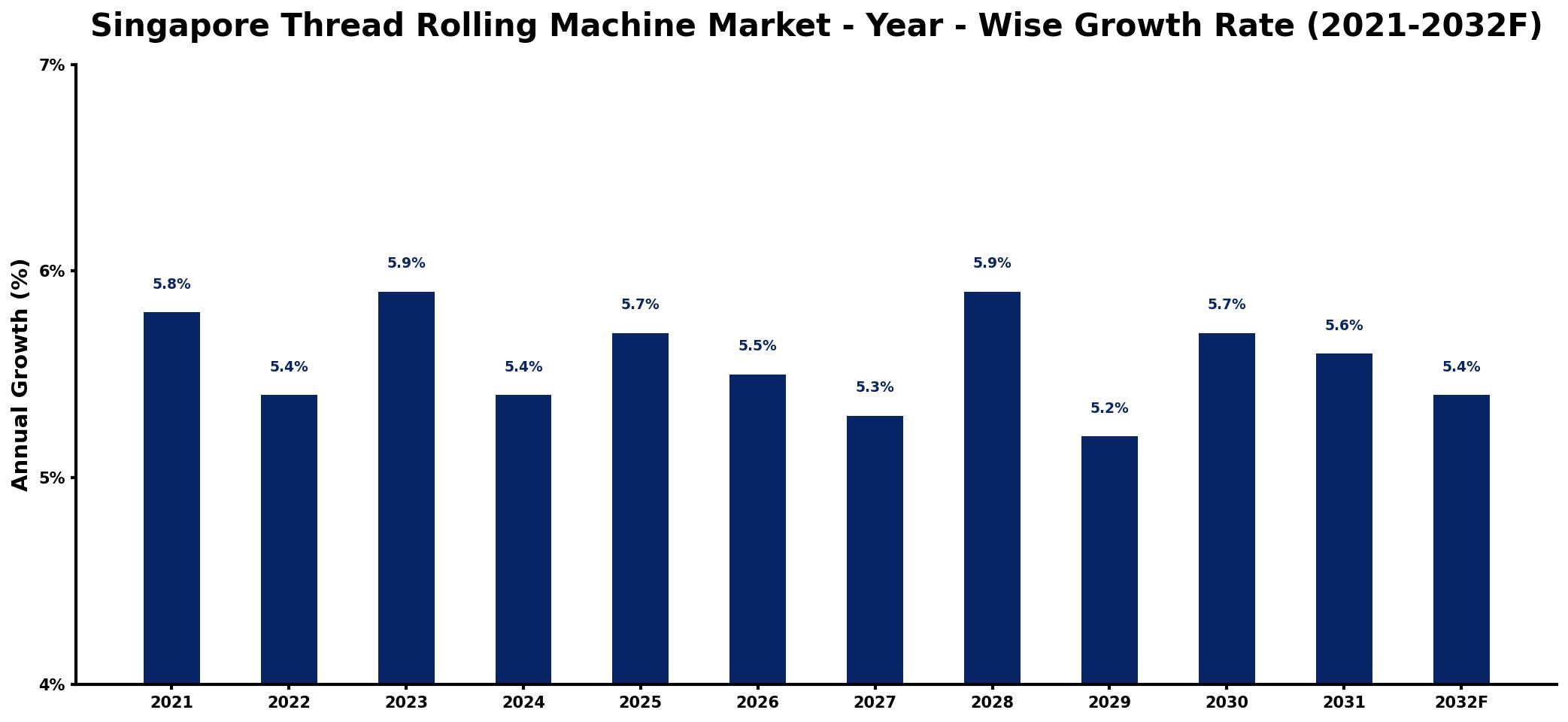
The table below presents the year‑wise growth rates along with the key drivers influencing the market
| Year | Growth Rate | Major Drivers |
| 2021 | 5.8% | Rising automotive manufacturing activities |
| 2022 | 5.4% | Increased demand from aerospace sector |
| 2023 | 5.9% | Growth in renewable energy projects |
| 2024 | 5.4% | Expansion of construction infrastructure projects |
| 2025 | 5.7% | Higher investments in industrial automation |
| 2026 | 5.5% | Surge in electronics production requirements |
| 2027 | 5.3% | Growing demand from telecommunications sector |
| 2028 | 5.9% | Increased adoption of precision engineering |
| 2029 | 5.2% | Rising popularity of green technologies |
| 2030 | 5.7% | Expansion in defense manufacturing capabilities |
| 2031 | 5.6% | increased overall sector activity |
| 2032 | 5.4% | Increased focus on product innovation |
Note: Market size estimations and growth projections presented in this report are based on 6Wresearch's proprietary forecasting methodology, utilizing the latest available industry data, government publications, and primary research inputs.
Singapore Thread Rolling Machine Market Synopsis
The demand for thread rolling machines in Singapore is closely tied to the nation's robust construction activities and manufacturing advancements. As industries increasingly require high-strength, precise threaded components for applications ranging from automotive to electronics, these machines play a critical role in ensuring quality and efficiency.
In addition, the local government's commitment to enhancing infrastructure and fostering a competitive manufacturing environment further propels market growth. Companies are under pressure to innovate, pushing for the development of more advanced thread rolling machines equipped with cutting-edge technology.
Singapore Thread Rolling Machine Market Key Takeaways
- The market is primarily driven by growth in the manufacturing sector, which requires high-quality threaded components.
- Technological advancements, particularly in CNC systems, are enhancing the precision and productivity of thread rolling machines.
- Government initiatives aimed at infrastructure development are expected to sustain demand for thread rolling machines.
- The recovery from the COVID-19 pandemic is creating renewed opportunities for market expansion.
- Industry players are increasingly investing in R&D to develop more efficient and reliable machines.
Evaluation of Restraints in Singapore Thread Rolling Machine Market
Despite the promising growth outlook, the Singapore Thread Rolling Machine Market faces specific restraints. Manufacturers must grapple with the need for precision and reliability, as threaded components are often used in critical applications where failure is not an option. This requirement places pressure on producers to continuously enhance their machines' performance while keeping costs competitive. Furthermore, navigating supply chain disruptions and fluctuations in raw material prices can complicate production schedules, adding another layer of challenge to market participants.
Singapore Thread Rolling Machine Market Trends
The market is currently witnessing several noteworthy trends. Firstly, there's a pronounced shift towards automation in manufacturing, with thread rolling machines increasingly integrating smart technologies and IoT capabilities. This trend enhances operational efficiency and real-time monitoring. Additionally, sustainability is becoming a priority, prompting the development of machines that not only improve output but also minimize waste and energy consumption. As industries strive for greener solutions, this trend is likely to shape future developments in the market.
Singapore Thread Rolling Machine Market Opportunities
There are substantial growth opportunities on the horizon for the Singapore Thread Rolling Machine Market. The ongoing industrial transformation in sectors like aerospace and precision engineering opens avenues for companies to introduce innovative machine designs that cater to evolving industry standards. Furthermore, as Singapore aims to position itself as a manufacturing hub in Southeast Asia, the potential for increased export demand for thread rolling machines is promising. Investing in technologies that enhance machine adaptability and efficiency will also create a competitive edge.
Government Initiatives in the Singapore Thread Rolling Machine Market
The Singapore government is playing a crucial role in stimulating the thread rolling machine market through various initiatives aimed at infrastructure development and manufacturing support. Policies promoting innovation and technology adoption in manufacturing sectors create a favorable environment for machine makers. Furthermore, public spending on construction projects is expected to lead to a higher demand for high-precision machinery, thereby positively impacting market growth.
Future Insights of the Singapore Thread Rolling Machine Market
Looking ahead to the period between 2026 and 2032, the Singapore Thread Rolling Machine Market is positioned for sustained growth driven by technological advancements and heightened industrial activity. The integration of AI and machine learning into manufacturing processes will likely elevate productivity and enhance product quality. As companies strive for competitive advantages, the emphasis on R&D investments will pave the way for next-generation thread rolling machines, reinforcing Singapore's status as a key player in the global manufacturing landscape.
Singapore Thread Rolling Machine Market Latest Developments (2025 - 2026)
Recent developments in the Singapore thread rolling machine market reflect a trend towards enhanced automation and smart manufacturing solutions. Industry participants are increasingly focused on leveraging advanced technologies to meet the growing demand for precision components. There is also a noticeable emphasis on sustainability, with manufacturers exploring eco-friendly machine designs and production processes. The recovery phase post-COVID-19 is fostering renewed collaborations and partnerships within the industry, propelling innovation and expanding market reach.
Singapore Thread Rolling Machine Market - Key Attractiveness of the Report
- 10 Years of Market Numbers
- Historical Data Starting from 2022 to 2025
- Base Year: 2025
- Forecast Data until 2032
- Key Performance Indicators Impacting the Market
- Major Upcoming Developments and Projects
Key Highlights of the Report:
- Singapore Thread Rolling Machine Market Outlook
- Market Size of Singapore Thread Rolling Machine Market, 2025
- Forecast of Singapore Thread Rolling Machine Market, 2032
- Historical Data and Forecast of Singapore Thread Rolling Machine Revenues & Volume for the Period 2022-2032F
- Singapore Thread Rolling Machine Market Trend Evolution
- Singapore Thread Rolling Machine Market Drivers and Challenges
- Singapore Thread Rolling Machine Price Trends
- Singapore Thread Rolling Machine Porter's Five Forces
- Singapore Thread Rolling Machine Industry Life Cycle
- Historical Data and Forecast of Singapore Thread Rolling Machine Market Revenues & Volume By Type for the Period 2022-2032F
- Historical Data and Forecast of Singapore Thread Rolling Machine Market Revenues & Volume By Two Axis Thread Rolling Machine for the Period 2022-2032F
- Historical Data and Forecast of Singapore Thread Rolling Machine Market Revenues & Volume By Three Axis Thread Rolling Machine for the Period 2022-2032F
- Historical Data and Forecast of Singapore Thread Rolling Machine Market Revenues & Volume By Application for the Period 2022-2032F
- Historical Data and Forecast of Singapore Thread Rolling Machine Market Revenues & Volume By Construction for the Period 2022-2032F
- Historical Data and Forecast of Singapore Thread Rolling Machine Market Revenues & Volume By Industrial for the Period 2022-2032F
- Historical Data and Forecast of Singapore Thread Rolling Machine Market Revenues & Volume By Others for the Period 2022-2032F
- Singapore Thread Rolling Machine Import Export Trade Statistics
- Market Opportunity Assessment By Type
- Market Opportunity Assessment By Application
- Singapore Thread Rolling Machine Top Companies Market Share
- Singapore Thread Rolling Machine Competitive Benchmarking By Technical and Operational Parameters
- Singapore Thread Rolling Machine Company Profiles
- Singapore Thread Rolling Machine Key Strategic Recommendations






































