Singapore Visual Analytics Market Size & Growth Rate (2026-2032)
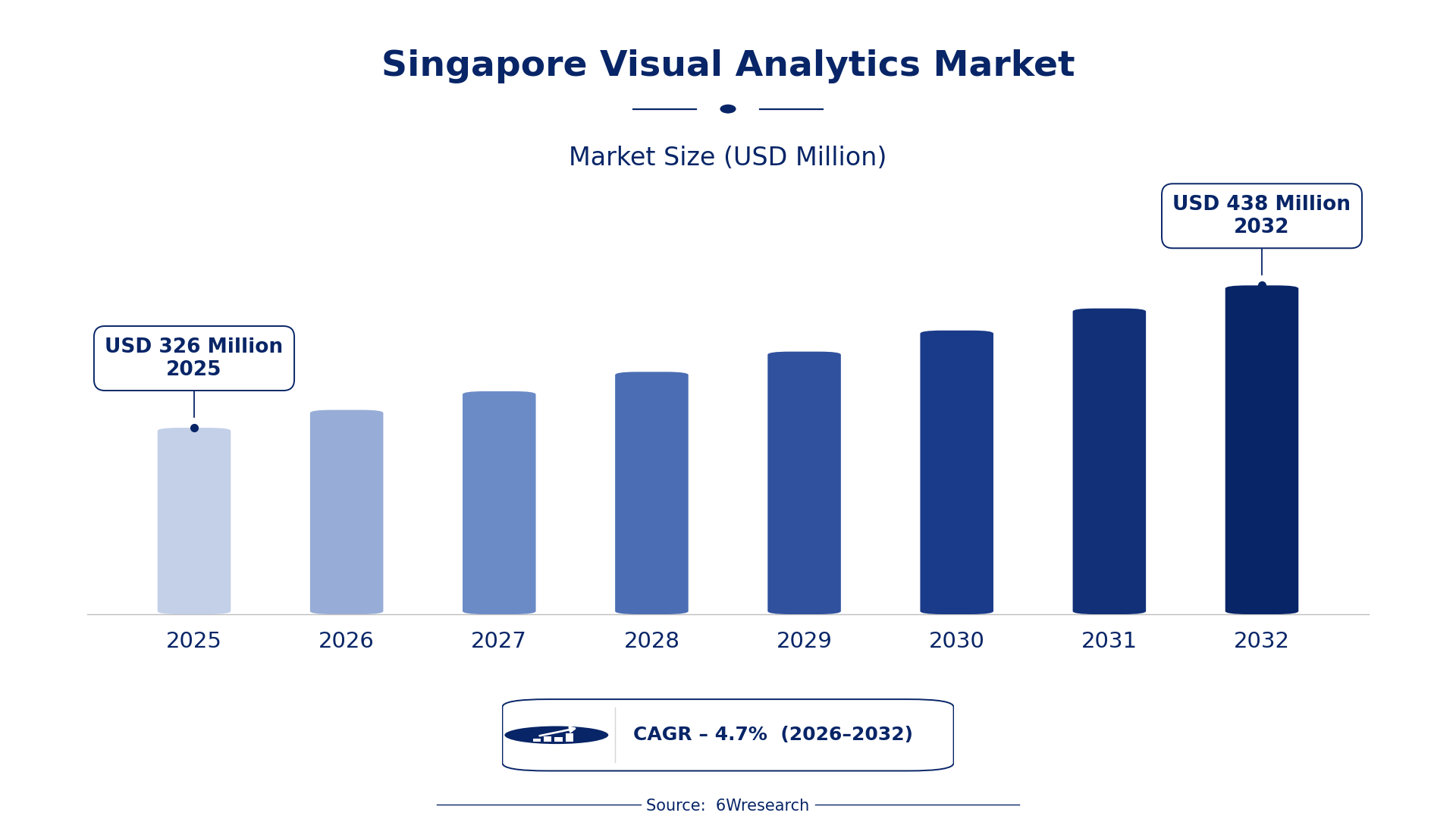
The Singapore Visual Analytics Market was estimated at USD 326 Million in 2025 and is projected to reach USD 438 Million by 2032, growing at a CAGR of 4.7% from 2026 to 2032.
Singapore Visual Analytics Market Synopsis
The surge in data generation across industries has led to an increasing demand for visual analytics tools in Singapore. Companies are recognizing the need for intuitive platforms that transform complex datasets into actionable insights, driving faster decision-making processes and improved operational efficiency.
As organizations strive to gain competitive advantages, the focus on real-time analytics has intensified. This trend is particularly evident in sectors such as healthcare and finance, where the ability to visualize data quickly can influence critical business outcomes and enhance stakeholder engagement.
Singapore Visual Analytics Market Year-wise Growth Rate and Key Drivers
This graph illustrates the annual growth rates of the Singapore Visual Analytics Market from 2021 to 2032, highlighting a steady upward trajectory and projected expansion over the forecast period.
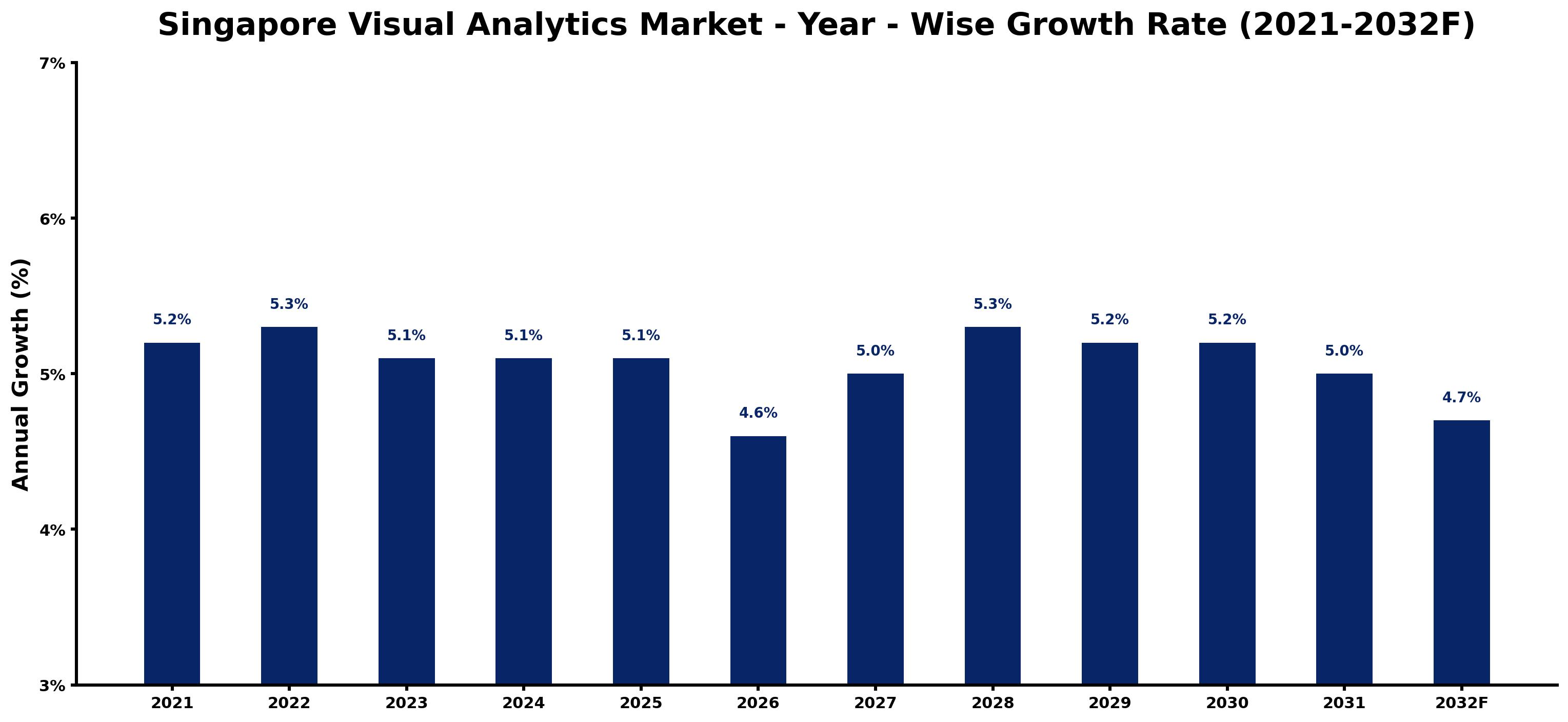
The table below presents the year‑wise growth rates along with the key drivers influencing the market
| Year | Growth Rate | Major Drivers |
| 2021 | 5.2% | Smart Nation initiative driving digital transformation efforts. |
| 2022 | 5.3% | Increased investment in AI technologies for visual insights. |
| 2023 | 5.1% | Growing number of startups leveraging analytics for innovation. |
| 2024 | 5.1% | Government data transparency policy boosting analytics adoption. |
| 2025 | 5.1% | Education sector integrating visual analytics into curricula. |
| 2026 | 4.6% | Rising e-commerce trends enhancing data visualization needs. |
| 2027 | 5.0% | Increased regulatory requirements for data reporting in finance. |
| 2028 | 5.3% | Local tech firms adopting big data for customer insights. |
| 2029 | 5.2% | Digital marketing sector expanding demand for visual tools. |
| 2030 | 5.2% | Boost in IoT devices generating data visualization opportunities. |
| 2031 | 5.0% | National healthcare strategy emphasizing data-driven patient care. |
| 2032 | 4.7% | Growing focus on smart city initiatives leveraging analytics. |
Note: Market size estimations and growth projections presented in this report are based on 6Wresearch's proprietary forecasting methodology, utilizing the latest available industry data, government publications, and primary research inputs.
Singapore Visual Analytics Market Key Takeaways
Below are some of the specific key takeaways from the market, including:
- The market is driven by the rising need for interactive and user-friendly data visualization tools.
- Healthcare and finance sectors are leading the demand for visual analytics solutions.
- Real-time data visualization is becoming a standard requirement among organizations.
- Key challenges include ensuring tools are accessible for users with varying data analysis skills.
- The COVID-19 pandemic significantly accelerated the adoption of visual analytics across multiple industries.
Evaluation of Restraints in Singapore Visual Analytics Market
Despite the promising growth of the visual analytics sector, there are notable constraints hindering broader adoption. One pressing issue is the steep learning curve associated with some advanced tools, which can alienate non-technical users. Organizations often struggle to find the right balance between complexity and usability, as overly intricate visualizations may overwhelm users rather than enlighten them. on top of that, the growing expectation for real-time analytics places additional strain on companies to continuously upgrade their systems and processes, which can lead to increased operational costs.
Singapore Visual Analytics Market Trends
The Singapore visual analytics market is currently witnessing several transformative trends. Firstly, the integration of artificial intelligence into visual analytics tools is enhancing the predictive capabilities of these solutions, allowing businesses to anticipate market shifts more effectively. Secondly, there’s a noticeable shift towards mobile-friendly analytics platforms, enabling decision-makers to access critical insights on-the-go. Finally, collaboration features are becoming increasingly important, fostering teamwork and shared insights among stakeholders in real-time.
Singapore Visual Analytics Market Opportunities
As the visual analytics market matures, several opportunities are emerging for growth and investment. Companies that focus on developing user-friendly interfaces will likely capture a substantial market share. Additionally, the demand for customized solutions tailored to specific industries presents a lucrative avenue for developers. The ongoing digital transformation initiatives across Singapore’s public and private sectors provide fertile ground for innovative analytics applications, especially in areas like smart city projects and healthcare analytics.
Government Initiatives in the Singapore Visual Analytics Market
Government policy is playing a crucial role in shaping the visual analytics market in Singapore. With a strong emphasis on digital transformation, the government has initiated several programs aimed at enhancing data analytics capabilities across various sectors. This proactive regulatory environment is vital for fostering innovation and ensuring that businesses can compete effectively on a global scale.
- A recently completed initiative focused on enhancing data sharing protocols among public agencies to streamline access to analytics tools.
- Current efforts include the rollout of a national digital infrastructure upgrade program, aimed at improving data analytics capabilities across various industries.
- Planned initiatives for the next few years involve establishing a regulatory framework to promote data transparency and analytics in the financial sector.
- Ongoing public-private partnerships are being developed to support the growth of analytics startups within Singapore.
Future Insights of the Singapore Visual Analytics Market
Looking ahead to 2026-2032, the Singapore visual analytics market is set for sustained growth as organizations increasingly recognize the value of data-driven decision-making. As more businesses invest in sophisticated analytics tools, the need for training and support will also rise, driving demand for consultancy services. Technological advancements, particularly in AI and machine learning, will further enhance the capabilities of visual analytics solutions, making them indispensable for organizations aiming to thrive in a data-centric world.
Singapore Visual Analytics Market Latest Developments
Over the past year, the Singapore visual analytics market has seen significant advancements, with companies increasingly investing in innovative technologies and solutions. The urgency for organizations to adapt to changing market conditions has accelerated the development of new tools and features tailored to specific industry needs.
- A major technology vendor launched an upgraded analytics platform in Q2 2025, featuring enhanced visualization capabilities and AI integration.
- In early 2025, a leading regional operator initiated a project to integrate real-time data analytics into its existing business intelligence systems.
- Current partnerships are underway, focusing on developing mobile analytics solutions to facilitate data access for remote teams.
- Upcoming initiatives include a public sector program expected to enhance healthcare analytics capabilities by mid-2026.
Singapore Visual Analytics Market - Key Attractiveness of the Report
- 10 Years of Market Numbers
- Historical Data Starting from 2022 to 2025
- Base Year: 2025
- Forecast Data until 2032
- Key Performance Indicators Impacting the Market
- Major Upcoming Developments and Projects
Key Highlights of the Report:
- Singapore Visual Analytics Market Outlook
- Market Size of Singapore Visual Analytics Market, 2025
- Forecast of Singapore Visual Analytics Market, 2032
- Historical Data and Forecast of Singapore Visual Analytics Revenues & Volume for the Period 2022-2032F
- Singapore Visual Analytics Market Trend Evolution
- Singapore Visual Analytics Market Drivers and Challenges
- Singapore Visual Analytics Price Trends
- Singapore Visual Analytics Porter's Five Forces
- Singapore Visual Analytics Industry Life Cycle
- Historical Data and Forecast of Singapore Visual Analytics Market Revenues & Volume By Component for the Period 2022-2032F
- Historical Data and Forecast of Singapore Visual Analytics Market Revenues & Volume By Software for the Period 2022-2032F
- Historical Data and Forecast of Singapore Visual Analytics Market Revenues & Volume By Services for the Period 2022-2032F
- Historical Data and Forecast of Singapore Visual Analytics Market Revenues & Volume By Deployment Model for the Period 2022-2032F
- Historical Data and Forecast of Singapore Visual Analytics Market Revenues & Volume By On-Premises for the Period 2022-2032F
- Historical Data and Forecast of Singapore Visual Analytics Market Revenues & Volume By On-Demand for the Period 2022-2032F
- Historical Data and Forecast of Singapore Visual Analytics Market Revenues & Volume By Business Function for the Period 2022-2032F
- Historical Data and Forecast of Singapore Visual Analytics Market Revenues & Volume By IT for the Period 2022-2032F
- Historical Data and Forecast of Singapore Visual Analytics Market Revenues & Volume By Sales and marketing for the Period 2022-2032F
- Historical Data and Forecast of Singapore Visual Analytics Market Revenues & Volume By Supply chain for the Period 2022-2032F
- Historical Data and Forecast of Singapore Visual Analytics Market Revenues & Volume By Finance for the Period 2022-2032F
- Historical Data and Forecast of Singapore Visual Analytics Market Revenues & Volume By Human resources (HR) for the Period 2022-2032F
- Historical Data and Forecast of Singapore Visual Analytics Market Revenues & Volume By Others for the Period 2022-2032F
- Historical Data and Forecast of Singapore Visual Analytics Market Revenues & Volume By Industry for the Period 2022-2032F
- Historical Data and Forecast of Singapore Visual Analytics Market Revenues & Volume By Banking, Financial Services, and Insurance (BFSI) for the Period 2022-2032F
- Historical Data and Forecast of Singapore Visual Analytics Market Revenues & Volume By Telecom and IT for the Period 2022-2032F
- Historical Data and Forecast of Singapore Visual Analytics Market Revenues & Volume By Retail and Consumer goods for the Period 2022-2032F
- Historical Data and Forecast of Singapore Visual Analytics Market Revenues & Volume By Healthcare and Life Sciences for the Period 2022-2032F
- Historical Data and Forecast of Singapore Visual Analytics Market Revenues & Volume By Manufacturing for the Period 2022-2032F
- Historical Data and Forecast of Singapore Visual Analytics Market Revenues & Volume By Government and Defense for the Period 2022-2032F
- Historical Data and Forecast of Singapore Visual Analytics Market Revenues & Volume By Energy and utilities for the Period 2022-2032F
- Historical Data and Forecast of Singapore Visual Analytics Market Revenues & Volume By Media and entertainment for the Period 2022-2032F
- Historical Data and Forecast of Singapore Visual Analytics Market Revenues & Volume By Organization Size for the Period 2022-2032F
- Historical Data and Forecast of Singapore Visual Analytics Market Revenues & Volume By Small and Medium-sized Enterprises (SMEs) for the Period 2022-2032F
- Historical Data and Forecast of Singapore Visual Analytics Market Revenues & Volume By Large Enterprises for the Period 2022-2032F
- Singapore Visual Analytics Import Export Trade Statistics
- Market Opportunity Assessment By Component
- Market Opportunity Assessment By Deployment Model
- Market Opportunity Assessment By Business Function
- Market Opportunity Assessment By Industry
- Market Opportunity Assessment By Organization Size
- Singapore Visual Analytics Top Companies Market Share
- Singapore Visual Analytics Competitive Benchmarking By Technical and Operational Parameters
- Singapore Visual Analytics Company Profiles
- Singapore Visual Analytics Key Strategic Recommendations






































