Singapore Workforce Analytics Market Size & Growth Rate (2026-2032)
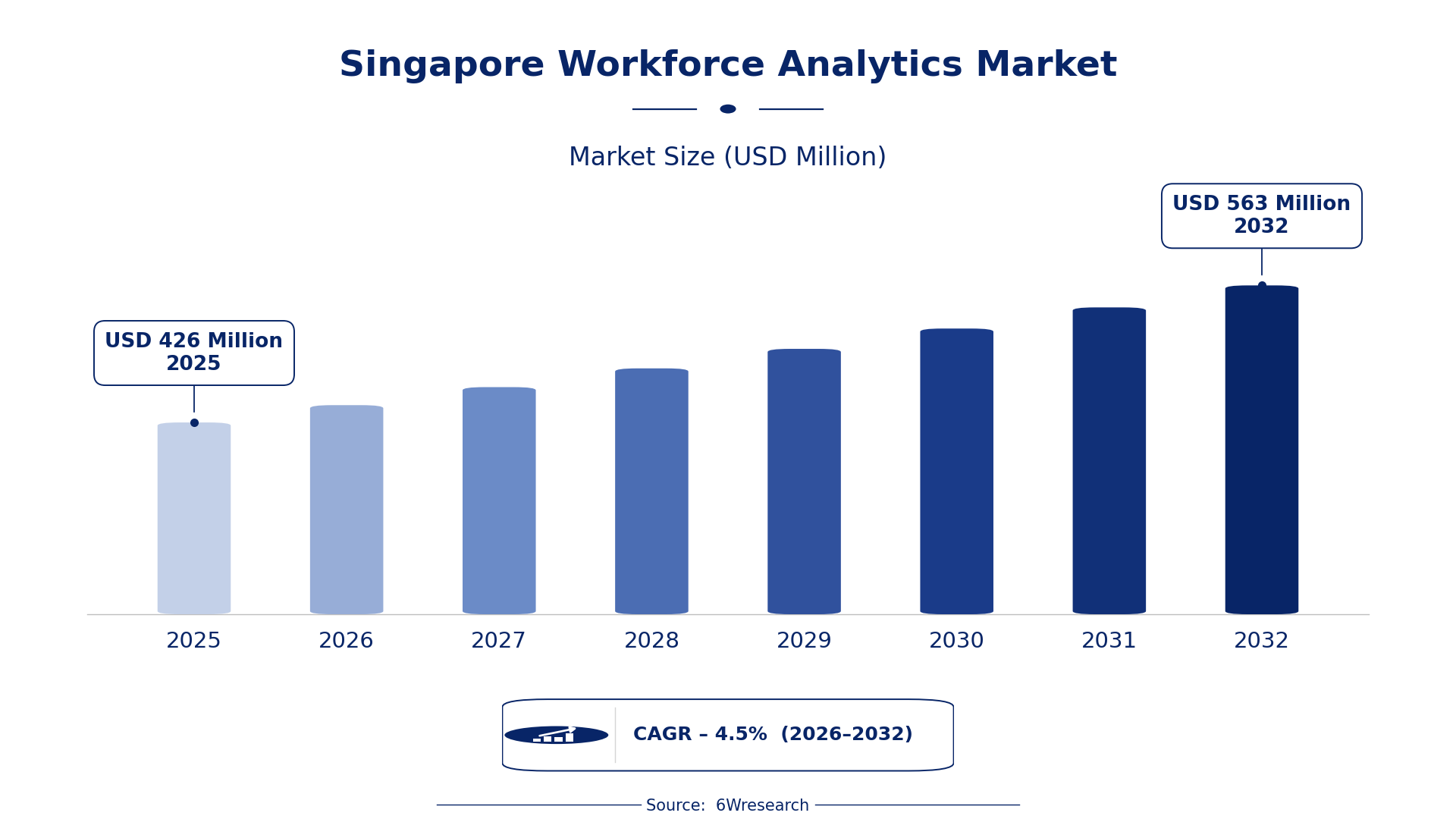
The Singapore Workforce Analytics Market was estimated at USD 426 Million in 2025 and is projected to reach USD 563 Million by 2032, growing at a CAGR of 4.5% from 2026 to 2032.
Singapore Workforce Analytics Market Synopsis
The Singapore Workforce Analytics Market is rapidly becoming a core component of strategic human resource management. Organizations in Singapore are increasingly recognizing the value of data in enhancing employee engagement, optimizing performance, and facilitating informed decision-making. This trend is fueled by a competitive labor market where talent retention is paramount.
As businesses adapt to the complexities of workforce management, the demand for sophisticated analytics tools is surging. These tools provide actionable insights into various HR dimensions, from recruitment efficacy to employee satisfaction, ultimately driving productivity and engagement. Companies are leveraging these insights to align their workforce strategies with organizational goals.
Singapore Workforce Analytics Market Year-wise Growth Rate and Key Drivers
This graph illustrates the annual growth rates of the Singapore Workforce Analytics Market from 2021 to 2032, highlighting a steady upward trajectory and projected expansion over the forecast period.
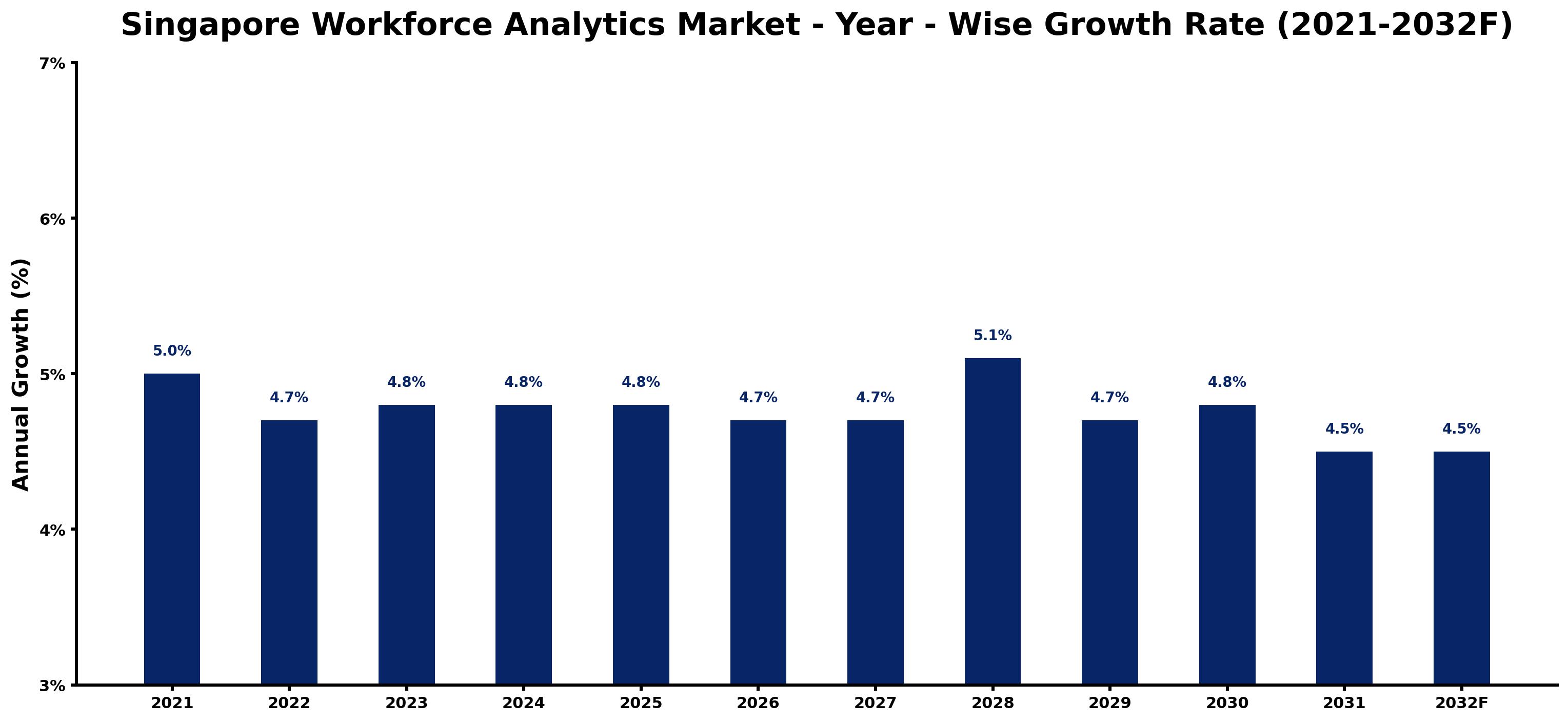
The table below presents the year‑wise growth rates along with the key drivers influencing the market
| Year | Growth Rate | Major Drivers |
| 2021 | 5.0% | Government's Smart Nation initiative boosting digital workforce solutions |
| 2022 | 4.7% | Increased demand for data-driven HR decision making |
| 2023 | 4.8% | Post-pandemic focus on remote workforce analytics adoption |
| 2024 | 4.8% | Enhanced workforce management regulations by the Ministry of Manpower |
| 2025 | 4.8% | Rising investment in employee wellbeing programs driving analytics use |
| 2026 | 4.7% | Greater emphasis on diversity and inclusion analytics practices |
| 2027 | 4.7% | Growing trend of skills gap analysis among employers |
| 2028 | 5.1% | Launch of AI-driven workforce optimization tools by startups |
| 2029 | 4.7% | Shift towards hybrid working models necessitating advanced analytics |
| 2030 | 4.8% | Increased governmental support for tech-driven HR transformation |
| 2031 | 4.5% | Ongoing digital transformation mandates driving workforce analytics growth |
| 2032 | 4.5% | Higher education sector investing in workforce predictive analytics |
Note: Market size estimations and growth projections presented in this report are based on 6Wresearch's proprietary forecasting methodology, utilizing the latest available industry data, government publications, and primary research inputs.
Singapore Workforce Analytics Market Key Takeaways
Below are some of the specific key takeaways from the market, including:
- Data-driven decision-making is critical for attracting and retaining top talent in Singapore.
- Workforce analytics tools enhance overall productivity by providing insights into employee performance.
- Organizations face challenges related to data privacy that must be carefully managed.
- The COVID-19 pandemic has accelerated the adoption of workforce analytics solutions.
- Leading vendors are continuously innovating to meet the growing demands of businesses.
Evaluation of Restraints in Singapore Workforce Analytics Market
While the Singapore Workforce Analytics Market exhibits significant growth potential, several restraints hinder its progress. Data privacy concerns remain at the forefront, as organizations must navigate stringent regulations that govern employee data usage. Companies often grapple with the ethical implications of collecting sensitive information, which can deter full-scale adoption of analytics tools. on top of that, issues related to data quality and access continue to pose challenges, impacting the reliability of insights derived from these analytics.
Singapore Workforce Analytics Market Trends
Several trends are shaping the Singapore Workforce Analytics Market. First, the emphasis on employee well-being is gaining traction, prompting organizations to utilize analytics to assess and enhance the overall workplace environment. Second, the integration of artificial intelligence into workforce analytics tools is improving predictive capabilities, allowing companies to anticipate turnover and employee needs more accurately. Lastly, the shift towards remote and hybrid work models is driving demand for analytics that support workforce flexibility and productivity tracking.
Singapore Workforce Analytics Market Opportunities
The market is ripe with opportunities for growth and investment. As businesses increasingly embrace digital transformation, the demand for advanced analytics solutions will only heighten. Companies focusing on developing customizable analytics platforms that cater to specific organizational needs are likely to thrive. on top of that, the growing interest in employee experience and engagement presents avenues for analytics that measure sentiment and satisfaction, positioning firms to respond proactively to workforce dynamics.
Government Initiatives in the Singapore Workforce Analytics Market
Government policies are playing a significant role in shaping the Singapore Workforce Analytics Market. The Singaporean government is prioritizing digital transformation across sectors, particularly in human resources. By fostering an environment conducive to innovation and data utilization, public policies are encouraging businesses to invest in workforce analytics, creating a data-centric culture within organizations.
- A national workforce digitalization program launched in early 2023 aims to enhance HR technology adoption among small and medium enterprises.
- Current initiatives include the SkillsFuture program, which provides funding for training in data analytics and HR technologies.
- Upcoming legislation expected in 2024 will mandate improved transparency in employee data usage, shaping how analytics are implemented.
- Ongoing discussions about creating a regulatory framework for ethical data use in HR practices are underway, reflecting the government’s commitment to balancing innovation with privacy concerns.
Future Insights of the Singapore Workforce Analytics Market
Looking ahead to 2026-2032, the Singapore Workforce Analytics Market is likely to continue its upward trajectory. As organizations increasingly rely on data-driven insights to guide their workforce strategies, the demand for sophisticated analytics tools will intensify. Additionally, the convergence of emerging technologies such as AI and machine learning will enhance the analytical capabilities available to HR professionals. Companies that can harness these advancements effectively will be well-positioned to attract and retain top talent in a competitive environment.
Singapore Workforce Analytics Market Latest Developments
In the last 12-14 months, the Singapore Workforce Analytics Market has seen notable activity, reflecting the urgency for organizations to adapt to changing workforce dynamics. Companies are increasingly investing in advanced analytics solutions to better understand their employees and optimize their human resource practices. This trend underscores the growing recognition of the value of data in fostering a more engaged and productive workforce.
- A major technology vendor launched an innovative workforce analytics platform in Q1 2023 that incorporates machine learning to provide real-time employee insights.
- In mid-2023, a regional HR consultancy partnered with a data analytics firm to enhance their workforce planning services, aiming to offer clients more granular insights into employee performance.
- By late 2023, a leading software provider announced an upgrade to its existing analytics tool, integrating new features that facilitate predictive analytics for talent management.
- An ongoing initiative that began in early 2023 aims to develop a comprehensive training program for HR professionals on the use of analytics in employee engagement strategies.
Singapore Workforce Analytics Market - Key Attractiveness of the Report
- 10 Years of Market Numbers
- Historical Data Starting from 2022 to 2025
- Base Year: 2025
- Forecast Data until 2032
- Key Performance Indicators Impacting the Market
- Major Upcoming Developments and Projects
Key Highlights of the Report:
- Singapore Workforce Analytics Market Outlook
- Market Size of Singapore Workforce Analytics Market, 2025
- Forecast of Singapore Workforce Analytics Market, 2032
- Historical Data and Forecast of Singapore Workforce Analytics Revenues & Volume for the Period 2022-2032F
- Singapore Workforce Analytics Market Trend Evolution
- Singapore Workforce Analytics Market Drivers and Challenges
- Singapore Workforce Analytics Price Trends
- Singapore Workforce Analytics Porter's Five Forces
- Singapore Workforce Analytics Industry Life Cycle
- Historical Data and Forecast of Singapore Workforce Analytics Market Revenues & Volume By Type for the Period 2022-2032F
- Historical Data and Forecast of Singapore Workforce Analytics Market Revenues & Volume By Solutions for the Period 2022-2032F
- Historical Data and Forecast of Singapore Workforce Analytics Market Revenues & Volume By Services for the Period 2022-2032F
- Historical Data and Forecast of Singapore Workforce Analytics Market Revenues & Volume By Deployment Type for the Period 2022-2032F
- Historical Data and Forecast of Singapore Workforce Analytics Market Revenues & Volume By Public Cloud for the Period 2022-2032F
- Historical Data and Forecast of Singapore Workforce Analytics Market Revenues & Volume By Private Cloud for the Period 2022-2032F
- Historical Data and Forecast of Singapore Workforce Analytics Market Revenues & Volume By Organization Size for the Period 2022-2032F
- Historical Data and Forecast of Singapore Workforce Analytics Market Revenues & Volume By Large Enterprise for the Period 2022-2032F
- Historical Data and Forecast of Singapore Workforce Analytics Market Revenues & Volume By Small & Medium-sized Enterprise for the Period 2022-2032F
- Historical Data and Forecast of Singapore Workforce Analytics Market Revenues & Volume By Vertical for the Period 2022-2032F
- Historical Data and Forecast of Singapore Workforce Analytics Market Revenues & Volume By BFSI for the Period 2022-2032F
- Historical Data and Forecast of Singapore Workforce Analytics Market Revenues & Volume By Energy & Utilities for the Period 2022-2032F
- Historical Data and Forecast of Singapore Workforce Analytics Market Revenues & Volume By Government & Public Sector for the Period 2022-2032F
- Historical Data and Forecast of Singapore Workforce Analytics Market Revenues & Volume By Retail for the Period 2022-2032F
- Historical Data and Forecast of Singapore Workforce Analytics Market Revenues & Volume By Healthcare for the Period 2022-2032F
- Historical Data and Forecast of Singapore Workforce Analytics Market Revenues & Volume By Telecom & IT for the Period 2022-2032F
- Historical Data and Forecast of Singapore Workforce Analytics Market Revenues & Volume By Travel & Hospitality for the Period 2022-2032F
- Historical Data and Forecast of Singapore Workforce Analytics Market Revenues & Volume By Manufacturing for the Period 2022-2032F
- Singapore Workforce Analytics Import Export Trade Statistics
- Market Opportunity Assessment By Type
- Market Opportunity Assessment By Deployment Type
- Market Opportunity Assessment By Organization Size
- Market Opportunity Assessment By Vertical
- Singapore Workforce Analytics Top Companies Market Share
- Singapore Workforce Analytics Competitive Benchmarking By Technical and Operational Parameters
- Singapore Workforce Analytics Company Profiles
- Singapore Workforce Analytics Key Strategic Recommendations






































