Slovakia Anthracite Market Top 5 Importing Countries and Market Competition (HHI) Analysis
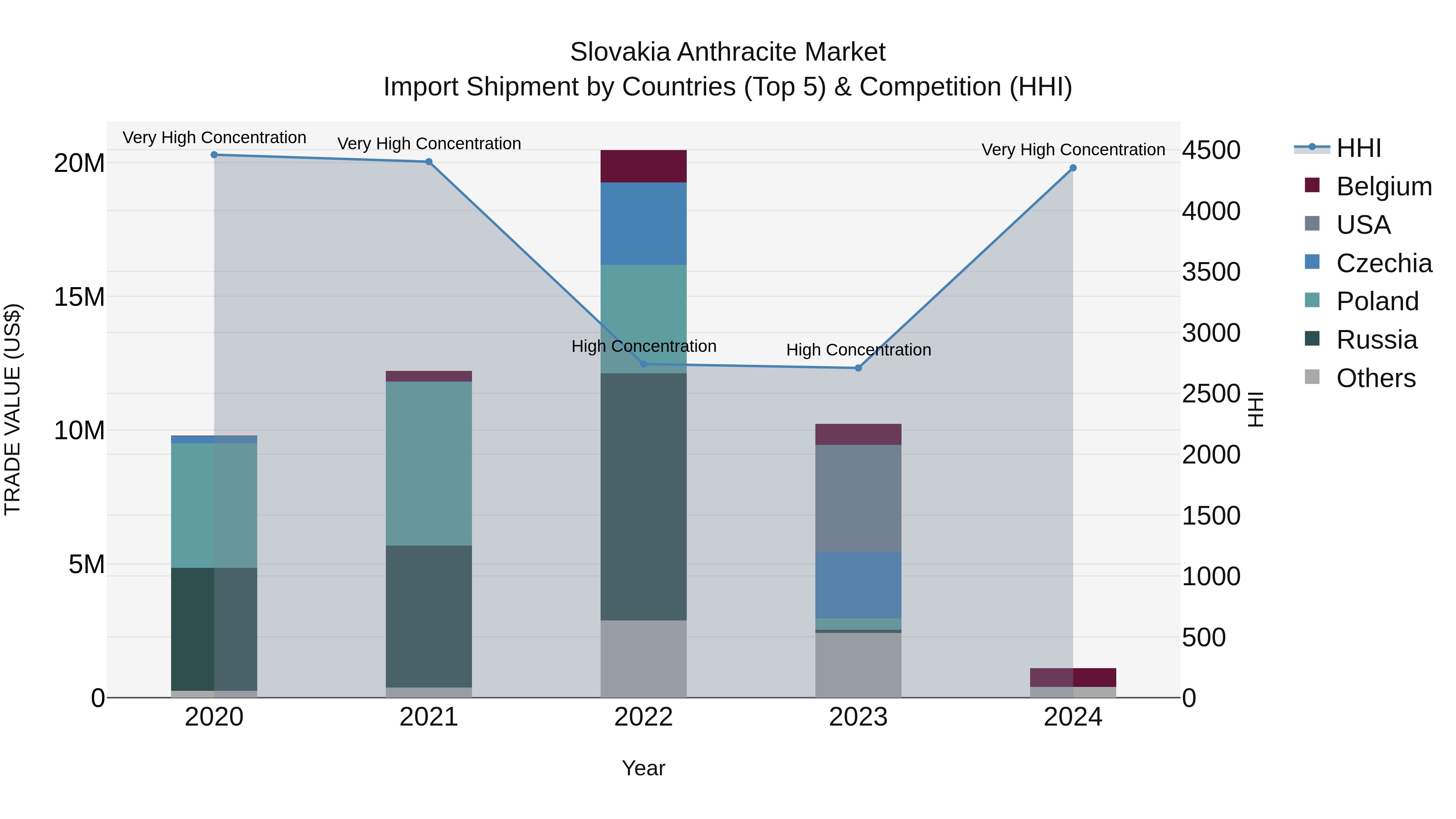
Slovakia saw a significant increase in anthracite imports in 2024, with top exporting countries including Belgium, China, Peru, and Vietnam. The Market Top 5 Importing Countries and Market Competition (HHI) Analysis exhibited a very high concentration level, indicating a dominant presence of key players. However, the industry experienced a sharp decline in both the compound annual growth rate (CAGR) and growth rate in 2024, reflecting potential challenges faced by the sector. It will be crucial for stakeholders to closely monitor Market Top 5 Importing Countries and Market Competition (HHI) Analysis dynamics and adapt strategies to navigate the changing landscape in the anthracite import Market Top 5 Importing Countries and Market Competition (HHI) Analysis in Slovakia.
Anthracite Market: Slovak Republic vs Top 5 Major Economies in 2027 (Europe)
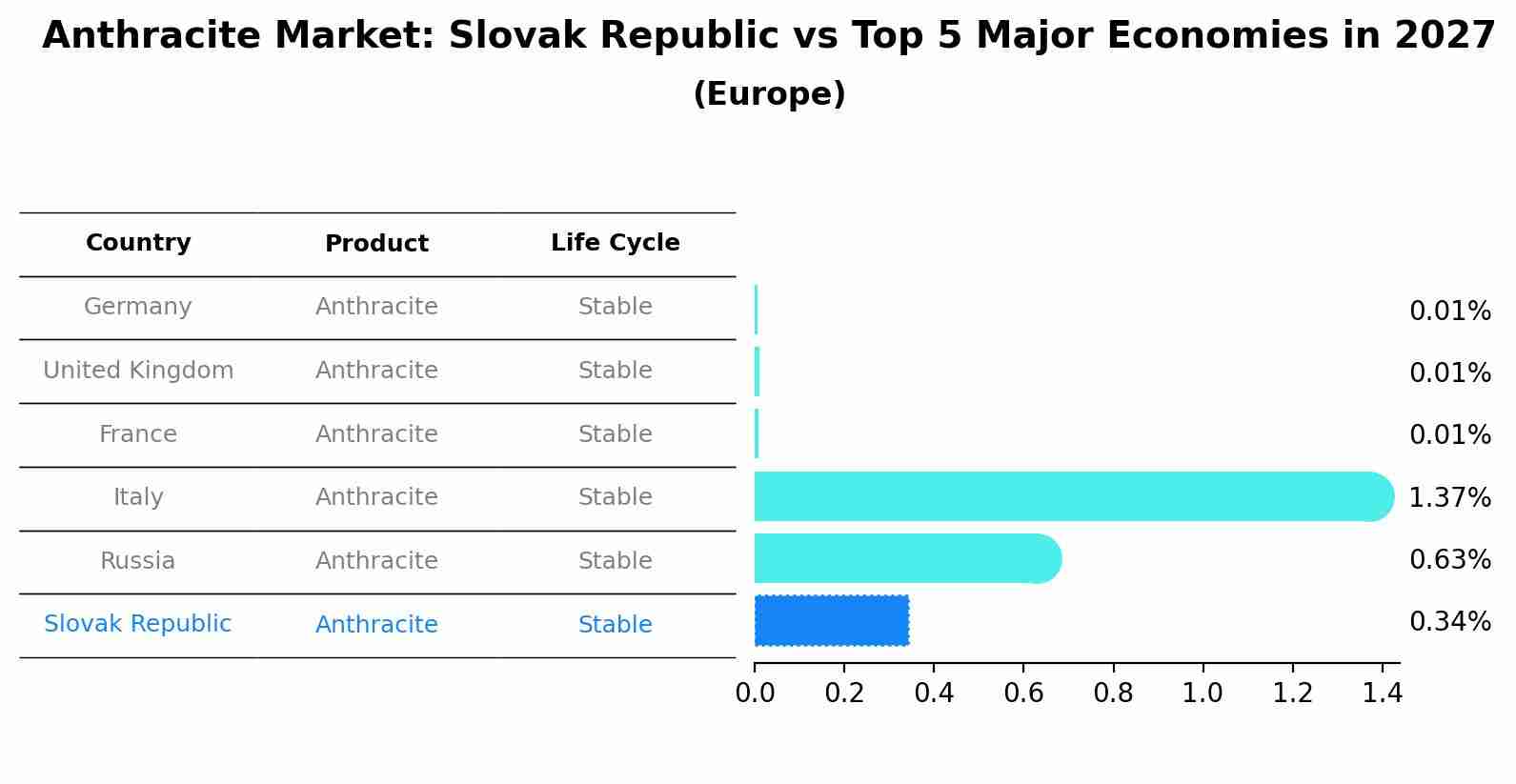
In the Europe region, the Anthracite market in Slovak Republic is projected to expand at a stable growth rate of 0.34% by 2027. The largest economy is Germany, followed by United Kingdom, France, Italy and Russia.
Slovakia Anthracite Market Overview
The Slovakia Anthracite market is relatively small but has shown steady growth in recent years. Anthracite, a type of coal known for its high carbon content and low impurities, is primarily used in residential heating and industrial applications in Slovakia. The demand for anthracite is driven by its efficiency in providing high heat output and low emissions compared to other types of coal. The market is influenced by factors such as government regulations on emissions, energy prices, and consumer preferences. Key players in the Slovakia Anthracite market include domestic coal mining companies, importers, and distributors. As the country continues to focus on reducing its carbon footprint and improving energy efficiency, the demand for anthracite is expected to remain stable or even increase in the coming years.
Slovakia Anthracite Market Trends
The Slovakia Anthracite Market is currently experiencing a growing demand due to its high carbon content and clean burning properties, making it an attractive option for industrial and residential heating applications. The market is also seeing an increasing focus on sustainable sourcing practices and environmentally friendly production methods, in line with global efforts to reduce carbon emissions. Additionally, there is a rising trend towards the utilization of anthracite in water filtration systems and as a component in manufacturing processes, driving further growth in the market. Overall, the Slovakia Anthracite Market is poised for expansion as consumers and industries seek cleaner and more efficient energy sources, with a strong emphasis on sustainability and environmental responsibility.
Slovakia Anthracite Market Challenges
In the Slovakia Anthracite Market, challenges primarily revolve around the declining demand for anthracite due to the global shift towards cleaner energy sources. The market faces pressure to adapt to more environmentally sustainable practices, which may require significant investments in technology and infrastructure. Additionally, competition from alternative fuels such as natural gas and renewable energy sources poses a threat to the anthracite market in Slovakia. Fluctuating prices and limited availability of high-quality anthracite deposits further complicate the situation for market players. To stay competitive, industry participants need to focus on innovation, diversification of product offerings, and forging strategic partnerships to navigate these challenges successfully.
Slovakia Anthracite Market Investment Opportunities
The Slovakia Anthracite Market presents promising investment opportunities due to the increasing demand for this high-quality coal primarily used in the steel industry and heating applications. With Slovakia being a significant producer of anthracite, investing in anthracite mining operations or trading companies could be lucrative. Additionally, as the country focuses on transitioning to cleaner energy sources, there may be opportunities to invest in technologies that improve the efficiency and environmental sustainability of anthracite mining and usage. Furthermore, with the European Union`s initiatives towards energy security and reducing carbon emissions, investing in Slovakia`s anthracite market could offer long-term growth potential and diversification in the energy sector. Conducting thorough market research and understanding the regulatory environment will be crucial for successful investment in the Slovakia Anthracite Market.
Slovakia Anthracite Market Government Policy
The Slovakian government has policies in place to regulate the anthracite market. These policies include environmental regulations aimed at reducing carbon emissions from anthracite production and consumption. Additionally, there are import and export regulations governing the trade of anthracite to ensure fair competition and protect domestic producers. The government also offers subsidies and incentives to promote the use of clean energy sources over anthracite, in line with EU directives for reducing greenhouse gas emissions. Overall, the government`s policies in the Slovakia anthracite market focus on balancing economic interests with environmental sustainability and compliance with international standards.
Slovakia Anthracite Market Future Outlook
The future outlook for the Slovakia Anthracite Market appears positive, driven by increasing demand for clean and efficient energy sources. Anthracite, known for its high carbon content and low impurities, is favored for its clean burning properties and high energy output. As the global focus on reducing carbon emissions intensifies, anthracite is likely to gain further traction as a preferred choice for heating and energy generation in Slovakia. Additionally, the country`s efforts to diversify its energy sources and reduce dependency on coal may create opportunities for anthracite producers. However, challenges such as competition from alternative energy sources and environmental concerns may pose a threat to the market`s growth. Overall, the Slovakia Anthracite Market is poised for steady growth in the coming years, driven by its favorable attributes and evolving energy landscape.
Key Highlights of the Report:
- Slovakia Anthracite Market Outlook
- Market Size of Slovakia Anthracite Market, 2021
- Forecast of Slovakia Anthracite Market, 2031
- Historical Data and Forecast of Slovakia Anthracite Revenues & Volume for the Period 2018 - 2031
- Slovakia Anthracite Market Trend Evolution
- Slovakia Anthracite Market Drivers and Challenges
- Slovakia Anthracite Price Trends
- Slovakia Anthracite Porter's Five Forces
- Slovakia Anthracite Industry Life Cycle
- Historical Data and Forecast of Slovakia Anthracite Market Revenues & Volume By Application for the Period 2018 - 2031
- Historical Data and Forecast of Slovakia Anthracite Market Revenues & Volume By Fuel for the Period 2018 - 2031
- Historical Data and Forecast of Slovakia Anthracite Market Revenues & Volume By Steel Making for the Period 2018 - 2031
- Historical Data and Forecast of Slovakia Anthracite Market Revenues & Volume By Sinter Plants for the Period 2018 - 2031
- Historical Data and Forecast of Slovakia Anthracite Market Revenues & Volume By Indurating Furnaces for the Period 2018 - 2031
- Historical Data and Forecast of Slovakia Anthracite Market Revenues & Volume By Furnace Coal Replacement for the Period 2018 - 2031
- Historical Data and Forecast of Slovakia Anthracite Market Revenues & Volume By Others for the Period 2018 - 2031
- Historical Data and Forecast of Slovakia Anthracite Market Revenues & Volume By End-user for the Period 2018 - 2031
- Historical Data and Forecast of Slovakia Anthracite Market Revenues & Volume By Steel for the Period 2018 - 2031
- Historical Data and Forecast of Slovakia Anthracite Market Revenues & Volume By Energy & Power for the Period 2018 - 2031
- Historical Data and Forecast of Slovakia Anthracite Market Revenues & Volume By Bricks for the Period 2018 - 2031
- Historical Data and Forecast of Slovakia Anthracite Market Revenues & Volume By Silicon & Glass for the Period 2018 - 2031
- Historical Data and Forecast of Slovakia Anthracite Market Revenues & Volume By Synthetic Fuels for the Period 2018 - 2031
- Historical Data and Forecast of Slovakia Anthracite Market Revenues & Volume By Others for the Period 2018 - 2031
- Slovakia Anthracite Import Export Trade Statistics
- Market Opportunity Assessment By Application
- Market Opportunity Assessment By End-user
- Slovakia Anthracite Top Companies Market Share
- Slovakia Anthracite Competitive Benchmarking By Technical and Operational Parameters
- Slovakia Anthracite Company Profiles
- Slovakia Anthracite Key Strategic Recommendations






































