Slovakia Contactless Payment Market Size & Growth Rate (2026-2032)
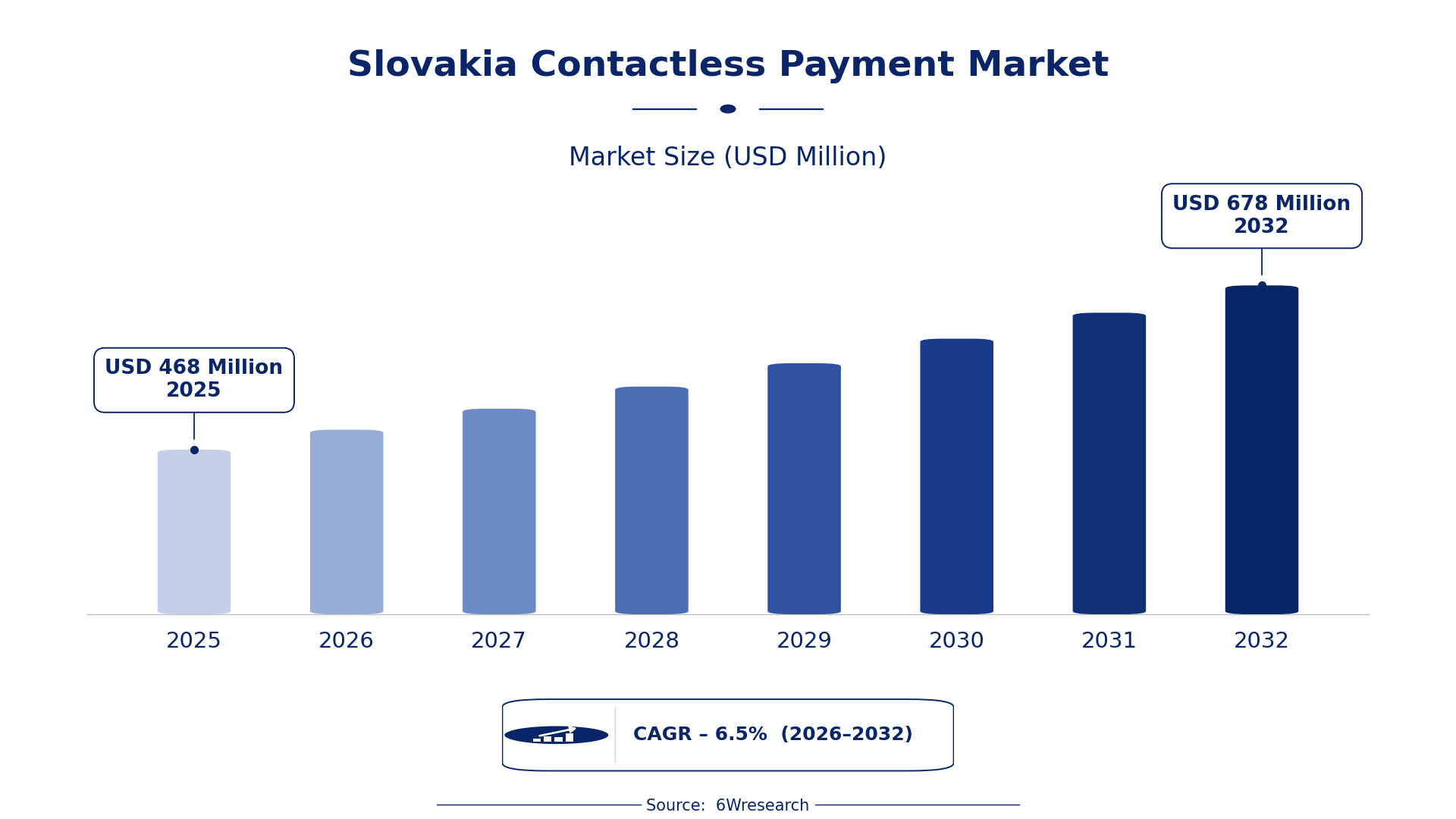
The Slovakia Contactless Payment Market was estimated at USD 468 Million in 2025 and is projected to reach USD 678 Million by 2032, growing at a CAGR of 6.5% from 2026 to 2032.
Slovakia Contactless Payment Market Synopsis
The primary driver of the Slovakia Contactless Payment Market is the increasing consumer preference for fast, secure, and convenient payment methods. This shift is largely fueled by the growing digitalization of payment systems, which has made contactless transactions not just a trend but a standard practice among consumers.
Major banks and financial institutions are actively endorsing contactless payments through the issuance of contactless cards and expanding the necessary infrastructure for acceptance. As mobile payment solutions gain traction, the market is poised for continuous growth, aligning with global trends towards cashless transactions.
Slovakia Contactless Payment Market Year-wise Growth Rate and Key Drivers
This graph illustrates the annual growth rates of the Slovakia Contactless Payment Market from 2021 to 2032, highlighting a steady upward trajectory and projected expansion over the forecast period.
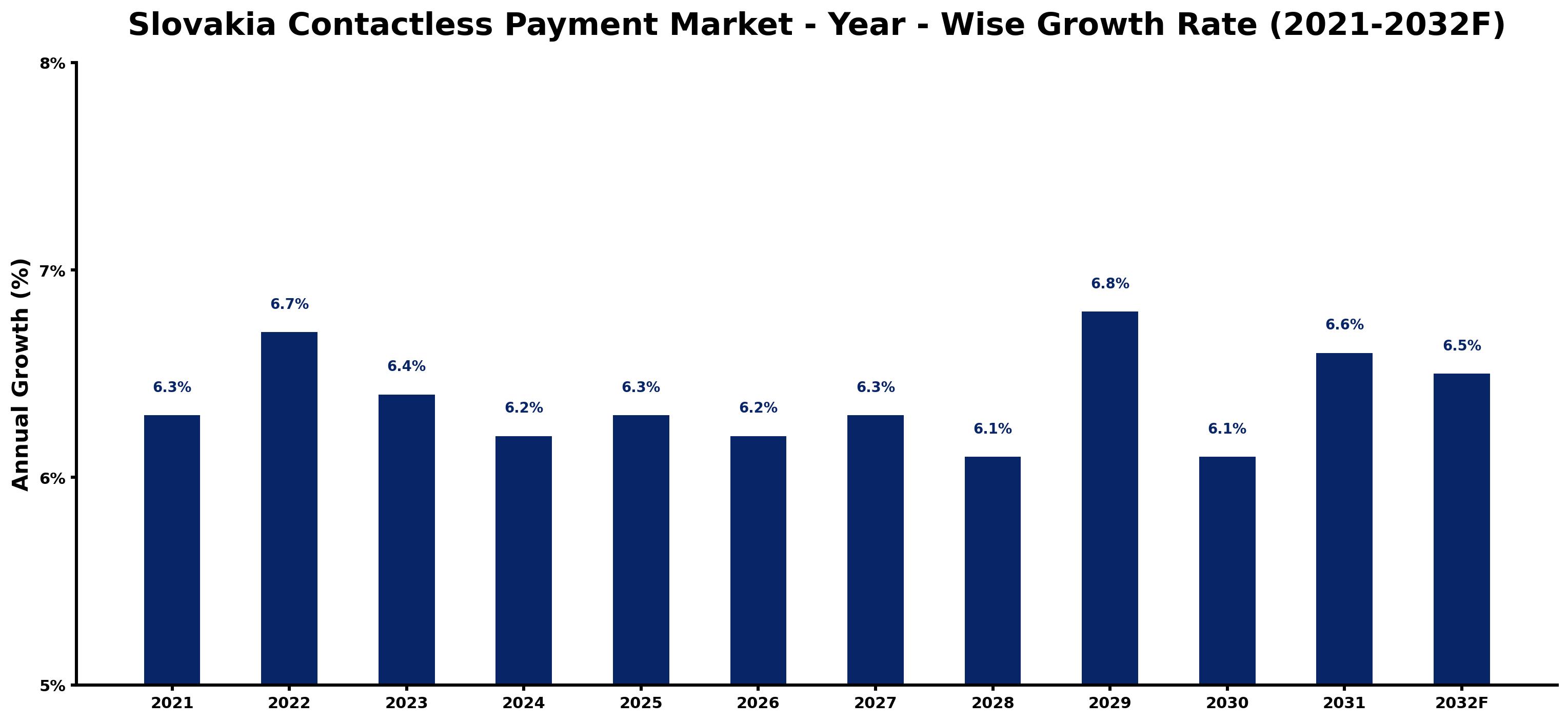
The table below presents the year‑wise growth rates along with the key drivers influencing the market
| Year | Growth Rate | Major Drivers |
| 2021 | 6.3% | Increase in mobile banking adoption among consumers |
| 2022 | 6.7% | Launch of Slovak National Bank's digital payment initiative |
| 2023 | 6.4% | Rise in contactless payment terminals in retail outlets |
| 2024 | 6.2% | Growing preference for cashless transactions post-pandemic |
| 2025 | 6.3% | Emergence of fintech companies enhancing user experience |
| 2026 | 6.2% | Proliferation of smartphone use among younger demographics |
| 2027 | 6.3% | Supportive government policies for digital payment innovations |
| 2028 | 6.1% | Investments in cybersecurity to boost consumer confidence |
| 2029 | 6.8% | Increase in travel and tourism driving payment needs |
| 2030 | 6.1% | Partnerships between banks and retailers for promotions |
| 2031 | 6.6% | Regulatory frameworks promoting faster payment solutions |
| 2032 | 6.5% | Consumer demand for seamless online and offline payments |
Note: Market size estimations and growth projections presented in this report are based on 6Wresearch's proprietary forecasting methodology, utilizing the latest available industry data, government publications, and primary research inputs.
Slovakia Contactless Payment Market Key Takeaways
Below are some of the specific key takeaways from the market, including:
- The increasing adoption of contactless payment methods reflects consumer demand for speed and convenience.
- Investment in infrastructure is critical for expanding acceptance among merchants.
- Mobile payment solutions are becoming integral to the payment ecosystem.
- Security concerns remain a barrier, necessitating enhanced measures to foster consumer trust.
- Government initiatives are crucial in promoting cashless transactions and supporting market growth.
Evaluation of Restraints in Slovakia Contactless Payment Market
The Slovakia Contactless Payment Market faces several restraints that hinder its growth potential. A notable challenge is the limited consumer awareness surrounding contactless payment technology, which leads to a preference for traditional methods. Many users still harbor skepticism regarding the security of contactless transactions, contributing to a slow adoption rate.
Additionally, the infrastructure for contactless payments, especially in smaller businesses and rural areas, is not sufficiently developed. This lack of terminals limits acceptance, creating a fragmented market where many consumers cannot utilize contactless options. Addressing these issues will be crucial for achieving broader market penetration.
Slovakia Contactless Payment Market Trends
The trend towards contactless payments is gaining momentum, driven by both consumer preferences and merchant adaptations. The COVID-19 pandemic has notably accelerated this shift, as many consumers are seeking to minimize physical contact during transactions. As a result, retailers are increasingly adopting contactless payment systems to meet evolving consumer expectations.
on top of that, the integration of contactless technology into smartphones and wearables is reshaping the way consumers engage with payments, making contactless transactions more accessible than ever. This evolution is likely to continue as technology advances and consumer habits evolve.
Slovakia Contactless Payment Market Opportunities
Investment opportunities abound in the Slovakia Contactless Payment Market, primarily driven by the growing consumer inclination towards cashless transactions. Payment processing companies and fintech startups focused on innovative solutions stand to benefit significantly as the market expands.
There is also a strong potential for partnerships with retailers to enhance contactless payment acceptance and for technology providers to develop infrastructure that supports the burgeoning demand. Given the regulatory support for cashless initiatives, the landscape is favorable for strategic investments.
Government Initiatives in the Slovakia Contactless Payment Market
The Slovak government has recognized the importance of promoting contactless payments as part of its broader strategy to reduce cash dependency and modernize the payment ecosystem. Regulatory frameworks are being established to ensure the safe adoption of contactless technology, emphasizing the need for secure transactions.
- A national program was launched in 2025 to enhance public awareness about the benefits of contactless payments.
- Ongoing efforts by the National Bank of Slovakia focus on setting transaction limits to safeguard consumers against potential fraud.
- Current initiatives encourage banks to invest in the necessary infrastructure to support widespread contactless acceptance.
- A planned public-private partnership is expected to expand the availability of contactless payment terminals by 2026.
Future Insights of the Slovakia Contactless Payment Market
Looking ahead to 2026-2032, the Slovakia Contactless Payment Market is likely to experience sustained growth, driven by ongoing technological advancements and changing consumer behaviors. The trend towards cashless transactions will continue to gain traction, supported by both consumer preferences and government policies aimed at enhancing payment efficiencies.
As more retailers adopt contactless payment solutions and consumer confidence grows, transaction volumes are expected to rise significantly. The integration of contactless capabilities into an increasing array of devices will further propel this momentum, positioning the market for robust expansion in the coming years.
Slovakia Contactless Payment Market Latest Developments
In the past year, the Slovakia Contactless Payment Market has seen substantial activity, with various developments aimed at enhancing the payment ecosystem. The push for contactless solutions has been driven by both consumer demand and technological innovations that make transactions more efficient and secure.
- A major technology vendor announced a new payment processing solution, launched in early 2025, enabling enhanced security features for contactless transactions.
- In mid-2025, a leading regional operator began an extensive rollout of contactless payment terminals across urban and rural areas, improving accessibility.
- An initiative that started in late 2024 focused on training merchants in adopting contactless payment technologies, and it remains underway.
- A planned update to the national payment infrastructure is expected to begin in the second half of 2026, aiming to integrate advanced security protocols.
Slovakia Contactless Payment Market - Key Attractiveness of the Report
- 10 Years of Market Numbers
- Historical Data Starting from 2022 to 2025
- Base Year: 2025
- Forecast Data until 2032
- Key Performance Indicators Impacting the Market
- Major Upcoming Developments and Projects
Key Highlights of the Report:
- Slovakia Contactless Payment Market Outlook
- Market Size of Slovakia Contactless Payment Market, 2025
- Forecast of Slovakia Contactless Payment Market, 2032
- Historical Data and Forecast of Slovakia Contactless Payment Revenues & Volume for the Period 2022-2032F
- Slovakia Contactless Payment Market Trend Evolution
- Slovakia Contactless Payment Market Drivers and Challenges
- Slovakia Contactless Payment Price Trends
- Slovakia Contactless Payment Porter's Five Forces
- Slovakia Contactless Payment Industry Life Cycle
- Historical Data and Forecast of Slovakia Contactless Payment Market Revenues & Volume By Component for the Period 2022-2032F
- Historical Data and Forecast of Slovakia Contactless Payment Market Revenues & Volume By Hardware for the Period 2022-2032F
- Historical Data and Forecast of Slovakia Contactless Payment Market Revenues & Volume By Solutions for the Period 2022-2032F
- Historical Data and Forecast of Slovakia Contactless Payment Market Revenues & Volume By Services for the Period 2022-2032F
- Historical Data and Forecast of Slovakia Contactless Payment Market Revenues & Volume By Vertical for the Period 2022-2032F
- Historical Data and Forecast of Slovakia Contactless Payment Market Revenues & Volume By Retail for the Period 2022-2032F
- Historical Data and Forecast of Slovakia Contactless Payment Market Revenues & Volume By Hospitality for the Period 2022-2032F
- Historical Data and Forecast of Slovakia Contactless Payment Market Revenues & Volume By Healthcare for the Period 2022-2032F
- Historical Data and Forecast of Slovakia Contactless Payment Market Revenues & Volume By Energy and Utilities for the Period 2022-2032F
- Historical Data and Forecast of Slovakia Contactless Payment Market Revenues & Volume By Transportation and Logistics for the Period 2022-2032F
- Historical Data and Forecast of Slovakia Contactless Payment Market Revenues & Volume By BFSI for the Period 2022-2032F
- Historical Data and Forecast of Slovakia Contactless Payment Market Revenues & Volume By Others (Government, telecommunications, and education) for the Period 2022-2032F
- Slovakia Contactless Payment Import Export Trade Statistics
- Market Opportunity Assessment By Component
- Market Opportunity Assessment By Vertical
- Slovakia Contactless Payment Top Companies Market Share
- Slovakia Contactless Payment Competitive Benchmarking By Technical and Operational Parameters
- Slovakia Contactless Payment Company Profiles
- Slovakia Contactless Payment Key Strategic Recommendations






































