Slovakia Interior Design Market Size, Share & Growth Rate
The Slovakia Interior Design Market was estimated at USD 878 Million in 2025 and is projected to reach USD 1261 Million by 2032, growing at a CAGR of 5.3% from 2026 to 2032. This growth is primarily driven by increasing disposable incomes among Slovak consumers, which are translating into greater expenditure on residential and commercial spaces. Additionally, the rising trend of sustainable living is pushing both designers and consumers toward eco-friendly materials and practices.
Slovakia Interior Design Market Year-wise Growth Rate and Key Drivers
This graph highlights how the Slovakia Interior Design Market has steadily grown over the years, supported by major growth factors.
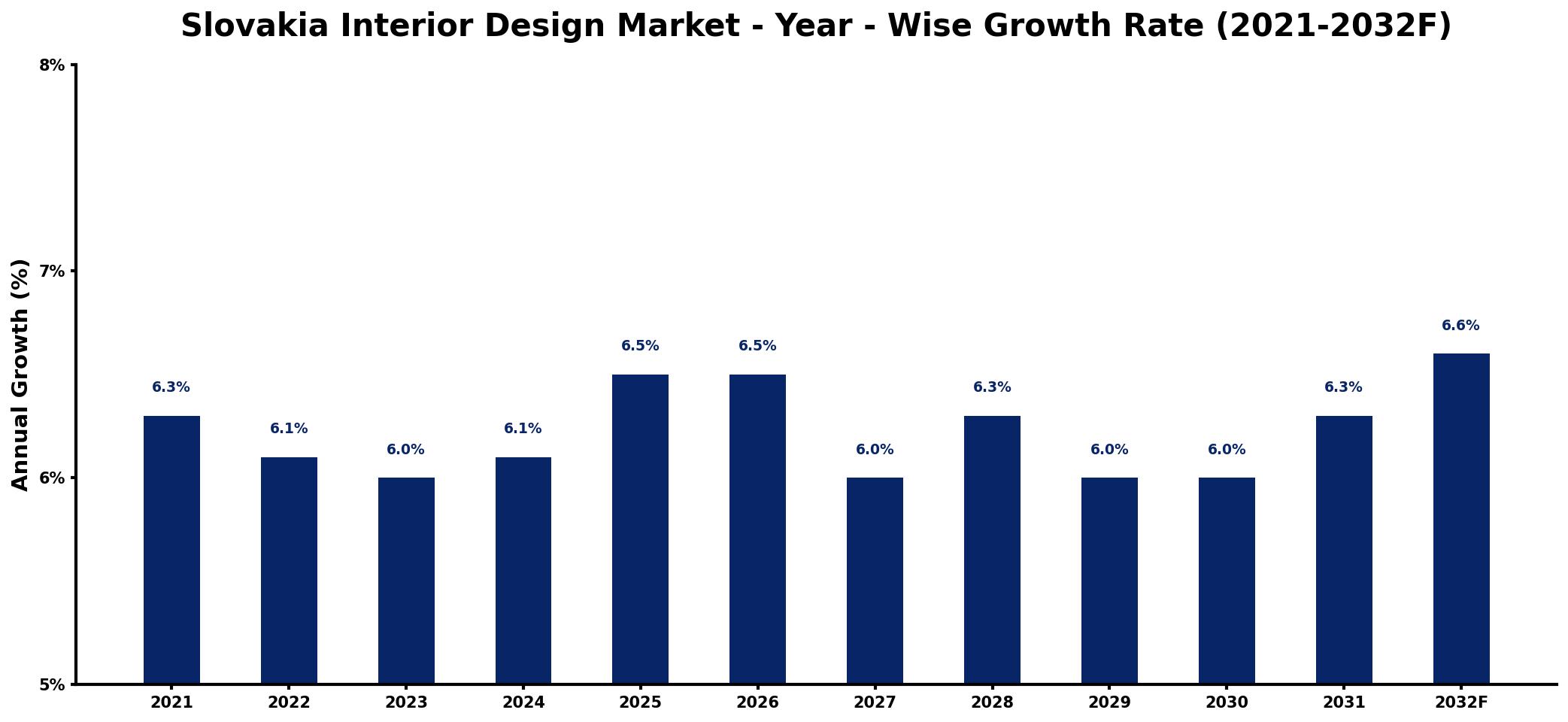
The table below presents the year‑wise growth rates along with the key drivers influencing the market
| Year | Growth Rate | Major Drivers |
| 2021 | 6.3% | Rising residential renovation projects |
| 2022 | 6.1% | Growth in sustainable materials usage |
| 2023 | 6.0% | Increase in remote workspaces demand |
| 2024 | 6.1% | Expansion of luxury housing market |
| 2025 | 6.5% | Surge in eco-friendly innovations |
| 2026 | 6.5% | Emergence of smart home technologies |
| 2027 | 6.0% | expanding healthcare application demand |
| 2028 | 6.3% | growing commercial sector adoption |
| 2029 | 6.0% | Boost in hospitality sector renovations |
| 2030 | 6.0% | Rising interest in minimalistic styles |
| 2031 | 6.3% | rising procurement volume requirements |
| 2032 | 6.6% | growing automotive sector requirements |
Note: Market size estimations and growth projections presented in this report are based on 6Wresearch's proprietary forecasting methodology, utilizing the latest available industry data, government publications, and primary research inputs.
Slovakia Interior Design Market Synopsis
The growing demand for modern and functional design solutions is reshaping the Slovakia interior design landscape. With a focus on aesthetics and practicality, clients are increasingly seeking personalized and unique spaces that reflect their individual lifestyles.
The surge in disposable incomes is enabling a broader segment of the population to invest in interior design services, contributing to a rise in the number of firms catering to diverse needs, from residential to commercial projects. This evolution not only emphasizes aesthetic appeal but also elevates the importance of sustainability in design choices.
Slovakia Interior Design Market Key Takeaways
- The market is moving towards eco-friendly practices, emphasizing sustainable materials and energy efficiency.
- Technological advancements are increasingly integrated into design processes, with smart home features becoming more prevalent.
- There is a strong consumer preference for minimalist and Scandinavian styles, focusing on clean lines and functionality.
- The industry is adapting to the demand for personalized design solutions that cater to individual lifestyles.
- Investment in innovative technologies and sustainable practices is essential for firms aiming to capture market share.
Evaluation of Restraints in Slovakia Interior Design Market
While the Slovakia interior design market is witnessing substantial growth, it is not without challenges. The competitive landscape has intensified, with numerous domestic and international firms vying for market share. This increased competition can dilute brand identity and complicate client acquisition. Moreover, fluctuating economic conditions can influence consumer spending behaviors, causing variability in demand for design services. Additionally, the absence of standardized regulations often results in inconsistent service quality, impacting client trust and satisfaction. Lastly, sourcing sustainable materials remains a logistical challenge, which can hinder the shift towards eco-conscious designs.
Slovakia Interior Design Market Trends
Current trends indicate a pronounced shift towards sustainability and eco-friendliness within the Slovakia interior design market. The emphasis on natural materials and energy-efficient solutions is resonating with environmentally conscious consumers. Furthermore, there is an observable preference for minimalist and Scandinavian design aesthetics, characterized by simplicity and functionality. Technological integration is also prominent, with features like smart home automation gaining traction in both residential and commercial projects, enhancing convenience and energy management.
Slovakia Interior Design Market Opportunities
The Slovakia interior design market presents several lucrative investment opportunities. With a robust consumer trend towards sustainable living, businesses that focus on eco-friendly materials and practices stand to gain a competitive edge. Additionally, the increasing interest in smart home technologies offers a promising avenue for firms willing to innovate and incorporate these advancements into their design solutions. The hospitality sector, in particular, is ripe for unique and luxurious design concepts, catering to the growing influx of tourists and the demand for memorable guest experiences.
Government Initiatives in the Slovakia Interior Design Market
The Slovak government plays an active role in promoting the interior design sector through various initiatives aimed at fostering innovation, sustainability, and quality standards. Policies encourage the use of eco-friendly materials and energy-efficient technologies in design projects, aligning with national environmental objectives. Support for skill development and training programs is also evident, aimed at enhancing the professionalism within the interior design industry and ensuring that practitioners can meet the evolving needs of consumers effectively.
Future Insights of the Slovakia Interior Design Market
The future of the Slovakia interior design market appears bright, characterized by evolving consumer preferences for unique and functional living spaces. As disposable incomes continue to rise, demand for innovative design solutions that blend aesthetics with sustainability will likely increase. The integration of advanced technologies like virtual and augmented reality is set to revolutionize client interactions and project visualization. As environmental consciousness deepens, the emphasis on eco-friendly practices will further shape market dynamics, leading to a creative and adaptive industry landscape.
Slovakia Interior Design Market Latest Developments (2025 - 2026)
Recent trends in the Slovakia interior design market showcase a growing emphasis on collaborative design processes, with designers increasingly partnering with clients to co-create unique spaces. Innovations in materials science have led to the introduction of new sustainable products that cater to the market's eco-conscious demand. Furthermore, the rise of online platforms for virtual consultations and 3D modeling is enhancing client engagement, making the design process more accessible and streamlined. As these trends continue, the market is positioned for dynamic growth and transformation.
Slovakia Interior Design Market - Key Attractiveness of the Report
- 10 Years of Market Numbers
- Historical Data Starting from 2022 to 2025
- Base Year: 2025
- Forecast Data until 2032
- Key Performance Indicators Impacting the Market
- Major Upcoming Developments and Projects
Key Highlights of the Report:
- Slovakia Interior Design Market Outlook
- Market Size of Slovakia Interior Design Market, 2025
- Forecast of Slovakia Interior Design Market, 2032
- Historical Data and Forecast of Slovakia Interior Design Revenues & Volume for the Period 2022-2032F
- Slovakia Interior Design Market Trend Evolution
- Slovakia Interior Design Market Drivers and Challenges
- Slovakia Interior Design Price Trends
- Slovakia Interior Design Porter's Five Forces
- Slovakia Interior Design Industry Life Cycle
- Historical Data and Forecast of Slovakia Interior Design Market Revenues & Volume By End Use for the Period 2022-2032F
- Historical Data and Forecast of Slovakia Interior Design Market Revenues & Volume By Commercial for the Period 2022-2032F
- Historical Data and Forecast of Slovakia Interior Design Market Revenues & Volume By Residential for the Period 2022-2032F
- Historical Data and Forecast of Slovakia Interior Design Market Revenues & Volume By Decoration Type for the Period 2022-2032F
- Historical Data and Forecast of Slovakia Interior Design Market Revenues & Volume By New for the Period 2022-2032F
- Historical Data and Forecast of Slovakia Interior Design Market Revenues & Volume By Renovations for the Period 2022-2032F
- Slovakia Interior Design Import Export Trade Statistics
- Market Opportunity Assessment By End Use
- Market Opportunity Assessment By Decoration Type
- Slovakia Interior Design Top Companies Market Share
- Slovakia Interior Design Competitive Benchmarking By Technical and Operational Parameters
- Slovakia Interior Design Company Profiles
- Slovakia Interior Design Key Strategic Recommendations






































