Slovakia Printed Electronics Market Size, Share & Growth Rate
The Slovakia Printed Electronics Market was estimated at USD 195 Million in 2025 and is projected to reach USD 268 Million by 2032, growing at a CAGR of 4.6% from 2026 to 2032. This growth trajectory is significantly influenced by increasing applications of flexible electronics across key sectors such as healthcare and automotive, where efficiency and lightweight solutions are paramount. Additionally, the burgeoning Internet of Things (IoT) market is creating substantial opportunities for innovative printed electronics solutions, enhancing their adoption across various industries.
Slovakia Printed Electronics Market Year-wise Growth Rate and Key Drivers
This graph highlights how the Slovakia Printed Electronics Market has steadily grown over the years, supported by major growth factors.
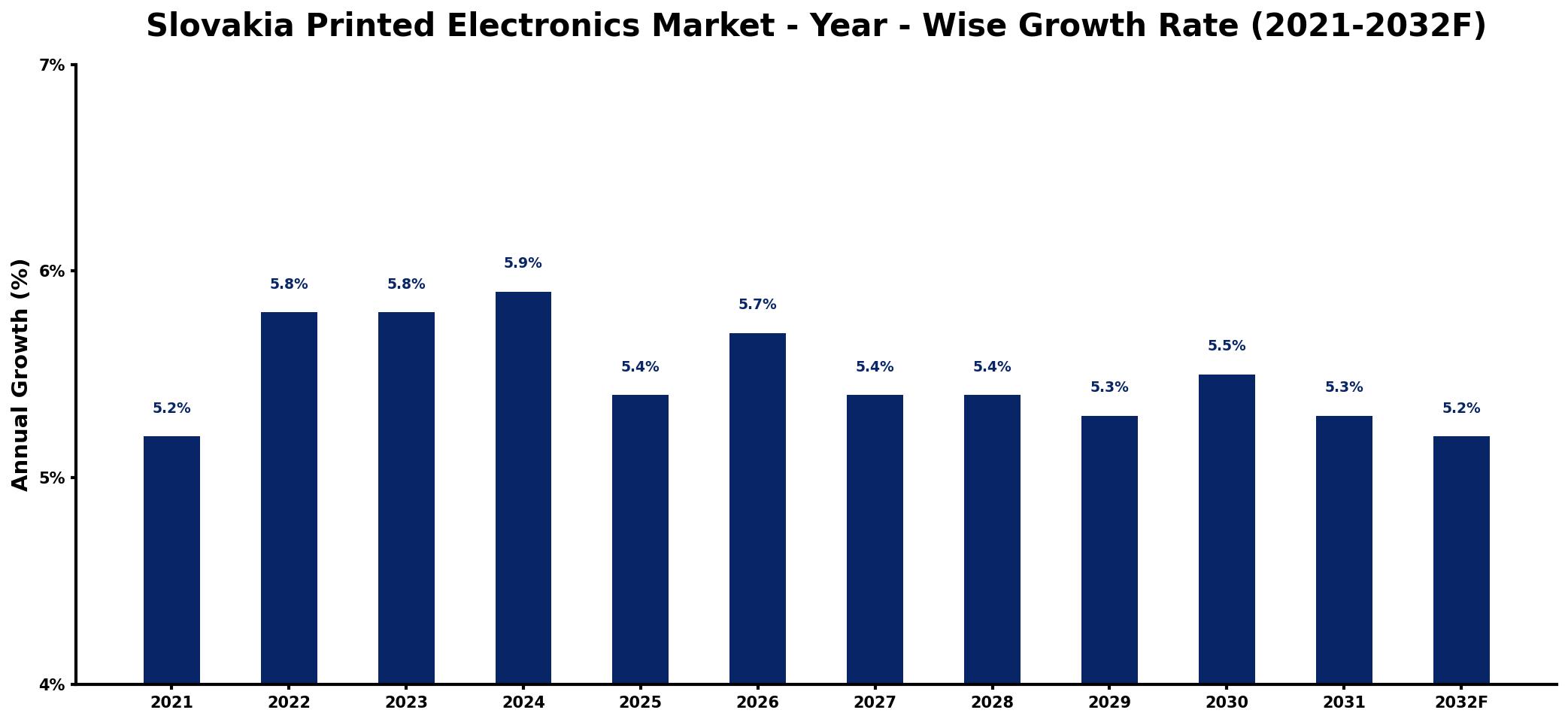
The table below presents the year‑wise growth rates along with the key drivers influencing the market
| Year | Growth Rate | Major Drivers |
| 2021 | 5.2% | Rising demand in packaging sector |
| 2022 | 5.8% | Increased investments in technology |
| 2023 | 5.8% | Expansion of renewable energy applications |
| 2024 | 5.9% | Growth in automotive innovations |
| 2025 | 5.4% | Surge in healthcare applications |
| 2026 | 5.7% | Advancements in wearable technology |
| 2027 | 5.4% | Enhancements in smart textiles |
| 2028 | 5.4% | Development of IoT solutions |
| 2029 | 5.3% | Integration with consumer goods |
| 2030 | 5.5% | Focus on sustainable materials |
| 2031 | 5.3% | Emergence of new startups |
| 2032 | 5.2% | increased domestic production output |
Note: Market size estimations and growth projections presented in this report are based on 6Wresearch's proprietary forecasting methodology, utilizing the latest available industry data, government publications, and primary research inputs.
Slovakia Printed Electronics Market Synopsis
The Slovakia Printed Electronics Market is currently experiencing a dynamic shift, marked by rising investments in research and development of advanced electronic solutions. The emphasis on sustainability and eco-friendly materials is reshaping product offerings and driving demand across multiple industries. Innovations in printing technology are further expanding the applications of printed electronics.
Industry players are focused on integrating cutting-edge technologies like OLED displays and printed sensors, responding to the growing demand for innovative solutions that meet consumer needs. With government support fostering collaboration and investment, the market is well-positioned for significant growth in the coming years.
Slovakia Printed Electronics Market Key Takeaways
- The market is projected to grow from USD 195 Million in 2025 to USD 268 Million by 2032.
- Increasing demand for flexible electronics in healthcare and automotive sectors is driving growth.
- Adoption of sustainable and recyclable materials is becoming a key trend in product development.
- Ongoing advancements in printing technologies are enhancing the versatility of printed electronics.
- Government initiatives are providing financial support for R&D and innovation in the sector.
Evaluation of Restraints in Slovakia Printed Electronics Market
Despite the positive outlook for the Slovakia Printed Electronics Market, several restraints could impede growth. One notable limitation is the insufficient understanding of printed electronics technologies among potential end-users, which may result in resistance to adopting these innovative solutions. Furthermore, the higher initial costs associated with implementing such technologies can discourage smaller businesses from investing. Additionally, a shortage of skilled professionals in the field complicates the design and production of printed electronic components. Addressing these challenges through education and strategic partnerships will be essential for market expansion.
Slovakia Printed Electronics Market Trends
Several trends are shaping the Slovakia Printed Electronics Market, notably the rising preference for flexible and lightweight electronic devices. This is particularly evident in healthcare applications, where wearable technology is gaining traction. Printed sensors, OLED displays, and RFID tags are increasingly popular for their cost-effectiveness and versatility, aligning with the shift toward smart packaging solutions. The emphasis on sustainability has also led to a surge in demand for eco-friendly materials, further driving innovation in the sector.
Slovakia Printed Electronics Market Opportunities
The landscape of investment opportunities within the Slovakia Printed Electronics Market is promising, especially in healthcare, automotive, consumer electronics, and smart packaging sectors. As technological advancements continue to reshape the industry, the need for printed electronics solutions will only intensify. Companies focusing on developing conductive inks, flexible displays, and sensors are well-positioned for growth. Furthermore, collaboration with research institutions and aligning with government initiatives supporting innovation can enhance competitive advantages for stakeholders.
Government Initiatives in the Slovakia Printed Electronics Market
The Slovak government is actively fostering the growth of the Printed Electronics Market through various supportive policies. These initiatives include R&D tax incentives aimed at encouraging investments in innovative technologies. Moreover, the government is providing grants and funding opportunities for businesses venturing into the development and commercialization of printed electronics products. Collaborations with research institutions also play a crucial role in enhancing knowledge and driving advancements in the field.
Future Insights of the Slovakia Printed Electronics Market
Looking ahead to 2026-2032, the Slovakia Printed Electronics Market is positioned for steady growth, largely attributed to the continuous demand for flexible electronic devices. Innovations in printed electronics are expected to enhance product performance while reducing costs. The integration of IoT applications and smart wearables will play a pivotal role in driving market expansion. However, addressing the knowledge gap regarding printed electronics technology will be critical for sustaining this momentum and maximizing the potential of the market.
Slovakia Printed Electronics Market Latest Developments (2025 - 2026)
Recent developments within the Slovakia Printed Electronics Market indicate a growing focus on sustainability and eco-friendly practices. Companies are increasingly exploring biodegradable materials and recyclable products to align with consumer preferences and environmental goals. Furthermore, advancements in printing technology are allowing for more intricate designs and applications, particularly in the areas of smart packaging and IoT solutions. Collaborative efforts among industry players and research institutions are also yielding innovative products that are set to redefine market dynamics.
Slovakia Printed Electronics Market - Key Attractiveness of the Report
- 10 Years of Market Numbers
- Historical Data Starting from 2022 to 2025
- Base Year: 2025
- Forecast Data until 2032
- Key Performance Indicators Impacting the Market
- Major Upcoming Developments and Projects
Key Highlights of the Report:
- Slovakia Printed Electronics Market Outlook
- Market Size of Slovakia Printed Electronics Market, 2025
- Forecast of Slovakia Printed Electronics Market, 2032
- Historical Data and Forecast of Slovakia Printed Electronics Revenues & Volume for the Period 2022-2032F
- Slovakia Printed Electronics Market Trend Evolution
- Slovakia Printed Electronics Market Drivers and Challenges
- Slovakia Printed Electronics Price Trends
- Slovakia Printed Electronics Porter's Five Forces
- Slovakia Printed Electronics Industry Life Cycle
- Historical Data and Forecast of Slovakia Printed Electronics Market Revenues & Volume By Material for the Period 2022-2032F
- Historical Data and Forecast of Slovakia Printed Electronics Market Revenues & Volume By Ink for the Period 2022-2032F
- Historical Data and Forecast of Slovakia Printed Electronics Market Revenues & Volume By Substrate for the Period 2022-2032F
- Historical Data and Forecast of Slovakia Printed Electronics Market Revenues & Volume By Technology for the Period 2022-2032F
- Historical Data and Forecast of Slovakia Printed Electronics Market Revenues & Volume By Screen for the Period 2022-2032F
- Historical Data and Forecast of Slovakia Printed Electronics Market Revenues & Volume By Inkjet for the Period 2022-2032F
- Historical Data and Forecast of Slovakia Printed Electronics Market Revenues & Volume By Flexographic for the Period 2022-2032F
- Historical Data and Forecast of Slovakia Printed Electronics Market Revenues & Volume By Gravure for the Period 2022-2032F
- Historical Data and Forecast of Slovakia Printed Electronics Market Revenues & Volume By Device for the Period 2022-2032F
- Historical Data and Forecast of Slovakia Printed Electronics Market Revenues & Volume By Displays for the Period 2022-2032F
- Historical Data and Forecast of Slovakia Printed Electronics Market Revenues & Volume By Photovoltaic for the Period 2022-2032F
- Historical Data and Forecast of Slovakia Printed Electronics Market Revenues & Volume By Lighting for the Period 2022-2032F
- Historical Data and Forecast of Slovakia Printed Electronics Market Revenues & Volume By RFID for the Period 2022-2032F
- Historical Data and Forecast of Slovakia Printed Electronics Market Revenues & Volume By Others for the Period 2022-2032F
- Slovakia Printed Electronics Import Export Trade Statistics
- Market Opportunity Assessment By Material
- Market Opportunity Assessment By Technology
- Market Opportunity Assessment By Device
- Slovakia Printed Electronics Top Companies Market Share
- Slovakia Printed Electronics Competitive Benchmarking By Technical and Operational Parameters
- Slovakia Printed Electronics Company Profiles
- Slovakia Printed Electronics Key Strategic Recommendations






































