Slovakia Table Olives Market Top 5 Importing Countries and Market Competition (HHI) Analysis
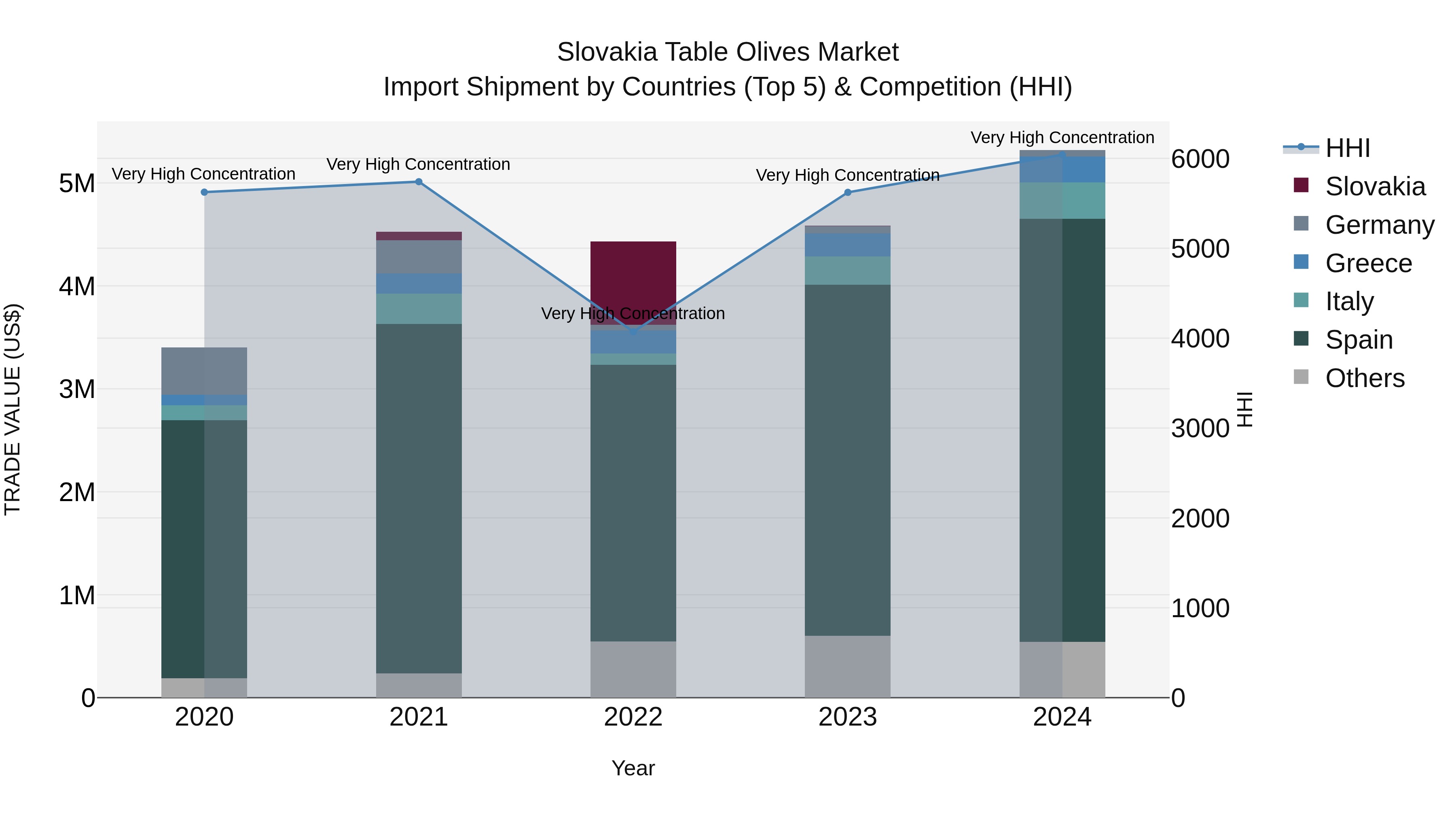
Slovakia`s table olives import Market Top 5 Importing Countries and Market Competition (HHI) Analysis continued to show strong growth in 2024, with Spain, Italy, Greece, Czechia, and Poland emerging as the top exporting countries. The high concentration in the Market Top 5 Importing Countries and Market Competition (HHI) Analysis, as indicated by the high Herfindahl-Hirschman Index (HHI), suggests a competitive landscape dominated by these key players. The impressive compound annual growth rate (CAGR) of 11.8% from 2020 to 2024 reflects the increasing demand for table olives in Slovakia. Furthermore, the growth rate of 16.0% in 2024 highlights the ongoing expansion and opportunities within the Market Top 5 Importing Countries and Market Competition (HHI) Analysis for both domestic and international suppliers.
Slovakia Table Olives Market Synopsis
The Slovakia table olives market is characterized by a growing demand for high-quality olives among consumers seeking healthy and flavorful food options. While traditionally not a major olive-producing region, Slovakia has shown an increasing interest in importing table olives from countries like Spain, Greece, and Italy. The market is predominantly driven by the rising awareness of the health benefits associated with olives, such as their high content of monounsaturated fats and antioxidants. Key players in the Slovakia table olives market include both domestic retailers and international brands looking to capitalize on the growing demand for Mediterranean cuisine ingredients. Additionally, the market is witnessing a trend towards organic and gourmet varieties of table olives, catering to a niche segment of health-conscious and discerning consumers.
Slovakia Table Olives Market Trends
The Slovakia Table Olives Market is experiencing a growing demand for healthier food options among consumers, leading to an increased interest in Mediterranean cuisine and its staple ingredient, olives. This trend is driving the market towards a wider variety of olive products, such as stuffed olives, marinated olives, and flavored olives, catering to different consumer preferences. Additionally, there is a rising awareness of the health benefits of olives, including their high antioxidant content and potential cardiovascular benefits, which is further boosting their popularity in the market. Opportunities exist for market players to innovate in terms of flavors and packaging to attract a wider consumer base, as well as to expand distribution channels to reach more retail outlets and foodservice establishments across Slovakia.
Slovakia Table Olives Market Challenges
In the Slovakia Table Olives Market, some challenges faced include limited consumer awareness and preference for traditional pickled vegetables over table olives, which hinders the growth of the market. Additionally, there is strong competition from imported olives, particularly from Mediterranean countries, which have a long-standing reputation for high-quality olives. Distribution and shelf space in retail stores can also be a challenge for local table olive producers, as they often have to compete with a wide variety of imported products. Furthermore, the lack of consistent domestic olive production in Slovakia means that local producers may struggle to meet demand and maintain a stable supply chain. Overall, increasing consumer education and awareness, enhancing product quality, and improving distribution channels are key areas that need to be addressed to overcome these challenges in the Slovakia Table Olives Market.
Slovakia Table Olives Market Investment Opportunities
The Slovakia Table Olives Market is primarily driven by increasing consumer awareness about the health benefits of olives, such as being a good source of healthy fats and antioxidants. The growing trend towards healthy eating habits and the rising demand for Mediterranean cuisine are also contributing to the market growth. Furthermore, the expanding food service industry in Slovakia, along with the increasing popularity of olive-based products in cooking and snacking, are driving the demand for table olives. The convenience factor of table olives as a ready-to-eat and versatile ingredient in various dishes is attracting more consumers. Additionally, the efforts of market players to introduce innovative flavors and packaging options are further fueling the market growth in Slovakia.
Slovakia Table Olives Market Government Polices
Government policies related to the Slovakia Table Olives Market primarily focus on ensuring food safety, quality standards, and compliance with European Union regulations. The Slovak government closely monitors the production, processing, and distribution of table olives to uphold standards set by the European Food Safety Authority. Additionally, there are regulations in place to ensure fair trade practices, labeling requirements, and support for domestic producers. The government also emphasizes sustainability and environmental protection in the agriculture sector, which may impact olive cultivation practices. Overall, the policies aim to maintain consumer confidence, promote market transparency, and support the growth of the table olives industry in Slovakia while aligning with EU guidelines.
Slovakia Table Olives Market Future Outlook
The Slovakia Table Olives Market is expected to witness steady growth in the coming years, driven by increasing consumer awareness of the health benefits associated with olives and the growing trend of Mediterranean cuisine. The demand for table olives is likely to be supported by the rising popularity of healthy snacking options and the expanding foodservice industry in Slovakia. Furthermore, the market is anticipated to benefit from the increasing availability of a variety of olives in supermarkets and specialty stores, catering to the diverse preferences of consumers. However, challenges such as competition from other snack options and volatile olive production due to weather conditions may pose some obstacles to market growth. Overall, the Slovakia Table Olives Market is projected to show promising opportunities for manufacturers and suppliers in the foreseeable future.
Key Highlights of the Report:
- Slovakia Table Olives Market Outlook
- Market Size of Slovakia Table Olives Market, 2024
- Forecast of Slovakia Table Olives Market, 2031
- Historical Data and Forecast of Slovakia Table Olives Revenues & Volume for the Period 2021- 2031
- Slovakia Table Olives Market Trend Evolution
- Slovakia Table Olives Market Drivers and Challenges
- Slovakia Table Olives Price Trends
- Slovakia Table Olives Porter's Five Forces
- Slovakia Table Olives Industry Life Cycle
- Historical Data and Forecast of Slovakia Table Olives Market Revenues & Volume By Type for the Period 2021- 2031
- Historical Data and Forecast of Slovakia Table Olives Market Revenues & Volume By Black Olive for the Period 2021- 2031
- Historical Data and Forecast of Slovakia Table Olives Market Revenues & Volume By Green Olive for the Period 2021- 2031
- Historical Data and Forecast of Slovakia Table Olives Market Revenues & Volume By Application for the Period 2021- 2031
- Historical Data and Forecast of Slovakia Table Olives Market Revenues & Volume By Online Store for the Period 2021- 2031
- Historical Data and Forecast of Slovakia Table Olives Market Revenues & Volume By Supermarket for the Period 2021- 2031
- Historical Data and Forecast of Slovakia Table Olives Market Revenues & Volume By Convenience Store for the Period 2021- 2031
- Historical Data and Forecast of Slovakia Table Olives Market Revenues & Volume By Other for the Period 2021- 2031
- Slovakia Table Olives Import Export Trade Statistics
- Market Opportunity Assessment By Type
- Market Opportunity Assessment By Application
- Slovakia Table Olives Top Companies Market Share
- Slovakia Table Olives Competitive Benchmarking By Technical and Operational Parameters
- Slovakia Table Olives Company Profiles
- Slovakia Table Olives Key Strategic Recommendations






































