Slovakia Tables Market Summary
The slovakia tables market was estimated at USD 196 Million in 2025 and is projected to reach USD 268 Million by 2032, growing at a CAGR of 5.5% from 2026 to 2032.
Slovakia Tables Market Year-wise Growth Rate and Key Drivers
This graph highlights how the Slovakia Tables Market has steadily grown over the past five years, supported by major growth factors.
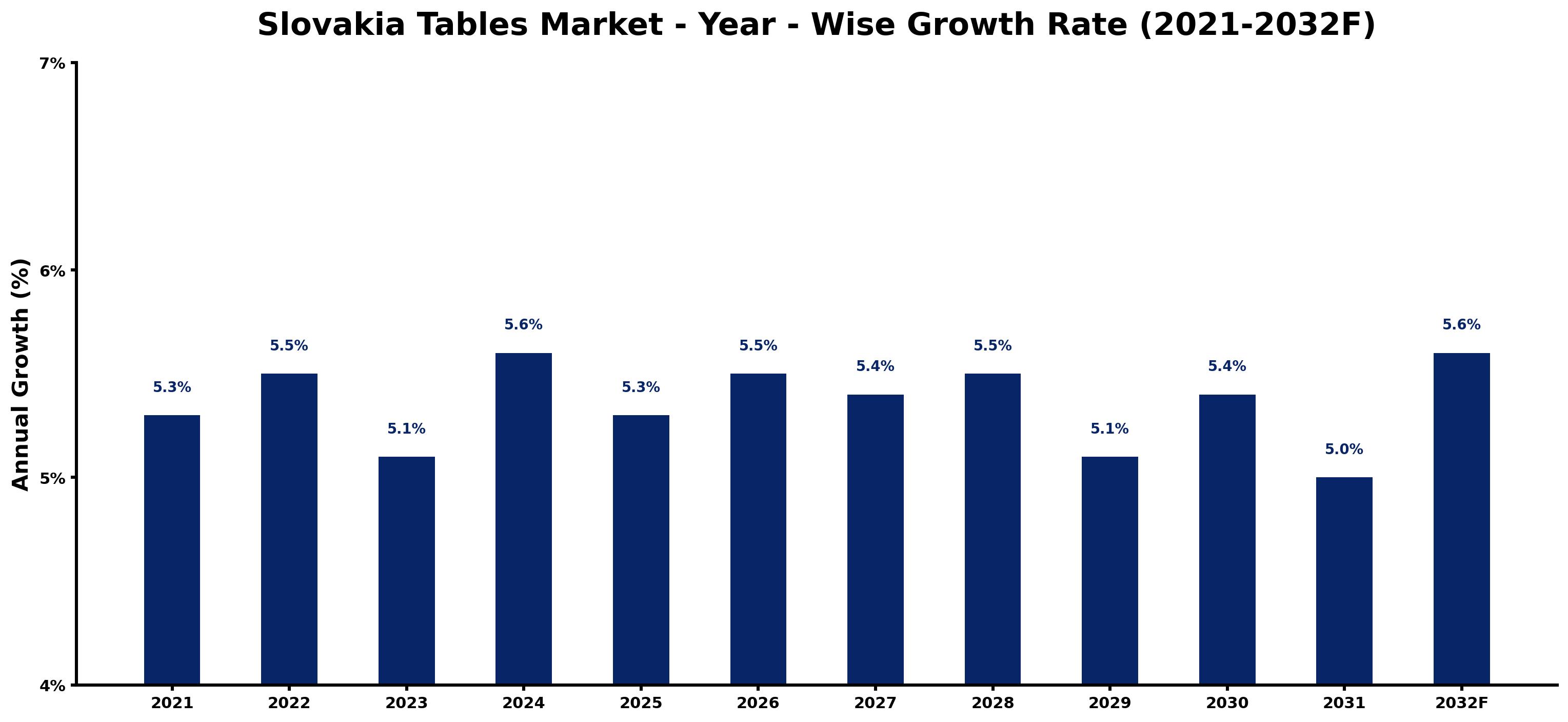
The table below presents the year wise growth rates along with the key drivers influencing the market
| Year | Growth Rate | Major Drivers |
| 2021 | 5.3% | Consumer interest in home-related furnishings surged during pandemic lockdowns across Europe. |
| 2022 | 5.5% | Sustainability concerns nudged manufacturers towards eco-friendly materials and practices in production. |
| 2023 | 5.1% | E-commerce growth expanded market access, facilitating online sales of various table styles. |
| 2024 | 5.6% | Urbanization trends prompted smaller living spaces, increasing demand for multi-functional furniture. |
| 2025 | 5.3% | Collaboration with local artisans became a trend, enhancing unique product offerings significantly. |
| 2026 | 5.5% | Shifts in lifestyle preferences led to a rise in home dining experiences and gatherings. |
| 2027 | 5.4% | Innovative designs emerged, appealing to millennials seeking stylish yet practical furniture solutions. |
| 2028 | 5.5% | Technological integration in furniture, like smart tables, began to attract tech-savvy customers. |
| 2029 | 5.1% | Post-pandemic renovations stimulated demand for modernized and customized home furnishings. |
| 2030 | 5.4% | Interest in workspace optimizations drove sales of ergonomic tables suitable for home offices. |
| 2031 | 5.0% | Emerging trends in minimalist living inspired reduced sizes and sleek designs in tables. |
| 2032 | 5.6% | Collaboration with interior designers forecasted a boom in tailored furniture solutions for clients. |
Note - Market size estimations and growth projections presented in this report are based on 6Wresearch's advanced forecasting approach, validated with industry datasets as of June 2026.
Slovakia Tables Market Synopsis
The Slovakia Tables Market is projected to reach 5.5% and witness significant growth during the forecast period (2026-2032). This market encompasses a variety of table products tailored for both residential and commercial applications. The increasing demand for durable and stylish furniture is reflective of broader trends in urbanization and rising disposable incomes, while evolving lifestyle preferences among consumers also drive market dynamics. The array of products includes dining tables, coffee tables, and outdoor tables, catering to diverse consumer needs and tastes.
Slovakia Tables Market Key Growth Drivers
Several key drivers underpin the growth of the Slovakia tables market. One primary factor is the rapid urbanization in Slovakia, leading to an increased demand for stylish yet functional furniture that meets space constraints. Additionally, as disposable incomes rise, consumers are more willing to invest in quality furniture, further propelling market growth. E-commerce platforms have also transformed the retail landscape, offering consumers a convenient avenue for exploring various table options. Moreover, changing lifestyle preferences, including the shift towards modern and minimalist designs, cater to the tastes of younger demographics. Furthermore, the increasing trend towards sustainable practices is influencing consumers to seek tables made from eco-friendly materials.
Slovakia Tables Market Trends and Opportunities
The Slovakia tables market is currently witnessing several notable trends that present lucrative opportunities for stakeholders. There is a marked shift towards sustainability, where consumers are increasingly interested in tables manufactured from recycled or reclaimed materials. The minimalist design movement is gaining traction, with sleek lines and simple aesthetics becoming highly desirable. Multi-functional tables are on the rise, as consumers seek innovative solutions that optimize limited living spaces. The popularity of metal and glass materials signifies a move towards contemporary designs, while traditional craftsmanship remains valued among certain consumer segments. Overall, these trends provide fertile ground for manufacturers and retailers to innovate and align with consumer expectations in the evolving market landscape.
Slovakia Tables Market Challenges and Restraints
Despite its promising outlook, the Slovakia tables market faces several challenges that could hinder growth. The intensifying competition from both local and international manufacturers poses a significant challenge, as companies strive to differentiate their products and enhance quality to capture consumer interest. Additionally, fluctuations in raw material prices can directly impact production costs, leading to potential profit margin pressures. The rapid evolution of consumer preferences necessitates that manufacturers remain agile and responsive to changing trends in interior design. This need for constant innovation can strain resources and complicate operational planning. To navigate these challenges effectively, businesses must focus on continuous market research, product differentiation, and cost management strategies.
Slovakia Tables Market Investment Opportunities
The Slovakia tables market offers several promising investment opportunities across various segments, particularly in dining, coffee, office, and outdoor tables. The rising demand for quality furniture in Slovakia presents a lucrative avenue for investors. Factors fueling this demand include increasing disposable income levels, changing lifestyle choices, and a growing urban population. Furthermore, the trend towards eco-friendly furniture opens new markets for investors keen on sustainable products. Engaging with local manufacturers, leveraging online sales channels, and focusing on product innovation are strategies that investors can utilize to align with evolving consumer preferences.
Slovakia Tables Market Government Investment and Initiatives
Government initiatives related to the Slovakia tables market are oriented towards bolstering domestic production and supporting small and medium-sized enterprises (SMEs). The Slovak government has implemented various incentives and subsidies aimed at promoting local manufacturing of furniture products, thus stimulating economic growth and job creation within the sector. Compliance with stringent quality and safety standards is also enforced, ensuring that products available in the market meet consumer expectations and regulatory requirements. Additionally, sustainability is a focal point of government policy, encouraging manufacturers to adopt eco-friendly materials and practices. Overall, these initiatives are designed to enhance the competitiveness of the tables market while safeguarding consumer interests.
Slovakia Tables Market Latest Developments (May 2025 - June 2026)
Recent developments in the Slovakia tables market between May 2025 and June 2026 indicate a continued evolution in consumer preferences and market offerings. The focus on sustainable materials has intensified, with a noticeable rise in the number of products marketed as eco-friendly. Moreover, the innovative designs that incorporate modern aesthetics while maintaining functionality have gained traction among consumers. E-commerce has seen substantial growth, with more retailers enhancing their online presence to cater to a digitally-savvy customer base. Additionally, the trend toward multifunctional furniture solutions continues to influence product development, as manufacturers respond to the increasing demand for space-efficient designs.
Slovakia Tables Market - Key Attractiveness of the Report
- 10 Years of Market Numbers
- Historical Data Starting from 2022 to 2025
- Base Year: 2025
- Forecast Data until 2032
- Key Performance Indicators Impacting the Market
- Major Upcoming Developments and Projects
Key Highlights of the Report:
- Slovakia Tables Market Outlook
- Market Size of Slovakia Tables Market, 2025
- Forecast of Slovakia Tables Market, 2032F
- Historical Data and Forecast of Slovakia Tables Revenues & Volume for the Period 2022-2032F
- Slovakia Tables Market Trend Evolution
- Slovakia Tables Market Drivers and Challenges
- Slovakia Tables Price Trends
- Slovakia Tables Porter's Five Forces
- Slovakia Tables Industry Life Cycle
- Historical Data and Forecast of Slovakia Tables Market Revenues & Volume By Types for the Period 2022-2032F
- Historical Data and Forecast of Slovakia Tables Market Revenues & Volume By Fabric for the Period 2022-2032F
- Historical Data and Forecast of Slovakia Tables Market Revenues & Volume By Leather for the Period 2022-2032F
- Historical Data and Forecast of Slovakia Tables Market Revenues & Volume By Metal for the Period 2022-2032F
- Historical Data and Forecast of Slovakia Tables Market Revenues & Volume By Wooden for the Period 2022-2032F
- Historical Data and Forecast of Slovakia Tables Market Revenues & Volume By Others for the Period 2022-2032F
- Historical Data and Forecast of Slovakia Tables Market Revenues & Volume By Applications for the Period 2022-2032F
- Historical Data and Forecast of Slovakia Tables Market Revenues & Volume By Family for the Period 2022-2032F
- Historical Data and Forecast of Slovakia Tables Market Revenues & Volume By Office for the Period 2022-2032F
- Historical Data and Forecast of Slovakia Tables Market Revenues & Volume By Others for the Period 2022-2032F
- Slovakia Tables Import Export Trade Statistics
- Market Opportunity Assessment By Types
- Market Opportunity Assessment By Applications
- Slovakia Tables Top Companies Market Share
- Slovakia Tables Competitive Benchmarking By Technical and Operational Parameters
- Slovakia Tables Company Profiles
- Slovakia Tables Key Strategic Recommendations






































