Slovenia Flip Flops Market Size (2020-2030)
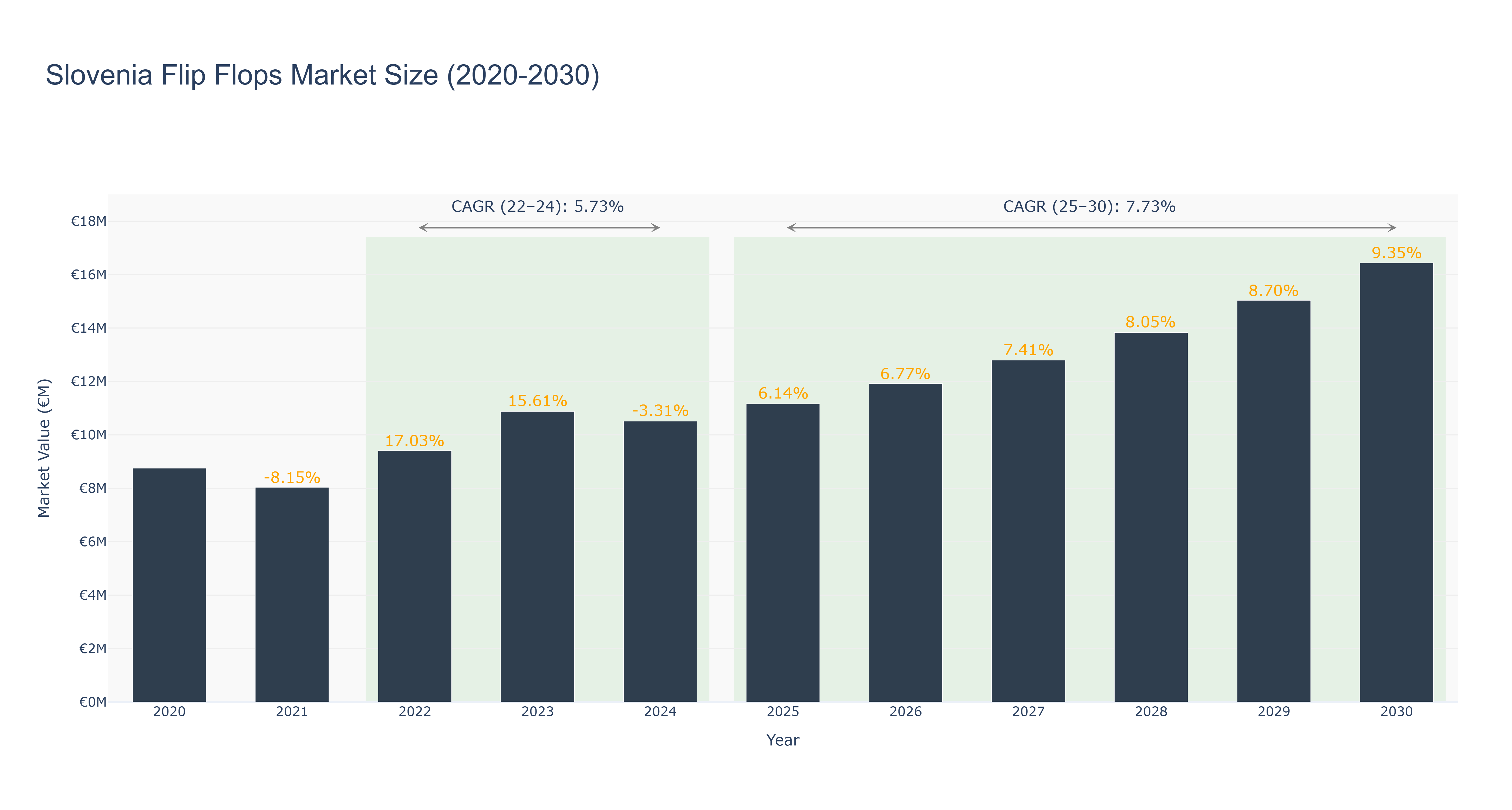
Slovenia Flip Flops Market has shown a steady growth trajectory over the years. The peak market size of €16.44 million is projected for 2030, reflecting a positive trend. From 2020 to 2024, the market size fluctuated, with a slight decline in 2024 due to a temporary setback. However, from 2025 to 2030, the market is forecasted to experience consistent growth, with a Compound Annual Growth Rate (CAGR) of 7.73%. The CAGR of 5.73% from 2022 to 2024 indicates a moderate growth phase. Industry drivers such as increasing consumer demand for comfortable and stylish footwear contribute to the market's expansion. Looking ahead, Slovenia Flip Flops Market is expected to see further advancements in sustainable materials and innovative designs, catering to evolving consumer preferences and boosting market growth.
Slovenia Flip Flops Market: Production & Trade Performance (2019-2025)
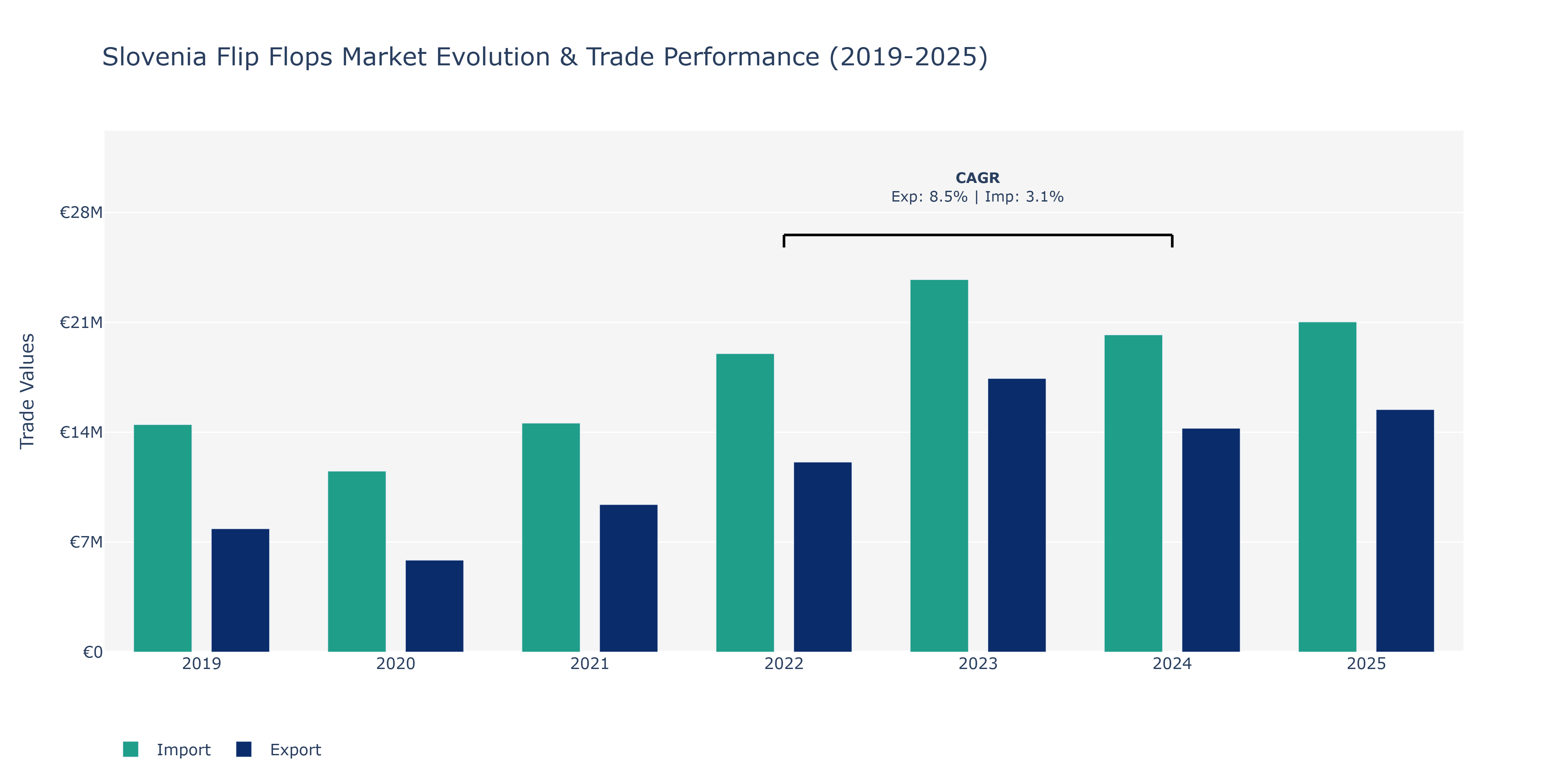
Between 2019 and 2025, Slovenia's Flip Flops Market witnessed fluctuations in both exports and imports. The market saw a decline in exports from €7.86 million in 2019 to around €5.85 million in 2020, possibly influenced by global economic conditions and pandemic-related disruptions. However, exports rebounded to €9.4 million in 2021 and peaked at €17.43 million in 2023, indicating a significant recovery and potential increased demand for Slovenian flip flops. Conversely, imports followed a similar trend, with a decrease from €14.49 million in 2019 to €11.52 million in 2020 before steadily rising to €23.72 million in 2023. This growth could be attributed to expanding consumer markets and the attractiveness of Slovenian flip flops in international markets. The market experienced a slight decrease in 2024 for both exports (€14.26 million) and imports (€20.21 million), which could be a result of supply chain challenges or evolving consumer preferences. In 2025, exports amounted to €15.45 million, and imports reached €21.03 million, indicating a stable market with continued demand for Slovenian flip flops. The CAGR for exports between 2022 and 2024 was 8.54%, reflecting a positive growth trajectory, while imports had a CAGR of 3.1% during the same period, indicating a more moderate expansion. The growth in exports can be attributed to Slovenia's reputation for quality footwear products and increased marketing efforts, driving higher demand globally. The rise in imports suggests the market's ability to source raw materials or meet production demands efficiently. The fluctuations in both exports and imports underscore the market's resilience and adaptability to changing economic conditions and consumer preferences, positioning Slovenia as a strong player in the global flip flops market.
Key Highlights of the Report:
- Slovenia Flip Flops Market Outlook
- Market Size of Slovenia Flip Flops Market, 2025
- Forecast of Slovenia Flip Flops Market, 2032
- Historical Data and Forecast of Slovenia Flip Flops Revenues & Volume for the Period 2022-2032F
- Slovenia Flip Flops Market Trend Evolution
- Slovenia Flip Flops Market Drivers and Challenges
- Slovenia Flip Flops Price Trends
- Slovenia Flip Flops Porter`s Five Forces
- Slovenia Flip Flops Industry Life Cycle
- Historical Data and Forecast of Slovenia Flip Flops Market Revenues & Volume By Sole Material for the Period 2022-2032F
- Historical Data and Forecast of Slovenia Flip Flops Market Revenues & Volume By EVA Flip Flops for the Period 2022-2032F
- Historical Data and Forecast of Slovenia Flip Flops Market Revenues & Volume By PVC Flip Flops for the Period 2022-2032F
- Historical Data and Forecast of Slovenia Flip Flops Market Revenues & Volume By Rubber Flip Flops for the Period 2022-2032F
- Historical Data and Forecast of Slovenia Flip Flops Market Revenues & Volume By EVA+Rubber Flip Flops for the Period 2022-2032F
- Historical Data and Forecast of Slovenia Flip Flops Market Revenues & Volume By Others for the Period 2022-2032F
- Historical Data and Forecast of Slovenia Flip Flops Market Revenues & Volume By End User for the Period 2022-2032F
- Historical Data and Forecast of Slovenia Flip Flops Market Revenues & Volume By Women Flip Flops for the Period 2022-2032F
- Historical Data and Forecast of Slovenia Flip Flops Market Revenues & Volume By Men Flip Flops for the Period 2022-2032F
- Historical Data and Forecast of Slovenia Flip Flops Market Revenues & Volume By Girls Flip Flops for the Period 2022-2032F
- Historical Data and Forecast of Slovenia Flip Flops Market Revenues & Volume By Boys Flip Flops for the Period 2022-2032F
- Slovenia Flip Flops Import Export Trade Statistics
- Market Opportunity Assessment By Sole Material
- Market Opportunity Assessment By End User
- Slovenia Flip Flops Top Companies Market Share
- Slovenia Flip Flops Competitive Benchmarking By Technical and Operational Parameters
- Slovenia Flip Flops Company Profiles
- Slovenia Flip Flops Key Strategic Recommendations






































