Slovenia Toaster Market Size (2020-2030)
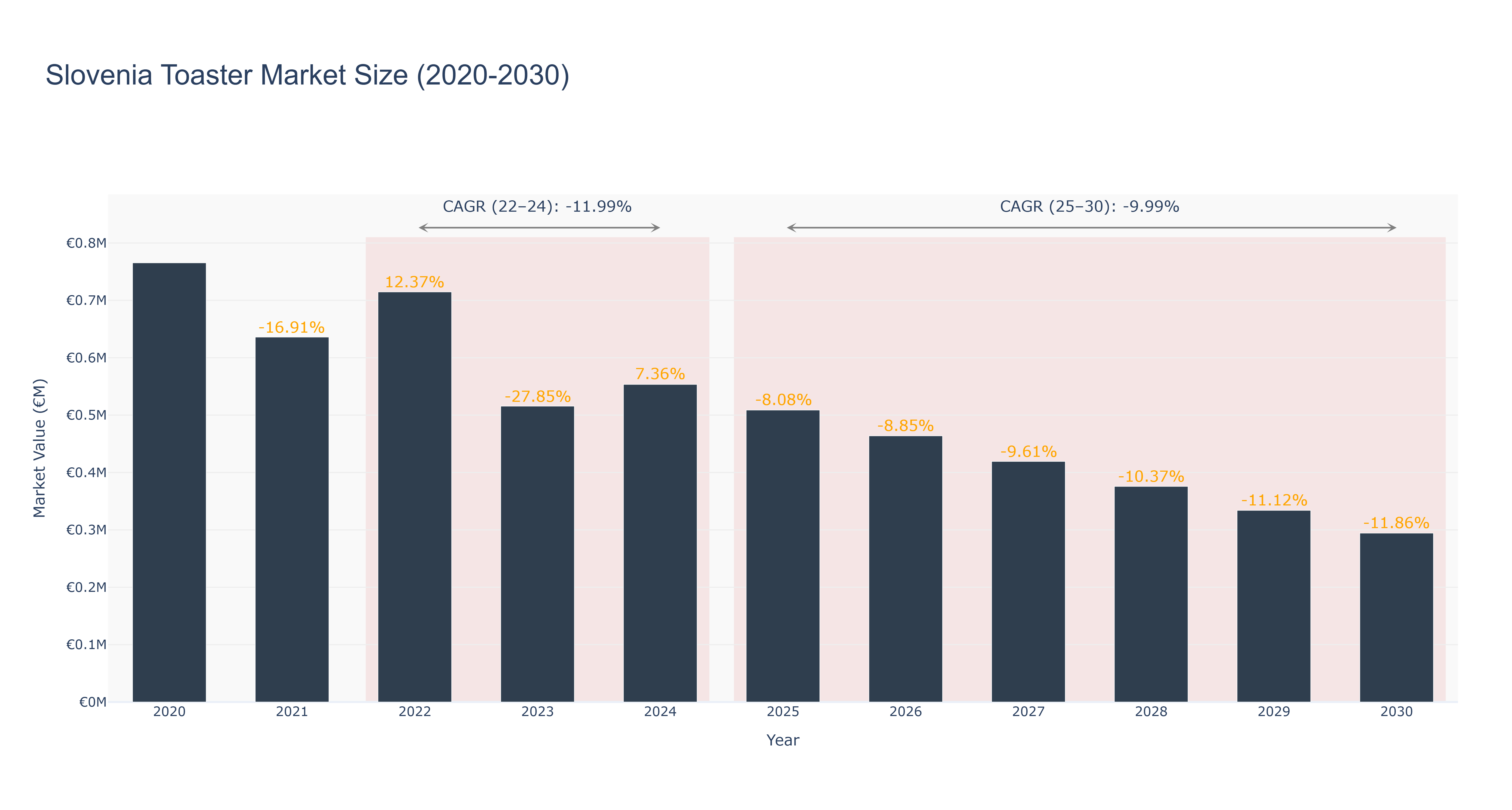
Slovenia Toaster Market has shown a declining trend in market size over the past decade. The peak market size of €0.77 million was observed in 2020, followed by a decrease to €0.52 million in 2023. The market is forecasted to further decline to €0.29 million by 2030, with a CAGR of -9.99% from 2025 to 2030. The negative growth rates can be attributed to factors such as changing consumer preferences, increased competition, and economic fluctuations impacting consumer spending. To revitalize the market, Slovenia is planning to introduce a sustainability initiative focusing on eco-friendly toasters to align with the growing environmental consciousness among consumers. This initiative is expected to attract environmentally conscious consumers and drive market growth in the future. Industry drivers for the Slovenia Toaster Market include technological advancements leading to innovative toaster designs, increasing urbanization driving demand for convenient kitchen appliances, and rising disposable incomes enhancing consumer purchasing power.
Slovenia Toaster Market: Production & Trade Performance (2019-2025)
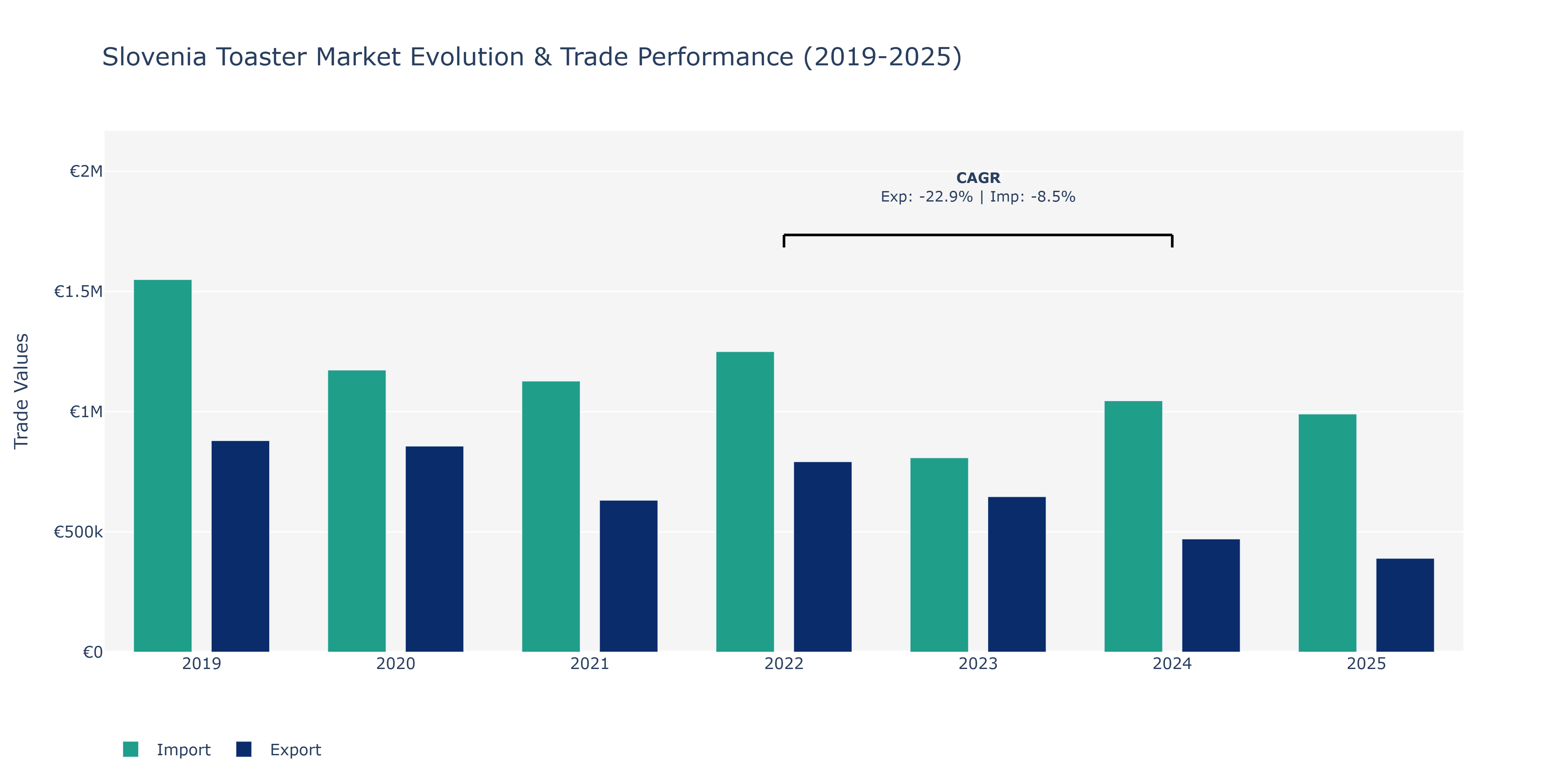
The Slovenia Toaster Market experienced varied trends in Exports and Imports from 2019 to 2025. In 2019, Imports peaked at €1.55 million, surpassing Exports of €879.25 thousand. However, both figures declined in 2020, with Exports at €856.57 thousand and Imports at €1.17 million. A notable shift occurred in 2021 when Exports decreased to €631.41 thousand, aligning more closely with Imports at €1.13 million. The following years saw fluctuations, with Exports hitting a low of €389.76 thousand in 2025, while Imports decreased to €990.07 thousand. The negative trend in Exports from 2022 to 2024, with a CAGR of -22.92%, can be attributed to changing consumer preferences, economic conditions affecting purchasing power, and possibly increased competition in the global market for toasters. The decline in Imports with a CAGR of -8.55% during the same period could reflect shifts in sourcing strategies, trade regulations, or disruptions in the supply chain. As the market continues to evolve, companies may need to adapt by focusing on product innovation, cost efficiencies, and strategic partnerships to navigate these fluctuations effectively.
Key Highlights of the Report:
- Slovenia Toaster Market Outlook
- Market Size of Slovenia Toaster Market, 2025
- Forecast of Slovenia Toaster Market, 2032
- Historical Data and Forecast of Slovenia Toaster Revenues & Volume for the Period 2022-2032F
- Slovenia Toaster Market Trend Evolution
- Slovenia Toaster Market Drivers and Challenges
- Slovenia Toaster Price Trends
- Slovenia Toaster Porter`s Five Forces
- Slovenia Toaster Industry Life Cycle
- Historical Data and Forecast of Slovenia Toaster Market Revenues & Volume By Product for the Period 2022-2032F
- Historical Data and Forecast of Slovenia Toaster Market Revenues & Volume By Pop-up Toasters for the Period 2022-2032F
- Historical Data and Forecast of Slovenia Toaster Market Revenues & Volume By Toaster Oven for the Period 2022-2032F
- Historical Data and Forecast of Slovenia Toaster Market Revenues & Volume By Conveyor Toasters for the Period 2022-2032F
- Historical Data and Forecast of Slovenia Toaster Market Revenues & Volume By Application for the Period 2022-2032F
- Historical Data and Forecast of Slovenia Toaster Market Revenues & Volume By Commercial for the Period 2022-2032F
- Historical Data and Forecast of Slovenia Toaster Market Revenues & Volume By Residential for the Period 2022-2032F
- Slovenia Toaster Import Export Trade Statistics
- Market Opportunity Assessment By Product
- Market Opportunity Assessment By Application
- Slovenia Toaster Top Companies Market Share
- Slovenia Toaster Competitive Benchmarking By Technical and Operational Parameters
- Slovenia Toaster Company Profiles
- Slovenia Toaster Key Strategic Recommendations






































