South Korea App Analytics Market Size & Growth Rate (2026-2032)
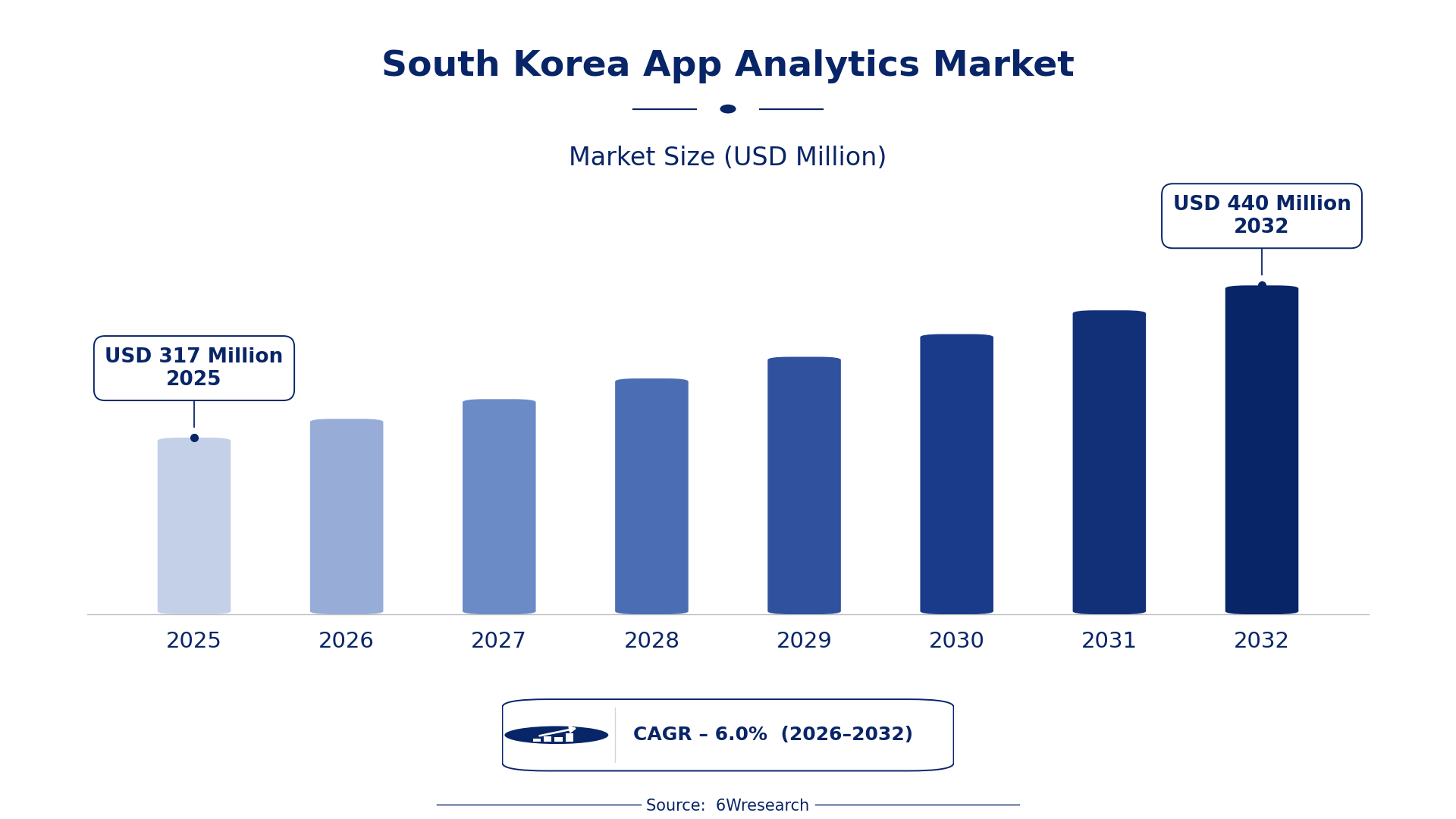
The South Korea App Analytics Market was estimated at USD 317 Million in 2025 and is projected to reach USD 440 Million by 2032, growing at a CAGR of 6.0% from 2026 to 2032.
South Korea App Analytics Market Synopsis
The South Korea App Analytics Market is currently witnessing a surge in activity, driven by the rapid adoption of mobile applications across various sectors. This momentum, however, contrasts with the challenges posed by evolving technology and user expectations, which continue to shape the market's trajectory.
As businesses increasingly prioritize data-driven strategies, the demand for sophisticated app analytics tools is set to rise. Organizations are looking for solutions that not only track performance but also provide actionable insights to enhance user engagement and retention, positioning themselves for sustained growth.
South Korea App Analytics Market Year-wise Growth Rate and Key Drivers
This graph illustrates the annual growth rates of the South Korea App Analytics Market from 2021 to 2032, highlighting a steady upward trajectory and projected expansion over the forecast period.
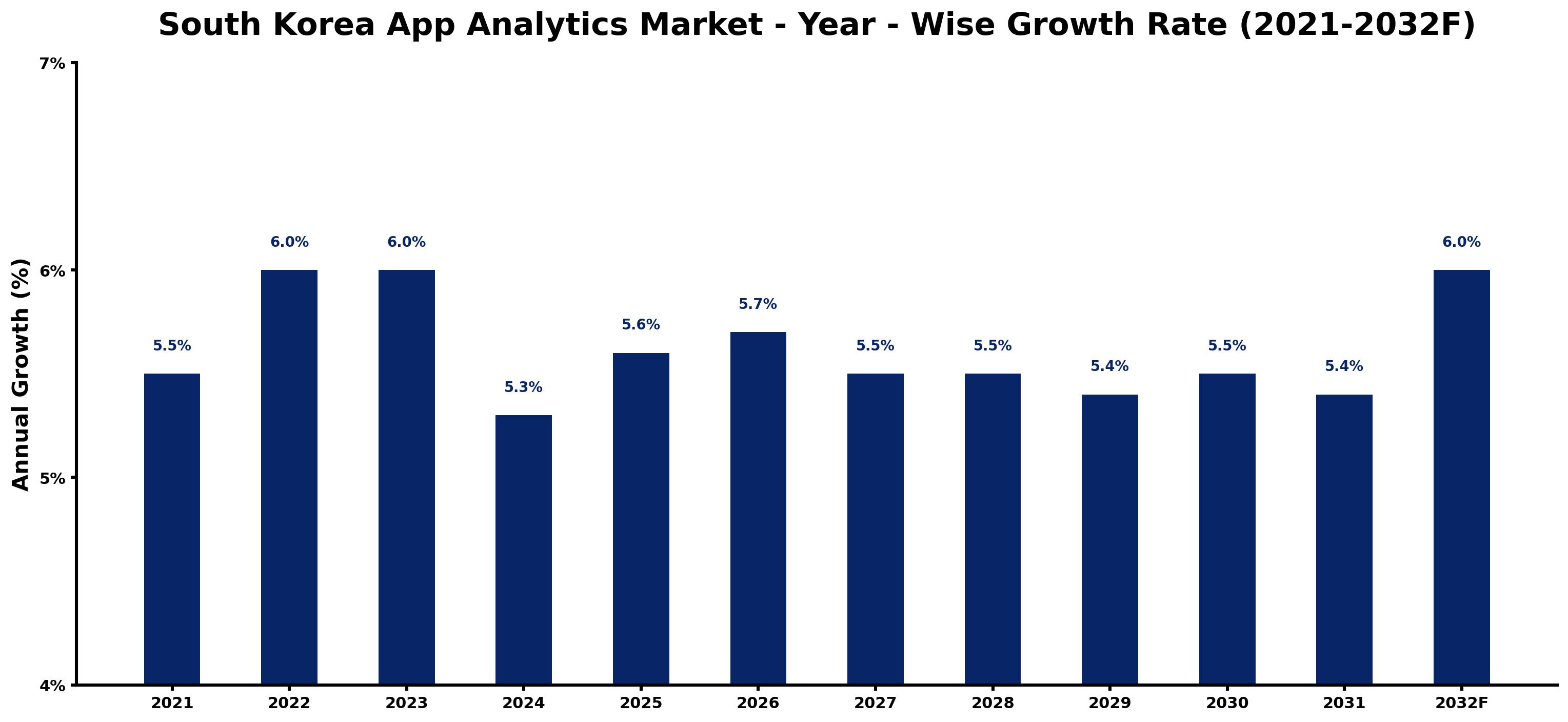
The table below presents the year‑wise growth rates along with the key drivers influencing the market
| Year | Growth Rate | Major Drivers |
| 2021 | 5.5% | Increased smartphone penetration boosting app usage data collection |
| 2022 | 6.0% | Rise of K-Pop applications leading to heightened analytics demand |
| 2023 | 6.0% | Launch of 5G networks enhancing app engagement metrics analysis |
| 2024 | 5.3% | Regulatory focus on user privacy shaping data analytics strategies |
| 2025 | 5.6% | Growth in e-commerce apps creating demand for performance tracking |
| 2026 | 5.7% | Popularity of mobile health apps necessitating usage insights |
| 2027 | 5.5% | Government backing for technology startups encouraging app innovation |
| 2028 | 5.5% | Educational apps gaining traction, increasing analytic requirements |
| 2029 | 5.4% | Rise in online streaming services driving app performance needs |
| 2030 | 5.5% | Increased focus on personalized user experience with analytics |
| 2031 | 5.4% | Expanding fintech apps necessitating real-time user behavior analysis |
| 2032 | 6.0% | Surge in local app developers driving analytics tool adoption |
Note: Market size estimations and growth projections presented in this report are based on 6Wresearch's proprietary forecasting methodology, utilizing the latest available industry data, government publications, and primary research inputs.
South Korea App Analytics Market Key Takeaways
Below are some of the specific key takeaways from the market, including:
- Robust growth projected in app analytics spending, highlighting the sector's increasing importance.
- The demand for real-time analytics is escalating, as businesses seek immediate insights into user behavior.
- Personalized marketing strategies are emerging as a focal point, utilizing analytics data for targeted campaigns.
- Investment in AI-driven analytics tools is on the rise, reflecting a shift towards advanced technological capabilities.
- Regulatory compliance, particularly concerning data privacy, remains a critical concern for app analytics providers.
Evaluation of Restraints in South Korea App Analytics Market
Despite the promising outlook, the South Korea App Analytics Market faces several constraints. Rapid technological changes necessitate continuous adaptation from analytics providers. Companies must ensure they can deliver accurate, real-time data analytics, which is challenging amid shifting consumer behaviors. on top of that, maintaining compliance with stringent data privacy regulations, such as the Personal Information Protection Act (PIPA), complicates operations. Organizations must navigate these hurdles while striving to remain competitive and relevant.
South Korea App Analytics Market Trends
A notable trend in the South Korea App Analytics Market is the rising demand for real-time analytics tools. Businesses are increasingly prioritizing immediate insights to refine user experiences and enhance app performance. Additionally, there is a pronounced shift towards AI-driven analytics, enabling companies to harness machine learning for deeper insights into user engagement.
The focus on personalized marketing is gaining traction, with companies leveraging data to create tailored user experiences. This trend is supported by the growing mobile app usage across sectors, making app analytics tools indispensable for businesses looking to optimize retention and monetization strategies.
South Korea App Analytics Market Opportunities
The landscape presents numerous growth opportunities, particularly in sectors such as e-commerce and mobile gaming. With South Korea's extensive smartphone penetration, businesses are eager to invest in analytics tools that can provide insights specific to their user base. Investors should consider backing companies that innovate and adapt their offerings to meet the unique needs of South Korean businesses.
on top of that, as the digital transformation accelerates, the emphasis on data-driven decision-making will likely fuel further demand for sophisticated app analytics solutions.
Government Initiatives in the South Korea App Analytics Market
The South Korean government plays a crucial role in fostering the growth of the app analytics market. With a focus on enhancing the digital economy, various initiatives are being implemented to support innovation and compliance in data handling. Government policies are designed to create a favorable environment for app analytics providers, emphasizing the importance of data security and user trust.
- A recently completed initiative by the Ministry of Science and ICT aimed to enhance funding for startups in the app analytics sector.
- Currently ongoing is a public-private partnership focused on developing advanced data processing technologies to support app analytics.
- A planned program set for launch in 2026 intends to provide resources for training professionals in app analytics and data privacy compliance.
- New regulatory guidelines introduced in 2025 aim to streamline compliance processes for app analytics providers.
- An initiative promoting collaboration between academic institutions and the tech industry is expected to commence in early 2026.
Future Insights of the South Korea App Analytics Market
Looking ahead to 2026-2032, the South Korea App Analytics Market is set for substantial growth. Factors driving this expansion include the increasing use of mobile applications across various industries and the heightened focus on data-driven insights. As businesses continue to recognize the value of app analytics tools for enhancing user engagement, the demand for innovative solutions will intensify.
on top of that, as digital transformation becomes a priority for many organizations, analytics tools that offer comprehensive insights into user behavior will be essential for remaining competitive in this fast-paced environment.
South Korea App Analytics Market Latest Developments
Recent months have seen considerable activity within the South Korea App Analytics Market. Companies are increasingly launching new products and services aimed at meeting the evolving demands of businesses seeking deeper insights. Collaboration between industry players is also on the rise, as firms look to enhance their analytics capabilities through partnerships.
- A major technology vendor introduced a new analytics platform in Q1 2025, designed to provide real-time user insights.
- An ongoing project, initiated in late 2025, focuses on integrating AI capabilities into existing analytics solutions to enhance predictive analytics.
- A partnership formed in early 2026 between two regional firms aims to develop cross-platform analytics tools.
- Upcoming in mid-2026 is a rollout of an upgraded version of a popular app analytics tool that will include enhanced data visualization features.
- A pilot program expected to launch in late 2026 will test new data privacy protocols in collaboration with local businesses.
South Korea App Analytics Market - Key Attractiveness of the Report
- 10 Years of Market Numbers
- Historical Data Starting from 2022 to 2025
- Base Year: 2025
- Forecast Data until 2032
- Key Performance Indicators Impacting the Market
- Major Upcoming Developments and Projects
Key Highlights of the Report:
- South Korea App Analytics Market Outlook
- Market Size of South Korea App Analytics Market, 2025
- Forecast of South Korea App Analytics Market, 2032
- Historical Data and Forecast of South Korea App Analytics Revenues & Volume for the Period 2022-2032F
- South Korea App Analytics Market Trend Evolution
- South Korea App Analytics Market Drivers and Challenges
- South Korea App Analytics Price Trends
- South Korea App Analytics Porter's Five Forces
- South Korea App Analytics Industry Life Cycle
- Historical Data and Forecast of South Korea App Analytics Market Revenues & Volume By Component for the Period 2022-2032F
- Historical Data and Forecast of South Korea App Analytics Market Revenues & Volume By Software for the Period 2022-2032F
- Historical Data and Forecast of South Korea App Analytics Market Revenues & Volume By Services for the Period 2022-2032F
- Historical Data and Forecast of South Korea App Analytics Market Revenues & Volume By Application for the Period 2022-2032F
- Historical Data and Forecast of South Korea App Analytics Market Revenues & Volume By Revenue analytics for the Period 2022-2032F
- Historical Data and Forecast of South Korea App Analytics Market Revenues & Volume By App performance analytics and operations for the Period 2022-2032F
- Historical Data and Forecast of South Korea App Analytics Market Revenues & Volume By User analytics for the Period 2022-2032F
- Historical Data and Forecast of South Korea App Analytics Market Revenues & Volume By Ad monitoring and marketing analytics for the Period 2022-2032F
- Historical Data and Forecast of South Korea App Analytics Market Revenues & Volume By Type for the Period 2022-2032F
- Historical Data and Forecast of South Korea App Analytics Market Revenues & Volume By Mobile app analytics for the Period 2022-2032F
- Historical Data and Forecast of South Korea App Analytics Market Revenues & Volume By Web app analytics for the Period 2022-2032F
- Historical Data and Forecast of South Korea App Analytics Market Revenues & Volume By Vertical for the Period 2022-2032F
- Historical Data and Forecast of South Korea App Analytics Market Revenues & Volume By Banking, Financial Services, and Insurance (BFSI) for the Period 2022-2032F
- Historical Data and Forecast of South Korea App Analytics Market Revenues & Volume By Retail for the Period 2022-2032F
- Historical Data and Forecast of South Korea App Analytics Market Revenues & Volume By Media and entertainment for the Period 2022-2032F
- Historical Data and Forecast of South Korea App Analytics Market Revenues & Volume By Logistics, travel, and transportation for the Period 2022-2032F
- Historical Data and Forecast of South Korea App Analytics Market Revenues & Volume By Telecom and IT for the Period 2022-2032F
- Historical Data and Forecast of South Korea App Analytics Market Revenues & Volume By Others for the Period 2022-2032F
- South Korea App Analytics Import Export Trade Statistics
- Market Opportunity Assessment By Component
- Market Opportunity Assessment By Application
- Market Opportunity Assessment By Type
- Market Opportunity Assessment By Vertical
- South Korea App Analytics Top Companies Market Share
- South Korea App Analytics Competitive Benchmarking By Technical and Operational Parameters
- South Korea App Analytics Company Profiles
- South Korea App Analytics Key Strategic Recommendations






































