South Korea Blenders Market Growth Rate
According to 6Wresearch internal database and industry insights, the South Korea Blenders Market is projected to grow at a compound annual growth rate (CAGR) of 6.8% during the forecast period from 2026 to 2032.
South Korea Blenders Market Year-wise Growth Rate and Key Drivers
This graph highlights how the South Korea Blenders Market has steadily grown over the past five years, supported by major growth Factors.
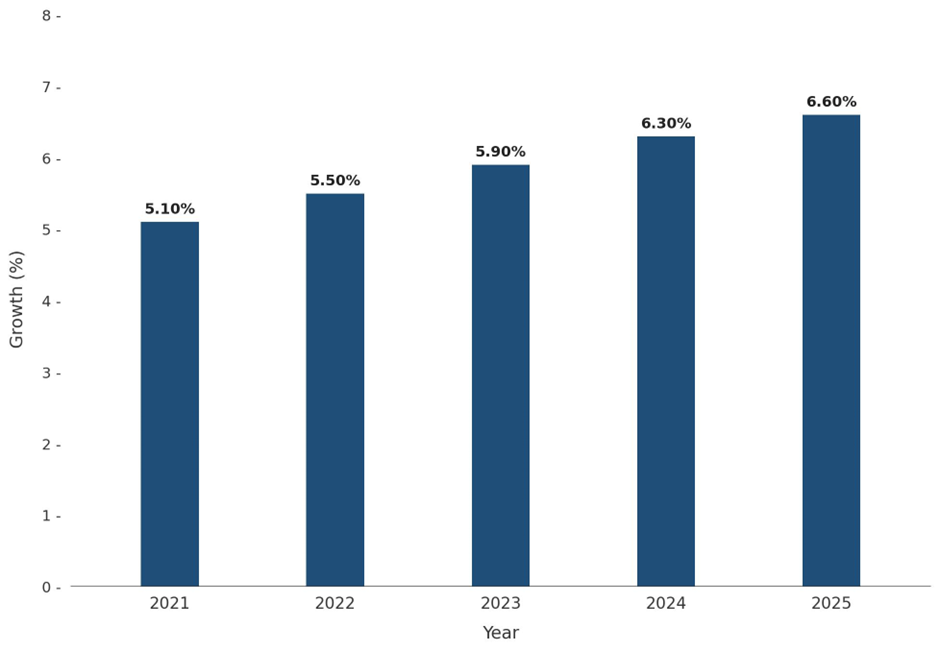
The table below presents the year‑wise growth rates along with the key drivers influencing the market
| Years | Est. Annual Growth in % | Growth Drivers |
| 2021 | 5.1% | Increasing adoption of home appliances in urban households. |
| 2022 | 5.5% | Growing health awareness and demand for smoothies and juices. |
| 2023 | 5.9% | The increasing demand for small kitchen appliances. |
| 2024 | 6.3% | The development of more efficient blender technology together with new design improvements. |
| 2025 | 6.6% | Increasing demand for multifunctional and high-performance blenders. |
Topics Covered in the South Korea Blenders Market Report
The South Korea Blenders Market report thoroughly covers the market by types and applications, providing an unbiased and detailed analysis of ongoing market trends, opportunities, challenges, and market drivers, helping stakeholders align their strategies with current and future market dynamics.
South Korea Blenders Market Highlights
| Report Name |
South Korea Blenders Market |
| Forecast period | 2026-2032 |
| CAGR | 6.8% |
| Market Size | Blenders |
South Korea Blenders Market Synopsis
The South Korea Blenders Market is experiencing steady growth driven by increasing health consciousness and growing demand for convenient kitchen appliances among consumers as blenders are widely used for preparing smoothies, juices, and healthy meals at home since technological advancements such as noise reduction, improved energy efficiency, and multifunctional features are enhancing product appeal. Additionally, compact, portable, and aesthetically designed blenders are gaining popularity among urban households, further contributing to the overall growth and expansion of the market.
Evaluation of Growth Drivers in the South Korea Blenders Market (2026-2032)
Below mentioned are some prominent drivers and their impact on the market dynamics:
| Drivers | Primary Segments Affected | Why It Matters (Evidence) |
| Growing Health Awareness | Single-Serve Blenders, Full-Size Blenders | Consumers are adopting blenders for preparing healthy drinks and meals. |
| Urbanization and Lifestyle Changes | Hand Blenders, Household Segment | Increasing urban population drives demand for compact appliances. |
| Technological Advancements | Full-Size Blenders, Hand Blenders | The new innovations enhance operational efficiency, product durability and system functionality. |
| Rising Demand for Convenience | Household Segment | Quick meal preparation boosts blender adoption. |
| Expansion of Online Sales Channels | All Types | The online distribution of products makes them more accessible to customers and expands their market presence. |
The South Korea Blenders Market Size is projected to grow at a CAGR of 6.8% from 2026 to 2032. The South Korea Blenders Market is growing continuously driven by the growing health awareness and the rising adoption of modern kitchen appliances across households and technological advancements in blender design, including improved motor efficiency and multifunctional features, are enhancing product appeal as consumers are increasingly demanding compact, efficient, and easy-to-use appliances that support quick food preparation. Furthermore, growing interest in healthy lifestyles and homemade beverages is further driving demand, supporting sustained market growth and encouraging manufacturers to introduce innovative and high-performance blender solutions.
Evaluation of Restraints in the South Korea Blenders Market
Below mentioned are some major restraints and their influence on the market dynamics:
| Restraints | Primary Segments Affected | What This Means (Evidence) |
| High Cost of Advanced Models | Full-Size Blenders | Premium products may limit affordability for some consumers. |
| Availability of Substitutes | Hand Blenders | Alternative appliances may impact demand. |
| Energy Consumption Concerns | Full-Size Blenders | High energy usage may deter adoption. |
| Limited Product Awareness | Single-Serve Blenders | market penetration will be delayed as people do not know about the product. |
| Intense Market Competition | All Segments | Presence of multiple brands impacts pricing and margins. |
South Korea Blenders Market Challenges
The South Korea Blenders Industry faces several hinderance in its growth including intense competition from both domestic and international brands, along with high price sensitivity among consumers as well as maintaining continuous product innovation while keeping costs competitive remains a significant concern for manufacturers. However, strict environmental regulations related to electronic waste management and energy consumption add operational complexity. Fluctuating component costs further impact profitability and addressing these challenges requires adoption of efficient cost management, sustainable manufacturing practices, innovation, and strong marketing strategies to remain competitive.
South Korea Blenders Market Trends
Here are some major trends changing the South Korea Blenders Market Growth dynamics:
- Increasing Popularity of Smart Blenders - The rising demand for smart blenders which contain digital controls and connectivity options has created a market that delivers user convenience and better user experience.
- Growth in Compact and Portable Blenders - Users prefer compact and portable blenders as they can easily use these products in their small urban kitchen spaces.
- Rising Demand for Multi-Functional Appliances - Consumers now prefer dual-function blenders which provide both grinding and chopping capabilities
- Expansion of Online Retail Channels - E-commerce platforms enable customers to discover different blender products through their online stores.
Investment Opportunities in the South Korea Blenders Market
The South Korea Blenders Market presents several investment opportunities, including:
- Development of Smart and Connected Appliances: Companies should dedicate funds to developing smart technology since it will create better products which consumers will find more appealing.
- Expansion in E-commerce Platforms: Companies that expand their online store operations will experience market presence expansion together with revenue growth.
- Focus on Energy-Efficient Products: Energy-efficient appliance production enables companies to fulfill both their regulatory obligations and their customer requirements through their energy-efficient product development.
- Growth in Premium Product Segment: The premium product segment will experience growth as high-income consumers will have access to products that offer advanced features.
Top 5 Leading Players in the South Korea Blenders Market
Below is the list of prominent companies leading the South Korea Blenders Market Share:
1. Hurom
| Company Name | Hurom |
|---|---|
| Established Year | 1974 |
| Headquarters | South Korea |
| Official Website | Click Here |
Hurom is a global leader in kitchen appliances, renowned for its innovative Slow Juicers and high-speed blenders that prioritize nutrient retention and high-performance blending technology.
2. Nuvant
| Company Name | Nuvant (Ocooker/Xiaomi Ecosystem) |
|---|---|
| Established Year | 2016 |
| Headquarters | China (with significant SK distribution) |
| Official Website | Click Here |
Known for sleek, minimalist designs, these blenders have gained massive popularity in South Korea for their high-speed capabilities and integration with smart home aesthetics.
3. Philips South Korea
| Company Name | Philips South Korea |
|---|---|
| Established Year | 1891 |
| Headquarters | Netherlands |
| Official Website | Click Here |
Philips maintains a dominant market share in South Korea by offering a wide range of vacuum blenders and high-speed ProBlend technology models that cater to health-conscious urban consumers.
4. Vitamix
| Company Name | Vitamix |
|---|---|
| Established Year | 1921 |
| Headquarters | USA |
| Official Website | Click Here |
Vitamix is the leading premium brand in the Korean market, favored by professional chefs and high-end residential users for its extreme durability and powerful motor performance.
5. Cuchen
| Company Name | Cuchen |
|---|---|
| Established Year | 1976 |
| Headquarters | South Korea |
| Official Website | Click Here |
A household name in South Korea, Cuchen specializes in premium kitchen electronics, offering high-speed blenders with specialized functions tailored to traditional and modern Korean dietary habits.
Government Regulations Introduced in the South Korea Blenders Market
According to South Korean government data, the Korea Agency for Technology and Standards (KATS) ensures that electrical appliances, including blenders, comply with strict safety and energy efficiency standards for example, mandatory energy efficiency labeling enables consumers to compare products based on power consumption, while safety certifications ensure durability and operational safety as these measures enhance product reliability, protect consumer interests, encourage manufacturers to maintain quality standards, and contribute to the sustainable and regulated growth of the blenders market.
Future Insights of the South Korea Blenders Market
The Future outlook for the South Korea Blenders Market remains positive, supported by continuous technological advancements and growing demand for smart and multifunctional kitchen appliances. Due to increasing consumer awareness regarding health, convenience, and energy efficiency is expected to drive further adoption. Additionally, the expansion of e-commerce platforms and innovative product launches will strengthen market presence as manufacturers focusing on design, performance, and sustainability are likely to gain competitive advantage, supporting long-term growth and development of the overall market.
Market Segmentation Analysis
The report offers a comprehensive study of the following market segments and their leading categories:
By Types - Full-Size Blenders to Dominate the Market
According to Ritika Kalra, Senior Research Analyst, 6Wresearch, Full-size blenders are expected to dominate the South Korea Blenders Market due to their high capacity, versatility, and suitability for both residential and commercial use. Their ability to handle a variety of food preparation tasks makes them a preferred choice among consumers.
By Applications - Household to Dominate the Market
The household segment will lead market share according to market forecasts. The household segment will lead the market as home cooking trends and health awareness among consumers continue to rise. The residential kitchen appliance market segment maintains its growth as consumers demand appliances that provide both convenience and efficiency.
Key Attractiveness of the Report
- 10 Years of Market Numbers
- Historical Data Starting from 2022 to 2025
- Base Year: 2025
- Forecast Data until 2032
- Key Performance Indicators Impacting the Market
- Major Upcoming Developments and Projects
Key Highlights of the Report:
- South Korea Blenders Market Outlook
- Market Size of South Korea Blenders Market, 2025
- Forecast of South Korea Blenders Market, 2032
- Historical Data and Forecast of South Korea Blenders Revenues & Volume for the Period 2022-2032
- South Korea Blenders Market Trend Evolution
- South Korea Blenders Market Drivers and Challenges
- South Korea Blenders Price Trends
- South Korea Blenders Porter's Five Forces
- South Korea Blenders Industry Life Cycle
- Historical Data and Forecast of South Korea Blenders Market Revenues & Volume By Types for the Period 2022-2032
- Historical Data and Forecast of South Korea Blenders Market Revenues & Volume By Hand Blenders for the Period 2022-2032
- Historical Data and Forecast of South Korea Blenders Market Revenues & Volume By Single-Serve Blenders for the Period 2022-2032
- Historical Data and Forecast of South Korea Blenders Market Revenues & Volume By Full-Size Blenders for the Period 2022-2032
- Historical Data and Forecast of South Korea Blenders Market Revenues & Volume By Applications for the Period 2022-2032
- Historical Data and Forecast of South Korea Blenders Market Revenues & Volume By Commercial for the Period 2022-2032
- Historical Data and Forecast of South Korea Blenders Market Revenues & Volume By Household for the Period 2022-2032
- South Korea Blenders Import Export Trade Statistics
- Market Opportunity Assessment By Types
- Market Opportunity Assessment By Applications
- South Korea Blenders Top Companies Market Share
- South Korea Blenders Competitive Benchmarking By Technical and Operational Parameters
- South Korea Blenders Company Profiles
- South Korea Blenders Key Strategic Recommendations
Market Covered
The report offers a comprehensive study of the subsequent market segments:
By Types
- Hand Blenders
- Single-Serve Blenders
- Full-Size Blenders
By Applications
- Commercial
- Household






































