South Korea Content Analytics Market Size & Growth Rate (2026-2032)
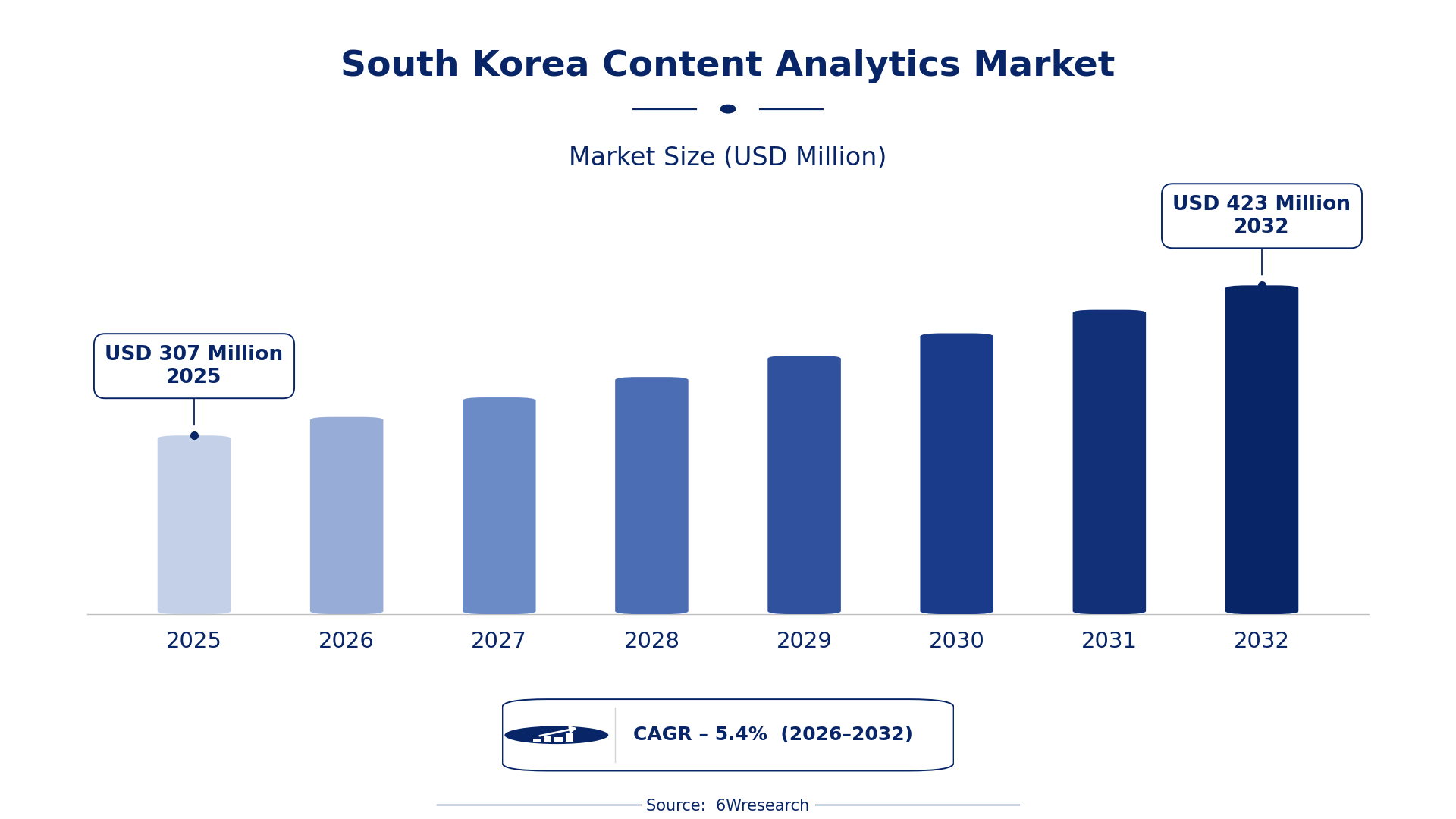
The South Korea Content Analytics Market was estimated at USD 307 Million in 2025 and is projected to reach USD 423 Million by 2032, growing at a CAGR of 5.4% from 2026 to 2032.
South Korea Content Analytics Market Synopsis
The driving force behind the South Korea Content Analytics Market is the increasing demand for data-driven insights across various industries. Companies are eager to harness unstructured data from diverse sources, including social media and customer interactions, to refine their strategies and enhance user experiences.
As businesses turn to advanced analytics tools, the integration of AI and natural language processing is becoming essential. These technologies are not only improving content discovery but also enabling personalized content strategies that cater to specific audience needs.
South Korea Content Analytics Market Year-wise Growth Rate and Key Drivers
This graph illustrates the annual growth rates of the South Korea Content Analytics Market from 2021 to 2032, highlighting a steady upward trajectory and projected expansion over the forecast period.
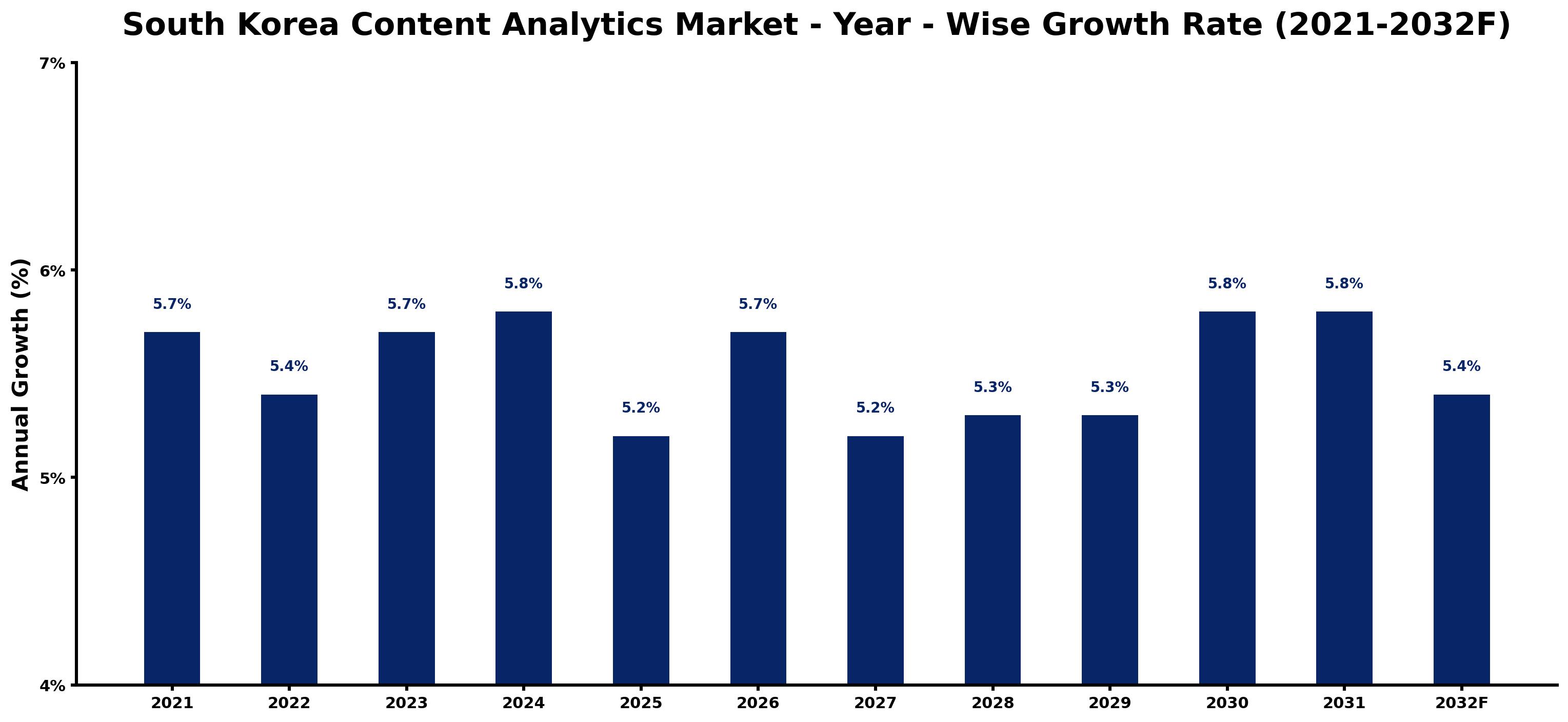
The table below presents the year‑wise growth rates along with the key drivers influencing the market
| Year | Growth Rate | Major Drivers |
| 2021 | 5.7% | Rise in K-Content global popularity and exports. |
| 2022 | 5.4% | Increased investment in AI-driven content analysis technologies. |
| 2023 | 5.7% | Government incentives for digital transformation in media. |
| 2024 | 5.8% | Surge in online streaming services boosting content analytics. |
| 2025 | 5.2% | Growing youth demographic driving social media engagement. |
| 2026 | 5.7% | Strengthened copyright regulations enhancing content protection. |
| 2027 | 5.2% | Rising awareness of data privacy affecting content strategies. |
| 2028 | 5.3% | E-sports boom requiring advanced audience analytics tools. |
| 2029 | 5.3% | Partnerships between tech firms and local content creators. |
| 2030 | 5.8% | Enhanced mobile internet access fueling content consumption. |
| 2031 | 5.8% | Emergence of localized advertising strategies amidst globalization. |
| 2032 | 5.4% | Demand for real-time analytics in live broadcasts. |
Note: Market size estimations and growth projections presented in this report are based on 6Wresearch's proprietary forecasting methodology, utilizing the latest available industry data, government publications, and primary research inputs.
South Korea Content Analytics Market Key Takeaways
Below are some of the specific key takeaways from the market, including:
- AI-driven analytics are transforming how companies interpret content data.
- Natural language processing is crucial for effective sentiment analysis.
- The market is witnessing an uptick in investments aimed at enhancing content management solutions.
- Data privacy and compliance remain top priorities for content analytics providers.
- Industries such as media, retail, and healthcare are leading the demand for content analytics solutions.
Evaluation of Restraints in South Korea Content Analytics Market
The South Korea Content Analytics Market is held back by several key restraints. One major challenge is the complexity of processing unstructured data from varied sources, which can lead to inconsistent insights. Additionally, companies must navigate stringent data privacy regulations that affect how they collect and analyze data. The need for actionable insights requires ongoing innovation in technologies like natural language processing and machine learning, presenting further hurdles for analytics providers aiming to optimize content strategies effectively.
South Korea Content Analytics Market Trends
Current trends in the South Korea Content Analytics Market include a marked shift towards AI-driven solutions that enhance data interpretation. Companies are increasingly employing sentiment analysis to tailor content to their audiences, improving engagement and retention. The use of machine learning algorithms is also on the rise, as businesses seek to automate content discovery and management processes, making them more efficient and effective.
South Korea Content Analytics Market Opportunities
There are substantial growth opportunities in the South Korea Content Analytics Market, particularly in sectors such as healthcare and retail, where personalized content can drive consumer engagement. As organizations continue to adopt advanced analytics tools, partnerships between technology providers and industry players will likely flourish. This collaboration can enhance the development of specialized solutions that meet unique business needs, paving the way for innovative applications of content analytics.
Government Initiatives in the South Korea Content Analytics Market
Government policy is shaping the South Korea Content Analytics Market by enforcing data privacy regulations and promoting advanced analytics adoption. The South Korean government prioritizes data management and business intelligence initiatives, recognizing the importance of analytics in enhancing competitiveness across industries. These policies encourage compliance and support technological advancements in content analytics.
- A regulatory framework was introduced in 2025 focusing on data privacy and compliance in analytics practices.
- Current initiatives include a national program aimed at improving digital infrastructure for better data accessibility and analysis.
- Upcoming plans involve incentives to promote AI and analytics technology adoption in public and private sectors.
- Recent collaboration between government agencies and tech firms aims to enhance research and development in analytics solutions.
- Efforts to streamline content analysis tools are currently underway, aiming to facilitate smoother data aggregation practices.
Future Insights of the South Korea Content Analytics Market
Looking ahead to 2026-2032, the South Korea Content Analytics Market is set to expand significantly. The convergence of AI technologies and content analytics will drive innovations that enable deeper insights from unstructured data. As businesses increasingly rely on data-driven decision-making, the demand for sophisticated analytics tools will only grow, underscoring the necessity for providers to adapt and innovate continuously.
South Korea Content Analytics Market Latest Developments
Recent activity in the South Korea Content Analytics Market indicates a strong focus on technological advancements and industry collaborations. Companies are investing in new tools and partnerships to enhance their analytics capabilities, reflecting a proactive approach to meet rising market demands.
- A major technology vendor launched an advanced content analytics platform in early 2025, designed to integrate AI and NLP capabilities.
- Current partnerships between analytics firms and retail companies are underway, aiming to develop tailored solutions for customer engagement.
- A public-private initiative focused on enhancing data privacy measures is expected to roll out in late 2026.
- Several firms are currently conducting pilot projects to test new machine learning algorithms for content analysis.
- A comprehensive upgrade of existing analytics infrastructure is planned for mid-2026 to support emerging technologies.
South Korea Content Analytics Market - Key Attractiveness of the Report
- 10 Years of Market Numbers
- Historical Data Starting from 2022 to 2025
- Base Year: 2025
- Forecast Data until 2032
- Key Performance Indicators Impacting the Market
- Major Upcoming Developments and Projects
Key Highlights of the Report:
- South Korea Content Analytics Market Outlook
- Market Size of South Korea Content Analytics Market, 2025
- Forecast of South Korea Content Analytics Market, 2032
- Historical Data and Forecast of South Korea Content Analytics Revenues & Volume for the Period 2022-2032F
- South Korea Content Analytics Market Trend Evolution
- South Korea Content Analytics Market Drivers and Challenges
- South Korea Content Analytics Price Trends
- South Korea Content Analytics Porter's Five Forces
- South Korea Content Analytics Industry Life Cycle
- Historical Data and Forecast of South Korea Content Analytics Market Revenues & Volume By Application for the Period 2022-2032F
- Historical Data and Forecast of South Korea Content Analytics Market Revenues & Volume By Speech Analytics for the Period 2022-2032F
- Historical Data and Forecast of South Korea Content Analytics Market Revenues & Volume By Text Analytics for the Period 2022-2032F
- Historical Data and Forecast of South Korea Content Analytics Market Revenues & Volume By Web Analytics for the Period 2022-2032F
- Historical Data and Forecast of South Korea Content Analytics Market Revenues & Volume By Social Media Analytics for the Period 2022-2032F
- Historical Data and Forecast of South Korea Content Analytics Market Revenues & Volume By Others for the Period 2022-2032F
- Historical Data and Forecast of South Korea Content Analytics Market Revenues & Volume By Deployment Type for the Period 2022-2032F
- Historical Data and Forecast of South Korea Content Analytics Market Revenues & Volume By On-Premises for the Period 2022-2032F
- Historical Data and Forecast of South Korea Content Analytics Market Revenues & Volume By Cloud/Hosted for the Period 2022-2032F
- Historical Data and Forecast of South Korea Content Analytics Market Revenues & Volume By Vertical for the Period 2022-2032F
- Historical Data and Forecast of South Korea Content Analytics Market Revenues & Volume By BFSI (Banking, Financial Services and Insurance) for the Period 2022-2032F
- Historical Data and Forecast of South Korea Content Analytics Market Revenues & Volume By Retail & Consumer Goods for the Period 2022-2032F
- Historical Data and Forecast of South Korea Content Analytics Market Revenues & Volume By IT & Telecom for the Period 2022-2032F
- Historical Data and Forecast of South Korea Content Analytics Market Revenues & Volume By Healthcare for the Period 2022-2032F
- Historical Data and Forecast of South Korea Content Analytics Market Revenues & Volume By Media & Entertainment for the Period 2022-2032F
- Historical Data and Forecast of South Korea Content Analytics Market Revenues & Volume By Government for the Period 2022-2032F
- Historical Data and Forecast of South Korea Content Analytics Market Revenues & Volume By Travel & Hospitality for the Period 2022-2032F
- Historical Data and Forecast of South Korea Content Analytics Market Revenues & Volume By Others for the Period 2022-2032F
- South Korea Content Analytics Import Export Trade Statistics
- Market Opportunity Assessment By Application
- Market Opportunity Assessment By Deployment Type
- Market Opportunity Assessment By Vertical
- South Korea Content Analytics Top Companies Market Share
- South Korea Content Analytics Competitive Benchmarking By Technical and Operational Parameters
- South Korea Content Analytics Company Profiles
- South Korea Content Analytics Key Strategic Recommendations






































