South Korea Denture cleaning products Market Size, Share & Growth Rate
The South Korea Denture cleaning products Market was estimated at USD 177 Million in 2025 and is projected to reach USD 246 Million by 2032, growing at a CAGR of 4.8% from 2026 to 2032. This growth trajectory is primarily driven by an aging population that increasingly relies on dentures and an escalating awareness of oral health practices. As consumers seek convenience and effectiveness in their denture care routines, the market is positioned to expand rapidly, facilitated by innovation and evolving consumer preferences.
South Korea Denture cleaning products Market Year-wise Growth Rate and Key Drivers
This graph highlights how the South Korea Denture cleaning products Market has steadily grown over the years, supported by major growth factors.
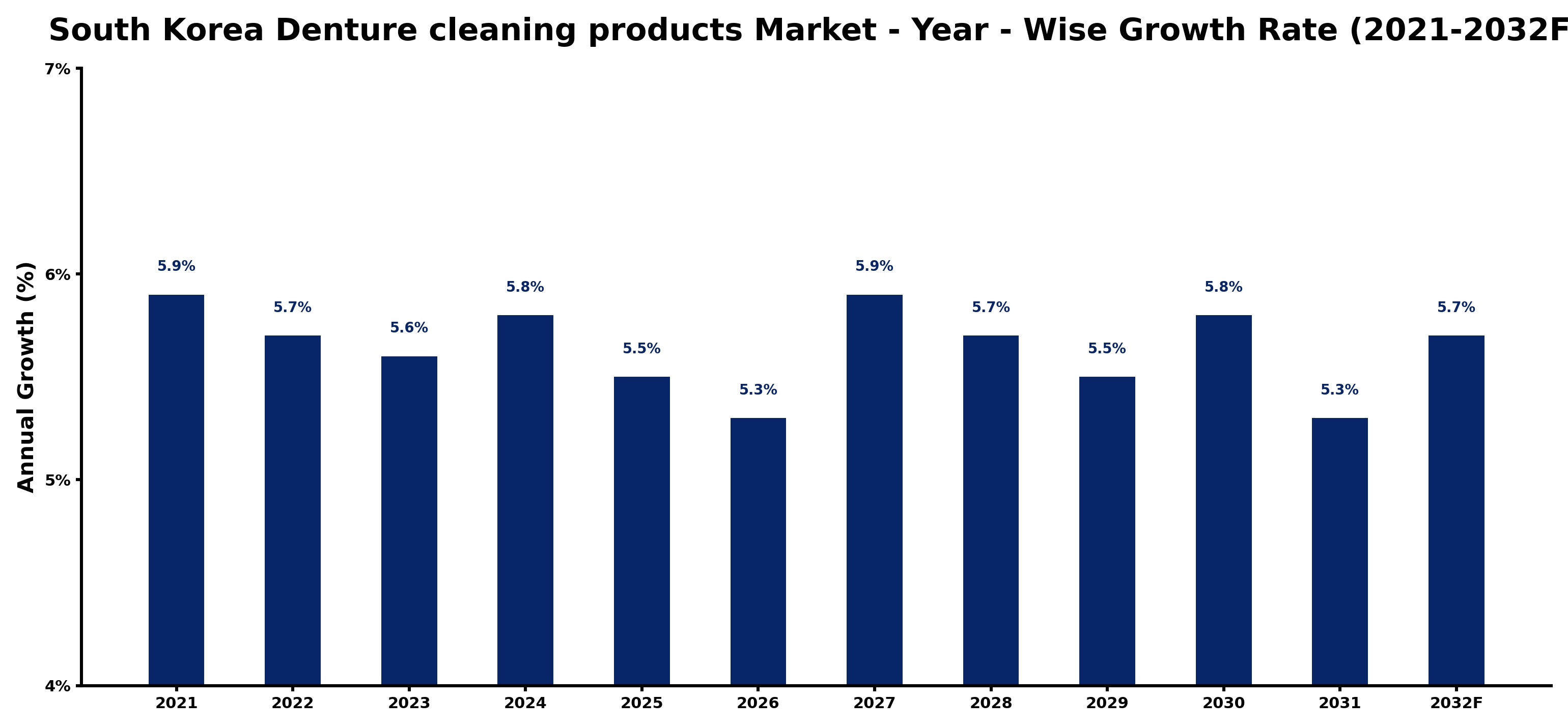
The table below presents the year‑wise growth rates along with the key drivers influencing the market
| Year | Growth Rate | Major Drivers |
| 2021 | 5.9% | Improved manufacturing processes boosted denture cleaner production capacity |
| 2022 | 5.7% | Advanced manufacturing technologies boost denture cleaner production efficiency |
| 2023 | 5.6% | Local manufacturers optimize production to meet rising denture care demand |
| 2024 | 5.8% | Denture cleaning product exports surged with international market demand recovery |
| 2025 | 5.5% | Manufacturing investments in advanced cleaning technology drive market competitiveness |
| 2026 | 5.3% | Increased dental service demands boost denture cleaner manufacturing volumes |
| 2027 | 5.9% | Strengthened production capabilities meet recovering demand for denture cleaners |
| 2028 | 5.7% | Increased local production capabilities boosted denture cleaner supply chains |
| 2029 | 5.5% | Manufacturing investments in advanced materials boost denture cleaning production |
| 2030 | 5.8% | Digital cleaning technology adoption boosts denture product market efficiency |
| 2031 | 5.3% | Modernized supply chains boosted denture cleaning product production efficiency |
| 2032 | 5.7% | Local manufacturers adopt automated systems for denture cleaner production |
Note - Market size estimations and growth projections presented in this report are based on 6Wresearch’s advanced forecasting approach, validated with industry datasets as of June 2026.
South Korea Denture cleaning products Market Synopsis
The strongest force shaping the South Korea denture cleaning products market is the growing demand for effective and convenient cleaning solutions. With an increasing number of elderly individuals requiring dentures, the emphasis on oral hygiene has never been higher, leading to a surge in product innovation.
Furthermore, consumers are increasingly favoring eco-friendly options, reflecting a broader societal shift towards sustainability. This is prompting companies to explore and develop natural denture cleaning solutions that align with health-conscious lifestyles while meeting the demand for efficient cleaning technologies.
South Korea Denture cleaning products Market Key Takeaways
- The market is expected to continue growing, fueled by an aging demographic and heightened awareness of oral hygiene.
- Consumers show a preference for natural and eco-friendly cleaning products, reflecting a shift toward sustainable living.
- Innovative technologies such as ultrasonic cleaners are becoming more popular, enhancing the efficiency of denture care.
- Education on proper denture cleaning methods remains essential to maximize product usage and consumer confidence.
- Investment in product development, particularly in natural and portable solutions, presents significant opportunities.
Evaluation of Restraints in South Korea Denture cleaning products Market
Despite its growth prospects, the South Korea denture cleaning products market faces notable challenges. A key restraint is the lack of consumer awareness surrounding proper denture care and cleaning methods. Many users may not fully understand the importance of using the right products, which can hinder optimal results. Additionally, the wide array of products available can confuse consumers, making it difficult for brands to distinguish themselves effectively. These factors necessitate targeted educational initiatives and clear marketing strategies to build trust and enhance product understanding among users.
South Korea Denture cleaning products Market Trends
A prominent trend shaping the South Korea denture cleaning products market is the increasing consumer preference for convenience. Products that facilitate quick and effective cleaning, like denture cleaning tablets and solutions, are gaining popularity due to their ability to deliver results without the need for manual scrubbing. Additionally, there is a significant rise in the popularity of eco-friendly cleaning products, driven by consumers' growing awareness of environmental issues. The integration of advanced cleaning technologies, such as ultrasonic cleaners, also exemplifies the market's shift towards innovation and efficiency.
South Korea Denture cleaning products Market Opportunities
The South Korea denture cleaning products market presents numerous investment opportunities, particularly in areas that cater to the aging population's needs. Innovations in ultrasonic cleaning technology and the development of biodegradable cleaning products can address the rising demand for effective yet environmentally friendly solutions. Additionally, creating portable cleaning devices for on-the-go use can tap into the lifestyle needs of active consumers. Collaborating with dental professionals to promote these advanced products can further enhance market penetration and consumer adoption.
Government Initiatives in the South Korea Denture cleaning products Market
In South Korea, the denture cleaning products market operates under stringent regulations set by the Ministry of Food and Drug Safety (MFDS). The government enforces Good Manufacturing Practice (GMP) standards to ensure product quality and safety. Labeling requirements are also enforced to provide consumers with accurate and clear information about the products. Such regulations not only protect public health but also aim to build consumer trust in denture cleaning products through rigorous oversight.
Future Insights of the South Korea Denture cleaning products Market
Looking forward, the South Korea denture cleaning products market is projected to maintain its growth momentum through 2032. As the population continues to age, there will be a sustained demand for denture-related products. Furthermore, advancements in technology and an increasing focus on preventive dental care will drive innovation in product offerings. Companies will likely focus on aligning their strategies with evolving consumer preferences and expanding their market share by emphasizing convenience, efficacy, and sustainability in their product lines.
South Korea Denture cleaning products Market Latest Developments (May 2025 - June 2026)
In recent months, the South Korea denture cleaning products market has witnessed significant advancements in product development, particularly with innovations focused on efficiency and environmental sustainability. Companies are increasingly introducing eco-friendly formulations that cater to consumer preferences for natural ingredients. There has also been a rise in the adoption of smart technologies in product design, including automated cleaning devices that enhance user convenience. As market players respond to evolving consumer demands, the overall landscape is becoming more dynamic and competitive.
South Korea Denture cleaning products Market - Key Attractiveness of the Report
- 10 Years of Market Numbers
- Historical Data Starting from 2022 to 2025
- Base Year: 2025
- Forecast Data until 2032
- Key Performance Indicators Impacting the Market
- Major Upcoming Developments and Projects
Key Highlights of the Report:
- South Korea Denture cleaning products Market Outlook
- Market Size of South Korea Denture cleaning products Market, 2025
- Forecast of South Korea Denture cleaning products Market, 2032
- Historical Data and Forecast of South Korea Denture cleaning products Revenues & Volume for the Period 2022-2032F
- South Korea Denture cleaning products Market Trend Evolution
- South Korea Denture cleaning products Market Drivers and Challenges
- South Korea Denture cleaning products Price Trends
- South Korea Denture cleaning products Porter's Five Forces
- South Korea Denture cleaning products Industry Life Cycle
- Historical Data and Forecast of South Korea Denture cleaning products Market Revenues & Volume By Type for the Period 2022-2032F
- Historical Data and Forecast of South Korea Denture cleaning products Market Revenues & Volume By Tablet for the Period 2022-2032F
- Historical Data and Forecast of South Korea Denture cleaning products Market Revenues & Volume By Liquid for the Period 2022-2032F
- Historical Data and Forecast of South Korea Denture cleaning products Market Revenues & Volume By Others for the Period 2022-2032F
- Historical Data and Forecast of South Korea Denture cleaning products Market Revenues & Volume By Applications for the Period 2022-2032F
- Historical Data and Forecast of South Korea Denture cleaning products Market Revenues & Volume By Dental Hospital for the Period 2022-2032F
- Historical Data and Forecast of South Korea Denture cleaning products Market Revenues & Volume By Home for the Period 2022-2032F
- Historical Data and Forecast of South Korea Denture cleaning products Market Revenues & Volume By Others for the Period 2022-2032F
- South Korea Denture cleaning products Import Export Trade Statistics
- Market Opportunity Assessment By Type
- Market Opportunity Assessment By Applications
- South Korea Denture cleaning products Top Companies Market Share
- South Korea Denture cleaning products Competitive Benchmarking By Technical and Operational Parameters
- South Korea Denture cleaning products Company Profiles
- South Korea Denture cleaning products Key Strategic Recommendations






































