South Korea MLOps Market Size & Growth Rate (2026-2032)
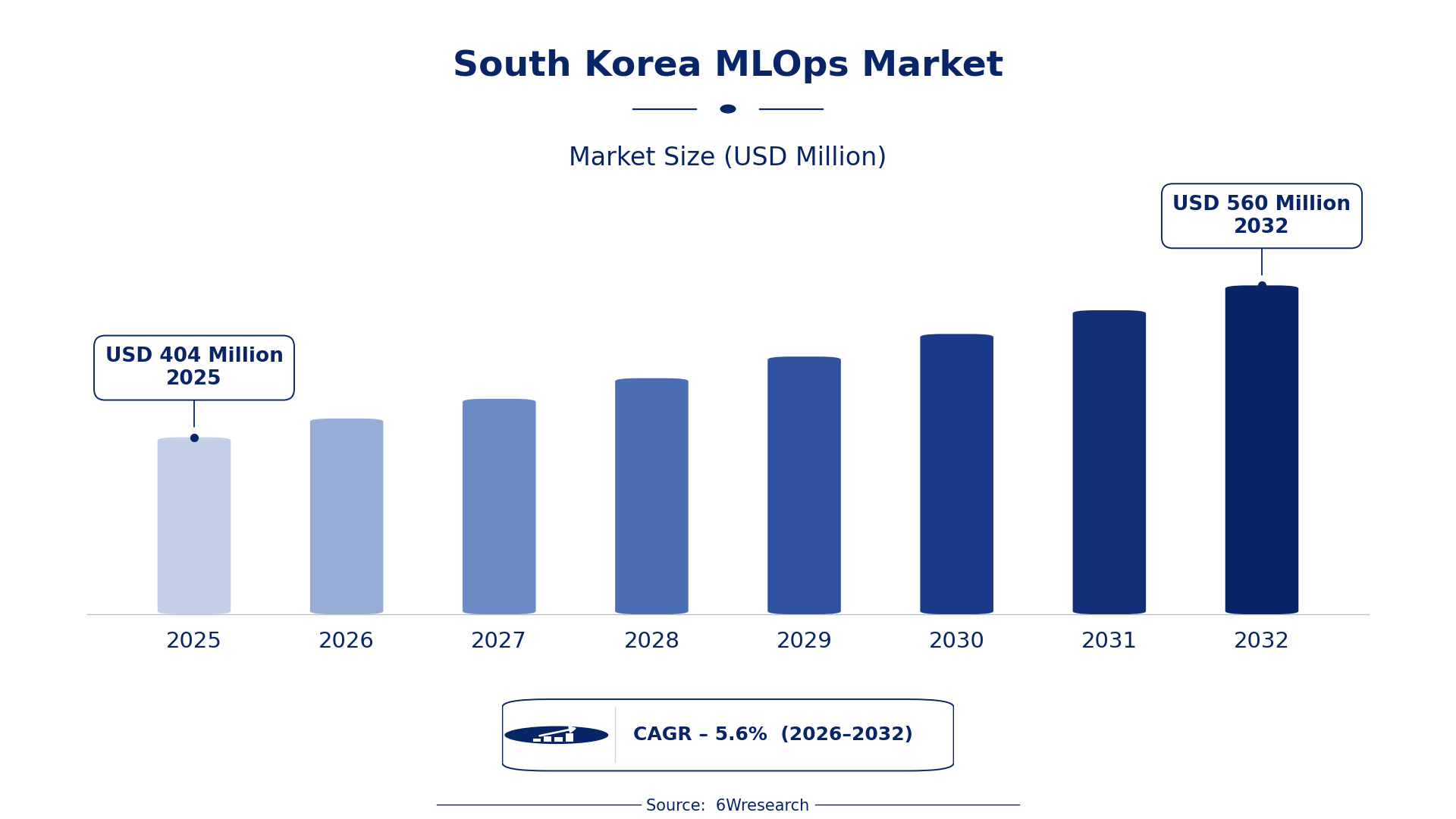
The South Korea MLOps Market was estimated at USD 404 Million in 2025 and is projected to reach USD 560 Million by 2032, growing at a CAGR of 5.6% from 2026 to 2032.
South Korea MLOps Market Synopsis
The South Korea MLOps market is witnessing a surge in activity as enterprises increasingly adopt AI and machine learning technologies. This momentum reflects a growing recognition of MLOps as essential for optimizing machine learning models, which is crucial for maintaining competitive advantage in a data-driven economy.
Looking ahead, the market is set to evolve significantly as organizations seek more streamlined solutions for managing complex ML operations. As the need for efficiency and transparency in AI initiatives rises, MLOps is expected to take center stage, driving further innovations and investments.
South Korea MLOps Market Year-wise Growth Rate and Key Drivers
This graph illustrates the annual growth rates of the South Korea MLOps Market from 2021 to 2032, highlighting a steady upward trajectory and projected expansion over the forecast period.
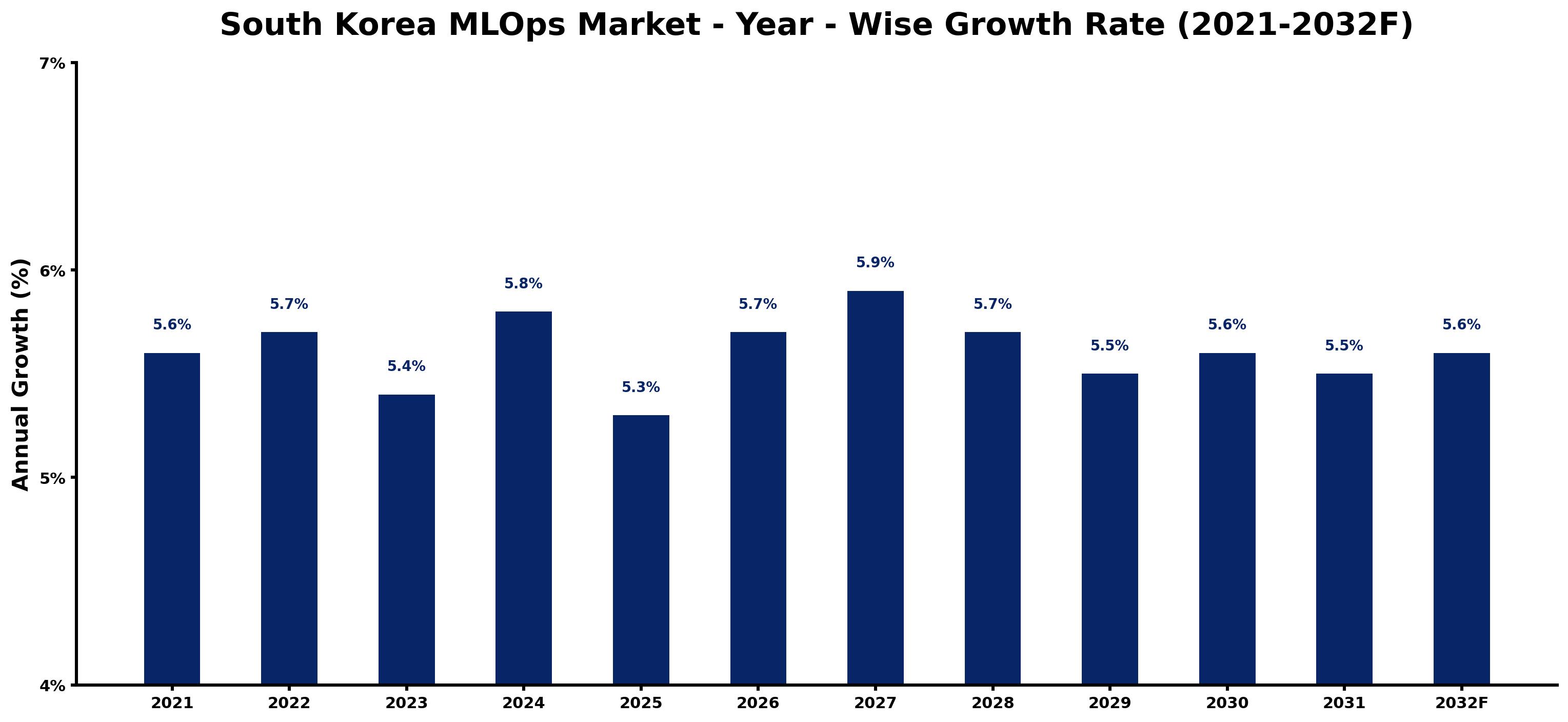
The table below presents the year‑wise growth rates along with the key drivers influencing the market
| Year | Growth Rate | Major Drivers |
| 2021 | 5.6% | Increased investment in AI by South Korean government initiatives. |
| 2022 | 5.7% | Growing adoption of AI technology in Korean manufacturing industries. |
| 2023 | 5.4% | Surge in data science programs at South Korean universities. |
| 2024 | 5.8% | Regulatory support for ethical AI practices by local authorities. |
| 2025 | 5.3% | Demand for real-time analytics in South Korean retail sector. |
| 2026 | 5.7% | Focus on MLOps for enhanced cybersecurity in financial services. |
| 2027 | 5.9% | Rising collaboration between startups and conglomerates in AI. |
| 2028 | 5.7% | Government funding for AI startups fostering market innovation. |
| 2029 | 5.5% | Increase in enterprise data hosting solutions driven by MLOps. |
| 2030 | 5.6% | Emergence of AI-driven healthcare solutions tailored for South Korea. |
| 2031 | 5.5% | Demand for automation tools in Korean logistics sector rises. |
| 2032 | 5.6% | Growth in AI ethics and explainability initiatives across industries. |
Note: Market size estimations and growth projections presented in this report are based on 6Wresearch's proprietary forecasting methodology, utilizing the latest available industry data, government publications, and primary research inputs.
South Korea MLOps Market Key Takeaways
Below are some of the specific key takeaways from the market, including:
- The increasing integration of MLOps with DevOps practices enhances the deployment of machine learning models.
- Automated machine learning tools are gaining traction, improving efficiency and scalability for businesses.
- Organizations prioritize model interpretability to comply with regulatory standards and ensure transparency.
- Investments in MLOps platforms are on the rise, particularly those offering model versioning and monitoring features.
- Demand for MLOps solutions is particularly strong in finance, healthcare, and e-commerce sectors.
Evaluation of Restraints in South Korea MLOps Market
Despite the promising outlook, the South Korea MLOps market faces notable hurdles. A significant shortage of skilled professionals in machine learning and data engineering limits the effective deployment of MLOps practices. Cultural factors, such as rigid hierarchical structures, can further impede swift adoption. Compliance with stringent data privacy regulations adds another layer of complexity, requiring organizations to tread carefully as they innovate. Addressing these challenges will necessitate a concerted effort to upskill the workforce and foster a more agile corporate culture.
South Korea MLOps Market Trends
Key trends shaping the South Korea MLOps market include a heightened focus on the convergence of MLOps and DevOps, aimed at streamlining machine learning operations. There is a rising demand for automated solutions that facilitate model management and deployment, indicating a shift towards enhancing operational efficiency. Additionally, businesses are increasingly aware of the importance of regulatory compliance, driving them to adopt practices that ensure model interpretability and transparency.
South Korea MLOps Market Opportunities
Investors have much to gain in the South Korea MLOps market, particularly as organizations ramp up their machine learning capabilities. Opportunities abound in developing MLOps platforms and tools that simplify the machine learning lifecycle. Consulting services that assist in the adoption of MLOps methodologies also present lucrative prospects. Strategic partnerships with local firms looking to enhance their AI capabilities can further unlock potential growth avenues.
Government Initiatives in the South Korea MLOps Market
The South Korean government actively supports the MLOps market through various policies aimed at fostering innovation and competitiveness. By providing funding and establishing regulatory frameworks, the government is positioning the country as a leader in AI and machine learning technologies. This proactive stance is critical for driving the adoption of MLOps solutions across industries.
- A recent initiative launched by the Ministry of Science and ICT focuses on enhancing R&D in artificial intelligence and machine learning, providing necessary funding and resources.
- Currently underway is a national program to improve digital infrastructure, which aims to facilitate the broader adoption of MLOps technologies.
- Planned for 2026, a public-private partnership is expected to promote AI innovation and enhance data analytics capabilities across sectors.
- Regulatory frameworks established in 2025 emphasize data privacy and security, ensuring compliance for businesses implementing MLOps solutions.
Future Insights of the South Korea MLOps Market
The future of the South Korea MLOps market looks promising, with robust growth anticipated as organizations increasingly depend on machine learning for strategic decision-making. The proliferation of data and advancements in AI technology will continue to drive demand for MLOps solutions. As businesses enhance their digital transformation initiatives, MLOps practices will become central to achieving efficiency and scalability, further solidifying the market's position in the region.
South Korea MLOps Market Latest Developments
In the past year, the South Korea MLOps market has seen considerable advancements in technology and practices. Companies are rapidly adopting new tools and methodologies to keep pace with the growing demand for efficient machine learning operations. This trend reflects a broader commitment to integrating AI into core business strategies.
- A major technology vendor launched an upgraded MLOps platform in early 2025, enhancing model management and deployment capabilities.
- An ongoing initiative began in mid-2025 to train professionals in machine learning and MLOps practices, addressing the skills gap in the workforce.
- Upcoming in late 2026, a new collaborative project aims to develop open-source MLOps tools tailored for the South Korean market.
- A partnership formed in early 2025 between regional firms focuses on sharing best practices in MLOps to improve operational efficiencies.
South Korea MLOps Market - Key Attractiveness of the Report
- 10 Years of Market Numbers
- Historical Data Starting from 2022 to 2025
- Base Year: 2025
- Forecast Data until 2032
- Key Performance Indicators Impacting the Market
- Major Upcoming Developments and Projects
The government has initiated several programs focused on R&D in AI and machine learning, providing funding and establishing regulatory frameworks to ensure data privacy and security in MLOps applications.
Key Highlights of the Report:
- South Korea MLOps Market Outlook
- Market Size of South Korea MLOps Market, 2025
- Forecast of South Korea MLOps Market, 2032
- Historical Data and Forecast of South Korea MLOps Revenues & Volume for the Period 2022-2032F
- South Korea MLOps Market Trend Evolution
- South Korea MLOps Market Drivers and Challenges
- South Korea MLOps Price Trends
- South Korea MLOps Porter's Five Forces
- South Korea MLOps Industry Life Cycle
- Historical Data and Forecast of South Korea MLOps Market Revenues & Volume By Component for the Period 2022-2032F
- Historical Data and Forecast of South Korea MLOps Market Revenues & Volume By Platform for the Period 2022-2032F
- Historical Data and Forecast of South Korea MLOps Market Revenues & Volume By Services for the Period 2022-2032F
- Historical Data and Forecast of South Korea MLOps Market Revenues & Volume By Deployment Mode for the Period 2022-2032F
- Historical Data and Forecast of South Korea MLOps Market Revenues & Volume By Cloud for the Period 2022-2032F
- Historical Data and Forecast of South Korea MLOps Market Revenues & Volume By On-premises for the Period 2022-2032F
- Historical Data and Forecast of South Korea MLOps Market Revenues & Volume By Organization Size for the Period 2022-2032F
- Historical Data and Forecast of South Korea MLOps Market Revenues & Volume By Large Enterprises for the Period 2022-2032F
- Historical Data and Forecast of South Korea MLOps Market Revenues & Volume By SMEs for the Period 2022-2032F
- Historical Data and Forecast of South Korea MLOps Market Revenues & Volume By Vertical for the Period 2022-2032F
- Historical Data and Forecast of South Korea MLOps Market Revenues & Volume By BFSI for the Period 2022-2032F
- Historical Data and Forecast of South Korea MLOps Market Revenues & Volume By Healthcare and Life Sciences for the Period 2022-2032F
- Historical Data and Forecast of South Korea MLOps Market Revenues & Volume By Retail and eCommerce for the Period 2022-2032F
- Historical Data and Forecast of South Korea MLOps Market Revenues & Volume By Telecom for the Period 2022-2032F
- South Korea MLOps Import Export Trade Statistics
- Market Opportunity Assessment By Component
- Market Opportunity Assessment By Deployment Mode
- Market Opportunity Assessment By Organization Size
- Market Opportunity Assessment By Vertical
- South Korea MLOps Top Companies Market Share
- South Korea MLOps Competitive Benchmarking By Technical and Operational Parameters
- South Korea MLOps Company Profiles
- South Korea MLOps Key Strategic Recommendations






































