Spain Apiculture Market Size, Share & Growth Rate
The Spain Apiculture Market was estimated at USD 147 Million in 2025 and is projected to reach USD 173 Million by 2032, growing at a CAGR of 2.4% from 2026 to 2032. This upward trajectory is driven primarily by the increasing consumer preference for organic and sustainably sourced honey, alongside the rising awareness of the health benefits associated with bee products. Additionally, Spain's favorable climate enhances honey production, making it a crucial player in the European Union's apiculture landscape.
Spain Apiculture Market Year-wise Growth Rate and Key Drivers
This graph highlights how the Spain Apiculture Market has steadily grown over the years, supported by major growth factors.
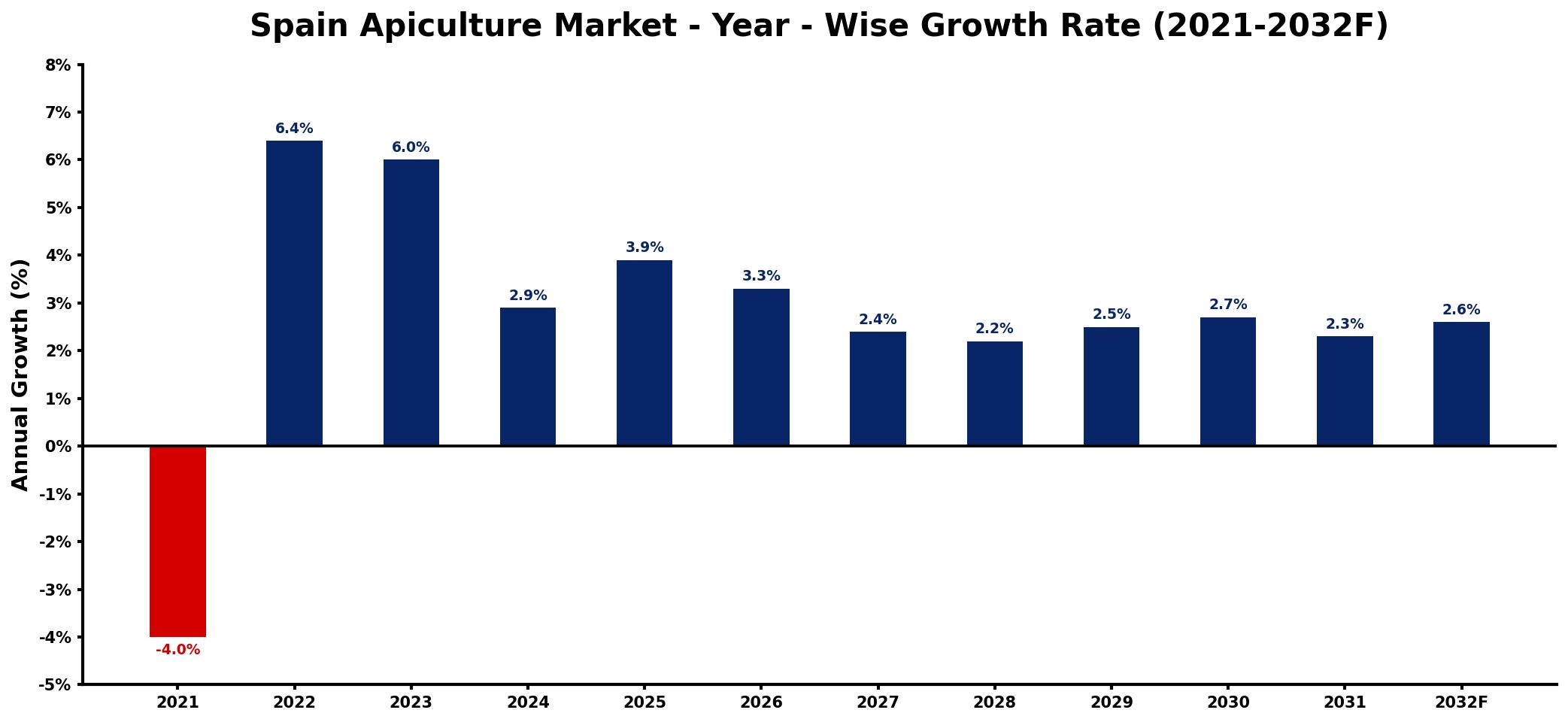
The table below presents the year‑wise growth rates along with the key drivers influencing the market
| Year | Growth Rate | Major Drivers |
| 2021 | -4.0% | decreased consumer interest in honey |
| 2022 | 6.4% | rising demand for organic products |
| 2023 | 6.0% | increased investment in bee farms |
| 2024 | 2.9% | growing popularity of natural sweeteners |
| 2025 | 3.9% | expansion of local farmer markets |
| 2026 | 3.3% | enhanced awareness of health benefits |
| 2027 | 2.4% | increased export opportunities abroad |
| 2028 | 2.2% | development of sustainable practices |
| 2029 | 2.5% | growing support for biodiversity initiatives |
| 2030 | 2.7% | rising consumer preference for local |
| 2031 | 2.3% | increased collaboration with researchers |
| 2032 | 2.6% | rising procurement volume requirements |
Note: Market size estimations and growth projections presented in this report are based on 6Wresearch's proprietary forecasting methodology, utilizing the latest available industry data, government publications, and primary research inputs.
Spain Apiculture Market Synopsis
The Spain Apiculture Market has shown remarkable momentum in recent years, characterized by a surge in both production and consumption of honey and related products. As a leading honey producer in the EU, Spain capitalizes on its rich floral diversity, which is pivotal for the high quality of its honey.
Looking ahead, the market is set to evolve with a stronger focus on sustainability and organic practices. Increased consumer demand for natural products is prompting beekeepers to innovate and adapt their methods, thus transforming the landscape of the apiculture industry in Spain.
Spain Apiculture Market Key Takeaways
- Spain ranks among the top honey producers in the EU, benefiting from diverse floral sources.
- Consumer demand for organic honey is rising, prompting beekeepers to adopt sustainable practices.
- Technological advancements in beekeeping, such as IoT, are enhancing production efficiency.
- Investment opportunities are emerging in value-added bee products and apiary tourism.
- Government initiatives are bolstering the sector through support for sustainability and bee health.
Evaluation of Restraints in Spain Apiculture Market
Despite its promising outlook, the Spain Apiculture Market faces significant constraints. Climate change presents challenges, causing unpredictable weather patterns that can disrupt bee populations and flowering cycles critical for honey production. The presence of pests and diseases, particularly the Varroa mite, poses an ongoing threat to hive health, demanding continuous vigilance and management. Furthermore, competition from lower-priced imported honey products challenges local producers, compelling them to invest in quality and sustainability to maintain market share.
Spain Apiculture Market Trends
Several notable trends are shaping the Spain Apiculture Market. A prominent trend is the growing preference for organic honey, fueled by an increased consumer awareness regarding health and environmental sustainability. This has resulted in a surge of beekeepers transitioning to organic methods and pursuing certification to meet market demands. Additionally, the integration of technology into beekeeping practices, including the utilization of IoT devices and data analytics, is gaining traction as a means to monitor hive conditions and optimize productivity. Efforts aimed at bee welfare and conservation are also on the rise, as stakeholders recognize the importance of maintaining healthy bee populations.
Spain Apiculture Market Opportunities
The Spain Apiculture Market offers numerous avenues for growth and investment. Expanding honey production through the adoption of modern beekeeping techniques represents a significant opportunity for enhancing efficiency and output. There is also a burgeoning market for value-added products, such as beeswax candles, propolis supplements, and royal jelly, which align with increasing consumer interest in natural health products. Furthermore, the concept of apiary tourism is gaining popularity, presenting opportunities for entrepreneurs to engage the public and raise awareness about the vital role bees play in agriculture and ecosystems.
Government Initiatives in the Spain Apiculture Market
The Spanish government actively promotes the sustainability and growth of the apiculture sector through various initiatives. Financial support and subsidies are available to beekeepers, encouraging them to maintain and expand their colonies. Strict regulations ensure the safety and quality of honey production, while research and development initiatives aim to improve bee health and productivity. These efforts underscore the government's commitment to fostering a robust and environmentally responsible apiculture industry, vital for biodiversity.
Future Insights of the Spain Apiculture Market
Looking towards 2026-2032, the Spain Apiculture Market is expected to maintain a positive growth trajectory. The increasing consumer preference for natural honey and related products will drive demand, supported by rising awareness of honey's health benefits and its applications in food and beverages. Government support for beekeeping activities, combined with initiatives aimed at promoting sustainable practices, will further catalyze market expansion. However, stakeholders must navigate the challenges posed by climate change and import competition to fully capitalize on the growth opportunities ahead.
Spain Apiculture Market Latest Developments (2025 - 2026)
The apiculture industry in Spain is witnessing transformative developments, including the increased adoption of innovative technologies by beekeepers. There is a growing focus on sustainability practices, with many producers obtaining organic certifications to appeal to health-conscious consumers. Additionally, educational programs promoting bee conservation have gained traction, fostering a deeper public appreciation for the role of bees in the ecosystem. These trends are reshaping the market dynamics as stakeholders adapt to evolving consumer preferences and environmental challenges.
Spain Apiculture Market - Key Attractiveness of the Report
- 10 Years of Market Numbers
- Historical Data Starting from 2022 to 2025
- Base Year: 2025
- Forecast Data until 2032
- Key Performance Indicators Impacting the Market
- Major Upcoming Developments and Projects
Key Highlights of the Report:
- Spain Apiculture Market Outlook
- Market Size of Spain Apiculture Market, 2025
- Forecast of Spain Apiculture Market, 2032
- Historical Data and Forecast of Spain Apiculture Revenues & Volume for the Period 2022-2032F
- Spain Apiculture Market Trend Evolution
- Spain Apiculture Market Drivers and Challenges
- Spain Apiculture Price Trends
- Spain Apiculture Porter's Five Forces
- Spain Apiculture Industry Life Cycle
- Historical Data and Forecast of Spain Apiculture Market Revenues & Volume By Product Type for the Period 2022-2032F
- Historical Data and Forecast of Spain Apiculture Market Revenues & Volume By Honey for the Period 2022-2032F
- Historical Data and Forecast of Spain Apiculture Market Revenues & Volume By Beeswax for the Period 2022-2032F
- Historical Data and Forecast of Spain Apiculture Market Revenues & Volume By Live-bees for the Period 2022-2032F
- Historical Data and Forecast of Spain Apiculture Market Revenues & Volume By Others for the Period 2022-2032F
- Historical Data and Forecast of Spain Apiculture Market Revenues & Volume By Application for the Period 2022-2032F
- Historical Data and Forecast of Spain Apiculture Market Revenues & Volume By Medical for the Period 2022-2032F
- Historical Data and Forecast of Spain Apiculture Market Revenues & Volume By Food Beverages for the Period 2022-2032F
- Historical Data and Forecast of Spain Apiculture Market Revenues & Volume By Cosmetics for the Period 2022-2032F
- Historical Data and Forecast of Spain Apiculture Market Revenues & Volume By Others for the Period 2022-2032F
- Spain Apiculture Import Export Trade Statistics
- Market Opportunity Assessment By Product Type
- Market Opportunity Assessment By Application
- Spain Apiculture Top Companies Market Share
- Spain Apiculture Competitive Benchmarking By Technical and Operational Parameters
- Spain Apiculture Company Profiles
- Spain Apiculture Key Strategic Recommendations






































