Spain Bisphenol A Market Size Growth Rate
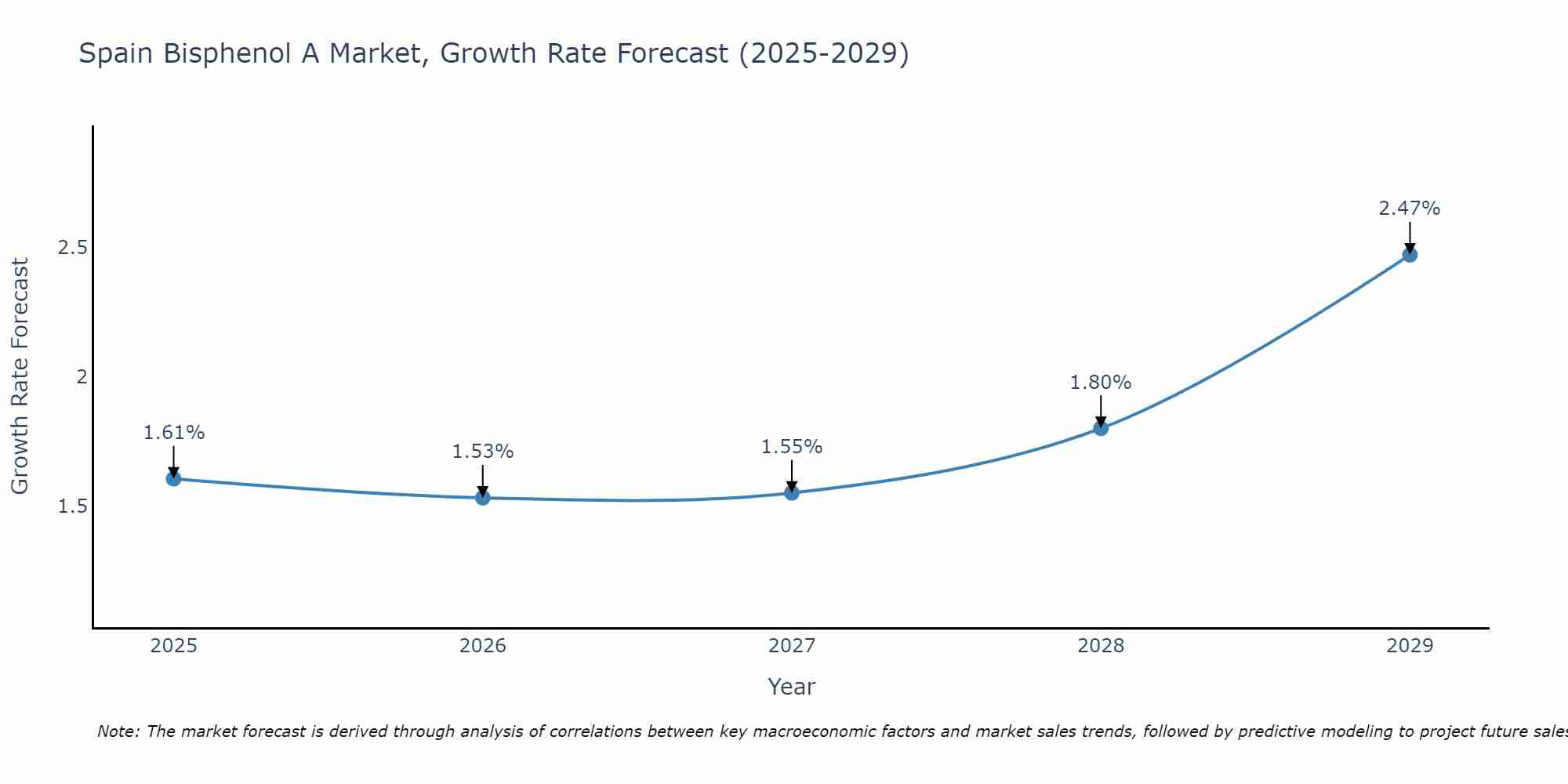
The Spain Bisphenol A Market is projected to witness mixed growth rate patterns during 2025 to 2029. From 1.61% in 2025, the growth rate steadily ascends to 2.47% in 2029.
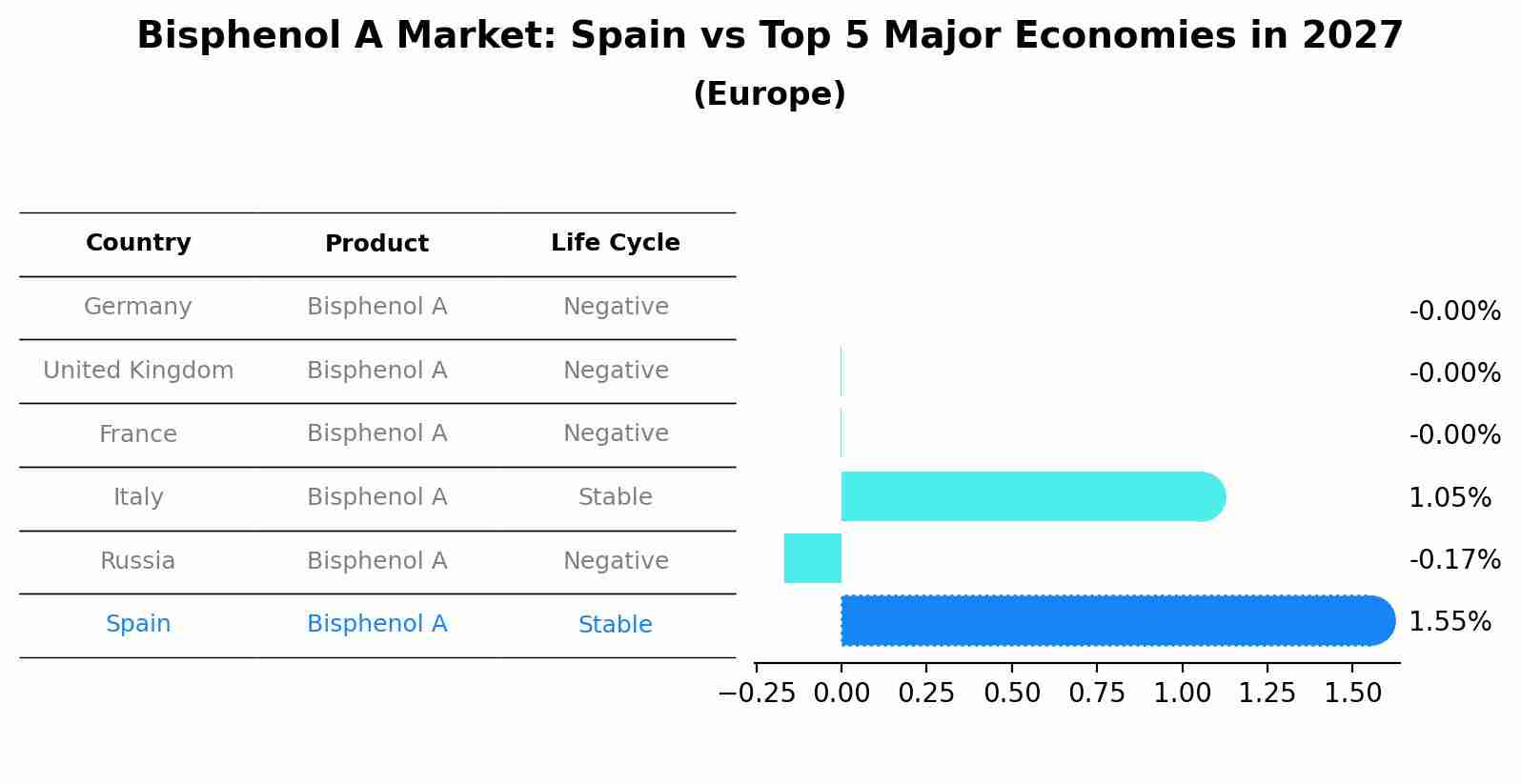
Bisphenol A Market: Spain vs Top 5 Major Economies in 2027 (Europe)
The Bisphenol A market in Spain is projected to grow at a stable growth rate of 1.55% by 2027, highlighting the country's increasing focus on advanced technologies within the Europe region, where Germany holds the dominant position, followed closely by United Kingdom, France, Italy and Russia, shaping overall regional demand.
Spain Bisphenol A Market Overview
The Spain Bisphenol A market is witnessing steady growth driven by the increasing demand from various end-use industries such as automotive, electronics, and packaging. Bisphenol A, commonly known as BPA, is extensively used in the production of polycarbonate plastics and epoxy resins, making it a crucial component in the manufacturing sector. The market is also influenced by stringent regulations aimed at restricting BPA usage in consumer products due to its potential health hazards. As a result, manufacturers are focusing on developing BPA-free alternatives to cater to the changing regulatory landscape and consumer preferences. Overall, the Spain Bisphenol A market is expected to continue its growth trajectory, propelled by evolving industry trends and technological advancements.
Spain Bisphenol A Market Trends
The Spain Bisphenol A market is witnessing a shift towards BPA-free alternatives due to increasing awareness about the potential health risks associated with BPA exposure. Consumers are becoming more conscious about the products they use, leading to a growing demand for BPA-free packaging materials in food and beverage, cosmetics, and household products. Government regulations and initiatives promoting the use of safer alternatives are also driving this trend. Manufacturers are responding to this demand by developing innovative BPA-free materials and investing in research to find sustainable solutions. As a result, the Spain Bisphenol A market is expected to see continued growth in BPA-free products, with a focus on safety, sustainability, and consumer preferences.
Spain Bisphenol A Market Challenges
In the Spain Bisphenol A market, one of the main challenges faced is increasing regulatory restrictions and consumer awareness regarding the potential health risks associated with Bisphenol A. This has led to a growing demand for BPA-free products and alternative materials, putting pressure on manufacturers to innovate and adapt their production processes. Additionally, the competitive landscape in the market is evolving, with more companies entering the space to meet the changing consumer preferences. Maintaining compliance with stringent regulations while also meeting consumer demands for safer alternatives presents a significant challenge for players in the Spain Bisphenol A market. Striking a balance between regulatory compliance, product innovation, and meeting consumer preferences will be crucial for companies operating in this market.
Spain Bisphenol A Market Investment Opportunities
Investment opportunities in the Spain Bisphenol A market could include potential growth in the production and demand for Bisphenol A (BPA) as it is a key component in the manufacturing of various products such as plastics, epoxy resins, and thermal paper. With the increasing awareness of BPA`s versatility and applications across industries like packaging, automotive, electronics, and construction, there is a growing market for BPA in Spain. Investors could consider opportunities in BPA production facilities, distribution networks, and research and development for alternative BPA-free products. Furthermore, advancements in technology and regulatory changes towards sustainable and environmentally friendly production processes present avenues for investment in the Spain Bisphenol A market. However, it is essential for investors to closely monitor market trends, regulations, and consumer preferences to make informed investment decisions in this sector.
Spain Bisphenol A Market Government Policy
In Spain, the government has implemented regulations concerning Bisphenol A (BPA) in various products to protect public health. The use of BPA in baby bottles has been banned since 2011, and the European Union has restricted its use in food contact materials since 2018. Additionally, Spain has established maximum limits for BPA migration in food packaging materials to ensure consumer safety. The government continues to monitor and evaluate the potential risks associated with BPA exposure, with ongoing research and assessments conducted by health authorities to determine the need for further regulatory measures. Overall, Spain`s policies aim to minimize BPA exposure and safeguard the well-being of its population.
Spain Bisphenol A Market Future Outlook
The future outlook for the Spain Bisphenol A market is expected to be positive but challenging due to increasing regulatory scrutiny and consumer awareness regarding the potential health risks associated with BPA. While demand for BPA is projected to remain steady in key industries such as plastics, food packaging, and electronics, manufacturers are increasingly seeking alternatives to BPA to meet regulatory requirements and consumer preferences for safer products. The market is likely to experience a shift towards BPA-free products, leading to opportunities for innovation and product development. Companies operating in the Spain Bisphenol A market will need to adapt to changing regulations and consumer demands to maintain competitiveness and sustain growth in the coming years.
Key Highlights of the Report:
- Spain Bisphenol A Market Outlook
- Market Size of Spain Bisphenol A Market, 2021
- Forecast of Spain Bisphenol A Market, 2027
- Historical Data and Forecast of Spain Bisphenol A Revenues & Volume for the Period 2018 - 2027
- Spain Bisphenol A Market Trend Evolution
- Spain Bisphenol A Market Drivers and Challenges
- Spain Bisphenol A Price Trends
- Spain Bisphenol A Porter's Five Forces
- Spain Bisphenol A Industry Life Cycle
- Historical Data and Forecast of Spain Bisphenol A Market Revenues & Volume By Application for the Period 2018 - 2027
- Historical Data and Forecast of Spain Bisphenol A Market Revenues & Volume By Polycarbonate Resin for the Period 2018 - 2027
- Historical Data and Forecast of Spain Bisphenol A Market Revenues & Volume By Epoxy Resin for the Period 2018 - 2027
- Historical Data and Forecast of Spain Bisphenol A Market Revenues & Volume By Unsaturated Polyester Resins for the Period 2018 - 2027
- Historical Data and Forecast of Spain Bisphenol A Market Revenues & Volume By Flame Retardants for the Period 2018 - 2027
- Historical Data and Forecast of Spain Bisphenol A Market Revenues & Volume By Others for the Period 2018 - 2027
- Historical Data and Forecast of Spain Bisphenol A Market Revenues & Volume By End-use for the Period 2018 - 2027
- Historical Data and Forecast of Spain Bisphenol A Market Revenues & Volume By Eye wear for the Period 2018 - 2027
- Historical Data and Forecast of Spain Bisphenol A Market Revenues & Volume By Automotive component for the Period 2018 - 2027
- Historical Data and Forecast of Spain Bisphenol A Market Revenues & Volume By Electronics for the Period 2018 - 2027
- Historical Data and Forecast of Spain Bisphenol A Market Revenues & Volume By Wind Energy Composites for the Period 2018 - 2027
- Historical Data and Forecast of Spain Bisphenol A Market Revenues & Volume By Paint and Coating for the Period 2018 - 2027
- Historical Data and Forecast of Spain Bisphenol A Market Revenues & Volume By Green House for the Period 2018 - 2027
- Historical Data and Forecast of Spain Bisphenol A Market Revenues & Volume By Others for the Period 2018 - 2027
- Spain Bisphenol A Import Export Trade Statistics
- Market Opportunity Assessment By Application
- Market Opportunity Assessment By End-use
- Spain Bisphenol A Top Companies Market Share
- Spain Bisphenol A Competitive Benchmarking By Technical and Operational Parameters
- Spain Bisphenol A Company Profiles
- Spain Bisphenol A Key Strategic Recommendations






































