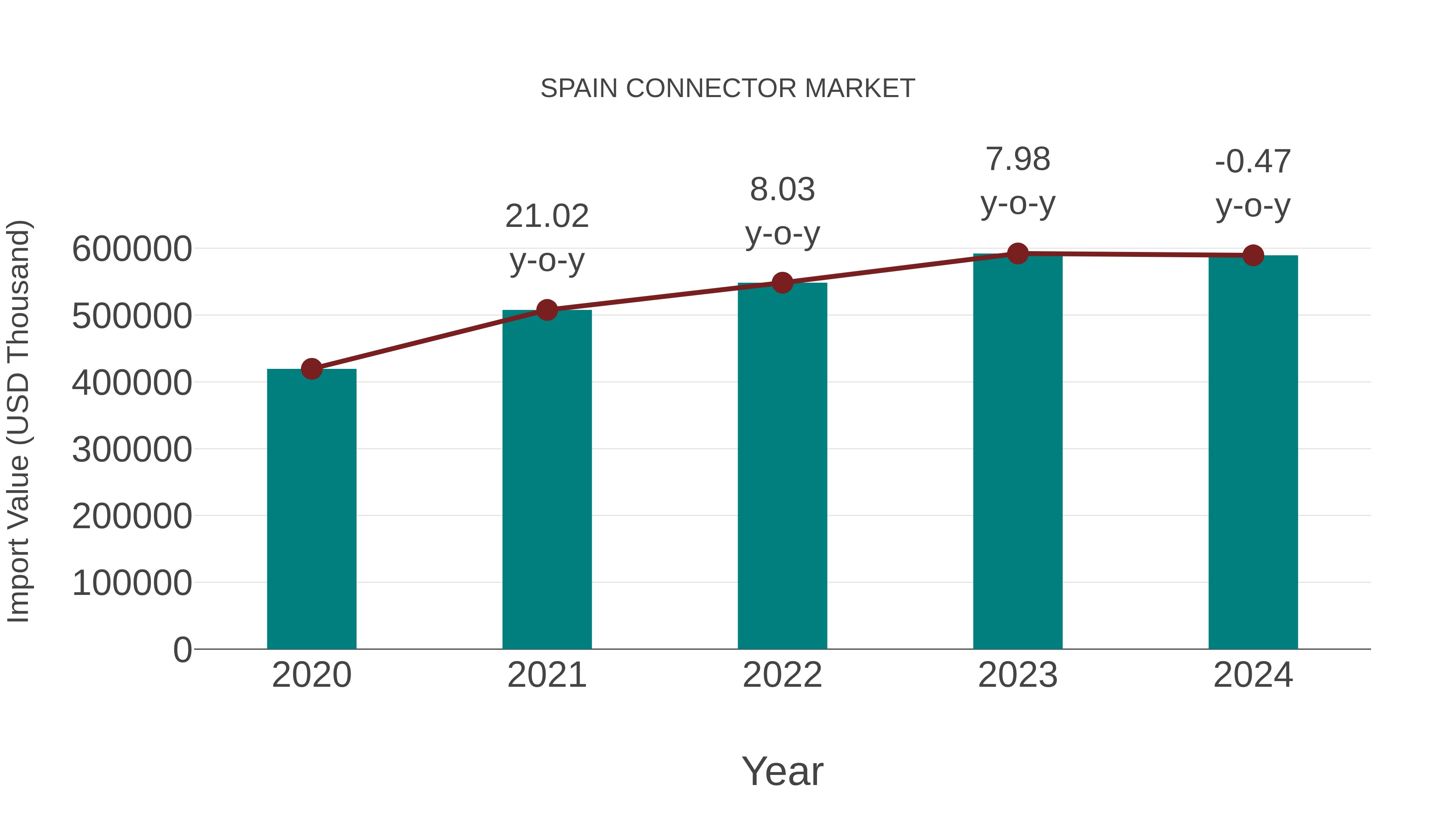
Spain Connector Market: Import Trend Analysis
In 2024, Spain`s connector market saw a consistent upward trend in imports. The market experienced a steady increase in imported connectors, reflecting a growing demand for these products within the country.
Connector Market: Spain vs Top 5 Major Economies in 2027 (Europe)
The Connector market in Spain is projected to grow at a stable growth rate of 3.01% by 2027, highlighting the country's increasing focus on advanced technologies within the Europe region, where Germany holds the dominant position, followed closely by United Kingdom, France, Italy and Russia, shaping overall regional demand.

Spain Connector Market Overview
The Spain connector market is a vital component of the country`s electronic and electrical industries. With the growing demand for advanced technology in sectors such as automotive, telecommunications, and consumer electronics, the market is witnessing robust growth. Key trends include the increasing adoption of electric vehicles and the push for automation, driving the need for high-performance connectors. Manufacturers are focusing on innovation and the development of environmentally friendly materials to meet stringent regulations and consumer preferences.
Drivers of the market
The Spain connector market is primarily driven by the increasing demand for connectivity solutions in various sectors, including telecommunications, automotive, and industrial applications. The growing adoption of electric vehicles (EVs) further fuels the need for advanced connectors that can handle higher power and data transmission. Additionally, technological advancements and the rise of automation in manufacturing processes are boosting the demand for innovative connector designs that enhance efficiency and reliability.
Challenges of the market
The Spain connector market faces challenges related to technological advancements and evolving standards. Manufacturers must continuously innovate to meet the increasing demands for higher performance and miniaturization. Additionally, the presence of counterfeit products poses a risk to quality and reliability. Regulatory compliance and environmental considerations, such as RoHS and REACH, further complicate production processes, requiring companies to invest in compliance measures.
Government Policy of the market
The Spanish connector market is influenced by government policies aimed at promoting technological innovation and digital transformation. Initiatives that support the development of smart technologies and sustainable practices are integral, particularly as Spain pushes towards a greener economy. The government also emphasizes standardization in the connector industry to ensure compatibility and interoperability among devices, which facilitates trade and manufacturing.
Key Highlights of the Report:
- Spain Connector Market Outlook
- Market Size of Spain Connector Market, 2024
- Forecast of Spain Connector Market, 2031
- Historical Data and Forecast of Spain Connector Revenues & Volume for the Period 2018 - 2031
- Spain Connector Market Trend Evolution
- Spain Connector Market Drivers and Challenges
- Spain Connector Price Trends
- Spain Connector Porter's Five Forces
- Spain Connector Industry Life Cycle
- Historical Data and Forecast of Spain Connector Market Revenues & Volume By Product for the Period 2018 - 2031
- Historical Data and Forecast of Spain Connector Market Revenues & Volume By PCB Connectors for the Period 2018 - 2031
- Historical Data and Forecast of Spain Connector Market Revenues & Volume By IO Connectors for the Period 2018 - 2031
- Historical Data and Forecast of Spain Connector Market Revenues & Volume By Circular Connectors for the Period 2018 - 2031
- Historical Data and Forecast of Spain Connector Market Revenues & Volume By Fiber Optic Connectors for the Period 2018 - 2031
- Historical Data and Forecast of Spain Connector Market Revenues & Volume By RF Coaxial Connectors for the Period 2018 - 2031
- Historical Data and Forecast of Spain Connector Market Revenues & Volume By Others for the Period 2018 - 2031
- Historical Data and Forecast of Spain Connector Market Revenues & Volume By End Use for the Period 2018 - 2031
- Historical Data and Forecast of Spain Connector Market Revenues & Volume By Telecom for the Period 2018 - 2031
- Historical Data and Forecast of Spain Connector Market Revenues & Volume By Transportation for the Period 2018 - 2031
- Historical Data and Forecast of Spain Connector Market Revenues & Volume By Automotive for the Period 2018 - 2031
- Historical Data and Forecast of Spain Connector Market Revenues & Volume By Industrial for the Period 2018 - 2031
- Historical Data and Forecast of Spain Connector Market Revenues & Volume By Computer & Peripherals for the Period 2018 - 2031
- Historical Data and Forecast of Spain Connector Market Revenues & Volume By Others for the Period 2018 - 2031
- Spain Connector Import Export Trade Statistics
- Market Opportunity Assessment By Product
- Market Opportunity Assessment By End Use
- Spain Connector Top Companies Market Share
- Spain Connector Competitive Benchmarking By Technical and Operational Parameters
- Spain Connector Company Profiles
- Spain Connector Key Strategic Recommendations






































