Spain Consent Management Market Size & Growth Rate (2026-2032)
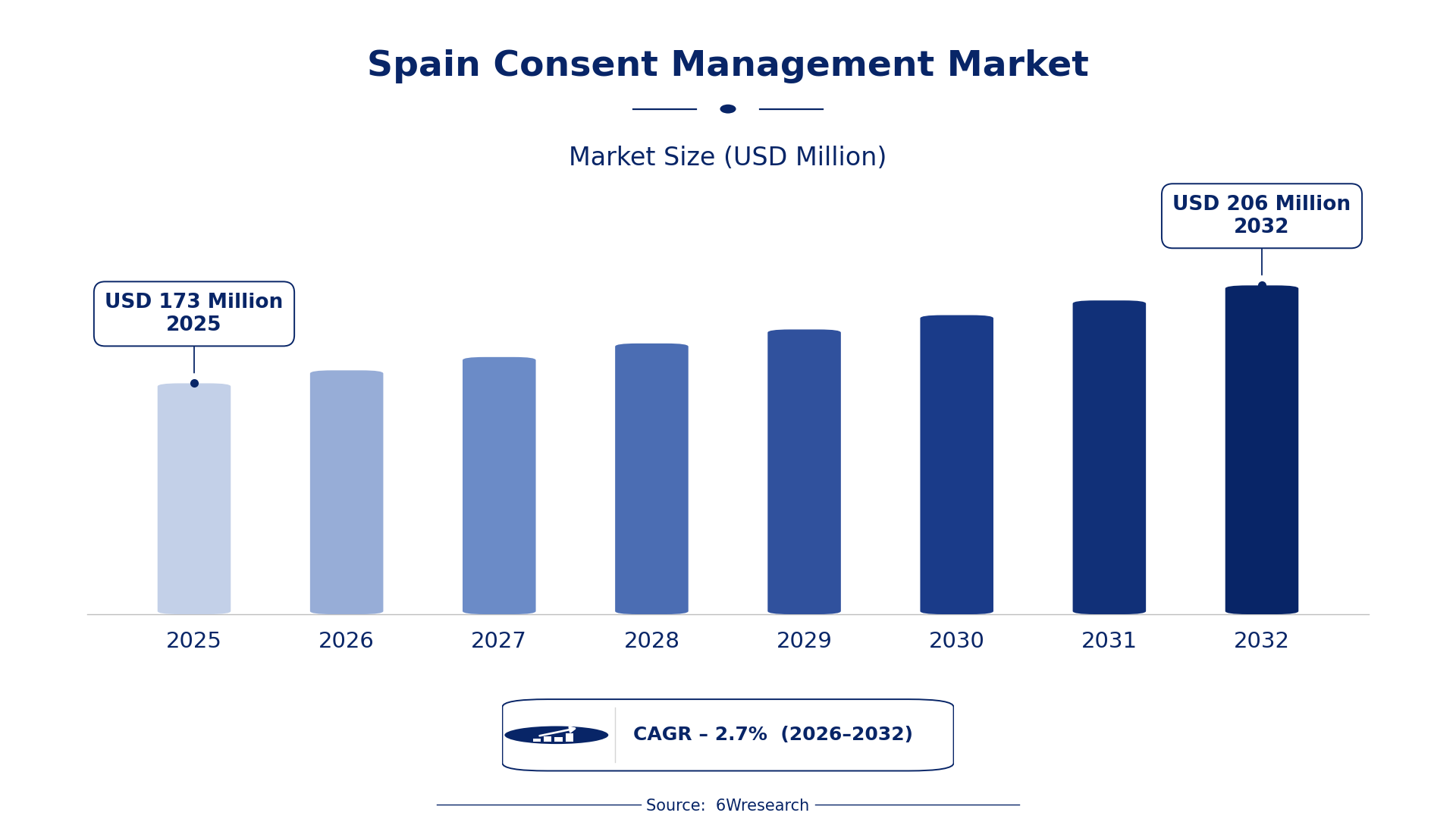
The Spain Consent Management Market was estimated at USD 173 Million in 2025 and is projected to reach USD 206 Million by 2032, growing at a CAGR of 2.7% from 2026 to 2032.
Spain Consent Management Market Synopsis
The driving force behind the Spain Consent Management Market is the stringent enforcement of data privacy regulations, particularly the General Data Protection Regulation (GDPR). Companies are compelled to adopt consent management solutions to ensure compliance and build consumer trust.
The focus on user consent has never been more critical, with organizations striving to balance the legal requirements for data protection with the need for personalized services. As consumers become increasingly aware of their rights regarding data privacy, businesses are investing in advanced consent management platforms that not only streamline compliance but also enhance user experience.
Spain Consent Management Market Year-wise Growth Rate and Key Drivers
This graph illustrates the annual growth rates of the Spain Consent Management Market from 2021 to 2032, highlighting a steady upward trajectory and projected expansion over the forecast period.
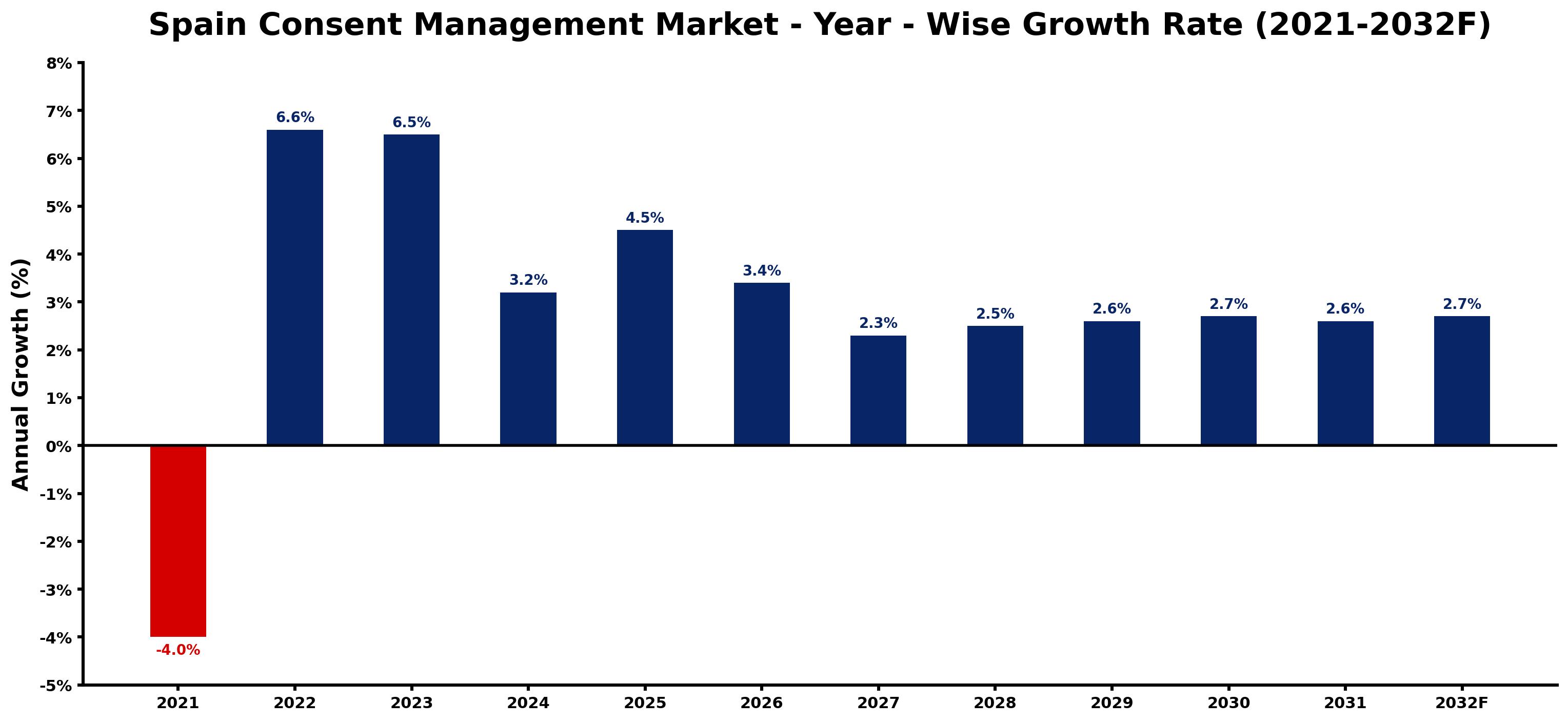
The table below presents the year‑wise growth rates along with the key drivers influencing the market
| Year | Growth Rate | Major Drivers |
| 2021 | -4.0% | GDPR enforcement issues by AEPD stalled adoption rates. |
| 2022 | 6.6% | GDPR compliance pressures boost consent solutions adoption. |
| 2023 | 6.5% | Increasing focus on data privacy regulations in Spain. |
| 2024 | 3.2% | Municipalities enhancing local data protection initiatives. |
| 2025 | 4.5% | Digital marketing firms prioritize consent management technologies. |
| 2026 | 3.4% | E-commerce growth drives demand for user consent frameworks. |
| 2027 | 2.3% | Healthcare sector's focus on patient data security escalates. |
| 2028 | 2.5% | Tech startups in Madrid demand tailored consent platforms. |
| 2029 | 2.6% | Legislative updates on data rights boost user awareness. |
| 2030 | 2.7% | Consumer concerns over data security rise significantly. |
| 2031 | 2.6% | Education sector's integration of digital consent management expands. |
| 2032 | 2.7% | Financial institutions strengthen user privacy interventions. |
Note: Market size estimations and growth projections presented in this report are based on 6Wresearch's proprietary forecasting methodology, utilizing the latest available industry data, government publications, and primary research inputs.
Spain Consent Management Market Key Takeaways
Below are some of the specific key takeaways from the market, including:
- The market is being propelled by growing awareness of data privacy rights among consumers.
- Companies are increasingly integrating consent management solutions with existing systems for efficiency.
- Investment in AI-driven consent management tools is on the rise to automate compliance tasks.
- There is a notable demand for user-friendly interfaces that simplify the consent process for end-users.
- Businesses are prioritizing solutions that manage cross-border data transfers effectively.
Evaluation of Restraints in Spain Consent Management Market
Despite its growth, the Spain Consent Management Market faces notable challenges. A primary issue is the complexity of compliance with GDPR and local regulations, which requires organizations to have robust systems for obtaining and managing consent. Many companies struggle with the technological demands of maintaining up-to-date consent preferences across various platforms. on top of that, there is a persistent gap in consumer education regarding data privacy, making it difficult for businesses to effectively communicate their practices and obligations. This lack of understanding can hinder efforts to foster trust and transparency.
Spain Consent Management Market Trends
Several trends are shaping the Spain Consent Management Market. The integration of consent management tools with Customer Relationship Management (CRM) systems has become increasingly common, enabling businesses to streamline data handling. Additionally, automated solutions leveraging artificial intelligence and machine learning are emerging, enhancing the efficiency of consent collection and management.
There is also a marked shift toward user-centric designs in consent management platforms, aimed at improving the consumer experience. As regulations evolve, companies are focusing on comprehensive solutions that address cross-border data compliance and the growing complexity of privacy laws.
Spain Consent Management Market Opportunities
The Spain Consent Management Market presents significant investment opportunities, particularly as businesses seek to enhance compliance with stringent privacy regulations. There's a growing demand for platforms that not only manage consent but also offer analytics to track consumer preferences effectively. Companies that provide innovative and adaptable consent management solutions are likely to see substantial growth, especially those catering to the unique needs of various sectors.
Government Initiatives in the Spain Consent Management Market
Government policies are profoundly influencing the Spain Consent Management Market, primarily through the enforcement of GDPR and local data protection laws. These regulations establish stringent guidelines for obtaining and managing user consent, compelling businesses to adopt compliant practices. The Spanish Data Protection Agency (AEPD) plays a critical role in ensuring adherence to these laws, which shapes market dynamics considerably.
- A recently completed initiative involved the AEPD's launch of public awareness campaigns to educate consumers about their data rights.
- Currently, the AEPD is rolling out enhanced monitoring frameworks to ensure businesses comply with consent regulations.
- A planned initiative aims to develop a comprehensive regulatory framework that addresses future data privacy challenges, expected to begin in late 2026.
- Ongoing workshops and seminars are being conducted to support companies in implementing GDPR-compliant consent management practices.
- In 2024, a public-private partnership was established to create resources aimed at improving data governance across various sectors.
Future Insights of the Spain Consent Management Market
Looking ahead to 2026-2032, the Spain Consent Management Market is likely to experience robust growth fueled by heightened consumer awareness and regulatory pressures. As businesses continue to navigate the complexities of data privacy, there will be an increasing push for innovative consent management solutions. Companies that prioritize transparency and compliance will not only meet regulatory demands but will also gain a competitive edge through enhanced customer loyalty and trust.
Spain Consent Management Market Latest Developments
In the past year, the Spain Consent Management Market has seen a flurry of activity, reflecting the urgency of compliance with evolving data privacy laws. Organizations are rapidly adapting their strategies and technologies to meet these demands, resulting in a dynamic market environment.
- A new consent management tool was launched in Q2 2025, offering advanced features for tracking user preferences and compliance documentation.
- A partnership between technology firms was announced in early 2025 to develop AI-driven solutions that automate consent management processes.
- Ongoing development of a comprehensive user education program aims to increase public understanding of data privacy rights, which began in late 2024.
- A major technology vendor is set to unveil a user-friendly interface for consent management solutions, with a rollout expected by mid-2026.
- In early 2025, a leading regional operator initiated a project to integrate consent management systems with their existing customer service platforms.
Spain Consent Management Market - Key Attractiveness of the Report
- 10 Years of Market Numbers
- Historical Data Starting from 2022 to 2025
- Base Year: 2025
- Forecast Data until 2032
- Key Performance Indicators Impacting the Market
- Major Upcoming Developments and Projects
Key Highlights of the Report:
- Spain Consent Management Market Outlook
- Market Size of Spain Consent Management Market, 2025
- Forecast of Spain Consent Management Market, 2032
- Historical Data and Forecast of Spain Consent Management Revenues & Volume for the Period 2022-2032F
- Spain Consent Management Market Trend Evolution
- Spain Consent Management Market Drivers and Challenges
- Spain Consent Management Price Trends
- Spain Consent Management Porter's Five Forces
- Spain Consent Management Industry Life Cycle
- Historical Data and Forecast of Spain Consent Management Market Revenues & Volume By Component for the Period 2022-2032F
- Historical Data and Forecast of Spain Consent Management Market Revenues & Volume By Software for the Period 2022-2032F
- Historical Data and Forecast of Spain Consent Management Market Revenues & Volume By Services for the Period 2022-2032F
- Historical Data and Forecast of Spain Consent Management Market Revenues & Volume By Deployment Type for the Period 2022-2032F
- Historical Data and Forecast of Spain Consent Management Market Revenues & Volume By Cloud for the Period 2022-2032F
- Historical Data and Forecast of Spain Consent Management Market Revenues & Volume By On-premises for the Period 2022-2032F
- Historical Data and Forecast of Spain Consent Management Market Revenues & Volume By Touchpoint for the Period 2022-2032F
- Historical Data and Forecast of Spain Consent Management Market Revenues & Volume By Mobile App for the Period 2022-2032F
- Historical Data and Forecast of Spain Consent Management Market Revenues & Volume By Web App for the Period 2022-2032F
- Historical Data and Forecast of Spain Consent Management Market Revenues & Volume By Organization Size for the Period 2022-2032F
- Historical Data and Forecast of Spain Consent Management Market Revenues & Volume By Large Enterprises for the Period 2022-2032F
- Historical Data and Forecast of Spain Consent Management Market Revenues & Volume By Small and Medium-sized Enterprises (SMEs) for the Period 2022-2032F
- Spain Consent Management Import Export Trade Statistics
- Market Opportunity Assessment By Component
- Market Opportunity Assessment By Deployment Type
- Market Opportunity Assessment By Touchpoint
- Market Opportunity Assessment By Organization Size
- Spain Consent Management Top Companies Market Share
- Spain Consent Management Competitive Benchmarking By Technical and Operational Parameters
- Spain Consent Management Company Profiles
- Spain Consent Management Key Strategic Recommendations






































