Spain Conversational Systems Market Size & Growth Rate (2026-2032)
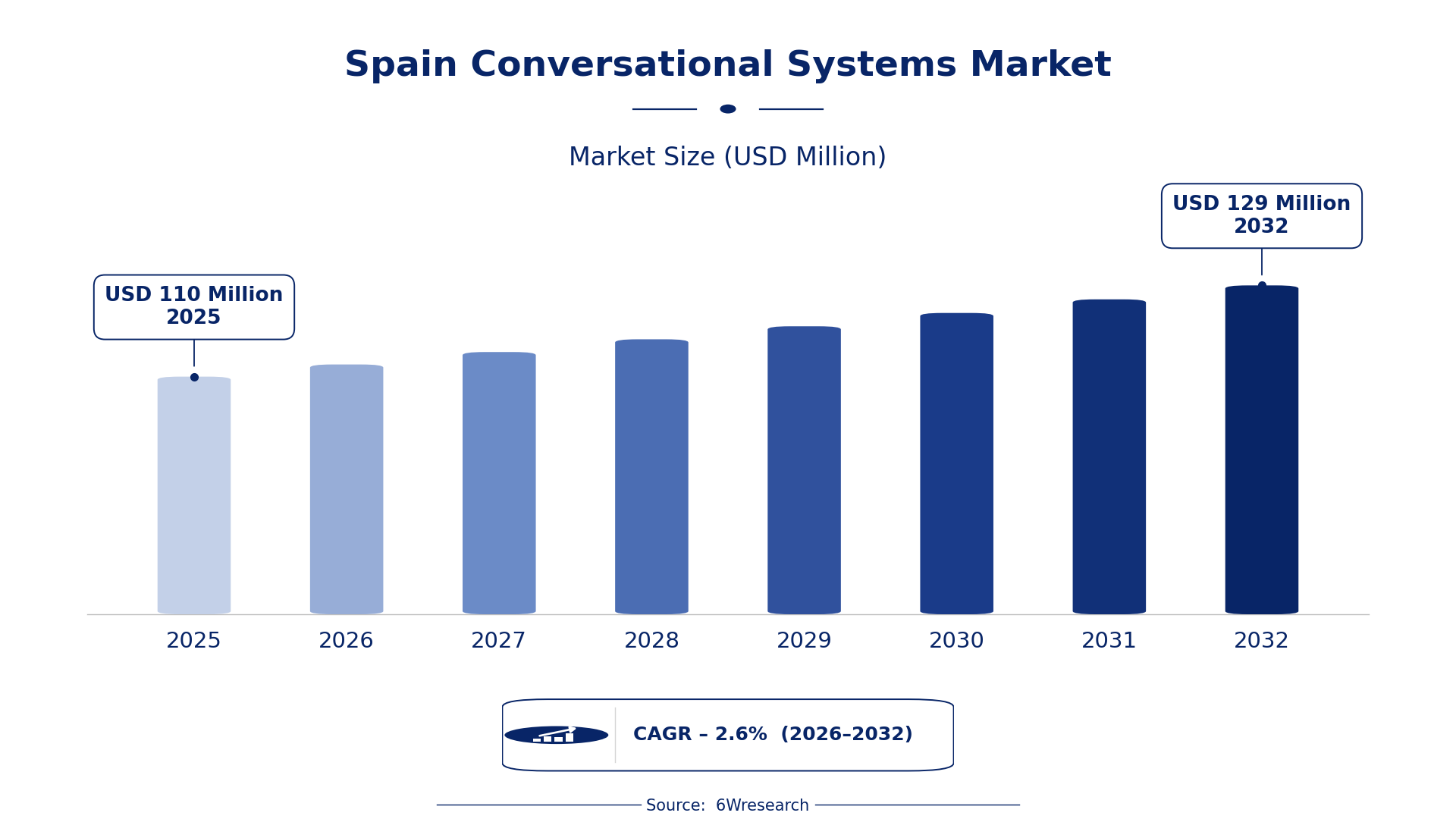
The Spain Conversational Systems Market was estimated at USD 110 Million in 2025 and is projected to reach USD 129 Million by 2032, growing at a CAGR of 2.6% from 2026 to 2032.
Spain Conversational Systems Market Synopsis
The conversational systems market in Spain has witnessed a remarkable surge in recent years, driven primarily by the increasing adoption of AI technologies across various sectors. As businesses strive for improved customer interaction, the demand for advanced chatbots and virtual assistants has skyrocketed. However, the path ahead remains laden with challenges, especially in refining natural language processing capabilities for the diverse Spanish dialects.
Looking forward, the market is expected to evolve significantly as companies seek to enhance their customer engagement strategies. With regulatory support and a clear push from the government towards AI integration, the market is on a trajectory that could redefine customer service standards in Spain.
Spain Conversational Systems Market Year-wise Growth Rate and Key Drivers
This graph illustrates the annual growth rates of the Spain Conversational Systems Market from 2021 to 2032, highlighting a steady upward trajectory and projected expansion over the forecast period.
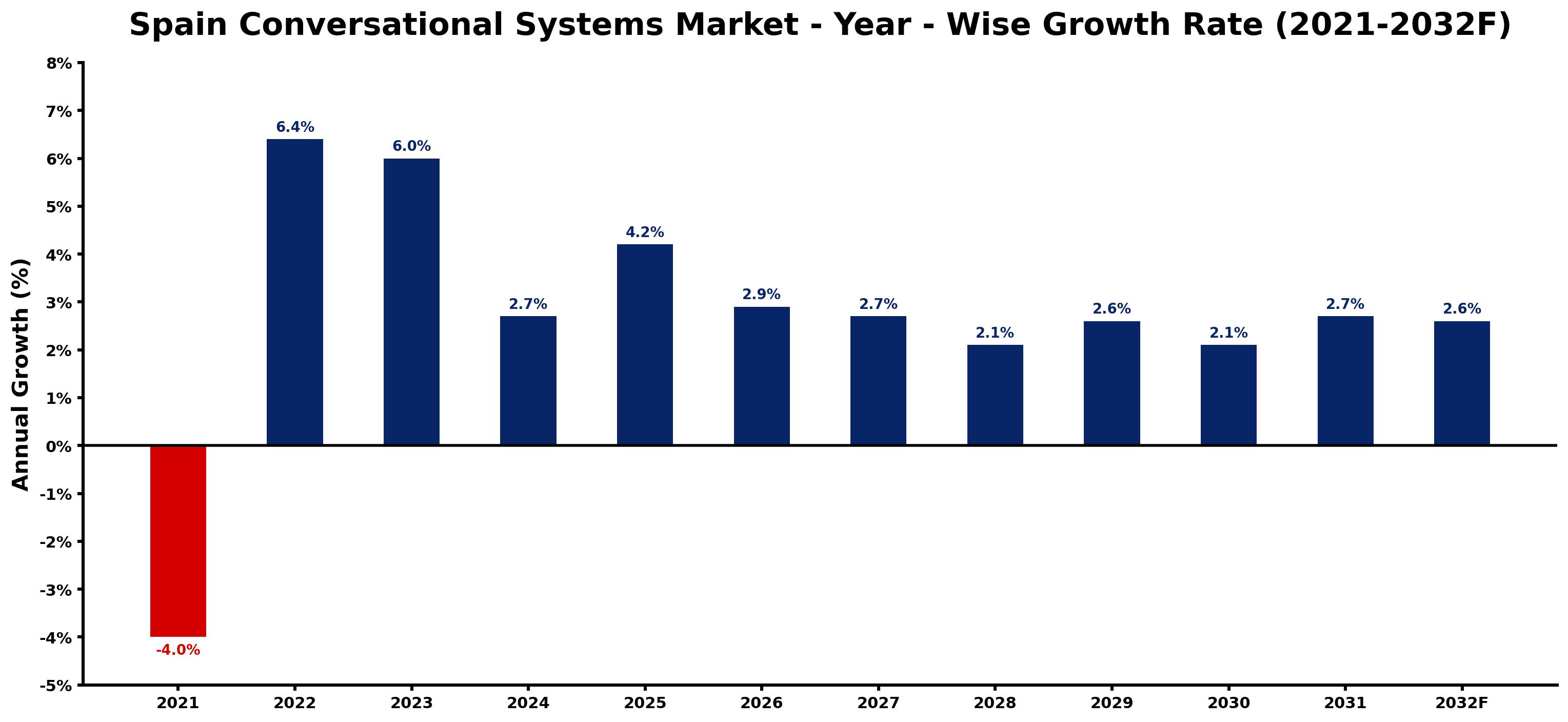
The table below presents the year‑wise growth rates along with the key drivers influencing the market
| Year | Growth Rate | Major Drivers |
| 2021 | -4.0% | Rising concerns over GDPR compliance stifling innovation. |
| 2022 | 6.4% | Increased investment in AI by Spanish tech startups. |
| 2023 | 6.0% | Government support for language processing research initiatives. |
| 2024 | 2.7% | Growing use of virtual assistants in Spanish retail. |
| 2025 | 4.2% | Regulatory changes promoting AI in customer service. |
| 2026 | 2.9% | Rising Spanish consumer preference for voice-activated devices. |
| 2027 | 2.7% | Boost in online education demand using conversational tools. |
| 2028 | 2.1% | Adoption of AI tools by regional healthcare providers. |
| 2029 | 2.6% | Collaboration between universities and tech firms in AI. |
| 2030 | 2.1% | Increased cloud adoption enhancing conversational system capabilities. |
| 2031 | 2.7% | Support from the Spanish government for digital transformation. |
| 2032 | 2.6% | Integration of conversational interfaces in public services. |
Note: Market size estimations and growth projections presented in this report are based on 6Wresearch's proprietary forecasting methodology, utilizing the latest available industry data, government publications, and primary research inputs.
Spain Conversational Systems Market Key Takeaways
Below are some of the specific key takeaways from the market, including:
- The market is experiencing steady growth, fueled by the need for AI-driven customer service solutions.
- Natural language processing advancements remain crucial for addressing regional dialects and enhancing user experience.
- Key sectors driving adoption include e-commerce, banking, and telecommunications.
- Government initiatives are actively promoting AI technologies in both public and private sectors.
- Businesses are increasingly prioritizing operational efficiency through automation via conversational systems.
Evaluation of Restraints in Spain Conversational Systems Market
Despite its growth potential, the Spain Conversational Systems Market is hampered by several factors. Chief among these is the challenge of developing natural language processing technologies that can adeptly handle the intricacies of the Spanish language and its regional variations. This limitation can hinder user satisfaction and adoption rates. on top of that, concerns surrounding data privacy and compliance with stringent regulations pose significant obstacles for businesses looking to integrate advanced conversational systems.
Spain Conversational Systems Market Trends
The landscape of conversational systems in Spain is being shaped by several key trends. Firstly, businesses are increasingly leveraging AI to create personalized customer experiences, moving away from generic interactions. Another trend is the growing collaboration between tech firms and service providers, aimed at enhancing the sophistication of chatbots and virtual assistants. Additionally, the emphasis on data security is prompting companies to invest in more secure AI solutions that comply with regulations.
Spain Conversational Systems Market Opportunities
Significant growth and investment opportunities exist within the Spain Conversational Systems Market. Companies focusing on tailored solutions that cater to specific industries can gain a competitive edge. on top of that, the push for digital transformation in public services offers a fertile ground for conversational systems adoption. As organizations seek to automate processes and improve customer service, the demand for innovative AI solutions is expected to rise.
Government Initiatives in the Spain Conversational Systems Market
The Spanish government is taking active steps to promote the integration of AI technologies, including conversational systems, into various sectors. This includes a focus on ethical usage and the development of secure interfaces for public engagement. The regulatory environment is increasingly favorable, encouraging businesses to innovate while ensuring compliance with privacy standards.
- A recently completed initiative aimed at establishing a framework for AI ethics and governance, fostering responsible AI development.
- Currently ongoing is a national program to enhance AI capabilities within public services, focusing on chatbot implementation for citizen engagement.
- Upcoming plans include a public-private partnership aimed at expanding access to conversational systems in underserved regions, set to launch by mid-2026.
- A regulatory framework introduced in 2025 mandates transparency in AI operations, ensuring that businesses adhere to ethical standards.
- The government has initiated funding opportunities for startups developing AI-driven conversational solutions, encouraging innovation.
Future Insights of the Spain Conversational Systems Market
From 2026 to 2032, the Spain Conversational Systems Market is expected to undergo transformative changes as businesses increasingly invest in AI technologies. With a growing emphasis on personalized customer experiences and operational efficiency, companies will likely adopt more sophisticated conversational systems. The regulatory support from the government will further bolster market growth, as businesses align with compliance requirements while innovating. As a result, we can anticipate a more integrated approach to customer service that leverages AI capabilities to their fullest potential.
Spain Conversational Systems Market Latest Developments
Recent activity within the Spain Conversational Systems Market highlights a vibrant push towards innovation and implementation. Companies are rapidly embracing AI technologies, with a notable increase in partnerships aimed at enhancing service offerings. This shift reflects a broader trend of digital transformation across various industries.
- A major technology vendor launched an advanced virtual assistant platform in early 2025, featuring enhanced natural language processing capabilities.
- An initiative that began in mid-2025 is currently underway, focusing on integrating AI-driven chatbots into customer service operations across the banking sector.
- A rollout expected to begin in the second half of 2026 aims to deploy conversational systems in public healthcare facilities, enhancing patient engagement.
- A partnership between leading regional firms initiated in early 2025 seeks to develop AI solutions tailored for the telecommunications sector, promoting user interaction.
- A planned upgrade to existing conversational systems across government platforms is set to be completed by late 2026, enhancing accessibility and usability.
Spain Conversational Systems Market - Key Attractiveness of the Report
- 10 Years of Market Numbers
- Historical Data Starting from 2022 to 2025
- Base Year: 2025
- Forecast Data until 2032
- Key Performance Indicators Impacting the Market
- Major Upcoming Developments and Projects
Key Highlights of the Report:
- Spain Conversational Systems Market Outlook
- Market Size of Spain Conversational Systems Market, 2025
- Forecast of Spain Conversational Systems Market, 2032
- Historical Data and Forecast of Spain Conversational Systems Revenues & Volume for the Period 2022-2032F
- Spain Conversational Systems Market Trend Evolution
- Spain Conversational Systems Market Drivers and Challenges
- Spain Conversational Systems Price Trends
- Spain Conversational Systems Porter's Five Forces
- Spain Conversational Systems Industry Life Cycle
- Historical Data and Forecast of Spain Conversational Systems Market Revenues & Volume By Component for the Period 2022-2032F
- Historical Data and Forecast of Spain Conversational Systems Market Revenues & Volume By Compute Platforms for the Period 2022-2032F
- Historical Data and Forecast of Spain Conversational Systems Market Revenues & Volume By Solutions for the Period 2022-2032F
- Historical Data and Forecast of Spain Conversational Systems Market Revenues & Volume By Services for the Period 2022-2032F
- Historical Data and Forecast of Spain Conversational Systems Market Revenues & Volume By Application for the Period 2022-2032F
- Historical Data and Forecast of Spain Conversational Systems Market Revenues & Volume By Customer Support and Personal Assistant for the Period 2022-2032F
- Historical Data and Forecast of Spain Conversational Systems Market Revenues & Volume By Branding and Advertisement for the Period 2022-2032F
- Historical Data and Forecast of Spain Conversational Systems Market Revenues & Volume By Data Privacy and Compliance for the Period 2022-2032F
- Historical Data and Forecast of Spain Conversational Systems Market Revenues & Volume By Others for the Period 2022-2032F
- Historical Data and Forecast of Spain Conversational Systems Market Revenues & Volume By Type for the Period 2022-2032F
- Historical Data and Forecast of Spain Conversational Systems Market Revenues & Volume By Voice Assisted for the Period 2022-2032F
- Historical Data and Forecast of Spain Conversational Systems Market Revenues & Volume By Text Assistant for the Period 2022-2032F
- Historical Data and Forecast of Spain Conversational Systems Market Revenues & Volume By Others for the Period 2022-2032F
- Historical Data and Forecast of Spain Conversational Systems Market Revenues & Volume By Vertical for the Period 2022-2032F
- Historical Data and Forecast of Spain Conversational Systems Market Revenues & Volume By BFSI for the Period 2022-2032F
- Historical Data and Forecast of Spain Conversational Systems Market Revenues & Volume By Media and Entertainment for the Period 2022-2032F
- Historical Data and Forecast of Spain Conversational Systems Market Revenues & Volume By Retail and eCommerce for the Period 2022-2032F
- Historical Data and Forecast of Spain Conversational Systems Market Revenues & Volume By Travel and Hospitality for the Period 2022-2032F
- Historical Data and Forecast of Spain Conversational Systems Market Revenues & Volume By Telecom for the Period 2022-2032F
- Historical Data and Forecast of Spain Conversational Systems Market Revenues & Volume By Healthcare and Life Sciences for the Period 2022-2032F
- Historical Data and Forecast of Spain Conversational Systems Market Revenues & Volume By Others for the Period 2022-2032F
- Spain Conversational Systems Import Export Trade Statistics
- Market Opportunity Assessment By Component
- Market Opportunity Assessment By Application
- Market Opportunity Assessment By Type
- Market Opportunity Assessment By Vertical
- Spain Conversational Systems Top Companies Market Share
- Spain Conversational Systems Competitive Benchmarking By Technical and Operational Parameters
- Spain Conversational Systems Company Profiles
- Spain Conversational Systems Key Strategic Recommendations






































