Spain Gamification in Education Market Size & Growth Rate (2026-2032)
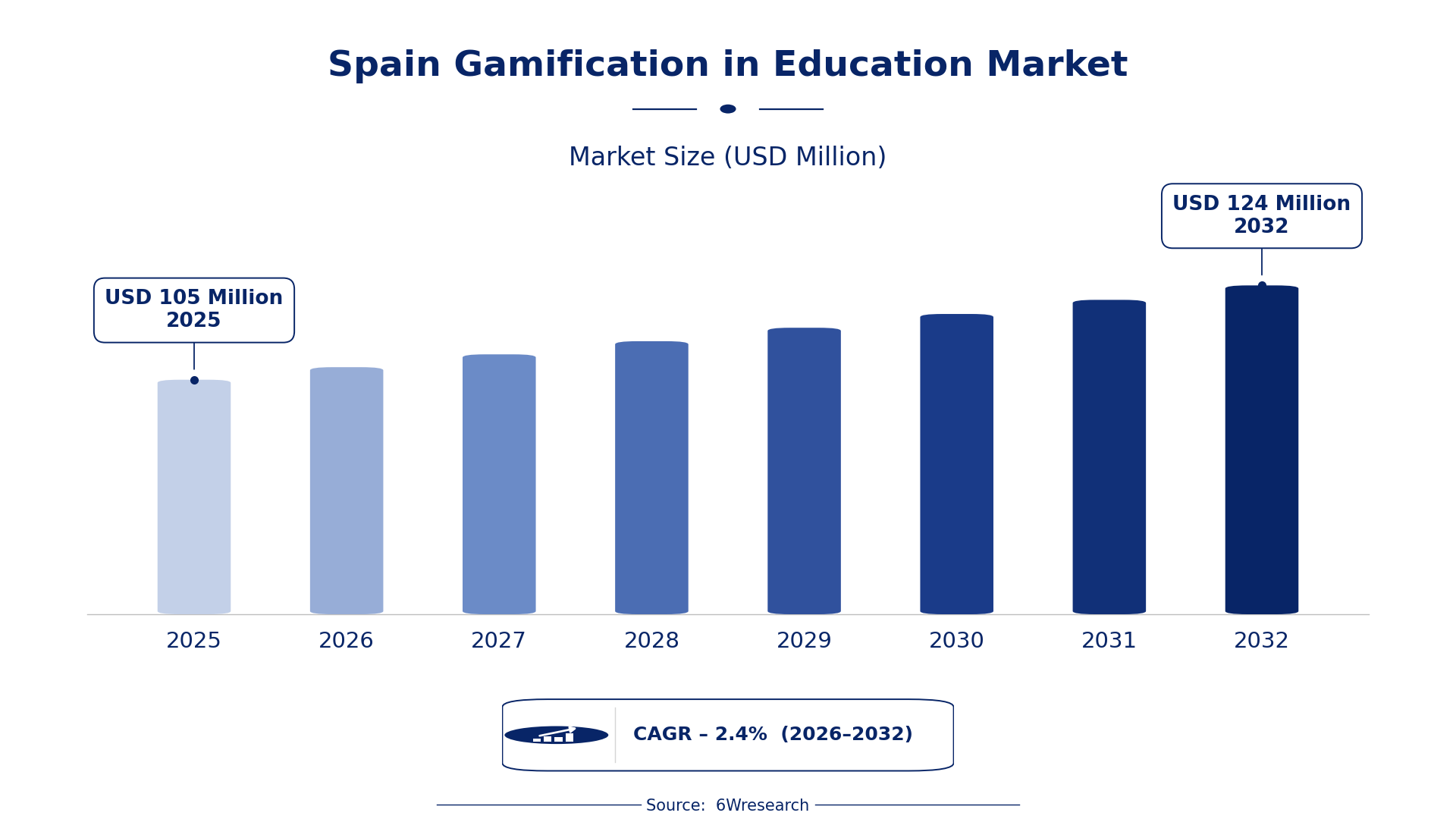
The Spain Gamification in Education Market was estimated at USD 105 Million in 2025 and is projected to reach USD 124 Million by 2032, growing at a CAGR of 2.4% from 2026 to 2032.
Spain Gamification in Education Market Synopsis
The integration of gamification into educational practices in Spain is rapidly gaining momentum. Schools and universities are increasingly utilizing game mechanics to engage students, fostering a more interactive learning environment that enhances motivation and educational outcomes.
This shift reflects a broader trend towards technology adoption in education, as institutions recognize the need for innovative tools that cater to diverse learning styles. The Spanish market is now characterized by a rich array of gamified platforms and tools designed to meet the needs of both educators and students.
Spain Gamification in Education Market Year-wise Growth Rate and Key Drivers
This graph illustrates the annual growth rates of the Spain Gamification in Education Market from 2021 to 2032, highlighting a steady upward trajectory and projected expansion over the forecast period.
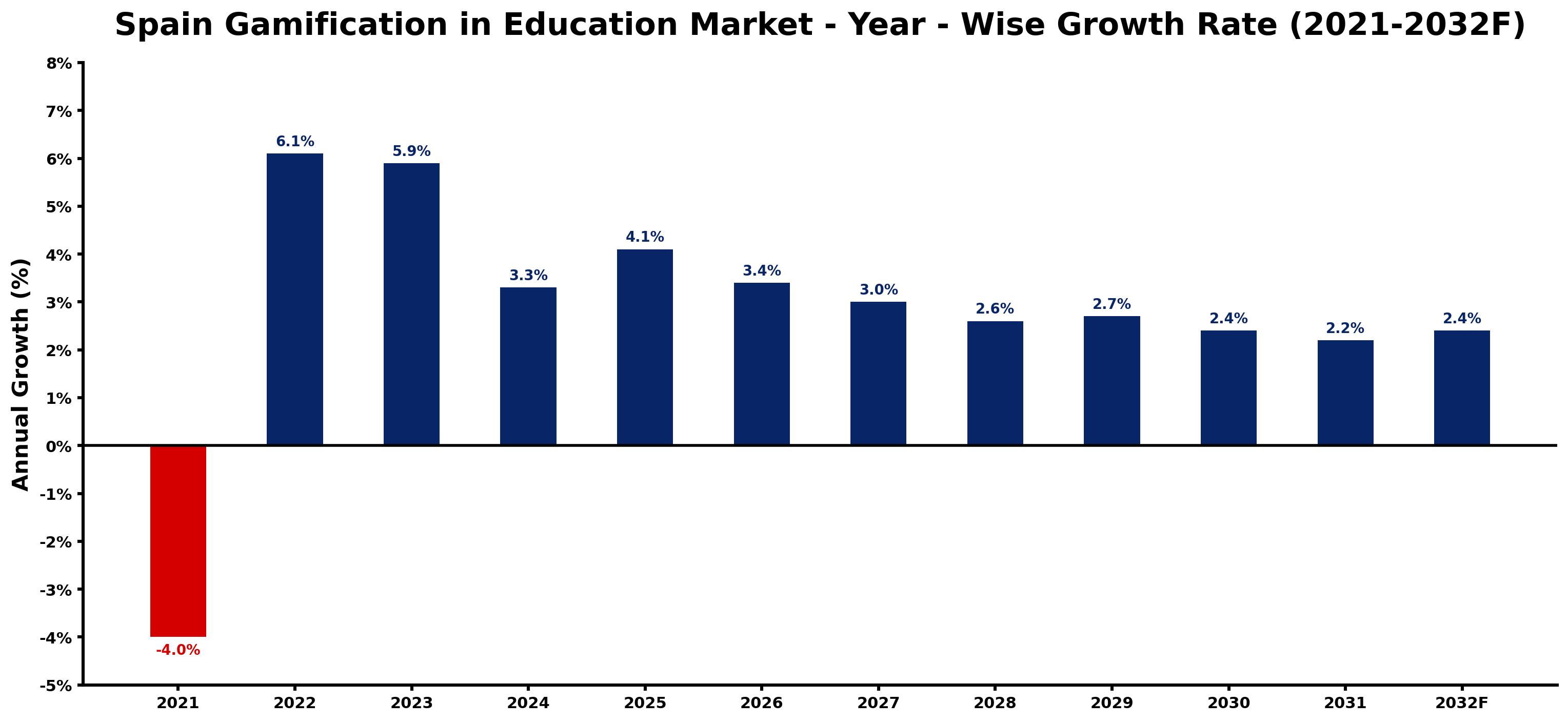
The table below presents the year‑wise growth rates along with the key drivers influencing the market
| Year | Growth Rate | Major Drivers |
| 2021 | -4.0% | Regional education budget cuts by Spanish government initiative |
| 2022 | 6.1% | Implementation of Spain's Educación Digital strategy in schools. |
| 2023 | 5.9% | Growing popularity of game-based learning among educators. |
| 2024 | 3.3% | Increased investment in EdTech startups focusing on gamification. |
| 2025 | 4.1% | Collaboration between universities and tech companies on gamified tools. |
| 2026 | 3.4% | Rise in remote learning necessitating engaging educational content. |
| 2027 | 3.0% | Support from regional governments for innovative teaching methods. |
| 2028 | 2.6% | Inclusion of gamification in national education curriculum reforms. |
| 2029 | 2.7% | Emphasis on student engagement in teacher training programs. |
| 2030 | 2.4% | Partnerships between NGOs and schools to promote gamified learning. |
| 2031 | 2.2% | Focus on enhancing student retention through gamification techniques. |
| 2032 | 2.4% | Adoption of adaptive learning technologies integrating gamified elements. |
Note: Market size estimations and growth projections presented in this report are based on 6Wresearch's proprietary forecasting methodology, utilizing the latest available industry data, government publications, and primary research inputs.
Spain Gamification in Education Market Key Takeaways
Below are some of the specific key takeaways from the market, including:
- Increasing adoption of gamification tools is enhancing student engagement across various educational levels.
- Personalized learning solutions are on the rise, tailoring educational experiences to individual student needs.
- The incorporation of augmented and virtual reality in educational games is creating immersive learning experiences.
- Collaborative gamification tools are promoting teamwork and problem-solving among students.
- Government initiatives are actively supporting the integration of gamification strategies in educational settings.
Evaluation of Restraints in Spain Gamification in Education Market
Resistance to change within educational institutions remains a notable barrier to the adoption of gamification. Many educators cling to traditional teaching methods, often due to a lack of understanding of gamification's potential benefits. Additionally, financial constraints can limit the ability to invest in gamified tools and platforms. Addressing these issues requires targeted training for educators, effective communication about the value of gamification, and strategic investment in educational technology.
Spain Gamification in Education Market Trends
The demand for gamification in education is propelled by several key trends. Personalized learning paths, which adapt to the unique needs of students, are becoming increasingly popular. on top of that, the integration of immersive technologies such as augmented reality (AR) and virtual reality (VR) is transforming the educational experience, allowing students to engage with content in unprecedented ways.
Collaboration through gamified tools is also trending, as these platforms encourage students to work together, enhancing both social skills and learning outcomes. on top of that, the convergence of gamification with learning management systems is simplifying the tracking of student progress, making it easier for educators to tailor their teaching strategies.
Spain Gamification in Education Market Opportunities
With the educational sector's increasing inclination toward engaging and interactive learning experiences, significant investment opportunities are emerging. Developers can focus on creating gamified platforms that cater to specific subjects or age groups. Additionally, there is a growing market for educational games and tools that incorporate AR and VR technologies.
Partnerships with educational institutions to implement gamified learning strategies represent another avenue for growth. As the demand for personalized learning continues to rise, there’s a clear opportunity for innovative solutions that enhance student engagement and educational effectiveness.
Government Initiatives in the Spain Gamification in Education Market
The Spanish government is actively fostering the growth of gamification in education through various policies and initiatives. The Ministry of Education is pushing for the integration of game-based learning in schools, enhancing engagement and motivation among students. This strategic focus on gamification aims to modernize educational practices and improve learning outcomes across the country.
- A national initiative encouraging the use of gamified learning methods was launched in early 2025, aimed at enhancing student engagement in primary and secondary education.
- Currently, the Ministry of Education is implementing a program that provides funding for research projects focusing on gamification in higher education.
- Planned for 2026, a public-private partnership is set to develop new educational games that align with the national curriculum.
- In 2024, a pilot program was introduced in select universities to integrate gamification into teacher training courses.
- Ongoing efforts to upgrade digital infrastructure in schools are expected to be completed by mid-2026, facilitating the adoption of gamified tools.
Future Insights of the Spain Gamification in Education Market
Looking ahead, the Spain Gamification in Education Market is set to experience substantial growth. As technology continues to evolve and educational institutions embrace innovative teaching methods, gamification will play a crucial role in shaping the future of learning. The anticipated increase in remote and hybrid learning environments will further accelerate the demand for gamified solutions, as educators seek to enhance student interaction and retention of knowledge.
With a focus on personalized learning and improved educational outcomes, the market is well-positioned to attract new entrants and investments, driving ongoing innovation in gamified educational tools and platforms.
Spain Gamification in Education Market Latest Developments
Recent activity in the Spain Gamification in Education Market reflects a strong commitment to enhancing student engagement through innovative solutions. Over the last year, various initiatives have emerged, demonstrating a clear trend toward integrating gamified learning into the educational framework.
- In early 2025, a major educational publisher launched a series of gamified learning modules tailored for primary education, receiving positive feedback from educators and students alike.
- An ongoing initiative initiated in mid-2025 focuses on developing AR-based educational games, enhancing interactive learning experiences for students.
- By Q3 2026, a new collaborative platform is expected to roll out, allowing students to work together on gamified projects, fostering teamwork and problem-solving skills.
- A partnership between a technology firm and a local university, established in late 2024, is currently developing a VR-based curriculum for science education.
- Plans are underway for a large-scale conference on gamification in education, set to take place in early 2027, aimed at bringing together educators, developers, and policymakers to share insights and innovations.
Spain Gamification in Education Market - Key Attractiveness of the Report
- 10 Years of Market Numbers
- Historical Data Starting from 2022 to 2025
- Base Year: 2025
- Forecast Data until 2032
- Key Performance Indicators Impacting the Market
- Major Upcoming Developments and Projects
Key Highlights of the Report:
- Spain Gamification in Education Market Outlook
- Market Size of Spain Gamification in Education Market, 2025
- Forecast of Spain Gamification in Education Market, 2032
- Historical Data and Forecast of Spain Gamification in Education Revenues & Volume for the Period 2022-2032F
- Spain Gamification in Education Market Trend Evolution
- Spain Gamification in Education Market Drivers and Challenges
- Spain Gamification in Education Price Trends
- Spain Gamification in Education Porter's Five Forces
- Spain Gamification in Education Industry Life Cycle
- Historical Data and Forecast of Spain Gamification in Education Market Revenues & Volume By Offering for the Period 2022-2032F
- Historical Data and Forecast of Spain Gamification in Education Market Revenues & Volume By Software for the Period 2022-2032F
- Historical Data and Forecast of Spain Gamification in Education Market Revenues & Volume By Services for the Period 2022-2032F
- Historical Data and Forecast of Spain Gamification in Education Market Revenues & Volume By End User for the Period 2022-2032F
- Historical Data and Forecast of Spain Gamification in Education Market Revenues & Volume By Academic for the Period 2022-2032F
- Historical Data and Forecast of Spain Gamification in Education Market Revenues & Volume By Corporate Training for the Period 2022-2032F
- Historical Data and Forecast of Spain Gamification in Education Market Revenues & Volume By Deployment Mode for the Period 2022-2032F
- Historical Data and Forecast of Spain Gamification in Education Market Revenues & Volume By Cloud for the Period 2022-2032F
- Historical Data and Forecast of Spain Gamification in Education Market Revenues & Volume By On-Premises for the Period 2022-2032F
- Spain Gamification in Education Import Export Trade Statistics
- Market Opportunity Assessment By Offering
- Market Opportunity Assessment By End User
- Market Opportunity Assessment By Deployment Mode
- Spain Gamification in Education Top Companies Market Share
- Spain Gamification in Education Competitive Benchmarking By Technical and Operational Parameters
- Spain Gamification in Education Company Profiles
- Spain Gamification in Education Key Strategic Recommendations






































