Spain Methyl Cellulose Market: Import Trend Analysis
In 2024, Spain`s methyl cellulose market saw a steady increase in imports. The trend reflected growing demand for this product in various industries within the country.
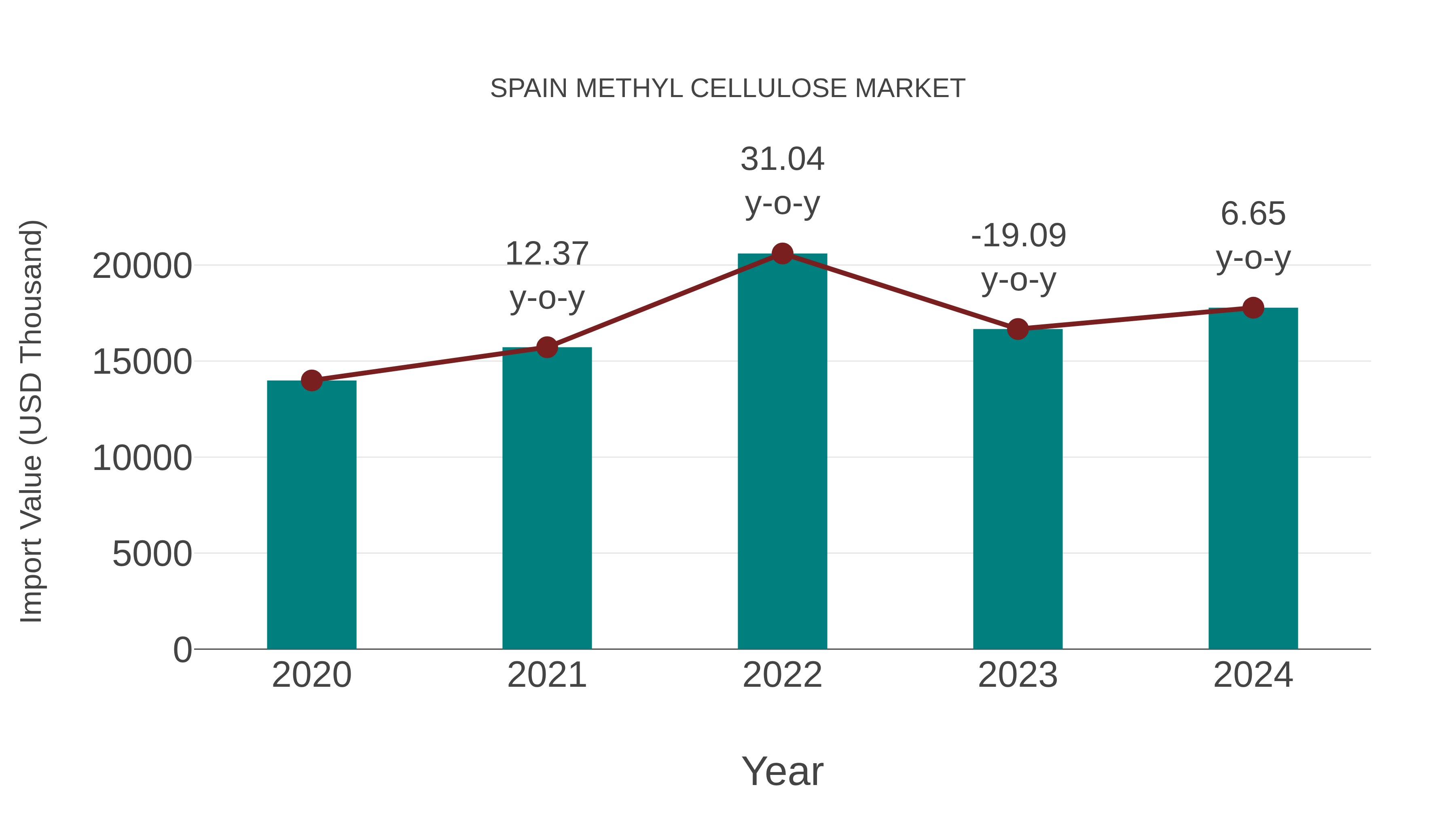
Spain Methyl Cellulose Market Overview
The Spain methyl cellulose market is witnessing steady growth due to the increasing demand from various end-use industries such as construction, food and beverage, pharmaceuticals, and personal care. Methyl cellulose, a versatile compound used as a thickener, emulsifier, and stabilizer, is gaining popularity in Spain for its properties such as water retention, film formation, and binding capabilities. The construction sector is a significant consumer of methyl cellulose for applications such as tile adhesives, cement mixes, and gypsum-based products. In the food industry, methyl cellulose is used as a food additive to improve texture and stability. With the growing emphasis on sustainable and eco-friendly products, the demand for methyl cellulose is expected to continue its upward trend in Spain.
Spain Methyl Cellulose Market Trends
The Spain methyl cellulose market is experiencing growth driven by various factors such as the increasing demand in construction, food and beverage, pharmaceutical, and personal care industries. Methyl cellulose is being widely used as a thickener, stabilizer, and emulsifier in food products, as well as a key ingredient in pharmaceutical formulations and cosmetics. The construction industry is also a major consumer of methyl cellulose due to its use in cement-based products for improved workability and water retention. Sustainability and eco-friendly products are becoming important factors influencing the market, leading to a rising interest in bio-based methyl cellulose derived from renewable sources. Overall, the Spain methyl cellulose market is expected to continue expanding as industries seek versatile and sustainable solutions for their products.
Spain Methyl Cellulose Market Challenges
In the Spain methyl cellulose market, some key challenges are increasing competition from alternative products, fluctuating raw material prices, and regulatory changes impacting the use of methyl cellulose in various industries. The market faces pressure from substitutes such as guar gum and xanthan gum, which offer similar functionalities at a potentially lower cost. Additionally, the volatility in raw material prices, particularly cellulose, can impact the overall production costs for methyl cellulose manufacturers. Regulatory changes, such as stricter environmental regulations or new safety standards, can also affect the demand and usage of methyl cellulose in sectors like food, pharmaceuticals, and construction. Adapting to these challenges and maintaining product quality and innovation will be crucial for companies operating in the Spain methyl cellulose market.
Spain Methyl Cellulose Market Investment Opportunities
The Spain methyl cellulose market presents various investment opportunities due to the growing demand for this versatile compound across industries such as construction, pharmaceuticals, food and beverages, and personal care. With its unique properties including thickening, stabilizing, and emulsifying capabilities, methyl cellulose is used in a wide range of applications such as building materials, drug delivery systems, food additives, and cosmetic products. Investors can capitalize on this market by exploring partnerships with manufacturers, investing in research and development for innovative applications, or even considering mergers and acquisitions to expand market presence. Additionally, the increasing focus on sustainable and eco-friendly products creates opportunities for investments in the development of bio-based methyl cellulose products to cater to the growing demand for environmentally friendly solutions.
Spain Methyl Cellulose Market Government Policy
In Spain, government policies related to the methyl cellulose market primarily focus on ensuring product safety, quality, and environmental sustainability. Regulatory bodies such as the Spanish Agency for Food Safety and Nutrition (AESAN) and the Ministry of Health are responsible for overseeing the production, import, and distribution of methyl cellulose products to ensure compliance with safety standards. Additionally, environmental regulations set by the Ministry of Ecological Transition and the European Chemicals Agency aim to minimize the environmental impact of methyl cellulose production and usage. These policies aim to protect consumer health, promote responsible manufacturing practices, and reduce the environmental footprint of the methyl cellulose market in Spain.
Spain Methyl Cellulose Market Future Outlook
The future outlook for the Spain methyl cellulose market appears to be promising, driven by the increasing demand for the product in various end-use industries such as construction, pharmaceuticals, food and beverages, and personal care. Methyl cellulose is widely used as a thickening agent, emulsifier, and stabilizer in these industries, and the trend towards natural and sustainable ingredients is expected to further boost its demand. Additionally, the growing construction sector in Spain is likely to drive the demand for methyl cellulose in cement and mortar applications for its water retention properties. With the focus on product innovation and development of advanced grades of methyl cellulose to cater to specific industry requirements, the market is anticipated to witness steady growth in the coming years.
Key Highlights of the Report:
- Spain Methyl Cellulose Market Outlook
- Market Size of Spain Methyl Cellulose Market,2025
- Forecast of Spain Methyl Cellulose Market, 2032
- Historical Data and Forecast of Spain Methyl Cellulose Revenues & Volume for the Period 2022-2032F
- Spain Methyl Cellulose Market Trend Evolution
- Spain Methyl Cellulose Market Drivers and Challenges
- Spain Methyl Cellulose Price Trends
- Spain Methyl Cellulose Porter's Five Forces
- Spain Methyl Cellulose Industry Life Cycle
- Historical Data and Forecast of Spain Methyl Cellulose Market Revenues & Volume By Type for the Period 2022-2032F
- Historical Data and Forecast of Spain Methyl Cellulose Market Revenues & Volume By Powder for the Period 2022-2032F
- Historical Data and Forecast of Spain Methyl Cellulose Market Revenues & Volume By Granules for the Period 2022-2032F
- Historical Data and Forecast of Spain Methyl Cellulose Market Revenues & Volume By Liquid for the Period 2022-2032F
- Historical Data and Forecast of Spain Methyl Cellulose Market Revenues & Volume By Application for the Period 2022-2032F
- Historical Data and Forecast of Spain Methyl Cellulose Market Revenues & Volume By Pharmaceuticals for the Period 2022-2032F
- Historical Data and Forecast of Spain Methyl Cellulose Market Revenues & Volume By Food Additives for the Period 2022-2032F
- Historical Data and Forecast of Spain Methyl Cellulose Market Revenues & Volume By Coatings for the Period 2022-2032F
- Historical Data and Forecast of Spain Methyl Cellulose Market Revenues & Volume By End Use for the Period 2022-2032F
- Historical Data and Forecast of Spain Methyl Cellulose Market Revenues & Volume By Construction for the Period 2022-2032F
- Historical Data and Forecast of Spain Methyl Cellulose Market Revenues & Volume By Personal Care for the Period 2022-2032F
- Historical Data and Forecast of Spain Methyl Cellulose Market Revenues & Volume By Paper & Textiles for the Period 2022-2032F
- Historical Data and Forecast of Spain Methyl Cellulose Market Revenues & Volume By Purity Level for the Period 2022-2032F
- Historical Data and Forecast of Spain Methyl Cellulose Market Revenues & Volume By High Purity for the Period 2022-2032F
- Historical Data and Forecast of Spain Methyl Cellulose Market Revenues & Volume By Industrial Grade for the Period 2022-2032F
- Historical Data and Forecast of Spain Methyl Cellulose Market Revenues & Volume By Low Purity for the Period 2022-2032F
- Historical Data and Forecast of Spain Methyl Cellulose Market Revenues & Volume By Manufacturing Process for the Period 2022-2032F
- Historical Data and Forecast of Spain Methyl Cellulose Market Revenues & Volume By Etherification for the Period 2022-2032F
- Historical Data and Forecast of Spain Methyl Cellulose Market Revenues & Volume By Hydroxypropylation for the Period 2022-2032F
- Historical Data and Forecast of Spain Methyl Cellulose Market Revenues & Volume By Others for the Period 2022-2032F
- Spain Methyl Cellulose Import Export Trade Statistics
- Market Opportunity Assessment By Type
- Market Opportunity Assessment By Application
- Market Opportunity Assessment By End Use
- Market Opportunity Assessment By Purity Level
- Market Opportunity Assessment By Manufacturing Process
- Spain Methyl Cellulose Top Companies Market Share
- Spain Methyl Cellulose Competitive Benchmarking By Technical and Operational Parameters
- Spain Methyl Cellulose Company Profiles
- Spain Methyl Cellulose Key Strategic Recommendations






































