Sri Lanka Construction and Mining Equipment Market Size, Share & Growth Rate
The Sri Lanka Construction and Mining Equipment Market was estimated at USD 343 Million in 2025 and is projected to reach USD 479 Million by 2032, growing at a CAGR of 4.9% from 2026 to 2032. This upward trajectory is significantly propelled by the countrys ongoing infrastructure development projects, including road construction and industrial zone establishment. Increased investments from both public and private sectors not only enhance demand for robust machinery but also drive technological advancements in equipment efficiency and environmental compliance.
Sri Lanka Construction and Mining Equipment Market Year-wise Growth Rate and Key Drivers
This graph highlights how the Sri Lanka Construction and Mining Equipment Market has steadily grown over the years, supported by major growth factors.
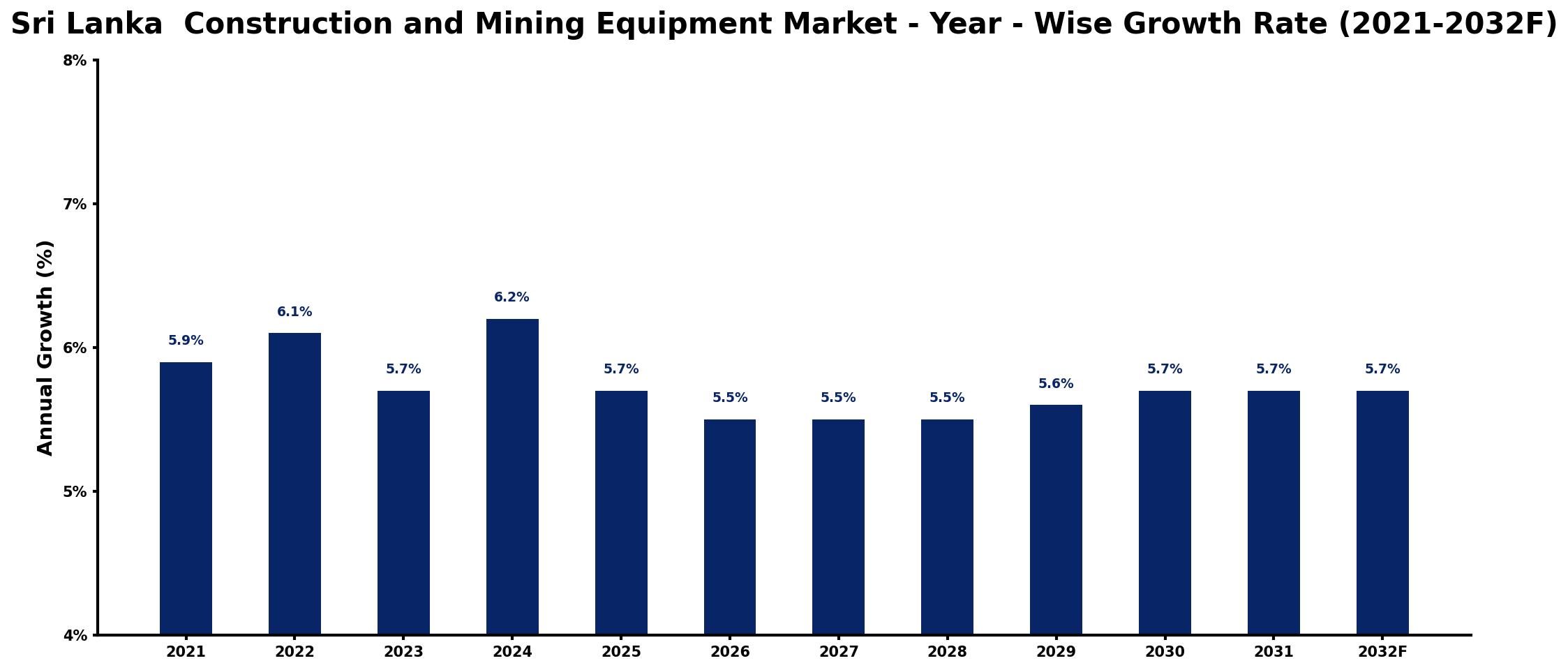
The table below presents the year‑wise growth rates along with the key drivers influencing the market
| Year | Growth Rate | Major Drivers |
| 2021 | 5.9% | Infrastructure development initiatives increase demand |
| 2022 | 6.1% | Government investments in public projects |
| 2023 | 5.7% | Rising urbanization boosts market needs |
| 2024 | 6.2% | Private sector expansion drives sales |
| 2025 | 5.7% | Sustainable projects gain investor interest |
| 2026 | 5.5% | Technological advancements enhance productivity |
| 2027 | 5.5% | Renewable energy projects create opportunities |
| 2028 | 5.5% | Increased foreign investments stimulate growth |
| 2029 | 5.6% | Regional development plans attract funding |
| 2030 | 5.7% | Housing sector growth requires support |
| 2031 | 5.7% | Economic recovery fuels project launches |
| 2032 | 5.7% | Innovations in logistics improve efficiency |
Note: Market size estimations and growth projections presented in this report are based on 6Wresearch's proprietary forecasting methodology, utilizing the latest available industry data, government publications, and primary research inputs.
Sri Lanka Construction and Mining Equipment Market Synopsis
Currently, the Sri Lanka Construction and Mining Equipment Market is characterized by a surge in infrastructure projects, which are critical for the nations economic growth. Various large-scale developments in roads, housing, and commercial spaces necessitate advanced machinery, significantly boosting market demand.
Simultaneously, the mining sector in Sri Lanka is evolving, with increased exploration and extraction activities. As a result, there is a pressing need for state-of-the-art equipment that not only meets operational demands but also adheres to stringent environmental regulations, fostering a trend towards sustainable practices within the industry.
Sri Lanka Construction and Mining Equipment Market Key Takeaways
- The market is driven by substantial investments in infrastructure development and mining activities.
- Technological innovations are leading to higher efficiency and compliance with environmental standards.
- Government policies are increasingly focusing on safety and local manufacturing incentives.
- Adoption of automated machinery is on the rise, enhancing operational capabilities.
- Challenges in regulatory compliance and skilled labor training persist, impacting market growth.
Evaluation of Restraints in Sri Lanka Construction and Mining Equipment Market
The growth of the Sri Lanka Construction and Mining Equipment Market is tempered by several restraints. The pace of infrastructure development can be inconsistent, often influenced by government funding cycles and policy changes. Regulatory compliance related to safety standards adds complexity for equipment procurement and operational execution. Additionally, the demand for a skilled workforce capable of handling advanced machinery continues to pose significant challenges for market players aiming to maintain competitive advantage in a rapidly evolving landscape.
Sri Lanka Construction and Mining Equipment Market Trends
A notable trend shaping the Sri Lanka Construction and Mining Equipment Market is the increasing reliance on technology for operational efficiency. The integration of automation and digitization within equipment is making inroads, allowing for improved safety and productivity on job sites. Moreover, the heightened emphasis on sustainability is driving manufacturers to develop equipment that complies with environmental regulations, pushing innovation in eco-friendly technologies.
Additionally, theres a growing trend towards rental models for construction and mining equipment. This shift is driven by budget constraints among companies, enabling them to access the latest technology without the significant capital expenditures associated with outright purchases. Such rental solutions are expected to attract both small and large enterprises looking to optimize their operational costs.
Sri Lanka Construction and Mining Equipment Market Opportunities
The Sri Lanka Construction and Mining Equipment Market presents numerous growth opportunities. With the government's commitment to infrastructure development, there is an increasing demand for high-quality machinery designed to withstand tough working conditions. Furthermore, the push for local manufacturing provides a unique advantage for companies willing to invest in production facilities, allowing them to tap into the domestic market with reduced logistics costs.
Expanding into remote areas with undeveloped infrastructure also creates an avenue for growth. The mining sector, in particular, offers opportunities for innovative solutions to enhance extraction processes while ensuring compliance with environmental norms, opening the door for partnerships and collaborations in research and development.
Government Initiatives in the Sri Lanka Construction and Mining Equipment Market
The Sri Lankan government is actively supporting the construction and mining equipment sector through a series of initiatives aimed at improving workplace safety, streamlining import regulations, and incentivizing local manufacturing. Policies designed to promote technology transfer are pivotal in elevating the industrys competitive edge. This includes providing subsidies and preferential treatment to businesses that invest in domestic production capabilities, thereby bolstering economic stability and job creation in the sector.
Future Insights of the Sri Lanka Construction and Mining Equipment Market
Looking ahead to the period between 2026 and 2032, the Sri Lanka Construction and Mining Equipment Market is poised for sustained growth. Continued government investment in infrastructure coupled with increasing private sector engagement will likely drive demand for advanced machinery. The shift towards sustainable practices will further necessitate the adoption of innovative technologies, positioning the market favorably for companies that can adapt quickly to emerging trends.
Sri Lanka Construction and Mining Equipment Market Latest Developments (2025 - 2026)
Recent developments in the Sri Lanka Construction and Mining Equipment Market indicate a marked shift towards modernization, with several stakeholders actively exploring partnerships to enhance product offerings. The focus remains on incorporating advanced technologies and automation into equipment designs, which is expected to reshape operational efficiency across the sector. Additionally, conversations around environmental compliance are gaining traction, with companies prioritizing eco-friendly solutions to meet evolving regulatory standards.
Sri Lanka Construction and Mining Equipment Market - Key Attractiveness of the Report
- 10 Years of Market Numbers
- Historical Data Starting from 2022 to 2025
- Base Year: 2025
- Forecast Data until 2032
- Key Performance Indicators Impacting the Market
- Major Upcoming Developments and Projects
Key Highlights of the Report:
- Sri Lanka Construction and Mining Equipment Market Outlook
- Market Size of Sri Lanka Construction and Mining Equipment Market, 2025
- Forecast of Sri Lanka Construction and Mining Equipment Market, 2032
- Historical Data and Forecast of Sri Lanka Construction and Mining Equipment Revenues & Volume for the Period 2022-2032F
- Sri Lanka Construction and Mining Equipment Market Trend Evolution
- Sri Lanka Construction and Mining Equipment Market Drivers and Challenges
- Sri Lanka Construction and Mining Equipment Price Trends
- Sri Lanka Construction and Mining Equipment Porter's Five Forces
- Sri Lanka Construction and Mining Equipment Industry Life Cycle
- Historical Data and Forecast of Sri Lanka Construction and Mining Equipment Market Revenues & Volume By Product Type for the Period 2022-2032F
- Historical Data and Forecast of Sri Lanka Construction and Mining Equipment Market Revenues & Volume By Loaders for the Period 2022-2032F
- Historical Data and Forecast of Sri Lanka Construction and Mining Equipment Market Revenues & Volume By Dozers for the Period 2022-2032F
- Historical Data and Forecast of Sri Lanka Construction and Mining Equipment Market Revenues & Volume By Excavators for the Period 2022-2032F
- Historical Data and Forecast of Sri Lanka Construction and Mining Equipment Market Revenues & Volume By Crushing for the Period 2022-2032F
- Historical Data and Forecast of Sri Lanka Construction and Mining Equipment Market Revenues & Volume By Pulverizing & Screening Equipment for the Period 2022-2032F
- Historical Data and Forecast of Sri Lanka Construction and Mining Equipment Market Revenues & Volume By Others for the Period 2022-2032F
- Historical Data and Forecast of Sri Lanka Construction and Mining Equipment Market Revenues & Volume By Application for the Period 2022-2032F
- Historical Data and Forecast of Sri Lanka Construction and Mining Equipment Market Revenues & Volume By Infrastructure for the Period 2022-2032F
- Historical Data and Forecast of Sri Lanka Construction and Mining Equipment Market Revenues & Volume By Mineral Mining for the Period 2022-2032F
- Historical Data and Forecast of Sri Lanka Construction and Mining Equipment Market Revenues & Volume By Residential Building for the Period 2022-2032F
- Historical Data and Forecast of Sri Lanka Construction and Mining Equipment Market Revenues & Volume By Metal Mining for the Period 2022-2032F
- Historical Data and Forecast of Sri Lanka Construction and Mining Equipment Market Revenues & Volume By Others for the Period 2022-2032F
- Sri Lanka Construction and Mining Equipment Import Export Trade Statistics
- Market Opportunity Assessment By Product Type
- Market Opportunity Assessment By Application
- Sri Lanka Construction and Mining Equipment Top Companies Market Share
- Sri Lanka Construction and Mining Equipment Competitive Benchmarking By Technical and Operational Parameters
- Sri Lanka Construction and Mining Equipment Company Profiles
- Sri Lanka Construction and Mining Equipment Key Strategic Recommendations






































