Sri Lanka Construction Lubricants Market: Import Trend Analysis
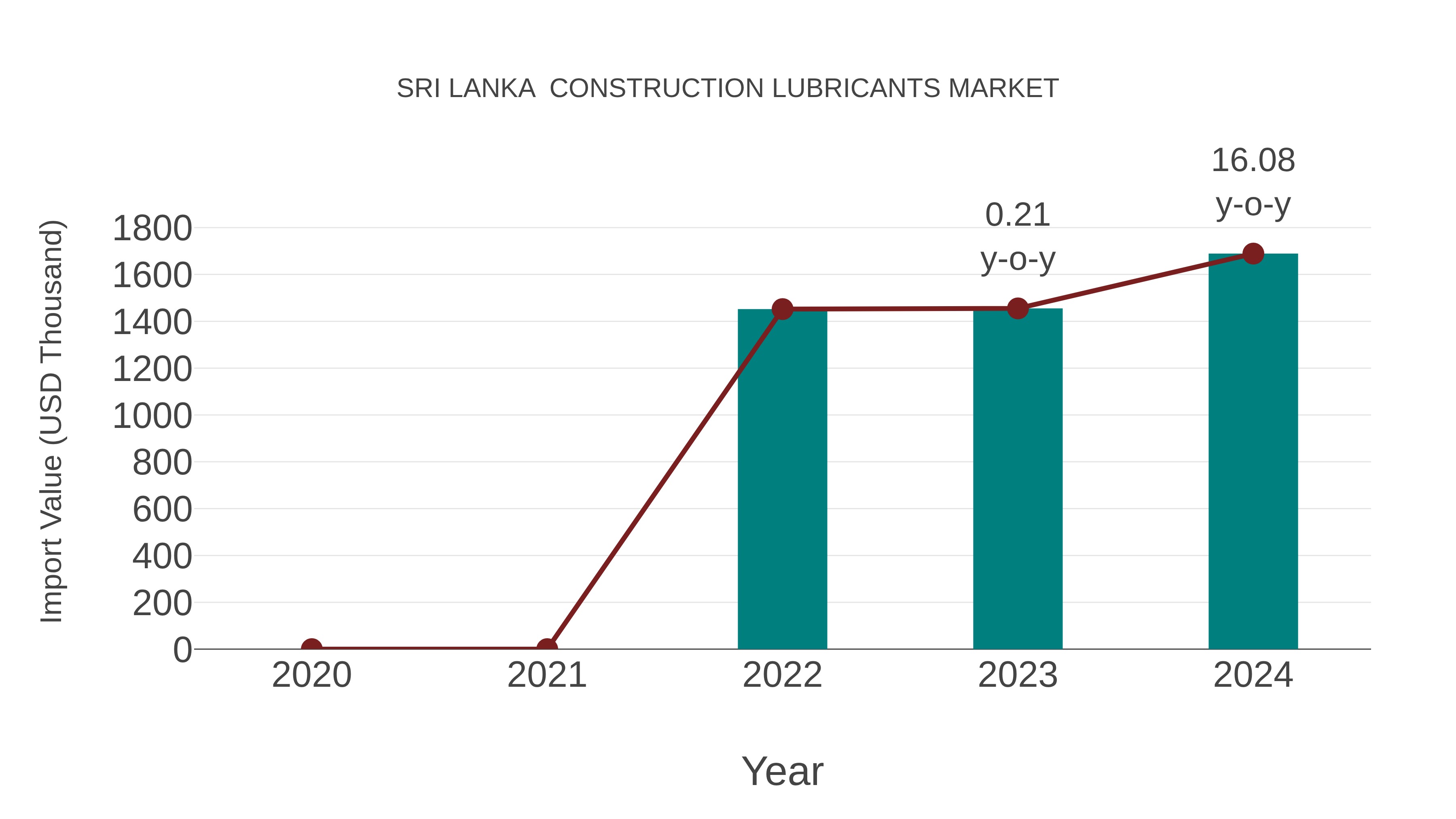
Sri Lanka import trend for construction lubricants showed a growth rate of 16.08% from 2023 to 2024, with a compound annual growth rate (CAGR) of 7.85% from 2020 to 2024. This growth can be attributed to increased infrastructure projects and construction activities in the region.
Sri Lanka Construction Lubricants Market Overview
The construction lubricants market in Sri Lanka is essential for maintaining the efficiency and longevity of construction machinery and equipment. Lubricants play a critical role in reducing friction, preventing wear and tear, and ensuring smooth operation of machinery. The market is driven by the ongoing demand for reliable and high-performance lubricants, with a focus on environmentally friendly and synthetic options.
Drivers of the market
The Sri Lanka construction lubricants market is driven by the increasing number of construction projects requiring heavy machinery and equipment. Lubricants play a crucial role in ensuring the efficient operation and longevity of these machines, thereby reducing maintenance costs and downtime. The expansion of infrastructure projects and industrial activities are significant factors contributing to the demand for construction lubricants.
Challenges of the market
Challenges in the construction lubricants market in Sri Lanka include price volatility of base oils, regulatory compliance with environmental standards, and maintaining product performance in diverse operating conditions. Manufacturers and distributors must navigate the complexity of supply chain logistics and storage facilities to ensure timely delivery and product integrity. Educating end-users about the importance of using quality lubricants to enhance equipment efficiency and longevity is crucial for market expansion.
Government Policy of the market
Government policies in Sri Lanka related to the construction lubricants market focus on environmental regulations, quality standards, and import tariffs. The government encourages the use of environmentally friendly lubricants through tax incentives and promotes local blending and manufacturing to reduce dependency on imports.
Key Highlights of the Report:
- Sri Lanka Construction Lubricants Market Outlook
- Market Size of Sri Lanka Construction Lubricants Market, 2025
- Forecast of Sri Lanka Construction Lubricants Market, 2032
- Historical Data and Forecast of Sri Lanka Construction Lubricants Revenues & Volume for the Period 2022-2032F
- Sri Lanka Construction Lubricants Market Trend Evolution
- Sri Lanka Construction Lubricants Market Drivers and Challenges
- Sri Lanka Construction Lubricants Price Trends
- Sri Lanka Construction Lubricants Porter's Five Forces
- Sri Lanka Construction Lubricants Industry Life Cycle
- Historical Data and Forecast of Sri Lanka Construction Lubricants Market Revenues & Volume By Base Oil for the Period 2022-2032F
- Historical Data and Forecast of Sri Lanka Construction Lubricants Market Revenues & Volume By Mineral Oil for the Period 2022-2032F
- Historical Data and Forecast of Sri Lanka Construction Lubricants Market Revenues & Volume By Synthetic Oil for the Period 2022-2032F
- Historical Data and Forecast of Sri Lanka Construction Lubricants Market Revenues & Volume By PAO for the Period 2022-2032F
- Historical Data and Forecast of Sri Lanka Construction Lubricants Market Revenues & Volume By PAG for the Period 2022-2032F
- Historical Data and Forecast of Sri Lanka Construction Lubricants Market Revenues & Volume By Esters for the Period 2022-2032F
- Historical Data and Forecast of Sri Lanka Construction Lubricants Market Revenues & Volume By Group III (Hydrocracking) for the Period 2022-2032F
- Historical Data and Forecast of Sri Lanka Construction Lubricants Market Revenues & Volume By Type for the Period 2022-2032F
- Historical Data and Forecast of Sri Lanka Construction Lubricants Market Revenues & Volume By Hydraulic Fluid for the Period 2022-2032F
- Historical Data and Forecast of Sri Lanka Construction Lubricants Market Revenues & Volume By Engine Oil for the Period 2022-2032F
- Historical Data and Forecast of Sri Lanka Construction Lubricants Market Revenues & Volume By Gear Oil for the Period 2022-2032F
- Historical Data and Forecast of Sri Lanka Construction Lubricants Market Revenues & Volume By Automatic Transmission Fluid for the Period 2022-2032F
- Historical Data and Forecast of Sri Lanka Construction Lubricants Market Revenues & Volume By Grease for the Period 2022-2032F
- Historical Data and Forecast of Sri Lanka Construction Lubricants Market Revenues & Volume By Compressor Oil for the Period 2022-2032F
- Historical Data and Forecast of Sri Lanka Construction Lubricants Market Revenues & Volume By Others for the Period 2022-2032F
- Historical Data and Forecast of Sri Lanka Construction Lubricants Market Revenues & Volume By Equipment Type for the Period 2022-2032F
- Historical Data and Forecast of Sri Lanka Construction Lubricants Market Revenues & Volume By Earthmoving for the Period 2022-2032F
- Historical Data and Forecast of Sri Lanka Construction Lubricants Market Revenues & Volume By Material Handling for the Period 2022-2032F
- Historical Data and Forecast of Sri Lanka Construction Lubricants Market Revenues & Volume By Heavy Construction Vehicle for the Period 2022-2032F
- Sri Lanka Construction Lubricants Import Export Trade Statistics
- Market Opportunity Assessment By Base Oil
- Market Opportunity Assessment By Type
- Market Opportunity Assessment By Equipment Type
- Sri Lanka Construction Lubricants Top Companies Market Share
- Sri Lanka Construction Lubricants Competitive Benchmarking By Technical and Operational Parameters
- Sri Lanka Construction Lubricants Company Profiles
- Sri Lanka Construction Lubricants Key Strategic Recommendations






































