Sri Lanka Oil and Gas Cloud Applications Market Size & Growth Rate (2026-2032)
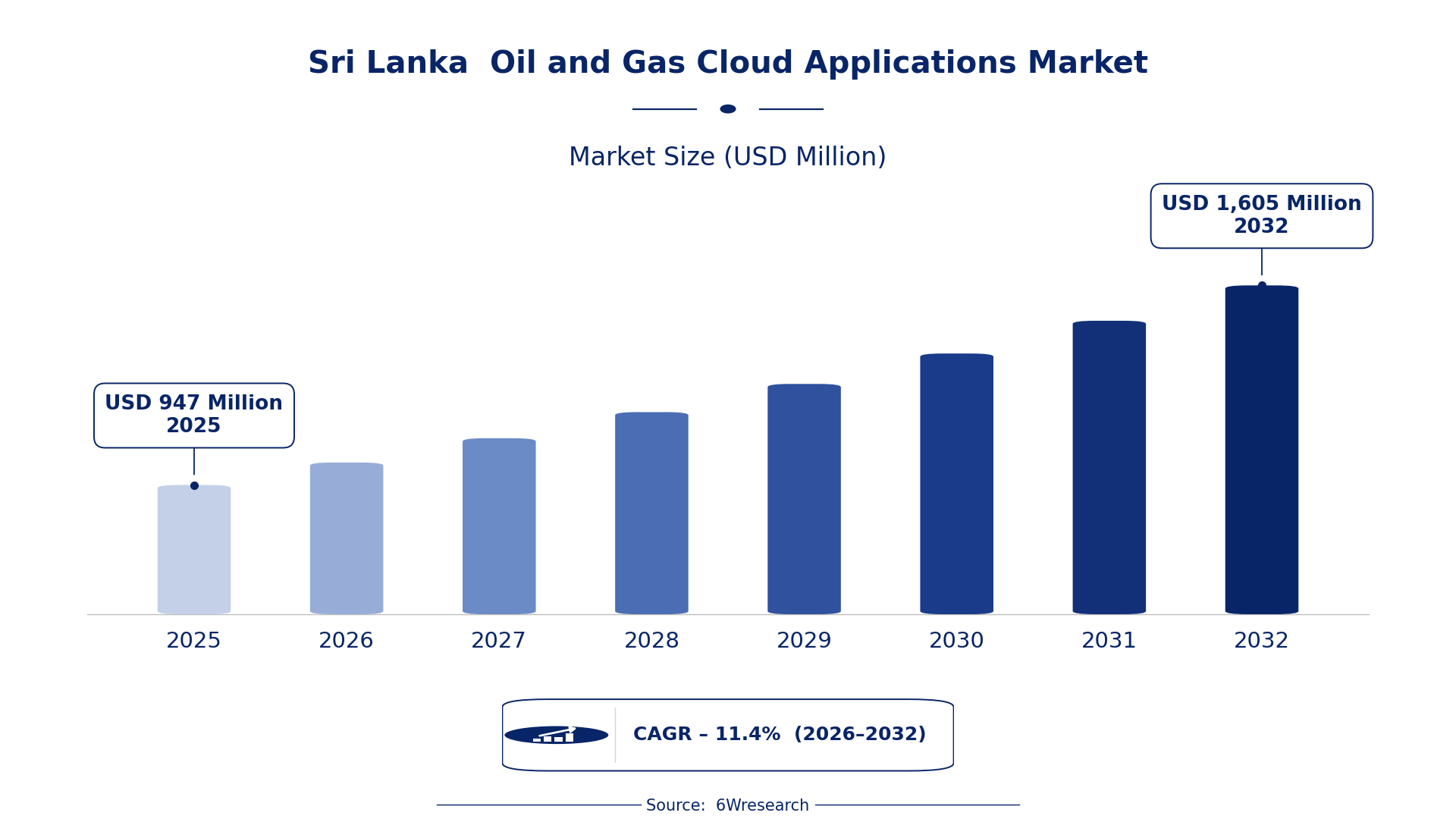
The Sri Lanka Oil and Gas Cloud Applications Market was estimated at USD 947 Million in 2025 and is projected to reach USD 1605 Million by 2032, growing at a CAGR of 11.4% from 2026 to 2032.
Sri Lanka Oil and Gas Cloud Applications Market Synopsis
The oil and gas cloud applications market in Sri Lanka is experiencing a notable shift as businesses increasingly embrace digital technologies. This momentum is not just a fleeting trend; it reflects a fundamental change in how the industry operates, focusing on enhancing efficiency and reducing costs through cloud solutions.
Looking forward, the market is set to expand significantly. With rising volatility in oil prices and growing demand for real-time data analytics, companies are compelled to adopt cloud applications. This shift promises not just operational improvements but also a more resilient industry structure that is better equipped to handle future challenges.
Sri Lanka Oil and Gas Cloud Applications Market Year-wise Growth Rate and Key Drivers
This graph illustrates the annual growth rates of the Sri Lanka Oil and Gas Cloud Applications Market from 2021 to 2032, highlighting a steady upward trajectory and projected expansion over the forecast period.
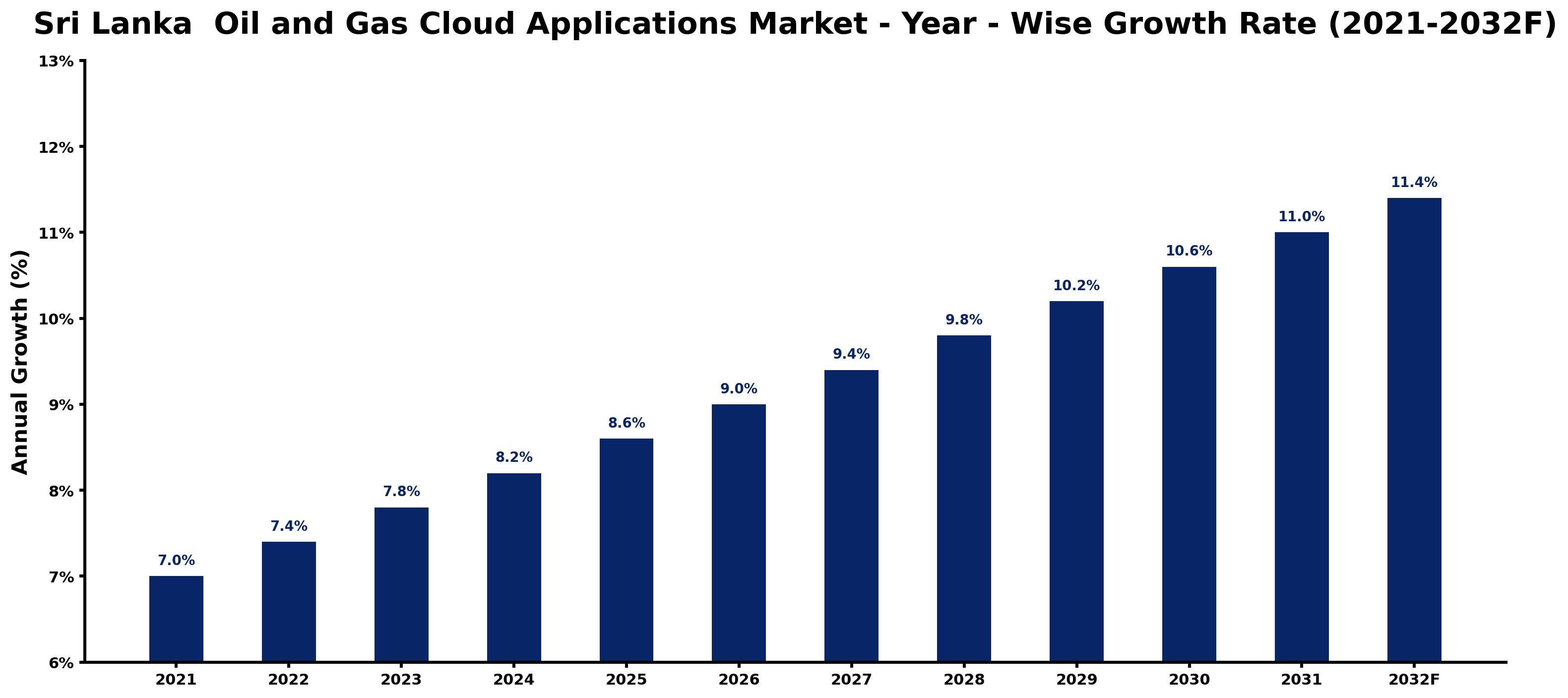
The table below presents the year‑wise growth rates along with the key drivers influencing the market
| Year | Growth Rate | Major Drivers |
| 2021 | 7.0% | Increased investments in digitalization by state-owned oil companies. |
| 2022 | 7.4% | Adoption of cloud-based solutions for energy management systems. |
| 2023 | 7.8% | Regulatory push for energy efficiency via cloud technologies. |
| 2024 | 8.2% | Rise of predictive analytics for oil exploration operations. |
| 2025 | 8.6% | Demand for data-driven decision making in oil pricing. |
| 2026 | 9.0% | Local talent development programs enhancing cloud skills in sector. |
| 2027 | 9.4% | Government incentives for adopting cloud technology in energy. |
| 2028 | 9.8% | Increase in offshore exploration necessitating advanced cloud solutions. |
| 2029 | 10.2% | Collaboration with tech startups to innovate oil cloud applications. |
| 2030 | 10.6% | Focus on sustainability, driving cloud adoption for emissions tracking. |
| 2031 | 11.0% | Integration of IoT with cloud for real-time oil monitoring. |
| 2032 | 11.4% | Growing emphasis on cybersecurity in oil cloud infrastructure. |
Note: Market size estimations and growth projections presented in this report are based on 6Wresearch's proprietary forecasting methodology, utilizing the latest available industry data, government publications, and primary research inputs.
Sri Lanka Oil and Gas Cloud Applications Market Key Takeaways
Below are some of the specific key takeaways from the market, including:
- The market is driven by the need for cost-effective IT solutions and the optimization of resource management.
- Cloud applications enhance collaboration and provide real-time data access, crucial for decision-making in the oil and gas sector.
- Increased focus on asset performance management is propelling demand for advanced cloud technologies.
- Partnerships between cloud service providers and oilfield service companies are becoming commonplace, improving operational agility.
- Regulatory compliance and data security remain critical concerns impacting cloud application deployment.
Evaluation of Restraints in Sri Lanka Oil and Gas Cloud Applications Market
High costs associated with cloud solutions are a primary restraint in the Sri Lanka oil and gas cloud applications market. Many companies struggle with the financial burden of transitioning to cloud-based systems, which limits their capacity for investment. on top of that, the technical expertise required for implementation and ongoing management presents another significant hurdle. There is also a noticeable gap in awareness regarding the advantages of cloud applications, causing slower adoption rates across the industry. Regulatory challenges, particularly concerning data security and privacy, further complicate the deployment of these technologies.
Sri Lanka Oil and Gas Cloud Applications Market Trends
A few key trends are emerging in the Sri Lanka oil and gas cloud applications market. The integration of IoT and big data analytics is becoming increasingly common, enabling companies to enhance their operational efficiency. Real-time monitoring and analytics tools are allowing firms to make informed decisions quickly, thus optimizing production processes. Additionally, innovations in cloud security are gaining traction, addressing concerns over data protection and compliance. The focus on sustainability is also prompting a shift towards cloud solutions that support green initiatives within the sector.
Sri Lanka Oil and Gas Cloud Applications Market Opportunities
The potential for growth in the Sri Lanka oil and gas cloud applications market is significant. Opportunities lie in the development of customized cloud solutions that cater specifically to the needs of local companies. With the increasing importance of data-driven decision-making, firms that can offer advanced analytics tools will likely see heightened demand. on top of that, the ongoing government push for digital transformation in the energy sector opens avenues for investment in cloud technologies. Companies that can innovate while ensuring regulatory compliance will position themselves favorably in the market.
Government Initiatives in the Sri Lanka Oil and Gas Cloud Applications Market
Government policies in Sri Lanka are increasingly supportive of digital transformation within the oil and gas sector. This focus on enhancing operational efficiency through cloud applications underscores the importance of aligning public policy with industry needs. Regulatory frameworks are evolving to facilitate the adoption of cloud technologies while ensuring compliance with data protection standards, thus fostering a more secure business environment.
- A national initiative launched in 2025 aims to provide financial incentives for oil and gas companies adopting cloud technologies.
- Current programs are underway to support research and development in cloud-based applications tailored for the energy sector.
- A planned regulatory framework is expected to be introduced by 2026, mandating enhanced data protection measures for cloud applications.
- Ongoing public-private partnerships are focusing on improving digital infrastructure, enabling better access to cloud services across the industry.
- Future initiatives are set to promote training programs aimed at enhancing technical expertise within the local workforce regarding cloud solutions.
Future Insights of the Sri Lanka Oil and Gas Cloud Applications Market
As we look to the future, the Sri Lanka oil and gas cloud applications market is likely to flourish. The increasing integration of advanced technologies such as artificial intelligence and machine learning into cloud solutions will revolutionize data processing capabilities. Firms that can harness these innovations will gain a competitive edge, driving operational improvements and cost reductions. With a strong emphasis on regulatory compliance and data security, the industry can anticipate a more structured approach to cloud adoption, ultimately leading to increased efficiency and profitability.
Sri Lanka Oil and Gas Cloud Applications Market Latest Developments
Recent activities in the Sri Lanka oil and gas cloud applications market reveal a strong push toward digitalization. Over the past year, companies have been aggressively seeking cloud solutions to enhance operational efficiency and decision-making. This shift is indicative of a broader trend where firms are recognizing the necessity of adopting advanced technologies to remain competitive.
- A collaborative project launched in early 2025 aimed at implementing cloud-based data analytics solutions for operational efficiency is currently underway.
- A major technology vendor announced a partnership in Q2 2025 to develop customized cloud applications for the oil and gas sector, enhancing real-time data access.
- A pilot program for a cloud security initiative began in late 2025, focusing on improving data protection measures for sensitive industry information.
- Plans for a cloud infrastructure upgrade project are expected to commence in mid-2026, enhancing overall IT capabilities for local firms.
- A comprehensive training program for oil and gas professionals on cloud technologies is scheduled for launch in early 2026, addressing skills gaps in the industry.
Sri Lanka Oil and Gas Cloud Applications Market - Key Attractiveness of the Report
- 10 Years of Market Numbers
- Historical Data Starting from 2022 to 2025
- Base Year: 2025
- Forecast Data until 2032
- Key Performance Indicators Impacting the Market
- Major Upcoming Developments and Projects
Key Highlights of the Report:
- Sri Lanka Oil and Gas Cloud Applications Market Outlook
- Market Size of Sri Lanka Oil and Gas Cloud Applications Market, 2025
- Forecast of Sri Lanka Oil and Gas Cloud Applications Market, 2032
- Historical Data and Forecast of Sri Lanka Oil and Gas Cloud Applications Revenues & Volume for the Period 2022-2032F
- Sri Lanka Oil and Gas Cloud Applications Market Trend Evolution
- Sri Lanka Oil and Gas Cloud Applications Market Drivers and Challenges
- Sri Lanka Oil and Gas Cloud Applications Price Trends
- Sri Lanka Oil and Gas Cloud Applications Porter's Five Forces
- Sri Lanka Oil and Gas Cloud Applications Industry Life Cycle
- Historical Data and Forecast of Sri Lanka Oil and Gas Cloud Applications Market Revenues & Volume By Component for the Period 2022-2032F
- Historical Data and Forecast of Sri Lanka Oil and Gas Cloud Applications Market Revenues & Volume By Solution for the Period 2022-2032F
- Historical Data and Forecast of Sri Lanka Oil and Gas Cloud Applications Market Revenues & Volume By Services for the Period 2022-2032F
- Historical Data and Forecast of Sri Lanka Oil and Gas Cloud Applications Market Revenues & Volume By Deployment Type for the Period 2022-2032F
- Historical Data and Forecast of Sri Lanka Oil and Gas Cloud Applications Market Revenues & Volume By Private for the Period 2022-2032F
- Historical Data and Forecast of Sri Lanka Oil and Gas Cloud Applications Market Revenues & Volume By Public Cloud for the Period 2022-2032F
- Historical Data and Forecast of Sri Lanka Oil and Gas Cloud Applications Market Revenues & Volume By Operation for the Period 2022-2032F
- Historical Data and Forecast of Sri Lanka Oil and Gas Cloud Applications Market Revenues & Volume By Upstream for the Period 2022-2032F
- Historical Data and Forecast of Sri Lanka Oil and Gas Cloud Applications Market Revenues & Volume By Midstream for the Period 2022-2032F
- Historical Data and Forecast of Sri Lanka Oil and Gas Cloud Applications Market Revenues & Volume By Downstream for the Period 2022-2032F
- Sri Lanka Oil and Gas Cloud Applications Import Export Trade Statistics
- Market Opportunity Assessment By Component
- Market Opportunity Assessment By Deployment Type
- Market Opportunity Assessment By Operation
- Sri Lanka Oil and Gas Cloud Applications Top Companies Market Share
- Sri Lanka Oil and Gas Cloud Applications Competitive Benchmarking By Technical and Operational Parameters
- Sri Lanka Oil and Gas Cloud Applications Company Profiles
- Sri Lanka Oil and Gas Cloud Applications Key Strategic Recommendations






































