| Product Code: ETC5827882 | Publication Date: Nov 2023 | Updated Date: Oct 2025 | Product Type: Market Research Report | |
| Publisher: 6Wresearch | Author: Ravi Bhandari | No. of Pages: 60 | No. of Figures: 30 | No. of Tables: 5 |
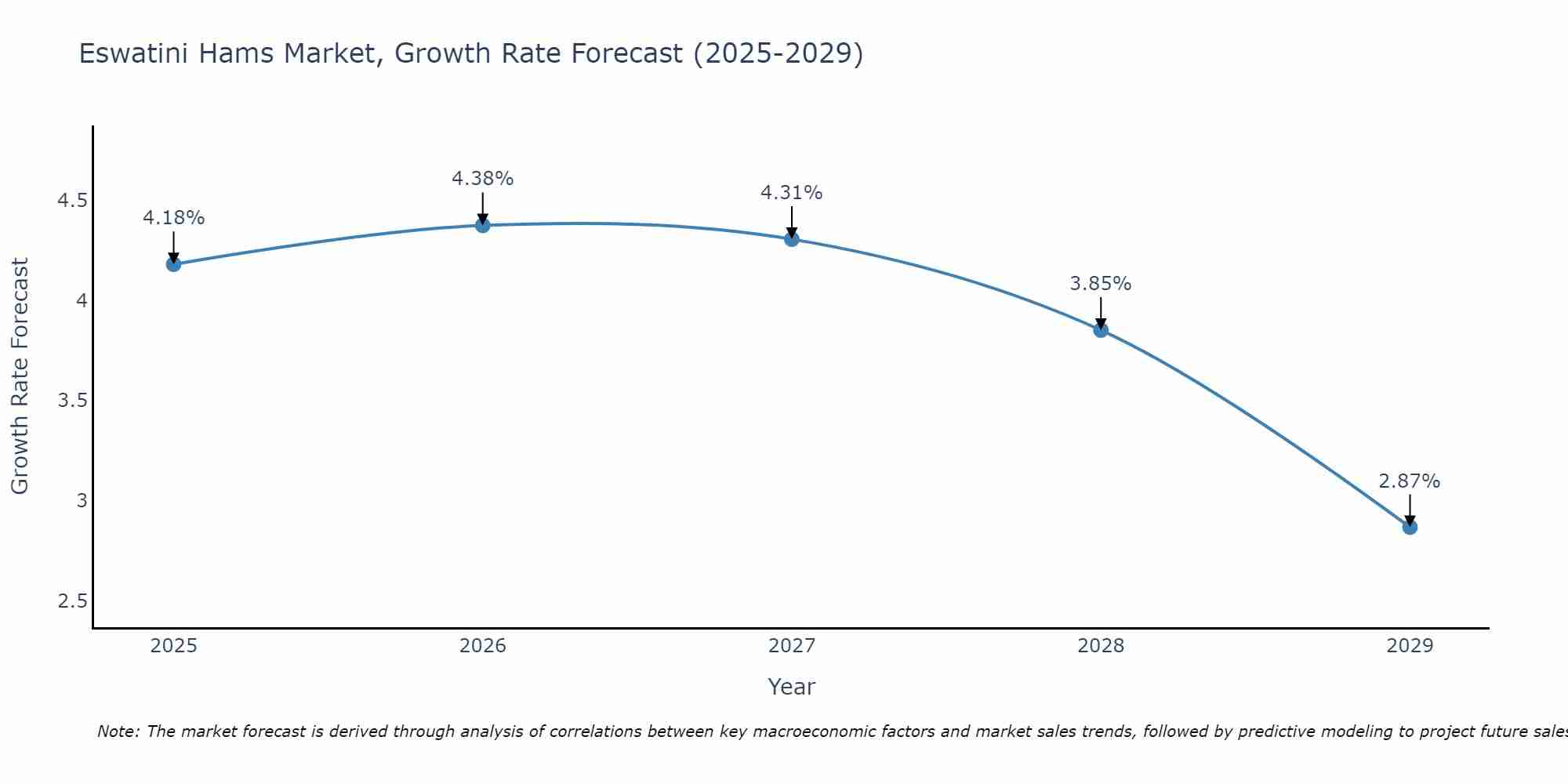
The Eswatini Hams Market is projected to witness mixed growth rate patterns during 2025 to 2029. Starting at 4.18% in 2025, the market peaks at 4.38% in 2026, and settles at 2.87% by 2029.
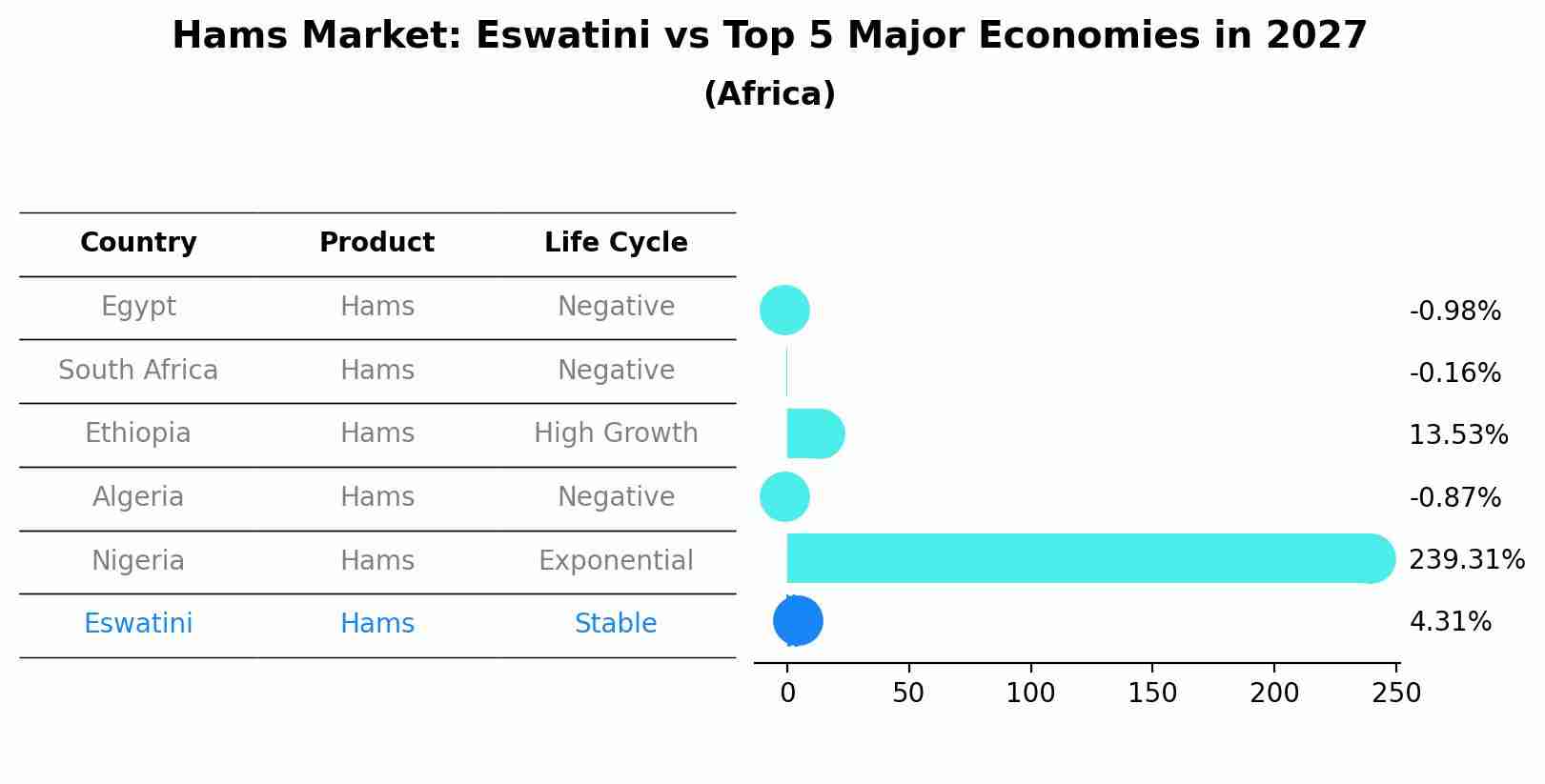
The Hams market in Eswatini is projected to grow at a stable growth rate of 4.31% by 2027, within the Africa region led by Egypt, along with other countries like South Africa, Ethiopia, Algeria and Nigeria, collectively shaping a dynamic and evolving market environment driven by innovation and increasing adoption of emerging technologies.
1 Executive Summary |
2 Introduction |
2.1 Key Highlights of the Report |
2.2 Report Description |
2.3 Market Scope & Segmentation |
2.4 Research Methodology |
2.5 Assumptions |
3 Swaziland Hams Market Overview |
3.1 Swaziland Country Macro Economic Indicators |
3.2 Swaziland Hams Market Revenues & Volume, 2021 & 2031F |
3.3 Swaziland Hams Market - Industry Life Cycle |
3.4 Swaziland Hams Market - Porter's Five Forces |
3.5 Swaziland Hams Market Revenues & Volume Share, By Type, 2021 & 2031F |
3.6 Swaziland Hams Market Revenues & Volume Share, By Applications, 2021 & 2031F |
4 Swaziland Hams Market Dynamics |
4.1 Impact Analysis |
4.2 Market Drivers |
4.2.1 Increasing consumer awareness and demand for high-quality, locally-produced hams |
4.2.2 Growth in the tourism sector leading to higher demand for traditional Swazi food products |
4.2.3 Rising disposable incomes and changing consumer preferences towards premium food products |
4.3 Market Restraints |
4.3.1 Price sensitivity among consumers due to economic challenges in the region |
4.3.2 Limited availability of skilled labor for ham production and processing |
4.3.3 Stringent regulations and compliance requirements impacting production costs |
5 Swaziland Hams Market Trends |
6 Swaziland Hams Market Segmentations |
6.1 Swaziland Hams Market, By Type |
6.1.1 Overview and Analysis |
6.1.2 Swaziland Hams Market Revenues & Volume, By Air Dried Cured Hams, 2021-2031F |
6.1.3 Swaziland Hams Market Revenues & Volume, By Smoked Hams, 2021-2031F |
6.2 Swaziland Hams Market, By Applications |
6.2.1 Overview and Analysis |
6.2.2 Swaziland Hams Market Revenues & Volume, By Supermarkets and Hypermarkets, 2021-2031F |
6.2.3 Swaziland Hams Market Revenues & Volume, By Independent Retailers, 2021-2031F |
6.2.4 Swaziland Hams Market Revenues & Volume, By Convenience Stores, 2021-2031F |
6.2.5 Swaziland Hams Market Revenues & Volume, By Specialist Retailers, 2021-2031F |
6.2.6 Swaziland Hams Market Revenues & Volume, By Online Retailers, 2021-2031F |
7 Swaziland Hams Market Import-Export Trade Statistics |
7.1 Swaziland Hams Market Export to Major Countries |
7.2 Swaziland Hams Market Imports from Major Countries |
8 Swaziland Hams Market Key Performance Indicators |
8.1 Percentage of repeat customers purchasing Swaziland hams |
8.2 Average order value for Swaziland hams products |
8.3 Number of new product launches or variations in the Swaziland hams market |
8.4 Customer satisfaction scores related to Swaziland hams products |
8.5 Percentage of market share compared to other meat products in Swaziland |
9 Swaziland Hams Market - Opportunity Assessment |
9.1 Swaziland Hams Market Opportunity Assessment, By Type, 2021 & 2031F |
9.2 Swaziland Hams Market Opportunity Assessment, By Applications, 2021 & 2031F |
10 Swaziland Hams Market - Competitive Landscape |
10.1 Swaziland Hams Market Revenue Share, By Companies, 2024 |
10.2 Swaziland Hams Market Competitive Benchmarking, By Operating and Technical Parameters |
11 Company Profiles |
12 Recommendations | 13 Disclaimer |

Export potential enables firms to identify high-growth global markets with greater confidence by combining advanced trade intelligence with a structured quantitative methodology. The framework analyzes emerging demand trends and country-level import patterns while integrating macroeconomic and trade datasets such as GDP and population forecasts, bilateral import–export flows, tariff structures, elasticity differentials between developed and developing economies, geographic distance, and import demand projections. Using weighted trade values from 2020–2024 as the base period to project country-to-country export potential for 2030, these inputs are operationalized through calculated drivers such as gravity model parameters, tariff impact factors, and projected GDP per-capita growth. Through an analysis of hidden potentials, demand hotspots, and market conditions that are most favorable to success, this method enables firms to focus on target countries, maximize returns, and global expansion with data, backed by accuracy.


By factoring in the projected importer demand gap that is currently unmet and could be potential opportunity, it identifies the potential for the Exporter (Country) among 190 countries, against the general trade analysis, which identifies the biggest importer or exporter.
To discover high-growth global markets and optimize your business strategy:
Click Here































