Sweden Loudspeaker Market Size (2020-2030)
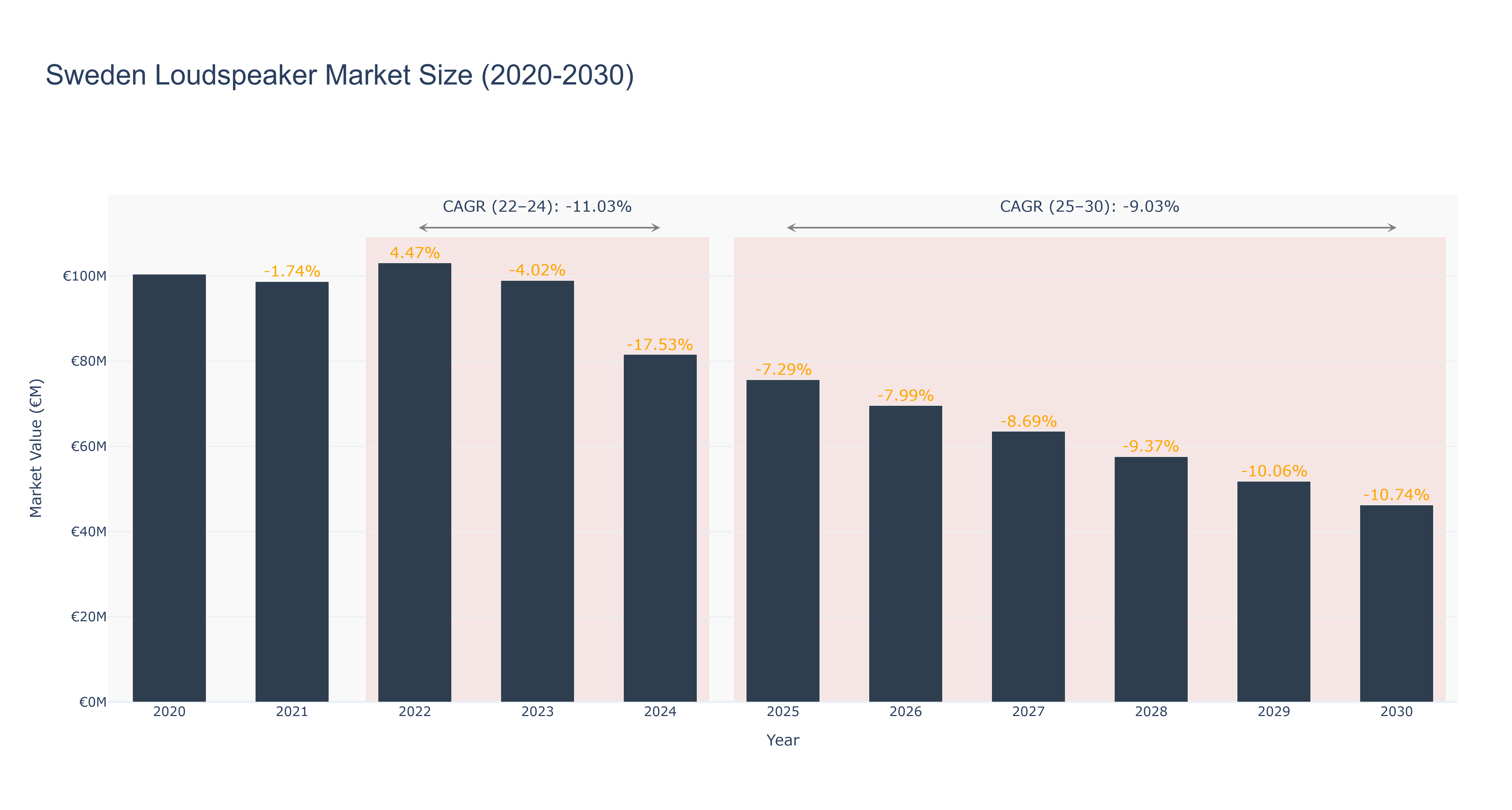
The Sweden Loudspeaker Market experienced its peak in 2020 with a market size of €100.42 million, followed by a decline to €98.67 million in 2021, reflecting a negative growth of 1.74%. The market rebounded in 2022, reaching €103.08 million, before facing significant downturns, culminating in a market size of €81.59 million in 2024, representing an actual CAGR of -11.03% from 2022 to 2024. Looking ahead, the forecasted period from 2025 to 2030 shows a continued decline, with projected market sizes decreasing from €75.64 million in 2025 to €46.24 million by 2030, reflecting a CAGR of -9.03%. Contributing factors to this downward trend include shifting consumer preferences towards integrated audio solutions and economic uncertainties affecting discretionary spending. The market's future remains challenging, with limited new developments on the horizon, indicating a need for innovation and adaptation to changing market dynamics.
Sweden Loudspeaker Market: Production & Trade Performance (2019-2025)
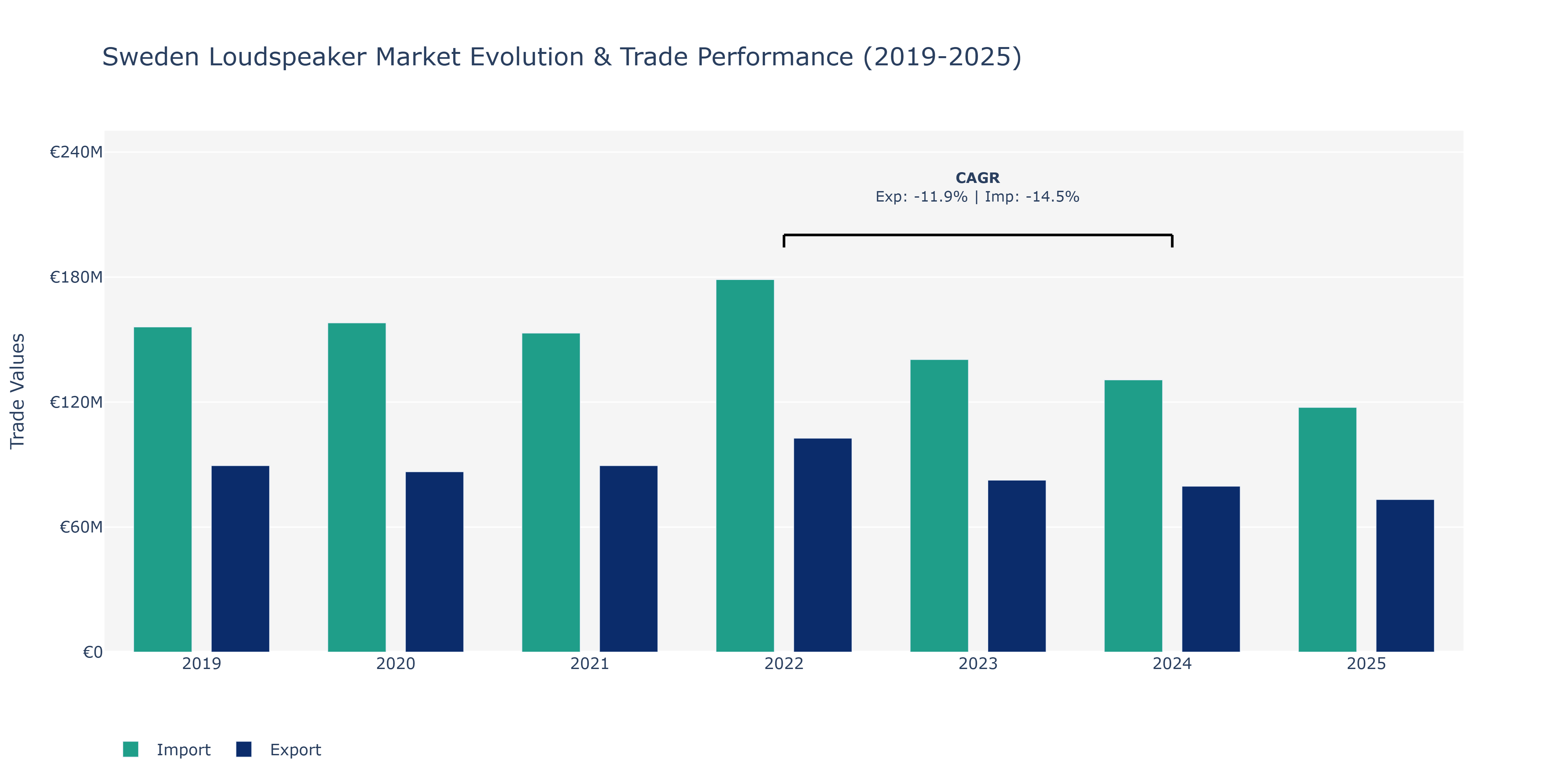
The Sweden Loudspeaker Market saw fluctuations in both Exports and Imports from 2019 to 2025. Exports started at €89.45 million in 2019, experienced a decline in 2020 to €86.51 million, and peaked in 2022 at €102.64 million before decreasing again. Imports followed a similar pattern, starting at €156.01 million in 2019, increasing to €178.77 million in 2022, and then declining in subsequent years. The decline in exports and imports in 2023 and 2024 can be attributed to various factors such as economic uncertainties impacting consumer spending, supply chain disruptions affecting production and distribution, and shifts in trade policies. These fluctuations reflect the market's sensitivity to external factors, emphasizing the need for market players to stay agile in response to evolving market conditions.
Sweden Loudspeaker Market Synopsis
The Sweden Loudspeaker Market is a dynamic and growing industry characterized by a high demand for premium audio products. With a strong focus on innovation and design, Swedish loudspeaker manufacturers are known for producing high-quality products that cater to both consumer and professional markets. The market is driven by factors such as the increasing popularity of home entertainment systems, the rise of streaming services, and the growing interest in audio technologies among consumers. Key players in the market include companies like Audio Pro, DLS Sweden, and Bowers & Wilkins, who offer a wide range of loudspeakers catering to different price points and preferences. As consumers continue to prioritize audio quality and immersive sound experiences, the Sweden Loudspeaker Market is expected to witness steady growth in the coming years.
Sweden Loudspeaker Market Trends
The Sweden Loudspeaker Market is experiencing a growing demand for smart speakers equipped with voice assistants such as Google Assistant and Amazon Alexa. Consumers are increasingly looking for high-quality audio products that offer seamless integration with smart home devices. There is also a trend towards wireless and portable speakers that provide convenience and flexibility for on-the-go use. With the rise of streaming services and home entertainment systems, there is a significant opportunity for companies to innovate in terms of technology, design, and connectivity features. Additionally, sustainability and eco-friendly materials are becoming important factors for consumers, presenting a potential niche market for environmentally conscious loudspeaker manufacturers in Sweden.
Sweden Loudspeaker Market Challenges
In the Sweden Loudspeaker Market, some key challenges include intense competition from global and local brands, leading to price pressures and the need for continuous innovation to differentiate products. Additionally, consumer preferences are shifting towards wireless and smart speaker technologies, requiring companies to invest in research and development to meet evolving demands. Regulatory requirements related to environmental sustainability and product safety also pose challenges for manufacturers in terms of compliance and cost implications. Lastly, economic uncertainties and fluctuations in consumer spending patterns can impact the overall demand for loudspeakers, influencing sales and market growth. To thrive in this competitive landscape, companies in the Sweden Loudspeaker Market must adapt quickly to changing trends and technologies while ensuring product quality and maintaining competitive pricing strategies.
Sweden Loudspeaker Market Investment Opportunities
The Sweden Loudspeaker Market is primarily driven by the increasing demand for high-quality audio products, driven by the growing trend of home entertainment systems and music streaming services. The rising popularity of smart speakers and wireless audio devices also contributes to market growth. Additionally, the focus on innovation and technological advancements such as voice recognition, Bluetooth connectivity, and portability further propel the market forward. The influence of lifestyle trends, such as a preference for aesthetically pleasing and space-saving audio solutions, also plays a role in driving consumer choices in the loudspeaker market in Sweden. Overall, a combination of technological advancements, changing consumer preferences, and the increasing adoption of smart home devices are key drivers shaping the Sweden Loudspeaker Market.
Sweden Loudspeaker Market Government Policie
In Sweden, the loudspeaker market is regulated by various government policies aimed at ensuring consumer safety and environmental sustainability. The Swedish government enforces strict quality standards and safety regulations for loudspeaker products to protect consumers from potential hazards. Additionally, there are policies in place to promote energy efficiency and minimize the environmental impact of loudspeaker manufacturing processes. Companies operating in the Swedish loudspeaker market are required to comply with these regulations to maintain market access and uphold ethical business practices. Overall, government policies in Sweden focus on creating a competitive and sustainable market for loudspeakers while safeguarding consumer interests and environmental concerns.
Sweden Loudspeaker Market Future Outlook
The future outlook for the Sweden Loudspeaker Market appears positive, driven by the increasing demand for smart home devices and high-quality audio equipment. The market is expected to witness steady growth due to technological advancements such as wireless connectivity and voice control features in loudspeakers. Additionally, the growing trend of home entertainment systems and the rising popularity of music streaming services are likely to further fuel market growth. With a focus on innovation and product development, key players in the Sweden Loudspeaker Market are anticipated to introduce new and advanced products to cater to the evolving consumer preferences. Overall, the market is poised for expansion in the coming years, presenting opportunities for both domestic and international loudspeaker manufacturers to capitalize on the growing demand in Sweden.
Key Highlights of the Report:
- Sweden Loudspeaker Market Outlook
- Market Size of Sweden Loudspeaker Market, 2025
- Forecast of Sweden Loudspeaker Market, 2032
- Historical Data and Forecast of Sweden Loudspeaker Revenues & Volume for the Period 2022- 2032
- Sweden Loudspeaker Market Trend Evolution
- Sweden Loudspeaker Market Drivers and Challenges
- Sweden Loudspeaker Price Trends
- Sweden Loudspeaker Porter's Five Forces
- Sweden Loudspeaker Industry Life Cycle
- Historical Data and Forecast of Sweden Loudspeaker Market Revenues & Volume By Product for the Period 2022- 2032
- Historical Data and Forecast of Sweden Loudspeaker Market Revenues & Volume By Soundbar for the Period 2022- 2032
- Historical Data and Forecast of Sweden Loudspeaker Market Revenues & Volume By Subwoofer for the Period 2022- 2032
- Historical Data and Forecast of Sweden Loudspeaker Market Revenues & Volume By In-wall for the Period 2022- 2032
- Historical Data and Forecast of Sweden Loudspeaker Market Revenues & Volume By Outdoor for the Period 2022- 2032
- Historical Data and Forecast of Sweden Loudspeaker Market Revenues & Volume By Other Product Types for the Period 2022- 2032
- Historical Data and Forecast of Sweden Loudspeaker Market Revenues & Volume By Application for the Period 2022- 2032
- Historical Data and Forecast of Sweden Loudspeaker Market Revenues & Volume By Communication for the Period 2022- 2032
- Historical Data and Forecast of Sweden Loudspeaker Market Revenues & Volume By Home Entertainment for the Period 2022- 2032
- Historical Data and Forecast of Sweden Loudspeaker Market Revenues & Volume By Automotive for the Period 2022- 2032
- Historical Data and Forecast of Sweden Loudspeaker Market Revenues & Volume By Events and Outdoor Entertainment for the Period 2022- 2032
- Sweden Loudspeaker Import Export Trade Statistics
- Market Opportunity Assessment By Product
- Market Opportunity Assessment By Application
- Sweden Loudspeaker Top Companies Market Share
- Sweden Loudspeaker Competitive Benchmarking By Technical and Operational Parameters
- Sweden Loudspeaker Company Profiles
- Sweden Loudspeaker Key Strategic Recommendations






































