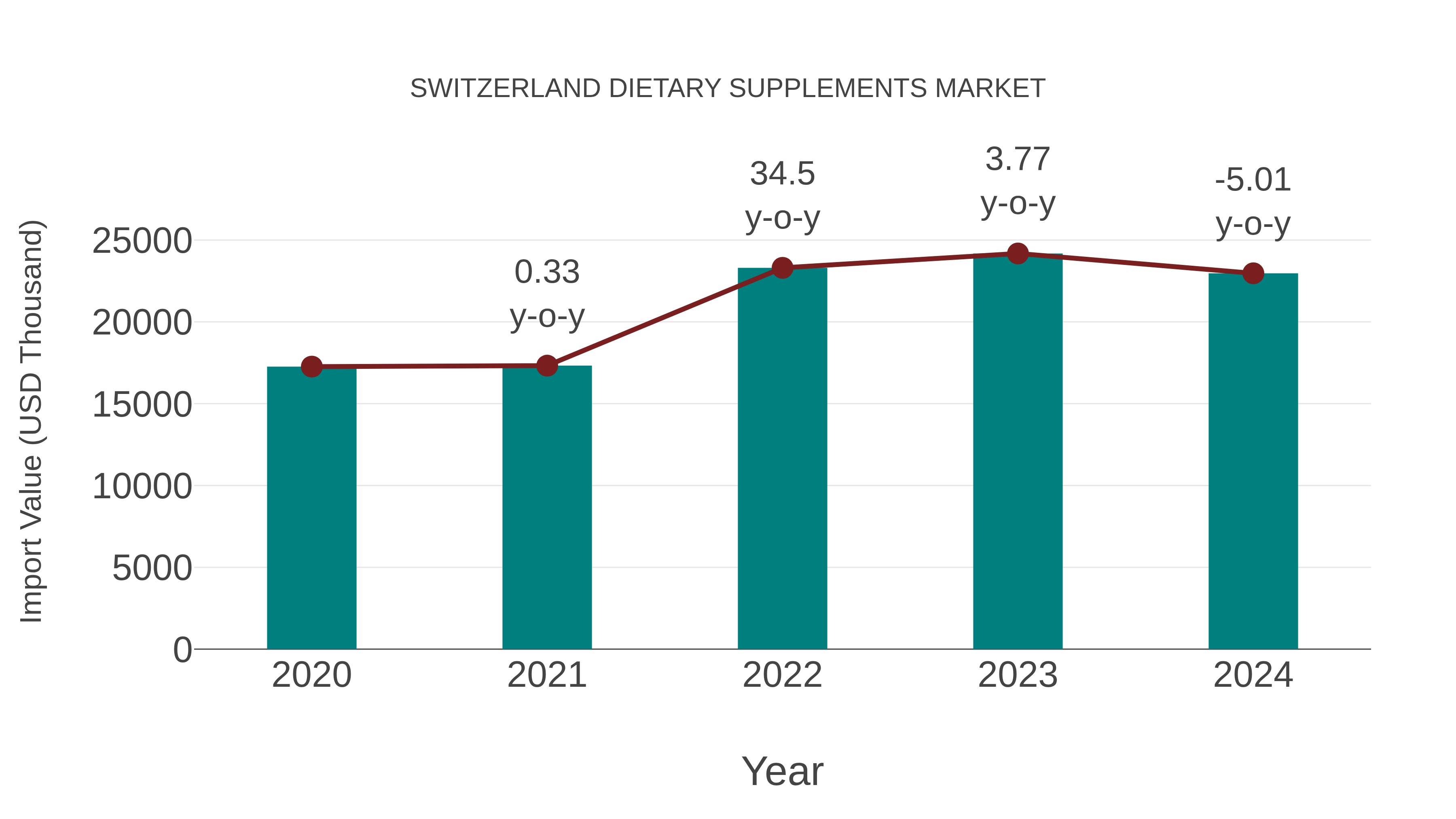
Switzerland Dietary Supplements Market: Import Trend Analysis
Switzerland import trend for dietary supplements saw a -5.01% decline from 2023 to 2024, with a 7.39% CAGR from 2020 to 2024. This could be attributed to shifts in consumer preferences or regulatory changes impacting the market dynamics during this period.
Switzerland Dietary Supplements Market Growth Rate
According to 6Wresearch internal database and industry insights, the Switzerland Dietary Supplements Market is projected to grow at a compound annual growth rate (CAGR) of 7.4% during the forecast period (2026-2032).
Topics Covered in the Switzerland Dietary Supplements Market Report
The Switzerland Dietary Supplements Market report thoroughly covers the market by ingredient, form, application, end user, and distribution channel. The market report provides an unbiased and detailed analysis of ongoing market trends, opportunities/high growth areas, and market drivers, which help stakeholders devise and align their market strategies according to the current and future market dynamics.
Switzerland Dietary Supplements Market Highlights
| Report Name | Switzerland Dietary Supplements Market |
| Forecast period | 2026-2032 |
| CAGR | 7.4% |
| Growing Sector | OTC Distribution Channel |
Switzerland Dietary Supplements Market Synopsis
Switzerland Dietary Supplements Market is expected to witness steady growth driven by higher awareness levels in consumers regarding prevention and wellness. Higher usage of natural and organic ingredients and the growing population of older individuals are driving the trend. Moreover, personalized nutrition solutions, combined with the development of retail and e-commerce platforms, have simplified market access. The consumption of dietary supplements for immunity, bones, and wellness is contributing towards the growth of the market.
Evaluation of Growth Drivers in the Switzerland Dietary Supplements Market
Below mentioned are some prominent drivers and their influence on the market dynamics:
| Drivers | Primary Segments Affected | Why it Matters (Evidence) |
| Rising Health Awareness | Vitamins; Adults | Consumers are proactively adopting supplements for preventive healthcare. |
| Increase in Aging Population | Green Tea Extracts; Geriatric | Surge in aging population spurs the need for bone and joint supplements. |
| Growing Presence of E-commerce | Various Types; OTC | E-commerce makes supplements more accessible. |
| Development of Personalized Nutrients | Proteins; Adults | Personalized dietary supplements increase their efficacy and customer involvement. |
| Growth in the Natural Supplements Market | Botanical Extracts; Various Consumer Groups | Favoring natural and organic dietary supplements fuels sales. |
Switzerland Dietary Supplements Market is expected to grow at the CAGR of 7.4% during the forecast period of 2026-2032. Increased consumer awareness about preventive care, the use of natural and organic products, and new ideas in personalized nutrition are all things that have helped the market grow. The growth of e-commerce platforms and strong healthcare systems also helps the market grow. Moreover, an increase in the aging population along with the consumption of immunity-boosting products also fuels growth, making dietary supplements an essential aspect of health management.
Evaluation of Restraints in the Switzerland Dietary Supplements Market
Below mentioned are some major restraints and their influence on the market dynamics:
| Restraints | Primary Segments Affected | What This Means (Evidence) |
| Stringent Regulatory Framework | All Types; OTC & Prescribed | Strict regulations increase compliance costs for manufacturers. |
| High Product Costs | Premium Supplements; Adults | Expensive products limit accessibility among price-sensitive consumers. |
| Risk of Overconsumption | Vitamins; Adults | Misuse of supplements may lead to health complications. |
| Limited Awareness of Dosage | All Types; Others | Improper usage reduces effectiveness and consumer trust. |
| Competition from Functional Foods | Proteins; General Health | Functional foods act as substitutes, reducing supplement demand. |
Switzerland Dietary Supplements Industry Challenges
Despite strong growth prospects, the Switzerland Dietary Supplements Industry faces several challenges that impact its expansion. The first issue is that of a stringent regulatory environment that will impose more burdens on manufactures and slow down approval processes. In addition, the expensive nature of the higher quality supplements will make them less accessible to some categories of consumers. Concerns over the issue of misuse and over-consumption have also come up in recent times. The last challenge is that posed by fortified beverages and foods, which continue to gain popularity among consumers.
Switzerland Dietary Supplements Market Trends
Emerging trends shaping the Switzerland Dietary Supplements Market Growth include:
- Personalized Nutrition Solutions: People are start to buy personalized dietary supplements that are designed according to the individual requirements of a person.
- Shift Toward Plant-Based Supplements: The growing consciousness about environmental issues and ethics are making people buy plant-based and vegan dietary supplements. This development will make the manufacturers include more products from plants.
- Growth in Gummies and Soft Gels Form: Younger people prefer to take nutritional supplements in the form of gummies and soft gels, which makes it easier for them to take these supplements.
Investment Opportunities in the Switzerland Dietary Supplements Market
Key investment areas in the Switzerland Dietary Supplements Market Share include:
- Online Channel Expansion – E-commerce investments can boost product visibility considerably. Online sales channels are gaining prominence as the primary method for distributing supplements.
- Personalized Nutrient Formulations – Businesses can consider developing personalized supplements through AI-based approaches. This category provides substantial growth opportunities owing to rising customer demand.
- Organic Supplement Product Lines – Businesses can focus on creating botanical and organic-based supplement products to cater to health-conscious consumers.
Top 5 Leading Players in the Switzerland Dietary Supplements Market
Some leading players operating in the Switzerland Dietary Supplements Market include:
1. Nestle Health Science
| Company Name | Nestle Health Science |
| Established Year | 2011 |
| Headquarters | Vevey, Switzerland |
| Official Website | Click Here |
Nestlé Health Science focuses on nutritional therapies and dietary supplements tailored for various health conditions. The company invests heavily in research and innovation, offering scientifically backed products that support immunity, metabolism, and overall wellness globally.
2. DSM-Firmenich
| Company Name | DSM-Firmenich |
| Established Year | 1902 |
| Headquarters | Kaiseraugst, Switzerland |
| Official Website | Click Here |
DSM-Firmenich provides essential nutrients including vitamins and omega fatty acids used in dietary supplements. The company emphasizes sustainable production and innovation, supporting global health through high-quality nutritional ingredients and solutions.
3. Lonza Group
| Company Name | Lonza Group |
| Established Year | 1897 |
| Headquarters | Basel, Switzerland |
| Official Website | Click Here |
Lonza specializes in health ingredients and capsules used in supplement manufacturing. The company supports innovation in nutraceuticals by offering advanced delivery systems and high-quality ingredients for enhanced bioavailability.
4. Herbalife Nutrition Ltd.
| Company Name | Herbalife Nutrition Ltd. |
| Established Year | 1980 |
| Headquarters | Los Angeles, USA |
| Official Website | Click Here |
Herbalife offers a wide range of dietary supplements focused on weight management, energy, and general wellness. The company operates through a direct selling model, expanding its presence across global markets including Switzerland.
5. Amway Corporation
| Company Name | Amway Corporation |
| Established Year | 1959 |
| Headquarters | Michigan, USA |
| Official Website | Click Here |
Amway produces nutritional supplements under its Nutrilite brand, emphasizing plant-based ingredients and scientific research. The company focuses on wellness and preventive healthcare, catering to diverse consumer needs worldwide.
Government Regulations Introduced in the Switzerland Dietary Supplements Market
There have been several programs instituted by the Switzerland government aimed at securing quality dietary supplements. Such regulatory authorities as the Federal Food Safety and Veterinary Office (FSVO) strictly regulate the labels, the safety of the ingredients used, and the medical claims of dietary supplements. For example, the legislation stipulates that any manufacturer must prove the effectiveness of its products through scientific evidence to guarantee consumer protection. Moreover, Switzerland encourages the adoption of labeling programs that enable consumers to understand dietary supplements better. Finally, awareness campaigns conducted by the Swiss government raise consumer consciousness about supplements.
Future Insights of the Switzerland Dietary Supplements Market
The Switzerland Dietary Supplements Market is expected to experience sustained growth in the coming years due to increasing focus on preventive healthcare and wellness. Advancements in personalized nutrition, along with the integration of digital health technologies, will further enhance consumer engagement. The trend of natural and organic supplement consumption is expected to increase due to the increasing awareness among the customers about health and environment. Moreover, the emergence of various online shopping sites will enhance the availability of products in the entire nation. Innovation in supplement formulations and packaging will open new avenues for players in the market.
Market Segmentation Analysis
The report offers a comprehensive study of the subsequent market segments and their leading categories.
Vitamins to Dominate the Market – By Ingredient
According to Rahul, Senior Research Analyst, 6Wresearch, Vitamins segment leads the Switzerland Dietary Supplements Market owing to their widespread use in immunity, bone health, and general wellness applications. The increasing need for daily nutrients and preventive health care measures are some of the key factors that contribute to the expansion of vitamins market. Apart from this, the increasing geriatric population and the knowledge related to micro nutrient deficiency among people have contributed immensely towards increased demand for vitamin supplements.
General Health to Dominate the Market – By Application
General health products have a dominant position due to the growing awareness of preventive healthcare. The focus of consumers on overall health maintenance has boosted the demand for multivitamins and daily nutritional supplements.
Adults to Dominate the Market – By End User
Adults form the largest consumer base due to hectic lives and rising health issues. Growing adoption of supplements for energy, immune system support, and stress relief is fueling segment growth.
Key Attractiveness of the Report
- 10 Years of Market Numbers.
- Historical Data Starting from 2022 to 2025.
- Base Year: 2025.
- Forecast Data until 2032.
- Key Performance Indicators Impacting the Market.
- Major Upcoming Developments and Projects.
Key Highlights of the Report:
- Switzerland Dietary Supplements Market Outlook
- Market Size of Switzerland Dietary Supplements Market, 2025
- Forecast of Switzerland Dietary Supplements Market, 2032
- Historical Data and Forecast of Switzerland Dietary Supplements Revenues & Volume for the Period 2022-2032F
- Switzerland Dietary Supplements Market Trend Evolution
- Switzerland Dietary Supplements Market Drivers and Challenges
- Switzerland Dietary Supplements Price Trends
- Switzerland Dietary Supplements Porter`s Five Forces
- Switzerland Dietary Supplements Industry Life Cycle
- Historical Data and Forecast of Switzerland Dietary Supplements Market Revenues & Volume By Ingredientfor the Period 2022-2032F
- Historical Data and Forecast of Switzerland Dietary Supplements Market Revenues & Volume By Vitamins for the Period 2022-2032F
- Historical Data and Forecast of Switzerland Dietary Supplements Market Revenues & Volume By Botanicals for the Period 2022-2032F
- Historical Data and Forecast of Switzerland Dietary Supplements Market Revenues & Volume By Minerals for the Period 2022-2032F
- Historical Data and Forecast of Switzerland Dietary Supplements Market Revenues & Volume By Proteins & Amino Acids for the Period 2022-2032F
- Historical Data and Forecast of Switzerland Dietary Supplements Market Revenues & Volume By Fibers & Specialty Carbohydrates for the Period 2022-2032F
- Historical Data and Forecast of Switzerland Dietary Supplements Market Revenues & Volume By Omega Fatty Acids for the Period 2022-2032F
- Historical Data and Forecast of Switzerland Dietary Supplements Market Revenues & Volume By Others for the Period 2022-2032F
- Historical Data and Forecast of Switzerland Dietary Supplements Market Revenues & Volume By Formfor the Period 2022-2032F
- Historical Data and Forecast of Switzerland Dietary Supplements Market Revenues & Volume By Tablets for the Period 2022-2032F
- Historical Data and Forecast of Switzerland Dietary Supplements Market Revenues & Volume By Capsules for the Period 2022-2032F
- Historical Data and Forecast of Switzerland Dietary Supplements Market Revenues & Volume By Soft gels for the Period 2022-2032F
- Historical Data and Forecast of Switzerland Dietary Supplements Market Revenues & Volume By Powders for the Period 2022-2032F
- Historical Data and Forecast of Switzerland Dietary Supplements Market Revenues & Volume By Gummies for the Period 2022-2032F
- Historical Data and Forecast of Switzerland Dietary Supplements Market Revenues & Volume By Liquids for the Period 2022-2032F
- Historical Data and Forecast of Switzerland Dietary Supplements Market Revenues & Volume By Others for the Period 2022-2032F
- Historical Data and Forecast of Switzerland Dietary Supplements Market Revenues & Volume By Applicationfor the Period 2022-2032F
- Historical Data and Forecast of Switzerland Dietary Supplements Market Revenues & Volume By Energy & Weight Management for the Period 2022-2032F
- Historical Data and Forecast of Switzerland Dietary Supplements Market Revenues & Volume By General Health for the Period 2022-2032F
- Historical Data and Forecast of Switzerland Dietary Supplements Market Revenues & Volume By Bone & Joint Health for the Period 2022-2032F
- Historical Data and Forecast of Switzerland Dietary Supplements Market Revenues & Volume By Gastrointestinal Health for the Period 2022-2032F
- Historical Data and Forecast of Switzerland Dietary Supplements Market Revenues & Volume By Immunity for the Period 2022-2032F
- Historical Data and Forecast of Switzerland Dietary Supplements Market Revenues & Volume By Cardiac Health for the Period 2022-2032F
- Historical Data and Forecast of Switzerland Dietary Supplements Market Revenues & Volume By Diabetes for the Period 2022-2032F
- Historical Data and Forecast of Switzerland Dietary Supplements Market Revenues & Volume By Others for the Period 2022-2032F
- Historical Data and Forecast of Switzerland Dietary Supplements Market Revenues & Volume By End user for the Period 2022-2032F
- Historical Data and Forecast of Switzerland Dietary Supplements Market Revenues & Volume By Adults for the Period 2022-2032F
- Historical Data and Forecast of Switzerland Dietary Supplements Market Revenues & Volume By Geriatric for the Period 2022-2032F
- Historical Data and Forecast of Switzerland Dietary Supplements Market Revenues & Volume By Pregnant Women for the Period 2022-2032F
- Historical Data and Forecast of Switzerland Dietary Supplements Market Revenues & Volume By Children for the Period 2022-2032F
- Historical Data and Forecast of Switzerland Dietary Supplements Market Revenues & Volume By Infants for the Period 2022-2032F
- Historical Data and Forecast of Switzerland Dietary Supplements Market Revenues & Volume By Distribution Channel for the Period 2022-2032F
- Historical Data and Forecast of Switzerland Dietary Supplements Market Revenues & Volume By OTC for the Period 2022-2032F
- Historical Data and Forecast of Switzerland Dietary Supplements Market Revenues & Volume By Prescribed for the Period 2022-2032F
- Switzerland Dietary Supplements Import Export Trade Statistics
- Market Opportunity Assessment By Ingredient
- Market Opportunity Assessment By Form
- Market Opportunity Assessment By Application
- Market Opportunity Assessment By End user
- Market Opportunity Assessment By Distribution Channel
- Switzerland Dietary Supplements Top Companies Market Share
- Switzerland Dietary Supplements Competitive Benchmarking By Technical and Operational Parameters
- Switzerland Dietary Supplements Company Profiles
- Switzerland Dietary Supplements Key Strategic Recommendations
Market Covered
The report offers a comprehensive study of the subsequent market segments:
By Ingredient
- Vitamins
- Botanicals
- Minerals
- Proteins & Amino Acids
- Fibers & Specialty Carbohydrates
- Omega Fatty Acids
- Others
By Form
- Tablets
- Capsules
- Soft gels
- Powders
- Gummies
- Liquids
- Others
By Application
- Energy & Weight Management
- General Health
- Bone & Joint Health
- Gastrointestinal Health
- Immunity
- Cardiac Health
- Diabetes
- Others
By End user
- Adults
- Geriatric
- Pregnant Women
- Children
- Infants
By Distribution Channel
- OTC
- Prescribed






































