Switzerland Interchangeable Lens Market (2026-2032) | Strategy, Industry, Supply, Growth, Competitive, Restraints, Challenges, Segmentation, Trends, Demand, Value, Pricing Analysis, Investment Trends, Companies, Analysis, Outlook, Revenue, Share, Drivers, Forecast, Strategic Insights, Consumer Insights, Opportunities, Competition, Size, Segments
Market Forecast By Lens Type (Wide Angle Lenses, Telephoto Lenses, Macro Lenses), By Camera Mount (Canon EF Mount, Nikon F Mount, Sony E Mount), By Aperture Range (f/1.2-f/2.8, f/2.8-f/4.0, f/4.0-f/5.6), By Image Stabilization (Optical Image Stabilization (OIS), Electronic Image Stabilization (EIS), Dual Image Stabilization (DIS)), By Autofocus System (Contrast Detection Autofocus (CDAF), Phase Detection Autofocus (PDAF), Hybrid Autofocus System) And Competitive Landscape
| Product Code: ETC12430892 | Publication Date: Apr 2025 | Updated Date: Mar 2026 | Product Type: Market Research Report | |
| Publisher: 6Wresearch | Author: Sachin Kumar Rai | No. of Pages: 65 | No. of Figures: 34 | No. of Tables: 19 |
Switzerland Interchangeable Lens Market: Import Trend Analysis
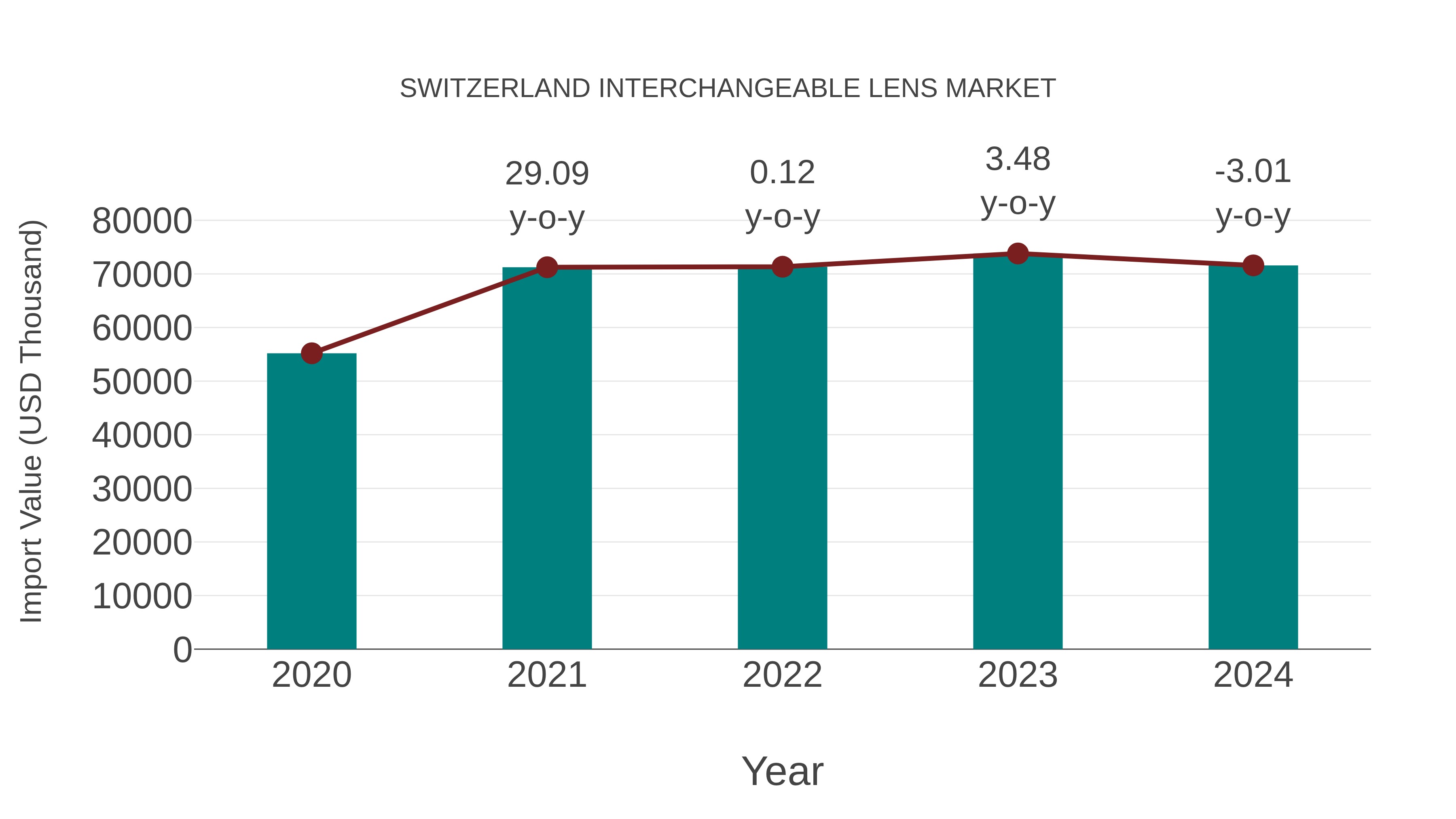
Switzerland import trend for the interchangeable lens market showed a growth rate of -3.01% from 2023 to 2024, with a compound annual growth rate (CAGR) of 6.72% from 2020 to 2024. This decline in growth could be attributed to shifting consumer preferences or global economic conditions impacting demand.
Switzerland Interchangeable Lens Market Market Overview
The Switzerland interchangeable lens market is characterized by a strong demand for high-quality camera lenses driven by the country`s affluent population with a keen interest in photography. Key players in the market include renowned brands such as Canon, Nikon, Sony, and Sigma, offering a wide range of lenses catering to various photography needs. The market is witnessing a trend towards mirrorless cameras, leading to a growing demand for compatible interchangeable lenses. Additionally, advancements in technology, such as improved autofocus systems and optical image stabilization, are influencing purchase decisions among consumers. With a focus on innovation and product development, the Switzerland interchangeable lens market is expected to continue its growth trajectory, fueled by the increasing popularity of photography as a hobby and profession in the country.
Switzerland Interchangeable Lens Market Trends
The Switzerland interchangeable lens market is experiencing a shift towards mirrorless cameras, with consumers showing a preference for their compact size, advanced technology, and improved performance compared to traditional DSLRs. Major camera manufacturers are focusing on developing innovative mirrorless models to cater to this growing demand. Additionally, there is a rising interest in high-quality lenses that offer versatility and exceptional image quality for both professional photographers and enthusiasts. With an emphasis on portability and convenience, lightweight lenses with advanced features such as image stabilization and fast autofocus are gaining popularity in the Swiss market. Overall, the trend in the Switzerland interchangeable lens market is moving towards cutting-edge mirrorless cameras and high-performance lenses that meet the needs of modern photographers.
Switzerland Interchangeable Lens Market Challenges
One of the key challenges faced in the Switzerland interchangeable lens market is increasing competition from both established players and new entrants. With the market becoming more saturated, companies are under pressure to differentiate their products through innovation, pricing strategies, and marketing efforts. Additionally, rapidly changing technology and consumer preferences pose a challenge for companies to stay ahead of the curve and meet evolving demands. Furthermore, economic uncertainties and fluctuations in currency exchange rates can impact pricing and profit margins, adding another layer of complexity to the market landscape. Overall, companies in the Switzerland interchangeable lens market need to continuously adapt to these challenges to maintain their competitive edge and sustain growth in the dynamic market environment.
Switzerland Interchangeable Lens Market Investment Opportunities
The Switzerland interchangeable lens market offers promising investment opportunities due to the country`s strong presence in the photography and imaging industry. With a high demand for professional and enthusiast-level cameras, there is a growing market for interchangeable lenses among photographers looking to enhance their creativity and technical capabilities. Investing in companies that manufacture high-quality lenses or provide innovative lens technologies could be lucrative in Switzerland`s market. Additionally, with the rise of social media and content creation, there is a growing need for high-quality imagery, further driving the demand for interchangeable lenses. Keeping an eye on technological advancements, consumer preferences, and market trends will be key to identifying profitable investment opportunities in this niche market segment.
Switzerland Interchangeable Lens Market Government Policy
In Switzerland, the interchangeable lens market is governed by various policies that aim to promote fair competition and consumer protection. The Swiss government closely monitors market activities through the Swiss Competition Commission (COMCO) to prevent anti-competitive behavior and ensure a level playing field for businesses. Additionally, the Swiss Federal Department of Finance regulates import and export activities related to interchangeable lenses to maintain trade balance and safeguard the interests of domestic manufacturers. The government also enforces strict product safety standards through the Swiss Federal Office of Public Health to protect consumers from potential hazards. Overall, the regulatory framework in Switzerland for the interchangeable lens market focuses on fostering a competitive market environment while prioritizing consumer welfare and industry compliance.
Switzerland Interchangeable Lens Market Future Outlook
The future outlook for the Switzerland interchangeable lens market appears promising with steady growth anticipated due to the increasing popularity of mirrorless cameras and the advancements in lens technology. Consumers are increasingly seeking high-quality interchangeable lenses to enhance their photography experience and achieve professional-level results. Additionally, the rise of social media platforms and the growing trend of content creation are driving the demand for versatile lenses that offer superior image quality. The market is expected to see further innovation in lens design and features, catering to the evolving needs of photographers and videographers. Overall, the Switzerland interchangeable lens market is poised for continued expansion as technology continues to advance and photography enthusiasts seek to upgrade their equipment for better performance.
Key Highlights of the Report:
- Switzerland Interchangeable Lens Market Outlook
- Market Size of Switzerland Interchangeable Lens Market,2025
- Forecast of Switzerland Interchangeable Lens Market, 2032
- Historical Data and Forecast of Switzerland Interchangeable Lens Revenues & Volume for the Period 2022-2032F
- Switzerland Interchangeable Lens Market Trend Evolution
- Switzerland Interchangeable Lens Market Drivers and Challenges
- Switzerland Interchangeable Lens Price Trends
- Switzerland Interchangeable Lens Porter's Five Forces
- Switzerland Interchangeable Lens Industry Life Cycle
- Historical Data and Forecast of Switzerland Interchangeable Lens Market Revenues & Volume By Lens Type for the Period 2022-2032F
- Historical Data and Forecast of Switzerland Interchangeable Lens Market Revenues & Volume By Wide Angle Lenses for the Period 2022-2032F
- Historical Data and Forecast of Switzerland Interchangeable Lens Market Revenues & Volume By Telephoto Lenses for the Period 2022-2032F
- Historical Data and Forecast of Switzerland Interchangeable Lens Market Revenues & Volume By Macro Lenses for the Period 2022-2032F
- Historical Data and Forecast of Switzerland Interchangeable Lens Market Revenues & Volume By Camera Mount for the Period 2022-2032F
- Historical Data and Forecast of Switzerland Interchangeable Lens Market Revenues & Volume By Canon EF Mount for the Period 2022-2032F
- Historical Data and Forecast of Switzerland Interchangeable Lens Market Revenues & Volume By Nikon F Mount for the Period 2022-2032F
- Historical Data and Forecast of Switzerland Interchangeable Lens Market Revenues & Volume By Sony E Mount for the Period 2022-2032F
- Historical Data and Forecast of Switzerland Interchangeable Lens Market Revenues & Volume By Aperture Range for the Period 2022-2032F
- Historical Data and Forecast of Switzerland Interchangeable Lens Market Revenues & Volume By f/1.2-f/2.8 for the Period 2022-2032F
- Historical Data and Forecast of Switzerland Interchangeable Lens Market Revenues & Volume By f/2.8-f/4.0 for the Period 2022-2032F
- Historical Data and Forecast of Switzerland Interchangeable Lens Market Revenues & Volume By f/4.0-f/5.6 for the Period 2022-2032F
- Historical Data and Forecast of Switzerland Interchangeable Lens Market Revenues & Volume By Image Stabilization for the Period 2022-2032F
- Historical Data and Forecast of Switzerland Interchangeable Lens Market Revenues & Volume By Optical Image Stabilization (OIS) for the Period 2022-2032F
- Historical Data and Forecast of Switzerland Interchangeable Lens Market Revenues & Volume By Electronic Image Stabilization (EIS) for the Period 2022-2032F
- Historical Data and Forecast of Switzerland Interchangeable Lens Market Revenues & Volume By Dual Image Stabilization (DIS) for the Period 2022-2032F
- Historical Data and Forecast of Switzerland Interchangeable Lens Market Revenues & Volume By Autofocus System for the Period 2022-2032F
- Historical Data and Forecast of Switzerland Interchangeable Lens Market Revenues & Volume By Contrast Detection Autofocus (CDAF) for the Period 2022-2032F
- Historical Data and Forecast of Switzerland Interchangeable Lens Market Revenues & Volume By Phase Detection Autofocus (PDAF) for the Period 2022-2032F
- Historical Data and Forecast of Switzerland Interchangeable Lens Market Revenues & Volume By Hybrid Autofocus System for the Period 2022-2032F
- Switzerland Interchangeable Lens Import Export Trade Statistics
- Market Opportunity Assessment By Lens Type
- Market Opportunity Assessment By Camera Mount
- Market Opportunity Assessment By Aperture Range
- Market Opportunity Assessment By Image Stabilization
- Market Opportunity Assessment By Autofocus System
- Switzerland Interchangeable Lens Top Companies Market Share
- Switzerland Interchangeable Lens Competitive Benchmarking By Technical and Operational Parameters
- Switzerland Interchangeable Lens Company Profiles
- Switzerland Interchangeable Lens Key Strategic Recommendations
Switzerland Interchangeable Lens Market (2026-2032): FAQs
6Wresearch actively monitors the Switzerland Interchangeable Lens Market and publishes its comprehensive annual report, highlighting emerging trends, growth drivers, revenue analysis, and forecast outlook. Our insights help businesses to make data-backed strategic decisions with ongoing market dynamics. Our analysts track relevent industries related to the Switzerland Interchangeable Lens Market, allowing our clients with actionable intelligence and reliable forecasts tailored to emerging regional needs.
Yes, we provide customisation as per your requirements. To learn more, feel free to contact us on sales@6wresearch.com
1 Executive Summary |
2 Introduction |
2.1 Key Highlights of the Report |
2.2 Report Description |
2.3 Market Scope & Segmentation |
2.4 Research Methodology |
2.5 Assumptions |
3 Switzerland Interchangeable Lens Market Overview |
3.1 Switzerland Country Macro Economic Indicators |
3.2 Switzerland Interchangeable Lens Market Revenues & Volume, 2022 & 2032F |
3.3 Switzerland Interchangeable Lens Market - Industry Life Cycle |
3.4 Switzerland Interchangeable Lens Market - Porter's Five Forces |
3.5 Switzerland Interchangeable Lens Market Revenues & Volume Share, By Lens Type, 2022 & 2032F |
3.6 Switzerland Interchangeable Lens Market Revenues & Volume Share, By Camera Mount, 2022 & 2032F |
3.7 Switzerland Interchangeable Lens Market Revenues & Volume Share, By Aperture Range, 2022 & 2032F |
3.8 Switzerland Interchangeable Lens Market Revenues & Volume Share, By Image Stabilization, 2022 & 2032F |
3.9 Switzerland Interchangeable Lens Market Revenues & Volume Share, By Autofocus System, 2022 & 2032F |
4 Switzerland Interchangeable Lens Market Dynamics |
4.1 Impact Analysis |
4.2 Market Drivers |
4.2.1 Technological advancements in interchangeable lens technology |
4.2.2 Increasing demand for high-quality photography equipment |
4.2.3 Growing popularity of mirrorless cameras in Switzerland |
4.3 Market Restraints |
4.3.1 High cost associated with interchangeable lens cameras |
4.3.2 Competition from smartphone cameras impacting entry-level interchangeable lens market |
5 Switzerland Interchangeable Lens Market Trends |
6 Switzerland Interchangeable Lens Market, By Types |
6.1 Switzerland Interchangeable Lens Market, By Lens Type |
6.1.1 Overview and Analysis |
6.1.2 Switzerland Interchangeable Lens Market Revenues & Volume, By Lens Type, 2022-2032F |
6.1.3 Switzerland Interchangeable Lens Market Revenues & Volume, By Wide Angle Lenses, 2022-2032F |
6.1.4 Switzerland Interchangeable Lens Market Revenues & Volume, By Telephoto Lenses, 2022-2032F |
6.1.5 Switzerland Interchangeable Lens Market Revenues & Volume, By Macro Lenses, 2022-2032F |
6.1.6 Switzerland Interchangeable Lens Market Revenues & Volume, By Zoom Lenses, 2022-2032F |
6.1.7 Switzerland Interchangeable Lens Market Revenues & Volume, By Fisheye Lenses, 2022-2032F |
6.2 Switzerland Interchangeable Lens Market, By Camera Mount |
6.2.1 Overview and Analysis |
6.2.2 Switzerland Interchangeable Lens Market Revenues & Volume, By Canon EF Mount, 2022-2032F |
6.2.3 Switzerland Interchangeable Lens Market Revenues & Volume, By Nikon F Mount, 2022-2032F |
6.2.4 Switzerland Interchangeable Lens Market Revenues & Volume, By Sony E Mount, 2022-2032F |
6.2.5 Switzerland Interchangeable Lens Market Revenues & Volume, By Micro Four Thirds Mount, 2022-2032F |
6.2.6 Switzerland Interchangeable Lens Market Revenues & Volume, By Fujifilm X Mount, 2022-2032F |
6.3 Switzerland Interchangeable Lens Market, By Aperture Range |
6.3.1 Overview and Analysis |
6.3.2 Switzerland Interchangeable Lens Market Revenues & Volume, By f/1.2-f/2.8, 2022-2032F |
6.3.3 Switzerland Interchangeable Lens Market Revenues & Volume, By f/2.8-f/4.0, 2022-2032F |
6.3.4 Switzerland Interchangeable Lens Market Revenues & Volume, By f/4.0-f/5.6, 2022-2032F |
6.3.5 Switzerland Interchangeable Lens Market Revenues & Volume, By f/5.6-f/8.0, 2022-2032F |
6.3.6 Switzerland Interchangeable Lens Market Revenues & Volume, By f/8.0-f/11.0, 2022-2032F |
6.4 Switzerland Interchangeable Lens Market, By Image Stabilization |
6.4.1 Overview and Analysis |
6.4.2 Switzerland Interchangeable Lens Market Revenues & Volume, By Optical Image Stabilization (OIS), 2022-2032F |
6.4.3 Switzerland Interchangeable Lens Market Revenues & Volume, By Electronic Image Stabilization (EIS), 2022-2032F |
6.4.4 Switzerland Interchangeable Lens Market Revenues & Volume, By Dual Image Stabilization (DIS), 2022-2032F |
6.5 Switzerland Interchangeable Lens Market, By Autofocus System |
6.5.1 Overview and Analysis |
6.5.2 Switzerland Interchangeable Lens Market Revenues & Volume, By Contrast Detection Autofocus (CDAF), 2022-2032F |
6.5.3 Switzerland Interchangeable Lens Market Revenues & Volume, By Phase Detection Autofocus (PDAF), 2022-2032F |
6.5.4 Switzerland Interchangeable Lens Market Revenues & Volume, By Hybrid Autofocus System, 2022-2032F |
7 Switzerland Interchangeable Lens Market Import-Export Trade Statistics |
7.1 Switzerland Interchangeable Lens Market Export to Major Countries |
7.2 Switzerland Interchangeable Lens Market Imports from Major Countries |
8 Switzerland Interchangeable Lens Market Key Performance Indicators |
8.1 Average selling price of interchangeable lens cameras in Switzerland |
8.2 Adoption rate of mirrorless cameras in the market |
8.3 Number of photography enthusiasts and professionals in Switzerland using interchangeable lens cameras |
9 Switzerland Interchangeable Lens Market - Opportunity Assessment |
9.1 Switzerland Interchangeable Lens Market Opportunity Assessment, By Lens Type, 2022 & 2032F |
9.2 Switzerland Interchangeable Lens Market Opportunity Assessment, By Camera Mount, 2022 & 2032F |
9.3 Switzerland Interchangeable Lens Market Opportunity Assessment, By Aperture Range, 2022 & 2032F |
9.4 Switzerland Interchangeable Lens Market Opportunity Assessment, By Image Stabilization, 2022 & 2032F |
9.5 Switzerland Interchangeable Lens Market Opportunity Assessment, By Autofocus System, 2022 & 2032F |
10 Switzerland Interchangeable Lens Market - Competitive Landscape |
10.1 Switzerland Interchangeable Lens Market Revenue Share, By Companies, 2025 |
10.2 Switzerland Interchangeable Lens Market Competitive Benchmarking, By Operating and Technical Parameters |
11 Company Profiles |
12 Recommendations |
13 Disclaimer |
Global Go To Market Strategy - 2030
Export potential enables firms to identify high-growth global markets with greater confidence by combining advanced trade intelligence with a structured quantitative methodology. The framework analyzes emerging demand trends and country-level import patterns while integrating macroeconomic and trade datasets such as GDP and population forecasts, bilateral import–export flows, tariff structures, elasticity differentials between developed and developing economies, geographic distance, and import demand projections. Using weighted trade values from 2020–2024 as the base period to project country-to-country export potential for 2030, these inputs are operationalized through calculated drivers such as gravity model parameters, tariff impact factors, and projected GDP per-capita growth. Through an analysis of hidden potentials, demand hotspots, and market conditions that are most favorable to success, this method enables firms to focus on target countries, maximize returns, and global expansion with data, backed by accuracy.
By factoring in the projected importer demand gap that is currently unmet and could be potential opportunity, it identifies the potential for the Exporter (Country) among 190 countries, against the general trade analysis, which identifies the biggest importer or exporter.
To discover high-growth global markets and optimize your business strategy:
Click Here
Pricing
- Single User License$ 1,995
- Department License$ 2,400
- Site License$ 3,120
- Global License$ 3,795

Leadership Perspectives from Industry Events
Search
Thought Leadership and Analyst Meet





Our Clients








6WResearch In News
- Doha a strategic location for EV manufacturing hub: IPA Qatar
- Demand for luxury TVs surging in the GCC, says Samsung
- Empowering Growth: The Thriving Journey of Bangladesh’s Cable Industry
- Demand for luxury TVs surging in the GCC, says Samsung
- Video call with a traditional healer? Once unthinkable, it’s now common in South Africa
- Intelligent Buildings To Smooth GCC’s Path To Net Zero
Latest Reports
- New Zealand Aseptic Manufacturing Market (2026-2032)
- Netherlands Aseptic Manufacturing Market (2026-2032)
- Nauru Aseptic Manufacturing Market (2026-2032)
- Namibia Aseptic Manufacturing Market (2026-2032)
- Mozambique Aseptic Manufacturing Market (2026-2032)
- Montenegro Aseptic Manufacturing Market (2026-2032)
- Mongolia Aseptic Manufacturing Market (2026-2032)
- Monaco Aseptic Manufacturing Market (2026-2032)
- Micronesia Aseptic Manufacturing Market (2026-2032)
- Mauritius Aseptic Manufacturing Market (2026-2032)
Industry Events and Analyst Meet

HIMTEX 2026

India Refining Summit 2026

India EV Show 2026

EV tech India Expo 2026

Auto Tech Asia 2026
Whitepaper
- Middle East & Africa Commercial Security Market Click here to view more.
- Middle East & Africa Fire Safety Systems & Equipment Market Click here to view more.
- GCC Drone Market Click here to view more.
- Middle East Lighting Fixture Market Click here to view more.
- GCC Physical & Perimeter Security Market Click here to view more.


