Taiwan 3D Glasses Market Growth Rate
According to 6Wresearch internal databases and industry insights, the Taiwan 3D Glasses Market is projected to grow at a steady compound annual growth rate (CAGR) of 11% during the forecast period 2026–2032.
Taiwan 3D Glasses Market Year-wise Growth Rate and Key Drivers (2022-2032)
This graph illustrates the annual growth rates of the Taiwan 3D Glasses Market from 2022 to 2032, highlighting a steady upward trajectory and projected market expansion over the forecast period.
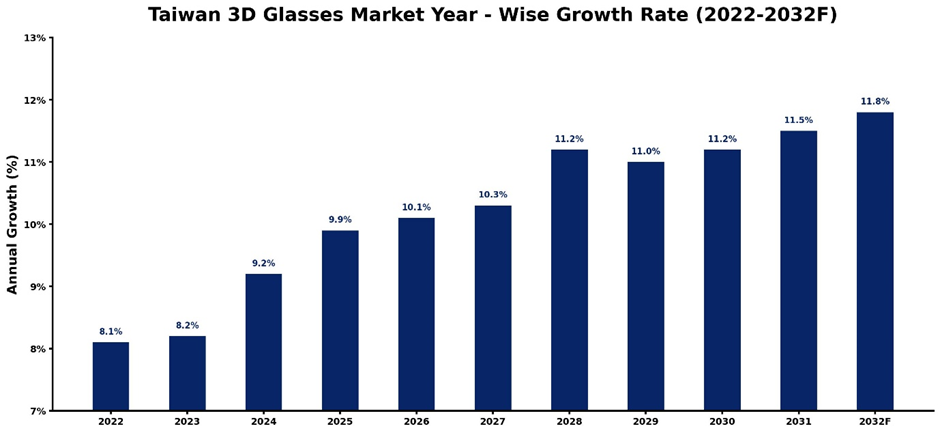
The following table summarizes the historical and forecasted growth rates of Taiwan 3D Glasses Market, along with the rationale behind each year’s performance.
| Year | Estimated Growth (%) | Market Rationale |
| 2022 | 8.1% | Market recovery began after pandemic impact; demand increased from gaming, education, and industrial applications. |
| 2023 | 8.2% | Growth supported by rising VR gaming use and enterprise training applications. |
| 2024 | 9.2% | New 3D/VR devices boosted demand, but high prices limited faster adoption. |
| 2025 | 9.9% | AI integration and improved smart glasses features drive market growth. |
| 2026 | 10.1% | Enterprise use in manufacturing, healthcare, and training increases adoption. |
| 2027 | 10.3% | Lower component costs and better device comfort support wider usage. |
| 2028 | 11.2% | Industrial AR applications and immersive learning solutions increase demand. |
| 2029 | 11% | AI features, improved battery life, and connectivity expand smart glasses adoption. |
| 2030 | 11.2% | Healthcare, logistics, and remote assistance applications drive growth. |
| 2031 | 11.5% | Mature technology and replacement demand support continued expansion. |
| 2032 | 11.8% | AI-powered 3D glasses become more mainstream across consumer and business sectors. |
Topics Covered in the Taiwan 3D Glasses Market Report
The Taiwan 3D Glasses Market report covers the market by product type and application. The report provides a detailed analysis of current market trends, growth opportunities, and key market drivers that will help stakeholders develop strategies based on present and future market dynamics.
Taiwan 3D Glasses Market Highlights
| Report Name | Taiwan 3D Glasses Market |
| Forecast period | 2026-2032 |
| CAGR | 11% |
| Growing Sector | IT & Industrial |
Taiwan 3D Glasses Market Synopsis
The Taiwan 3D Glasses Market is witnessing steady expansion, influenced by the country’s electronics manufacturing ecosystem, advanced semiconductor capabilities, and increasing adoption of immersive technologies. The vital factors for the market expansion are increasing demand for immersive gaming, industrial visualization, healthcare simulation, education technology, and enterprise training solutions. Furthermore, the inclusion of AI, improved optical technologies, and lightweight wearable designs are expected to accelerate the adoption during the forecast period.
Evaluation of Growth Drivers in Taiwan 3D Glasses Market (2022–2032)
Below are the major drivers influencing market dynamics:
| Drivers | Primary Segment Affected | Why It Matters |
| Advanced Semiconductor & Display Ecosystem | Hardware Manufacturers / AR-VR Device Developers | Taiwan’s strong semiconductor and display panel support local production of 3D glasses. |
| Growth of Gaming & Entertainment Applications | Consumer Segment | Increasing demand for immersive gaming content supports consumer adoption. |
| Industrial AR/VR Adoption | Manufacturing, Engineering & Logistics | 3D glasses are used by companies for equipment maintenance and workforce training. |
| AI Integration in Smart Glasses | Consumer & Enterprise Segments | Real-time translation enhances product value, due to AI-powered features. |
| Healthcare & Education Applications | Medical Training / Learning Solutions | 3D visualization improves medical education, research, and interactive learning experiences. |
The Taiwan 3D Glasses Market Share is anticipated to rise at a CAGR of 11% during 2026–2032, influenced by increasing need for immersive technologies, AI-powered smart glasses, enterprise applications, and industrial AR adoption across manufacturing, healthcare, and education sectors. Taiwan’s strong semiconductor ecosystem, accounting for over 60% of global semiconductor foundry capacity, encourage innovation in display and wearable technologies. Growing investments in sensors and automation solutions will further accelerate market growth during the forecast period.
Evaluation of Restraints in Taiwan 3D Glasses Market
Below are the major restraints influencing market dynamics:
| Restraints | Primary Segment Affected | What This Means |
| High Product Cost | Consumer Market | Premium components increase device prices, limiting mass consumer adoption. |
| Limited Consumer Awareness | Retail & Entertainment Segment | Practical daily applications of 3D glasses are limited as consumers are unaware of its daily usage. |
| Comfort & Design Limitations | Wearable Device Segment | Stagnant adoption due to weight, battery life, and long usage comfort. |
| Limited 3D Content Availability | Gaming & Media Applications | Constrained consumer requirement due to lack of high-quality immersive content. |
| Competition from Alternative Technologies | AR/VR Hardware Market | Traditional displays and other wearable devices compete with 3D glasses adoption. |
Taiwan 3D Glasses Market Challenges
Despite the strong growth factors, the market is tackling with challenges such as high manufacturing costs, limited consumer adoption, and content availability. Mass-market penetration constrained by advanced displays, sensors, and processors can hike the device prices by 20–40%. Slows adoption across consumer and enterprise segments due to limited immersive content availability. Battery efficiency, lightweight design, and user comfort still are the primary concerns, with many devices, that require upgradations beyond 2–4 hours of continuous usage.
Taiwan 3D Glasses Market Trends
Key market trends influencing Taiwan 3D glasses sector are presented below:
- Industrial AR Adoption: Manufacturing industries are increasingly using 3D glasses for equipment inspection, remote support, digital workflows, and employee training.
- Lightweight & Advanced Optical Technologies: To boost the user comfort, companies are focusing on smaller designs, improved lenses, better displays, and enhanced battery performance.
- Healthcare & Medical Visualization Growth: Medical education, surgical simulation, and patient visualization technologies creates huge demand for 3D glasses.
- Expansion of Immersive Gaming: Consumer requirement is backed by growing interest in VR (virtual reality) gaming, virtual environments, and interactive entertainment.
Investment Opportunities in Taiwan 3D Glasses Market
Strategic investment opportunities in the Taiwan 3D glasses market include the following:
- AI-enabled Smart Glasses Platforms: For enterprise and consumer applications, investment possibilities exist in the manufacturing of AI-enabled wearable devices.
- Advanced Display & Optical Components: Growing demand can be fulfilled by companies that invest in micro-displays, optical systems, sensors and lightweight components.
- Industrial AR Solutions: The manufacturing, semiconductor production, logistics and engineering sectors creates investment potential in customized 3D glasses solutions.
- Healthcare & Education Technology: Investment potential present for 3D visualization platforms, medical simulation tools and immersive learning solutions in healthcare and education technologies.
Top Leading Players in Taiwan 3D Glasses Market
Below is a curated list of leading companies in the Taiwan 3D glasses market:
1. Himax Technologies, Inc.
| Company Name | Himax Technologies, Inc. |
|---|---|
| Established Year | 2001 |
| Headquarters | Tainan, Taiwan |
| Official Website | Click Here |
Himax Technologies, Inc. develops advanced display driver ICs, micro display solutions, near-eye displays, and iToF (Indirect Time-of-Flight) depth sensing technologies that support 3D, AR glasses, and smart wearable applications.
2. AUO Corporation
| Company Name | AUO Corporation |
|---|---|
| Established Year | 1996 |
| Headquarters | Hsinchu, Taiwan |
| Official Website | Click Here |
AUO Corporation provides advanced TFT-LCD panels, 3D display technologies, polarized 3D solutions, and glasses-free (naked-eye) 3D display innovations for consumer and industrial applications.
3. Innolux Corporation
| Company Name | Innolux Corporation |
|---|---|
| Established Year | 2003 |
| Headquarters | Miaoli County, Taiwan |
| Official Website | Click Here |
Innolux Corporation offers high-performance display panels and 3D visualization solutions for entertainment and specialized applications requiring polarized and active 3D glasses technologies.
4. G-TECH Optoelectronics Corporation
| Company Name | G-TECH Optoelectronics Corporation |
|---|---|
| Established Year | 1997 |
| Headquarters | Taoyuan, Taiwan |
| Official Website | Click Here |
G-TECH Optoelectronics Corporation manufactures optical components, protective glass, and precision optoelectronic solutions that support the supply chain for 3D displays and advanced electronic devices.
5. Foxconn
| Company Name | Foxconn |
|---|---|
| Established Year | 1974 |
| Headquarters | New Taipei City, Taiwan |
| Official Website | Click Here |
Foxconn provides large-scale electronics manufacturing, hardware assembly, and supply chain capabilities for smart glasses, wearable devices, and advanced consumer electronics.
Government Initiatives being implemented in the Taiwan 3D Glasses Market
According to the Taiwanese government data, the market is encouraged through initiatives focused on digital transformation, semiconductor innovation, and advanced technology development. To expand the Taiwan 3D Glasses Market size, programs support AI, smart manufacturing, and Industry 4.0 adoption, which will boost the use of AR/VR and 3D visualization solutions across manufacturing, healthcare, and education sectors. Additionally, digital learning initiatives and technology adoption programs are increasing demand for immersive solutions, supporting the growth of Taiwan’s 3D glasses ecosystem through 2032.
Future Insights of the Taiwan 3D Glasses Market
The market is anticipated to witness strong progress. Rising adoption of AR/VR technologies, AI-powered smart glasses, and industrial applications are the key factors for its progress. Taiwan’s semiconductor industry, contributing over 60% of global foundry capacity, supports innovation in wearable technologies, results in boosting the Taiwan 3D Glasses Market revenue. Additionally, increasing applications in manufacturing, healthcare, gaming, and education are expected to accelerate market penetration, while advancements in lightweight designs, displays, and sensors will improve user adoption and product affordability.
Market Segmentation Analysis
This report presents a detailed analysis of the market segments along with their leading categories:
By Product Type - Polarized 3D Glasses Led the Market and Active Shutter 3D Glasses Set for Rapid Growth
According to Shubham Padhi, Senior Research Analyst, 6Wresearch, by product type, in 2025, the Polarized 3D Glasses dominated the Taiwan 3D Glasses Market with 45% market share, driven by its widespread use in cinemas and cost-effective 3D visualization solutions. However, by 2032, the Active Shutter 3D Glasses segment is expected to grow fastest with a CAGR of around 12.5%, influenced by increasing adoption in gaming, high-end VR applications.
By Applications - Media Dominated the Market and Set for Rapid Expansion
By Applications, due to strong demand for 3D gaming and home entertainment in 2025, the Media commanded the Taiwan 3D Glasses Market by application with 65% market share. And the Media segment is projected to remain dominant with a CAGR of around 10.8%, backed by advancements in immersive entertainment and gaming platforms, during 2026-2032.
Note: Market size estimations and growth projections presented in this report are based on 6Wresearch's proprietary forecasting methodology, utilizing the latest available industry data, government publications, and primary research inputs.
Key Attractiveness of the Report:
- 10 Years of Market Numbers
- Historical Data Starting from 2022 to 2025
- Base Year: 2025
- Forecast Data until 2032
- Key Performance Indicators Impacting the Market
- Major Upcoming Developments and Projects
Key Highlights of the Report:
- Taiwan 3D Glasses Market Outlook
- Market Size of Taiwan 3D Glasses Market, 2025
- Forecast of Taiwan 3D Glasses Market, 2032
- Historical Data and Forecast of Taiwan 3D Glasses Revenues & Volume for the Period 2022-2032
- Taiwan 3D Glasses Market Trend Evolution
- Taiwan 3D Glasses Market Drivers and Challenges
- Taiwan 3D Glasses Price Trends
- Taiwan 3D Glasses Porter`s Five Forces
- Taiwan 3D Glasses Industry Life Cycle
- Historical Data and Forecast of Taiwan 3D Glasses Market Revenues & Volume By Product Type for the Period 2022-2032
- Historical Data and Forecast of Taiwan 3D Glasses Market Revenues & Volume By Active shutter for the Period 2022-2032
- Historical Data and Forecast of Taiwan 3D Glasses Market Revenues & Volume By Polarized for the Period 2022-2032
- Historical Data and Forecast of Taiwan 3D Glasses Market Revenues & Volume By Anaglyph for the Period 2022-2032
- Historical Data and Forecast of Taiwan 3D Glasses Market Revenues & Volume By Applications for the Period 2022-2032
- Historical Data and Forecast of Taiwan 3D Glasses Market Revenues & Volume By Media for the Period 2022-2032
- Historical Data and Forecast of Taiwan 3D Glasses Market Revenues & Volume By Cinemas for the Period 2022-2032
- Taiwan 3D Glasses Import Export Trade Statistics
- Market Opportunity Assessment By Product Type
- Market Opportunity Assessment By Applications
- Taiwan 3D Glasses Top Companies Market Share
- Taiwan 3D Glasses Competitive Benchmarking By Technical and Operational Parameters
- Taiwan 3D Glasses Company Profiles
- Taiwan 3D Glasses Key Strategic Recommendations
Market Covered
The report offers an extensive study of the following market segments:
By Product Type
- Active Shutter
- Polarized
- Anaglyph
By Applications
- Media
- Cinemas






































