Tajikistan Bamboo Furniture Market Size, Share & Growth Rate
The Tajikistan Bamboo Furniture Market was estimated at USD 340 Million in 2025 and is projected to reach USD 475 Million by 2032, growing at a CAGR of 4.9% from 2026 to 2032. This positive growth trajectory is largely driven by increasing consumer awareness regarding sustainability and eco-friendly living. As more Tajik consumers seek out stylish yet environmentally conscious furniture options, local artisans are responding with innovative designs that emphasize the unique attributes of bamboo.
Tajikistan Bamboo Furniture Market Year-wise Growth Rate and Key Drivers
This graph highlights how the Tajikistan Bamboo Furniture Market has steadily grown over the years, supported by major growth factors.
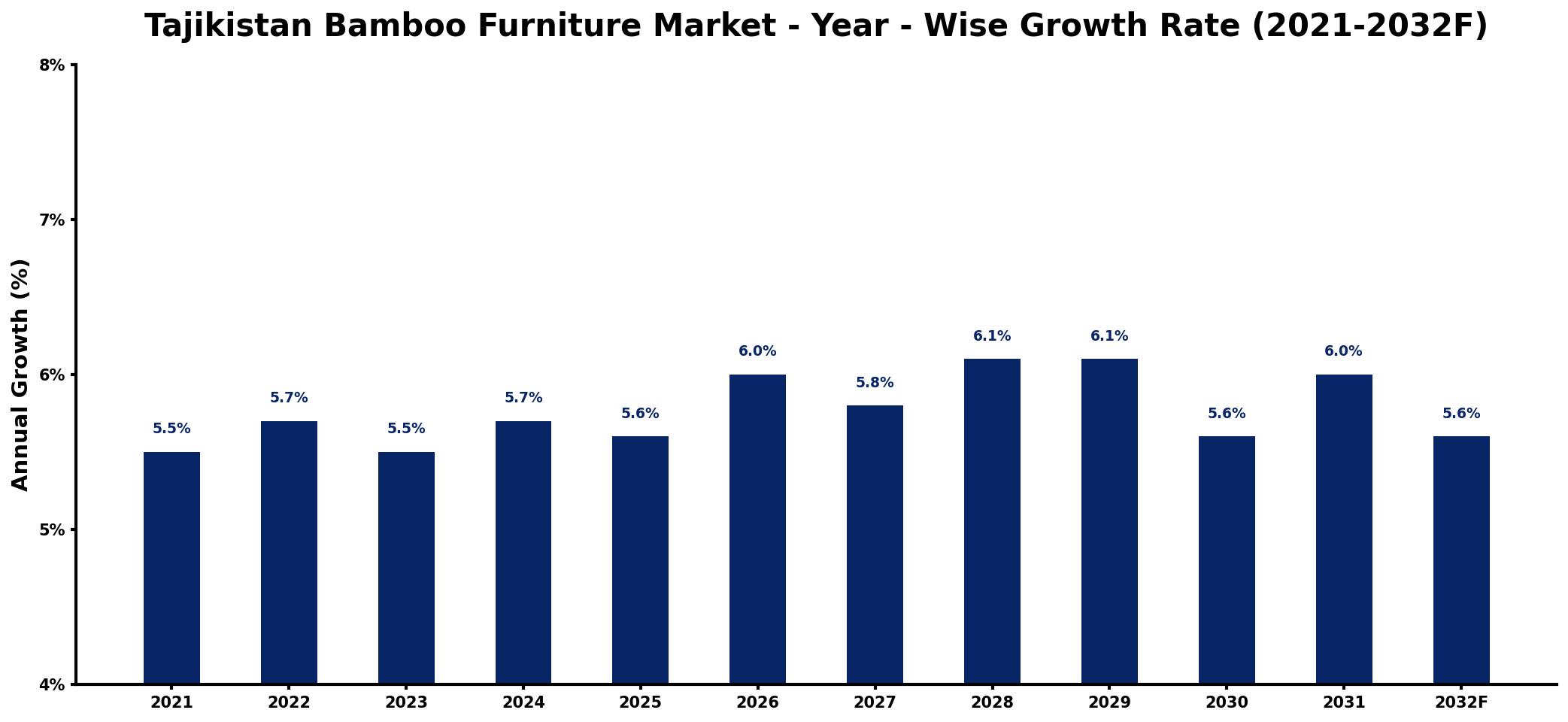
The table below presents the year‑wise growth rates along with the key drivers influencing the market
| Year | Growth Rate | Major Drivers |
| 2021 | 5.5% | Rising consumer interest sustainability |
| 2022 | 5.7% | Increased disposable income households |
| 2023 | 5.5% | Growing urbanization and modernization |
| 2024 | 5.7% | Enhanced eco-friendly product awareness |
| 2025 | 5.6% | Expansion of retail distribution networks |
| 2026 | 6.0% | Investment in sustainable production methods |
| 2027 | 5.8% | Emerging trends in home decor |
| 2028 | 6.1% | Shift towards natural materials preference |
| 2029 | 6.1% | Growing demand for artisanal products |
| 2030 | 5.6% | Increased focus on interior design |
| 2031 | 6.0% | strengthening underlying market demand |
| 2032 | 5.6% | Rising interest in eco-conscious living |
Note: Market size estimations and growth projections presented in this report are based on 6Wresearch's proprietary forecasting methodology, utilizing the latest available industry data, government publications, and primary research inputs.
Tajikistan Bamboo Furniture Market Synopsis
The Tajikistan Bamboo Furniture Market is witnessing an invigorating shift as consumers embrace eco-friendly alternatives in their home furnishings. With bamboo recognized for its rapid growth and renewable qualities, it offers a promising solution for those seeking sustainable options. As local manufacturers harness these advantages, the market is gradually carving out a niche within the larger furniture sector.
Recent trends highlight a rising demand for bamboo furniture that combines functionality with aesthetic appeal. Consumers are increasingly attracted to unique and customizable pieces that tell a story of sustainability. In response, local artisans are stepping up production efforts, focusing on the craftsmanship and design that bamboo allows, which is further propelling the market's growth.
Tajikistan Bamboo Furniture Market Key Takeaways
- The market is projected to grow from USD 340 Million in 2025 to USD 475 Million by 2032.
- There is a notable shift towards sustainable and eco-friendly furniture among consumers.
- Innovative designs and modern aesthetics are gaining traction in bamboo furniture offerings.
- Local manufacturers are addressing supply chain challenges through improved practices.
- Government policies are increasingly supportive of sustainable furniture manufacturing.
Evaluation of Restraints in Tajikistan Bamboo Furniture Market
Despite its growth potential, the Tajikistan Bamboo Furniture Market faces notable restraints. Limited consumer awareness about the benefits of bamboo compared to traditional materials like wood and metal can hinder adoption rates. Furthermore, sourcing high-quality bamboo materials and finding skilled artisans who can produce superior furniture remain significant challenges. These factors can lead to inconsistencies in supply and potentially increase production costs, thereby affecting competitiveness in the broader furniture market.
Tajikistan Bamboo Furniture Market Trends
Emerging trends within the Tajikistan Bamboo Furniture Market point toward a growing preference for sustainable living. This shift is underscored by consumers increasingly gravitating towards renewable materials and eco-friendly products. Additionally, the incorporation of bamboo into modern design paradigms—combining functionality with artistic expression—is propelling demand. Manufacturers are exploring innovative techniques to showcase bamboo's versatility, appealing to a broader demographic that prioritizes style alongside sustainability.
Tajikistan Bamboo Furniture Market Opportunities
Investment opportunities abound in the Tajikistan Bamboo Furniture Market, driven by a global trend favoring sustainable products. By leveraging the growing consumer base seeking eco-friendly furniture, investors can enter a market ripe for expansion. Furthermore, Tajikistan's strategic location within the Belt and Road Initiative presents avenues for exporting bamboo furniture to neighboring regions, enhancing the market's appeal for both local and international investors.
Government Initiatives in the Tajikistan Bamboo Furniture Market
The Tajikistan government is actively promoting the bamboo furniture sector through various supportive policies. These initiatives include providing financial incentives for local manufacturers and facilitating sustainable bamboo cultivation. Furthermore, regulatory frameworks are being established to ensure product quality and safety, thereby encouraging innovation and growth within the industry. Such governmental backing underscores a commitment to sustainable practices while enhancing market opportunities for bamboo furniture producers.
Future Insights of the Tajikistan Bamboo Furniture Market
Looking ahead, the Tajikistan Bamboo Furniture Market is positioned for steady growth through 2032. Increased consumer advocacy for sustainability, coupled with effective government initiatives, will continue to drive demand. As more players enter the market, a wider variety of bamboo furniture products will emerge, catering to diverse consumer preferences. This evolution will likely lead to further innovation and improved quality, shaping the future landscape of the market.
Tajikistan Bamboo Furniture Market Latest Developments (2025 - 2026)
Recent developments in the Tajikistan Bamboo Furniture Market indicate a growing focus on sustainability and design innovation. Manufacturers are increasingly collaborating with local artisans to enhance craftsmanship and create unique product offerings. Simultaneously, awareness campaigns are being launched to educate consumers about the benefits of bamboo furniture, aiming to boost market acceptance. These trends reflect a dynamic market environment that is evolving rapidly.
Tajikistan Bamboo Furniture Market - Key Attractiveness of the Report
- 10 Years of Market Numbers
- Historical Data Starting from 2022 to 2025
- Base Year: 2025
- Forecast Data until 2032
- Key Performance Indicators Impacting the Market
- Major Upcoming Developments and Projects
Key Highlights of the Report:
- Tajikistan Bamboo Furniture Market Outlook
- Market Size of Tajikistan Bamboo Furniture Market, 2025
- Forecast of Tajikistan Bamboo Furniture Market, 2032
- Historical Data and Forecast of Tajikistan Bamboo Furniture Revenues & Volume for the Period 2022-2032F
- Tajikistan Bamboo Furniture Market Trend Evolution
- Tajikistan Bamboo Furniture Market Drivers and Challenges
- Tajikistan Bamboo Furniture Price Trends
- Tajikistan Bamboo Furniture Porter's Five Forces
- Tajikistan Bamboo Furniture Industry Life Cycle
- Historical Data and Forecast of Tajikistan Bamboo Furniture Market Revenues & Volume By Type for the Period 2022-2032F
- Historical Data and Forecast of Tajikistan Bamboo Furniture Market Revenues & Volume By Chairs & Tables for the Period 2022-2032F
- Historical Data and Forecast of Tajikistan Bamboo Furniture Market Revenues & Volume By Stools for the Period 2022-2032F
- Historical Data and Forecast of Tajikistan Bamboo Furniture Market Revenues & Volume By Beds for the Period 2022-2032F
- Historical Data and Forecast of Tajikistan Bamboo Furniture Market Revenues & Volume By Others for the Period 2022-2032F
- Historical Data and Forecast of Tajikistan Bamboo Furniture Market Revenues & Volume By End User for the Period 2022-2032F
- Historical Data and Forecast of Tajikistan Bamboo Furniture Market Revenues & Volume By Residential for the Period 2022-2032F
- Historical Data and Forecast of Tajikistan Bamboo Furniture Market Revenues & Volume By Commercial for the Period 2022-2032F
- Tajikistan Bamboo Furniture Import Export Trade Statistics
- Market Opportunity Assessment By Type
- Market Opportunity Assessment By End User
- Tajikistan Bamboo Furniture Top Companies Market Share
- Tajikistan Bamboo Furniture Competitive Benchmarking By Technical and Operational Parameters
- Tajikistan Bamboo Furniture Company Profiles
- Tajikistan Bamboo Furniture Key Strategic Recommendations






































