Cellulose Esters Market: Tanzania vs Top 5 Major Economies in 2027 (Africa)
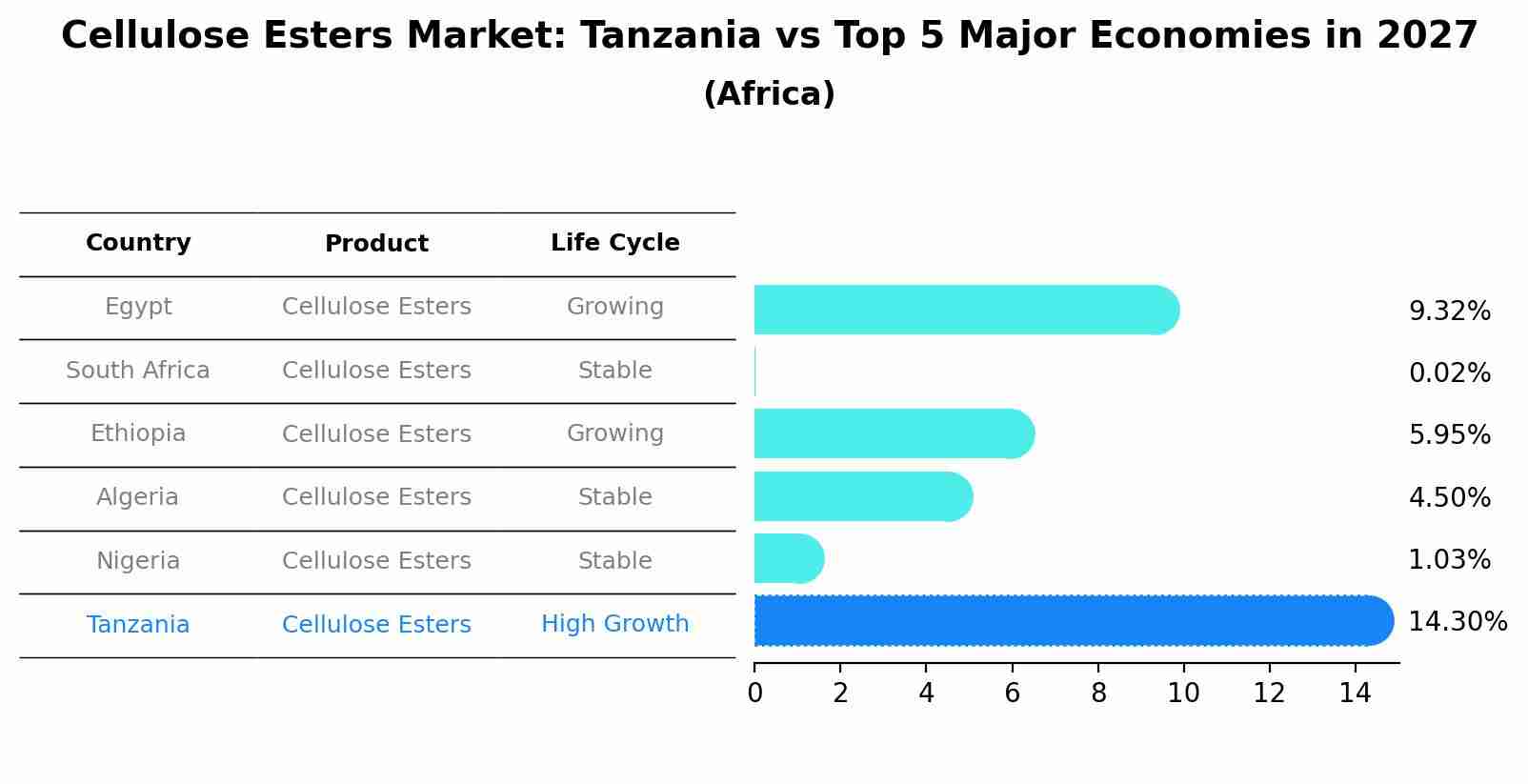
By 2027, the Cellulose Esters market in Tanzania is anticipated to reach a growth rate of 14.30%, as part of an increasingly competitive Africa region, where Egypt remains at the forefront, supported by South Africa, Ethiopia, Algeria and Nigeria, driving innovations and market adoption across sectors.
Tanzania Cellulose Esters Market Overview
The Tanzania Cellulose Esters Market is experiencing steady growth due to increasing demand for eco-friendly and sustainable products in industries such as pharmaceuticals, textiles, and food packaging. Cellulose esters are widely used as film formers, thickeners, and binders in various applications, driving their popularity in the market. The market is also seeing a rise in research and development activities to enhance the properties and applications of cellulose esters, further fueling market growth. Key players in the Tanzania Cellulose Esters Market are focusing on product innovation and strategic partnerships to strengthen their market presence and cater to the evolving needs of customers. Overall, the market is poised for continued expansion driven by the growing awareness of environmentally friendly alternatives in diverse industries.
Tanzania Cellulose Esters Market Trends
The Tanzania Cellulose Esters Market is witnessing significant growth driven by increasing demand for eco-friendly and sustainable products in industries such as textiles, pharmaceuticals, and food packaging. Key trends in the market include a shift towards bio-based cellulose esters due to their biodegradability and non-toxic nature, as well as the rising adoption of cellulose acetate for cigarette filters and eyewear frames. Manufacturers are investing in research and development to enhance the properties and applications of cellulose esters, such as improved thermal stability and chemical resistance. Additionally, the growing awareness among consumers about the environmental impact of traditional plastics is driving the demand for cellulose esters as a greener alternative, further boosting market growth in Tanzania.
Tanzania Cellulose Esters Market Challenges
In the Tanzania Cellulose Esters Market, one of the major challenges faced is the limited awareness and understanding of the potential applications and benefits of cellulose esters among both consumers and industry players. This lack of awareness hinders the market growth as potential users may not fully grasp the advantages of using cellulose esters in various products. Additionally, the availability of raw materials and the cost of production can be significant challenges in the market. Limited infrastructure and technological capabilities for processing cellulose esters could also pose obstacles to market development. Overall, addressing these challenges through education, research and development, and strategic partnerships could help unlock the full potential of the Tanzania Cellulose Esters Market.
Tanzania Cellulose Esters Market Investment Opportunities
The Tanzania Cellulose Esters Market presents promising investment opportunities due to its growing demand in various industries such as pharmaceuticals, textiles, and food packaging. With increasing awareness about sustainable and eco-friendly products, the demand for cellulose esters as a biodegradable alternative to traditional materials is on the rise. Investing in the Tanzania Cellulose Esters Market can be lucrative for investors looking to capitalize on this trend. Additionally, advancements in technology and research are leading to the development of innovative cellulose ester products with enhanced properties, further widening the market potential. Overall, investing in the Tanzania Cellulose Esters Market offers the potential for long-term growth and profitability.
Tanzania Cellulose Esters Market Government Policy
The Tanzania government has implemented policies to regulate the Cellulose Esters Market, focusing on sustainability and environmental protection. These policies include promoting the use of eco-friendly cellulose esters in various industries, encouraging research and development in sustainable manufacturing processes, and enforcing strict regulations on waste disposal and emissions. Additionally, the government has introduced incentives for companies that adopt green practices and penalizes those that violate environmental standards. Overall, the government`s policies aim to drive the growth of the Tanzania Cellulose Esters Market while ensuring that it operates in an environmentally responsible manner.
Tanzania Cellulose Esters Market Future Outlook
The Tanzania Cellulose Esters Market is poised for steady growth in the coming years, driven by increasing demand for sustainable and eco-friendly materials in various industries such as pharmaceuticals, textiles, and electronics. The growing awareness of the environmental impact of synthetic materials is expected to fuel the adoption of cellulose esters as a viable alternative. Additionally, the government`s initiatives to promote the use of bio-based products and the rising investments in research and development activities are likely to further boost market growth. With advancements in technology and a shift towards green chemistry, the Tanzania Cellulose Esters Market is anticipated to expand, offering lucrative opportunities for manufacturers and suppliers in the region.
Key Highlights of the Report:
- Tanzania Cellulose Esters Market Outlook
- Market Size of Tanzania Cellulose Esters Market, 2021
- Forecast of Tanzania Cellulose Esters Market, 2031
- Historical Data and Forecast of Tanzania Cellulose Esters Revenues & Volume for the Period 2021 - 2031
- Tanzania Cellulose Esters Market Trend Evolution
- Tanzania Cellulose Esters Market Drivers and Challenges
- Tanzania Cellulose Esters Price Trends
- Tanzania Cellulose Esters Porter's Five Forces
- Tanzania Cellulose Esters Industry Life Cycle
- Historical Data and Forecast of Tanzania Cellulose Esters Market Revenues & Volume By Type for the Period 2021 - 2031
- Historical Data and Forecast of Tanzania Cellulose Esters Market Revenues & Volume By Cellulose acetate for the Period 2021 - 2031
- Historical Data and Forecast of Tanzania Cellulose Esters Market Revenues & Volume By Cellulose acetate propionate for the Period 2021 - 2031
- Historical Data and Forecast of Tanzania Cellulose Esters Market Revenues & Volume By Cellulose acetate butyrate for the Period 2021 - 2031
- Historical Data and Forecast of Tanzania Cellulose Esters Market Revenues & Volume By Cellulose nitrate for the Period 2021 - 2031
- Historical Data and Forecast of Tanzania Cellulose Esters Market Revenues & Volume By Others for the Period 2021 - 2031
- Historical Data and Forecast of Tanzania Cellulose Esters Market Revenues & Volume By Applications for the Period 2021 - 2031
- Historical Data and Forecast of Tanzania Cellulose Esters Market Revenues & Volume By Coatings for the Period 2021 - 2031
- Historical Data and Forecast of Tanzania Cellulose Esters Market Revenues & Volume By Films and tapes for the Period 2021 - 2031
- Historical Data and Forecast of Tanzania Cellulose Esters Market Revenues & Volume By Cigarette filters for the Period 2021 - 2031
- Historical Data and Forecast of Tanzania Cellulose Esters Market Revenues & Volume By Inks for the Period 2021 - 2031
- Historical Data and Forecast of Tanzania Cellulose Esters Market Revenues & Volume By Plasticizers for the Period 2021 - 2031
- Historical Data and Forecast of Tanzania Cellulose Esters Market Revenues & Volume By Others for the Period 2021 - 2031
- Tanzania Cellulose Esters Import Export Trade Statistics
- Market Opportunity Assessment By Type
- Market Opportunity Assessment By Applications
- Tanzania Cellulose Esters Top Companies Market Share
- Tanzania Cellulose Esters Competitive Benchmarking By Technical and Operational Parameters
- Tanzania Cellulose Esters Company Profiles
- Tanzania Cellulose Esters Key Strategic Recommendations






































